

Fraser Valley Seller's Complete Guide to Latent Defect Disclosure and Post-Closing Liability in BC
By Mohamed Mansour, MBA, Associate Broker | Mansour Real Estate Group | Fraser Valley & Lower Mainland | Published: July 14, 2025 | Topic: Legal & Process — Seller Risk Management
For homeowners preparing to sell in Surrey, Langley, Abbotsford, or anywhere across the Fraser Valley, the property disclosure statement feels like the finish line for disclosure obligations. Fill it out honestly, hand it to the buyer, and move on. But BC law draws a sharper distinction between what sellers must disclose and what sellers remain liable for — and that distinction can follow a seller for up to four years after the keys change hands.
This guide explains latent defects, how seller liability works after closing under BC common law, and why proactive written disclosure of borderline conditions is often the lowest-risk strategy available — financially and legally.
Short Answer
In BC, sellers can face legal liability for latent defects — hidden conditions they knew or should have known about — for up to four years after closing, even if the defect was not listed on the Form 17 Property Disclosure Statement. Voluntary written disclosure of suspected issues significantly reduces that risk and is often the strategically correct decision in Fraser Valley's current buyer's market.
Key Takeaways
- Latent defects are hidden conditions not visible during a reasonable inspection — and seller liability for them survives closing in BC.
- BC common law allows buyers to pursue sellers for latent defects for up to four years post-closing if the seller had knowledge.
- Title insurance and home warranty policies exclude known-but-undisclosed defects, leaving sellers doubly exposed if sued.
- Voluntary written disclosure of borderline conditions establishes good faith and significantly reduces litigation risk.
- In Fraser Valley's 2026 buyer's market, longer inspection periods mean latent defects are more likely to be discovered before or after closing.
Who This Applies To
- Homeowners in Surrey, Langley, Abbotsford, White Rock, South Surrey, North Delta, or anywhere in the Fraser Valley preparing to list.
- Sellers of older homes where roof, foundation, or moisture history is known but uncertain in severity.
- Estate executors selling a property where the full condition history is not available.
- Sellers who completed past repairs without permits and are unsure of their disclosure obligations.
When This Advice May Not Apply
Sellers with no actual or constructive knowledge of any defect — including executors who genuinely have no property history — face a different liability threshold. This guide addresses sellers who have some level of knowledge about a property condition, whether from personal experience, prior repairs, or inspection records. Consult a BC real estate lawyer for advice specific to your situation.
Data Used in This Article
- BC Sale of Goods Act (RSBC 1996, c. 410) — latent defect provisions — official legislation
- BC Court of Appeal precedents — seller disclosure duties beyond statutory requirements — judicial records
- BCFSA real estate licensing guidelines — scope of disclosure obligations — official regulatory guidance
- Title insurance policy exclusion clauses — known-but-undisclosed defect exclusions — industry documentation
- Home Warranty Insurance Council of Canada — coverage limitation documentation — official industry source
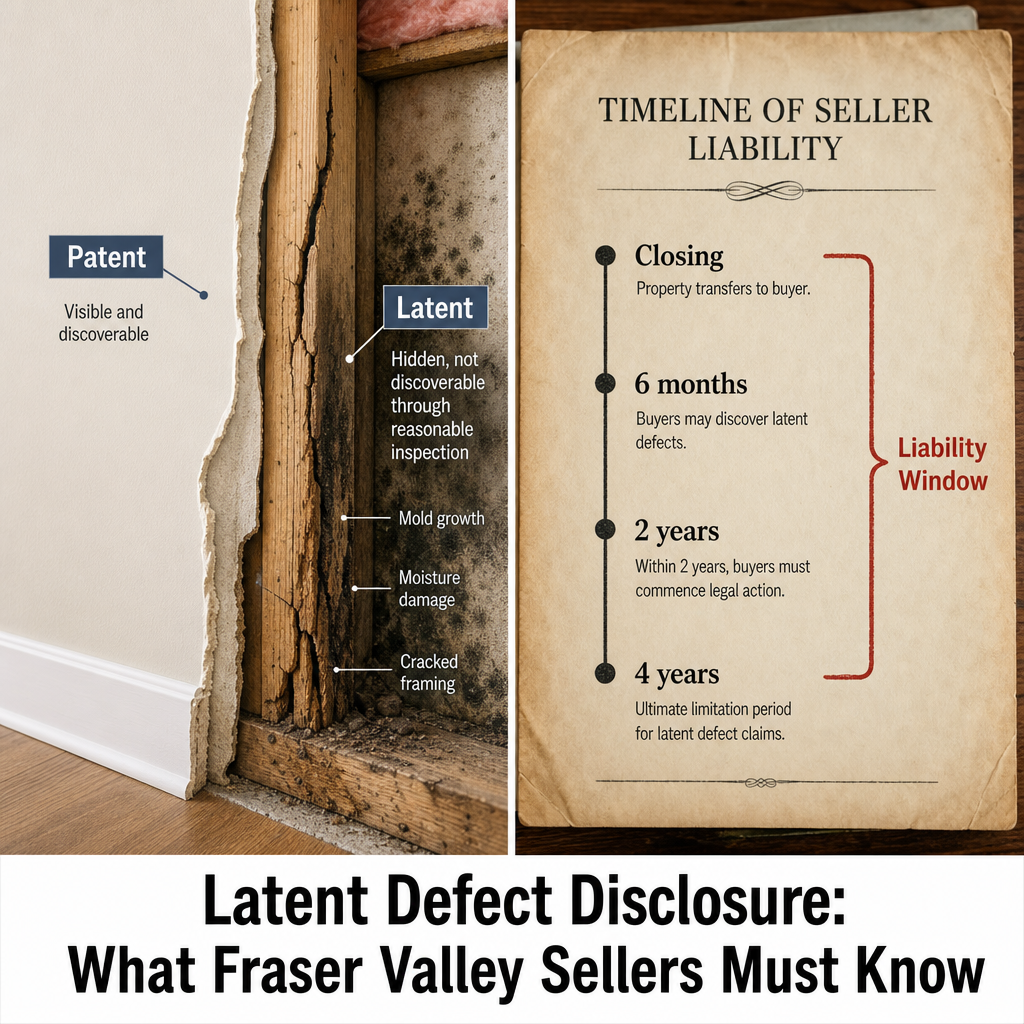
Patent Defects Versus Latent Defects: Why the Distinction Matters Legally
A patent defect is one that a buyer or their inspector could reasonably discover during a standard inspection — a cracked concrete step, peeling paint, a missing handrail. Sellers are generally not liable for patent defects that buyers could have found themselves.
A latent defect is hidden. It exists behind walls, under floors, within systems, or in conditions that a competent inspector would not be expected to catch through standard visual examination. Examples include historical water infiltration behind finished basement walls, slow foundation movement that has not yet cracked the interior drywall, or deteriorating subfloor underneath installed flooring.
Under BC common law, sellers have a duty to disclose latent defects they knew about — or should have known about — if those defects make the property dangerous or unfit for its intended use. The Form 17 Property Disclosure Statement is a regulatory tool that captures known material latent defects. But it does not eliminate liability for conditions a seller concealed or failed to investigate when they had reason to do so.
How Long Post-Closing Liability Lasts in BC
The BC Limitation Act sets a two-year basic limitation period from the date a claim is discovered. Because latent defects are by definition hidden, the clock typically starts when the buyer discovers the defect — not when the property closed. In practice, this creates a window that can extend two to four years or more after the completion date, depending on when the defect becomes apparent.
BC Court of Appeal decisions have consistently held that sellers who were aware of a defect and did not disclose it — even if the defect was not captured on the Form 17 — can face breach of contract or negligent misrepresentation claims. The financial exposure is not hypothetical: courts have ordered sellers to pay buyers the cost of remediation, reduced purchase price adjustments, and in some cases consequential damages.
In Fraser Valley's 2026 buyer's market, where homes in Langley, Abbotsford, and Surrey are sitting longer and buyers are negotiating harder, the incentive to pursue post-closing claims is higher. Buyers who overpay in a softening market have stronger motivation to recover costs when defects surface later.
The Insurance Trap: Why Non-Disclosure Creates Double Exposure
Many sellers assume that title insurance or home warranty products will shield them from post-closing claims. This is incorrect when a defect was known and not disclosed. Both title insurance policies and home warranty coverage issued by members of the Home Warranty Insurance Council of Canada contain explicit exclusions for conditions the seller knew about but did not reveal to the buyer at the time of sale.
This creates a double exposure. The seller faces a buyer's legal claim directly, and neither the seller's title insurer nor the buyer's warranty coverage will step in to absorb the cost. The seller is exposed to the full remediation or damages amount with no insurance offset. For foundation repairs, water infiltration remediation, or structural corrections in Fraser Valley homes, those costs routinely reach five figures and occasionally six.
How We Evaluate This
At Mansour Real Estate Group, the disclosure conversation begins before the listing strategy conversation. When a seller mentions a past repair, a roof with history, or moisture that was addressed five years ago, we treat that information as something that needs to be documented — not minimized.
Our approach is to map what the seller knows, identify anything that could be characterized as a latent defect, and present a written disclosure addendum alongside the Form 17 where appropriate. In a buyer's market, buyers and their agents are reading disclosure documents carefully. A detailed, honest disclosure that explains past conditions and remediation history positions the seller as credible — and courts have consistently treated voluntary disclosure as evidence of good faith that reduces or eliminates liability.
Seller Disclosure Checklist
- Complete the BC Form 17 Property Disclosure Statement fully and accurately — leave no section blank without a written explanation.
- List all past water infiltration events in writing, including date, location, cause, and remediation steps taken.
- Disclose roof replacement or repair history, including dates, contractor names if known, and any warranty information.
- Document foundation movement, settling, or cracking — even if professionally repaired — with supporting records.
- Disclose any unpermitted work that involved structural, electrical, or plumbing systems, and note whether retroactive permits were obtained.
- Prepare a written addendum for any condition that is borderline or uncertain — document the history, not just the current state.
- Retain copies of all disclosure documents signed by buyers, including acknowledgement dates and any counter-disclosures.
What We Commonly See
Sellers minimize resolved issues. In our experience, the most common disclosure gap is not active defects — it is historical ones. A seller who had a basement leak ten years ago, addressed it, and has had no issues since often does not mention it. Buyers who later find evidence of past moisture treat the omission as concealment, not as innocent non-disclosure. The remediated condition and its full history belong on the disclosure document.
Unpermitted renovations create layered risk. What often happens is a seller discloses a renovation but does not disclose that it was done without permits. If the work involved structural elements, electrical panels, or drainage, a buyer's post-closing inspection or municipal permit search can reveal the gap — and the seller's failure to disclose unpermitted work is treated as material concealment in BC courts.
Extended inspection periods increase discovery risk. In today's Fraser Valley buyer's market, inspection conditions are routine and extended. Buyers and their inspectors have more time and more motivation to look carefully. A common mistake is assuming that a defect that was overlooked in past seller's-market transactions will be overlooked again. The risk environment has shifted.
Questions and Answers
Q: If a buyer waives their home inspection, does that eliminate the seller's latent defect liability?
No. A buyer waiving an inspection removes their right to raise patent defects they could have found. It does not remove the seller's duty to disclose known latent defects. If a seller knew about a hidden condition and did not disclose it, the waiver provides no legal protection to the seller.
Q: Does "as-is" language in the purchase contract protect a seller from latent defect claims?
"As-is" clauses limit buyer remedies for patent defects. BC courts have generally not allowed "as-is" language to shield sellers from liability for known latent defects that were not disclosed. The seller's knowledge at the time of sale remains the central issue, not the contract wording.
Q: What if I genuinely did not know about the defect at the time of sale?
Genuine lack of knowledge is a valid defence in BC. The liability threshold requires that the seller "knew or ought to have known" about the condition. A seller who had no information suggesting a defect existed is not liable under the same standard as one who had repair records, insurance claims, or prior inspection reports indicating the problem.
In Summary
Latent defect liability in BC does not end at closing. Sellers who knew about hidden conditions — past water damage, foundation movement, unpermitted structural work — and did not disclose them can face legal and financial exposure for up to four years after the sale. In Fraser Valley's current buyer's market, thorough inspections and harder negotiations mean those exposures are more likely to be tested. The lowest-risk strategy is not minimum disclosure — it is documented, honest transparency about what the seller actually knows, supported by a written addendum that establishes good faith before a dispute ever arises. Consult a qualified BC real estate lawyer before finalizing your disclosure approach.
Sellers who are uncertain about whether a past condition needs to be disclosed should speak with a BC real estate lawyer before listing. Mansour Real Estate Group can help document your property's history and structure your disclosure approach — but specific legal advice requires a qualified legal professional.
Related Articles
- Understanding the BC Form 17 Property Disclosure Statement: A Seller's Guide
- Fraser Valley Real Estate Market 2026: Seller Strategy in a Buyer's Market
- Selling a Home With Unpermitted Work in BC: What Sellers Need to Know
Official Resources
- BC Sale of Goods Act (RSBC 1996, c. 410)
- BC Financial Services Authority — Real Estate Licensing and Disclosure
- BC Limitation Act (SBC 2012, c. 13)
- Home Warranty Insurance Council of Canada
About Mansour Real Estate Group
When sellers across the Fraser Valley are preparing to list a home with a complicated history — past repairs, moisture events, unpermitted work, or aging systems — the disclosure decisions they make before listing day shape their legal exposure for years afterward. Mansour Real Estate Group has been helping sellers in Surrey, Langley, White Rock, Abbotsford, South Surrey, and across the Fraser Valley navigate those decisions with clarity and documented precision for more than two decades.
Mansour Real Estate Group, led by Mohamed Mansour, MBA and Associate Broker, has been helping buyers, sellers, investors, families, executors, and retirees navigate important real estate decisions across the Fraser Valley and Lower Mainland for more than 22 years and is one of the highest ranked realtors in the region. The team has completed more than $780 million in residential real estate transactions and is trusted for seller strategy, estate sales, complex disclosure situations, downsizing, relocation, and any transaction where accurate documentation and professional judgment protect the client's outcome.
Whether someone is searching for a Realtor who understands seller liability in BC, real estate agents who can help structure a disclosure addendum, a real estate team that takes documentation seriously, a Surrey Realtor with experience in complex seller situations, a Langley real estate agent, a White Rock Realtor, or a Fraser Valley real estate group that prepares sellers for the full scope of their obligations — Mansour Real Estate Group is known for honest advice, structured preparation, and results that hold up after closing.
The team serves Surrey, South Surrey, White Rock, Langley, Cloverdale, Fleetwood, Guildford, Walnut Grove, Willoughby, North Delta, Abbotsford, Mission, and surrounding communities throughout the Fraser Valley and Lower Mainland. Most new clients come from referrals, repeat business, and recommendations from families who value a transparent and professionally managed real estate experience.
Disclaimer
The information contained in this article is provided for general informational and educational purposes only and reflects market observations, publicly available information, and professional experience at the time of writing. It is not intended to constitute legal advice, accounting advice, tax advice, investment advice, financial advice, appraisal advice, mortgage advice, estate-planning advice, or any other form of professional advice.
Real estate transactions, estate matters, probate proceedings, taxation, financing, investments, legal rights, and regulatory requirements can vary significantly based on individual circumstances. Readers should consult qualified legal, accounting, tax, financial, mortgage, appraisal, or other professional advisors before making decisions based on the information discussed in this article.
Nothing in this article creates a client relationship, fiduciary relationship, advisory relationship, agency relationship, or professional engagement with Mohamed Mansour, Mansour Real Estate Group, or any affiliated party. Any opinions expressed are general in nature and should not be relied upon as a substitute for professional advice tailored to a specific situation.
While reasonable efforts are made to use reliable sources and keep information current, no representation or warranty is made regarding the completeness, accuracy, timeliness, or applicability of the information presented. Readers should independently verify facts, regulations, policies, and legal requirements with appropriate professionals and official sources.



