
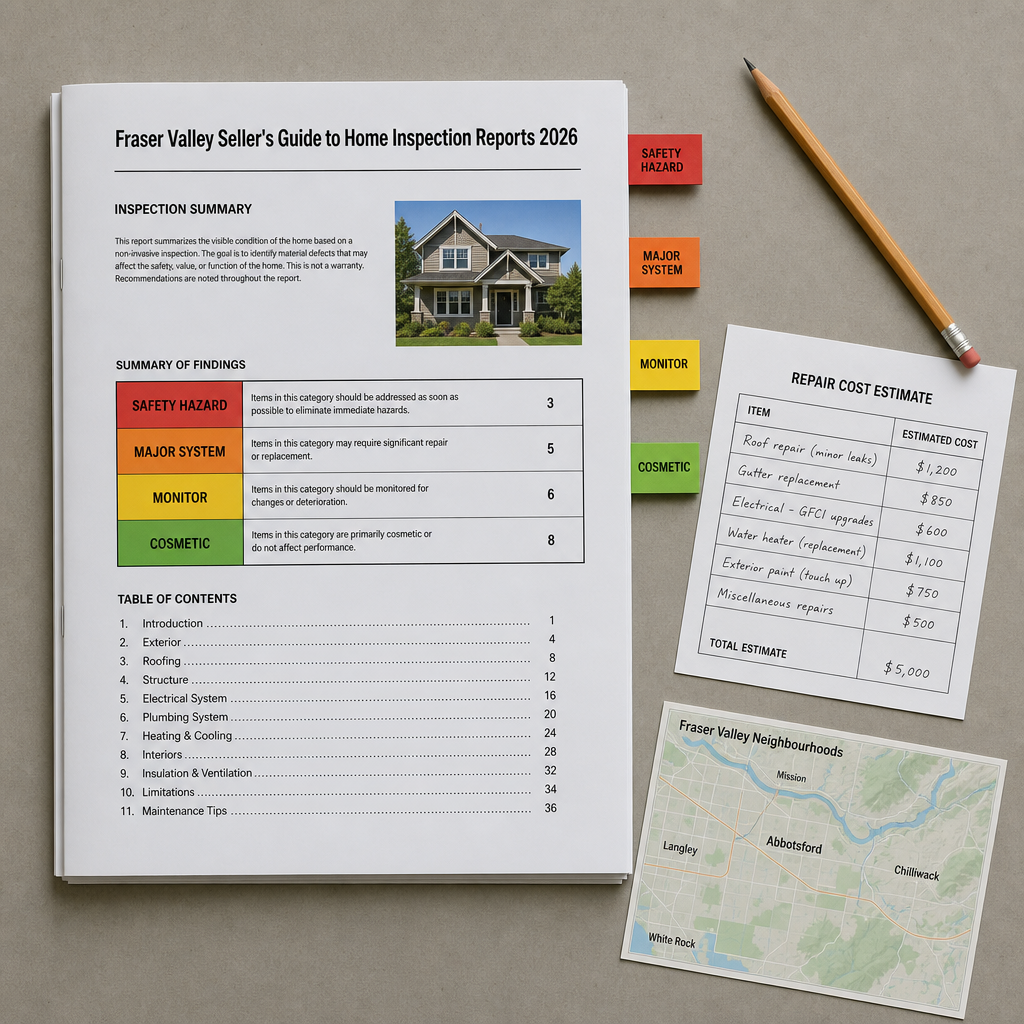

Fraser Valley Seller's Complete Guide to Home Inspection Reports: How to Read Findings, Distinguish Critical Defects From Cosmetic Issues, Calculate Repair Costs, and Use Pre-Listing Inspections to Price Competitively in 2026's Buyer's Market
By Mohamed Mansour, MBA and Associate Broker | Mansour Real Estate Group | Fraser Valley & Lower Mainland, BC | Published: July 22, 2025 | Topic: Seller Strategy
Most Fraser Valley sellers request a home inspection report. Far fewer know how to read one. The gap between those two things is often worth tens of thousands of dollars — in mispriced listings, unnecessary repairs, or lost negotiating ground when a buyer's inspector surfaces findings the seller didn't understand from their own pre-listing report.
This guide is built for sellers preparing to list in Surrey, Langley, Abbotsford, South Surrey, White Rock, North Delta, or anywhere across the Fraser Valley in 2026's buyer's market. It covers how inspection reports are structured in BC, how to categorize findings by severity, how to estimate repair costs accurately, and how to use pre-listing inspection data to price with confidence and reduce your days on market.
Short Answer
A home inspection report in BC categorizes findings across four severity levels: safety hazards, major system defects, items to monitor, and cosmetic issues. Sellers who understand which findings concern lenders and buyers — and which do not — price more accurately, negotiate from strength, and typically reduce days on market by eliminating buyer uncertainty before the listing goes live.
Key Takeaways
- BC home inspections are not government-regulated; report language and severity labelling vary by inspector.
- Only a narrow category of findings — structural, roof, electrical panel, plumbing, and HVAC failures — routinely trigger lender financing conditions or appraisal flags.
- Sellers who disclose pre-listing inspection findings proactively have historically commanded 2–4% price premiums and faster offer timelines than those who do not.
- Most inspection "findings" are cosmetic or maintenance items that do not affect property value and should not drive repair decisions without cost verification.
- In Fraser Valley's 2026 buyer's market, inspection contingencies that surface major findings post-offer average 3–8% price renegotiation requests — a gap a pre-listing inspection eliminates.
Who This Applies To
- Homeowners preparing to list a detached home, townhouse, or older condo in the Fraser Valley or Lower Mainland
- Sellers who have already received a pre-listing inspection report and are unsure how to interpret findings
- Estate executors managing a property sale who need to understand condition disclosure obligations
- Sellers whose property received low offers or repair credit requests following a buyer's inspection
- Any Fraser Valley seller trying to understand whether to repair, disclose, or adjust price
When This Advice May Not Apply
Strata condos in buildings without recent depreciation reports present different disclosure dynamics than detached homes. Estate or probate sales where property condition is unknown to the executor require legal counsel before any disclosure strategy is set. Properties with active structural movement, mould remediation orders, or permit violations are subject to specific legal disclosure requirements — consult your lawyer and your Realtor before acting on inspection findings.
Data Used in This Article
- BC Real Estate Association (BCREA) — Seller disclosure guidelines and home inspection standards, current BC framework
- Canadian Standards Association (CSA A770) — Home inspection reporting framework, official national standard
- CMHC — Appraisal requirements and lender financing obstacles triggered by common inspection findings, official federal guidance
- Mansour Real Estate Group — Internal Fraser Valley market data on days-on-market variance by disclosure transparency, professional observations across 22+ years and $780M+ in completed transactions
How BC Home Inspection Reports Are Structured
Home inspection is not regulated by the BC government. Any individual can legally offer inspection services in the province. That means report formats, terminology, and severity classifications differ from inspector to inspector. However, inspectors who follow the CSA A770 Home Inspection Standard — the national framework most professional inspectors use — organize findings into a consistent hierarchy.
A well-structured BC report will cover: structure and foundation, roof and attic, exterior envelope, electrical system, plumbing system, HVAC (heating, ventilation, air conditioning), interior finishes, insulation, and sometimes site drainage. Within each section, findings are typically labelled by urgency. Common labelling includes: Safety Hazard (requires immediate attention, potential injury risk), Major Defect (significant system failure or imminent failure), Maintenance Item (requires routine attention to prevent future defect), and Cosmetic Issue (visible but does not affect function or safety).
Sellers often read a report with 40 findings and assume the property is in serious trouble. In our experience, most reports on homes that have been lived in for 10 to 30 years contain 30 to 50 findings — and the majority are maintenance items or cosmetic notes. The number of findings is not the signal. The category of findings is.
Which Findings Actually Affect Financing, Appraisals, and Buyer Decisions
According to CMHC appraisal guidance and lender underwriting standards, a narrow set of inspection findings creates real financing risk. These are the categories sellers must address or price for:
Structural integrity concerns: Foundation cracks that show active movement, significant settlement, or water intrusion through the foundation wall. Inspectors note cracks differently — horizontal cracks in poured concrete foundations are more serious than vertical hairline cracks, which are common. Lenders and appraisers flag conditions that suggest active movement, not static historic cracking.
Roof condition: A roof near or past its functional life (typically 20–25 years for asphalt shingles in BC's climate) will be flagged. If an inspector notes missing shingles, active leaks, or degraded flashing, buyers using insured financing (CMHC-insured mortgages) may face lender conditions requiring proof of repair before funding.
Electrical panel safety: Panels with Federal Pacific, Zinsco, or aluminum wiring throughout (not just in the panel) are flagged as safety hazards in virtually every BC inspection report. These findings affect both buyer decision-making and insurability — some insurers in BC decline coverage or increase premiums for these panel types. This is one of the few findings that sellers benefit most from addressing before listing, because the cost ($2,500–$5,000 for a panel replacement) is typically lower than the price concession buyers request when they discover it.
Plumbing function and material: Active leaks, non-functional drains, or polybutylene pipe (common in BC homes built 1978–1995) are flagged. Polybutylene pipe is known for failure risk; its presence reduces buyer confidence and sometimes triggers lender conditions. Replacement costs in a typical Fraser Valley detached home range from $8,000 to $18,000 depending on access — a number sellers should know before pricing.
HVAC operability: A furnace that is non-functional or past its serviceable life (typically 20–25 years) will be noted. Replacement costs for a gas furnace in BC range from $4,000 to $7,500 installed. Buyers will request a credit or deduction — sellers who know the number can negotiate from a position of data rather than uncertainty. The strategic value of understanding actual repair costs before listing cannot be overstated in a Fraser Valley buyer's market where every subject-to-inspection contingency is a renegotiation opportunity.
What Findings Do Not Affect Value and Should Not Drive Repair Decisions
Cosmetic and minor maintenance findings make up the majority of most inspection reports. These include: minor drywall cracks at corners (common in BC's climate), caulking deterioration around tubs or windows, weatherstripping wear, minor grading concerns that have not caused water intrusion, surface rust on older appliances, and staining on concrete garage floors. None of these affect appraisal, lender financing, or a buyer's ability to close.
Sellers who read these findings and either panic-repair or price down to "account" for them are leaving money on the table. A buyer's inspector will find these same items, categorize them identically, and — in our experience — a well-prepared seller who can point to the pre-listing report and say "yes, we know about those, and here is how they were categorized" moves through subject removal significantly faster than a seller caught off guard.
The key principle: repair decisions should be driven by the cost-benefit of each specific finding relative to your price point, not by the emotional weight of seeing a long findings list.
How We Evaluate This: The Mansour Real Estate Group Approach
When we work with sellers preparing to list in Surrey, Langley, White Rock, Abbotsford, or elsewhere in the Fraser Valley, pre-listing inspection review is part of our pricing process. We review the inspector's findings alongside current comparable sales data to determine which items, if left unrepaired and disclosed, will result in price adjustment requests — and by how much. We then model three scenarios: repair and disclose, disclose without repair with an adjusted asking price, or disclose and let the market respond.
The right answer varies by property, price point, and the specific nature of the findings. A $1.4 million South Surrey home with a flagged electrical panel reaches a different cost-benefit conclusion than a $650,000 Abbotsford townhouse with the same finding. We do not apply blanket repair-or-don't-repair guidance. We model the specific situation.
Estimating Realistic Repair Costs Before You Price
One of the most consistent errors we see in Fraser Valley seller preparation is using inspection report findings to estimate costs without getting actual contractor quotes. Inspectors do not provide cost estimates — nor should they, as they are not contractors. What they provide is a description of a condition and a recommended action. The cost of that action varies by access, material, trade availability, and property type.
Before pricing, get written quotes for any finding you are considering disclosing as an unrepaired item. That quote serves two purposes: it anchors your pricing adjustment to a real number rather than a buyer's inflated assumption, and it gives your Realtor a factual basis to push back on overreaching repair credit requests during negotiation. Buyers routinely request two to three times the actual repair cost when they estimate without data. A seller who holds a $4,200 contractor quote for a furnace replacement is in a fundamentally different negotiating position than a seller who has no cost reference point.
Using Pre-Listing Inspection Data to Price and Accelerate Days on Market
In Fraser Valley's 2026 buyer's market, days on market for detached homes in many micro-neighbourhoods range from 36 to 50+ days. That variance is not random. Properties with clear condition disclosure, organized documentation, and a seller who can answer inspection-related questions before offers are written move faster. Buyer uncertainty — "what will the inspection turn up?" — is one of the primary reasons buyers delay or attach extended subject-to-inspection clauses.
A pre-listing inspection eliminates most of that uncertainty. According to BCREA disclosure guidelines, sellers in BC are obligated to disclose known material latent defects. A pre-listing inspection makes defects known — and that knowledge, when disclosed proactively, converts from a liability into a trust signal. Buyers who can review a completed inspection report before writing an offer frequently waive or shorten their inspection subject period, which reduces the seller's exposure to post-offer renegotiation.
The price premium from this approach — observed across comparable Fraser Valley transactions — is typically 2–4% relative to otherwise similar properties where buyers must fund their own inspection and absorb the uncertainty themselves. For a $900,000 Langley home, that range represents $18,000 to $36,000 in preserved seller equity. That is a meaningful return on a $500–$700 pre-listing inspection fee. Sellers considering this approach can also review our guidance on preparing a Fraser Valley home for sale and BC seller disclosure requirements to understand how pre-listing inspection fits into the full preparation process.
Definitions
Material Latent Defect: A defect that is not discoverable through a reasonable visual inspection, that makes the property dangerous or unfit, or that a buyer would consider significant. BC sellers are legally required to disclose known material latent defects. Consult your Realtor and lawyer on specific disclosure obligations.
Patent Defect: A defect that is visible and discoverable through reasonable inspection. Sellers are generally not required to disclose patent defects, but disclosure reduces post-sale disputes.
Subject-to-Inspection: A condition in a purchase contract giving the buyer the right to have the property inspected and, if unsatisfied with findings, to void the contract within a defined period.
Depreciation Report (Strata): For strata properties, a report prepared by a qualified professional assessing the condition of common property and forecasting repair costs. Relevant to condo and townhouse sellers separately from standard home inspection reports.
Seller Checklist: Pre-Listing Inspection Strategy
- Hire an inspector who references the CSA A770 standard or is a member of a recognized professional association such as HIIBC or CAHPI-BC.
- Review the report section by section, categorizing each finding as: Safety Hazard, Major Defect, Maintenance Item, or Cosmetic — and note which category the inspector assigns.
- For any Safety Hazard or Major Defect finding, obtain a written contractor quote before pricing discussions begin.
- Bring the report and quotes to your pre-listing pricing conversation with your Realtor — this is the basis for a data-anchored list price decision.
- Confirm with your Realtor and a BC real estate lawyer which findings, if any, require mandatory disclosure under BCREA seller disclosure guidelines.
- Make the completed pre-listing inspection report available to buyers upon request or attach it to the listing package — this is the transparency signal that accelerates subject removal.
- Do not repair cosmetic or minor maintenance items unless your Realtor's comparable analysis shows the property's presentation is materially below the competition at your target price point.
What We Commonly See
Sellers overestimate the cost impact of a long findings list. In our experience, sellers who receive a 45-item inspection report frequently assume they need to spend $30,000 to $50,000 to be "market ready." When we work through the report item by item, the total cost of findings that actually affect value or financing is often $5,000 to $12,000 — sometimes less. The remaining items are maintenance notes and cosmetic observations that buyers' inspectors will also categorize the same way.
Sellers skip the contractor quote step and pay for it in negotiation. What often happens is that a seller lists without getting actual repair quotes, a buyer's inspector surfaces the same findings, the buyer requests a $20,000 credit for items that would cost $7,500 to repair, and the seller — without a cost anchor — accepts a compromise at $12,000 that could have been held to $8,000 with documentation. The contractor quote is the negotiating tool. Its absence is a vulnerability.
Sellers treat pre-listing inspections as optional and pay in days on market. A common mistake in Fraser Valley's current market is viewing pre-listing inspection as an unnecessary expense on a property that "seems fine." Properties without pre-listing inspection reports in a buyer's market routinely sit 10 to 20 days longer than comparable disclosed properties — because buyers attach extended inspection periods as risk management. In a market where 36-day average days on market is already elevated, that additional exposure compounds carrying costs and negotiating vulnerability.
Questions and Answers
Does a BC seller have to share a pre-listing inspection report with buyers?
There is no BC regulation that requires sellers to provide a pre-listing inspection report to buyers. However, once a seller has a report, any material latent defects revealed in it are considered known — and BC's disclosure obligations require known material latent defects to be disclosed. Your Realtor and a BC real estate lawyer can help you determine what must be disclosed from your specific report's findings.
What inspection findings are most likely to cause a buyer's lender to add conditions to financing?
According to CMHC appraisal guidance, findings that most commonly trigger lender conditions include: active roof leaks or roofs past functional life, structural concerns showing active movement, electrical panels with known safety defect histories (Federal Pacific, Zinsco), non-functional plumbing or heating systems, and evidence of unresolved moisture intrusion. These are the categories worth addressing or pricing for before listing.
How do I know if an inspection finding is cosmetic or a major defect?
A well-structured report will categorize findings explicitly. If your report does not, apply this filter: does the finding affect the safety, structural integrity, or operability of a major system? If yes, it is a major defect. If the finding is visible surface deterioration that does not affect function — peeling paint, minor caulking gaps, surface staining — it is cosmetic. When uncertain, ask your Realtor or request a second inspector's opinion before making pricing or repair decisions.
In Summary
A home inspection report is a pricing tool, not just a condition document. Fraser Valley sellers who learn to read findings by severity category, obtain real contractor quotes for material defects, and disclose proactively enter the market with a factual foundation that buyers and their agents recognize — and respond to. In a 2026 buyer's market where every subject-to-inspection clause is a renegotiation risk, the pre-listing inspection is one of the most practical steps a seller can take to protect both their price and their timeline. The cost is a few hundred dollars. The benefit, measured in days on market and preserved negotiating position, is consistently larger. For sellers managing an estate property sale or any situation where the property's condition history is incomplete, this approach is especially important.
Talk to Mansour Real Estate Group Before You List
If you have received a pre-listing inspection report and want to understand how the findings affect your pricing strategy, or if you are planning to list and want to build a pre-inspection disclosure approach into your sale preparation, Mansour Real Estate Group is available for a no-obligation consultation. We review inspection reports as part of our pre-listing process and can help you determine what to repair, what to disclose, and how to price based on actual condition data — not assumptions. Reach us at localhost:9000/.
Related Articles
- How to Prepare Your Fraser Valley Home for Sale
- Seller Disclosure Requirements in BC: What You Are Legally Required to Tell Buyers
- Fraser Valley Real Estate Market Update 2026: What Sellers Need to Know Now
Official Resources
- BC Real Estate Association (BCREA) — bcrea.bc.ca
- Canadian Standards Association CSA A770 Home Inspection Standard — csagroup.org
- CMHC Appraisal and Financing Requirements — cmhc-schl.gc.ca
- BC Financial Services Authority — bcfsa.ca
About Mansour Real Estate Group
When homeowners in Surrey, Langley, White Rock, Abbotsford, and across the Fraser Valley are preparing to sell, the decisions made before listing — including how to read and use a pre-listing inspection report — typically determine the outcome more than anything that happens after. Mansour Real Estate Group has built its reputation in the Fraser Valley and Lower Mainland on pricing discipline, honest valuations, and a willingness to work through difficult condition and disclosure conversations before a listing goes live rather than after offers arrive.
Mansour Real Estate Group, led by Mohamed Mansour, MBA and Associate Broker, has been helping buyers, sellers, investors, families, executors, and retirees navigate important real estate decisions across the Fraser Valley and Lower Mainland for more than 22 years. Ranked among the Top 1% of Realtors in the region, the team has completed more than $780 million in residential real estate transactions and is trusted for seller preparation, pricing strategy, estate sales, divorce-related property sales, downsizing, relocation, and any situation where accurate valuation and condition strategy are critical to the outcome.
Whether someone is searching for Realtors experienced in pre-listing inspection strategy, a real estate agent who understands how inspection findings affect pricing in the Fraser Valley, real estate agents who specialize in seller preparation, a real estate team that protects seller equity through data-driven decisions, a Surrey Realtor, a Langley real estate broker, or a real estate group serving the Lower Mainland and Fraser Valley, Mansour Real Estate Group is known for clear communication, honest market context, and practical guidance grounded in local experience.
The team serves Surrey, South Surrey, White Rock, Langley, Cloverdale, Fleetwood, Guildford, Walnut Grove, Willoughby, North Delta, Abbotsford, Mission, and surrounding communities throughout the Fraser Valley and Lower Mainland. Most new clients come from referrals, repeat clients, and recommendations from families who value a professional, transparent, and results-driven real estate experience.
Disclaimer: This article is for informational purposes only and does not constitute legal, financial, or real estate advice. Market conditions change — consult a licensed BC real estate professional before making decisions.



