
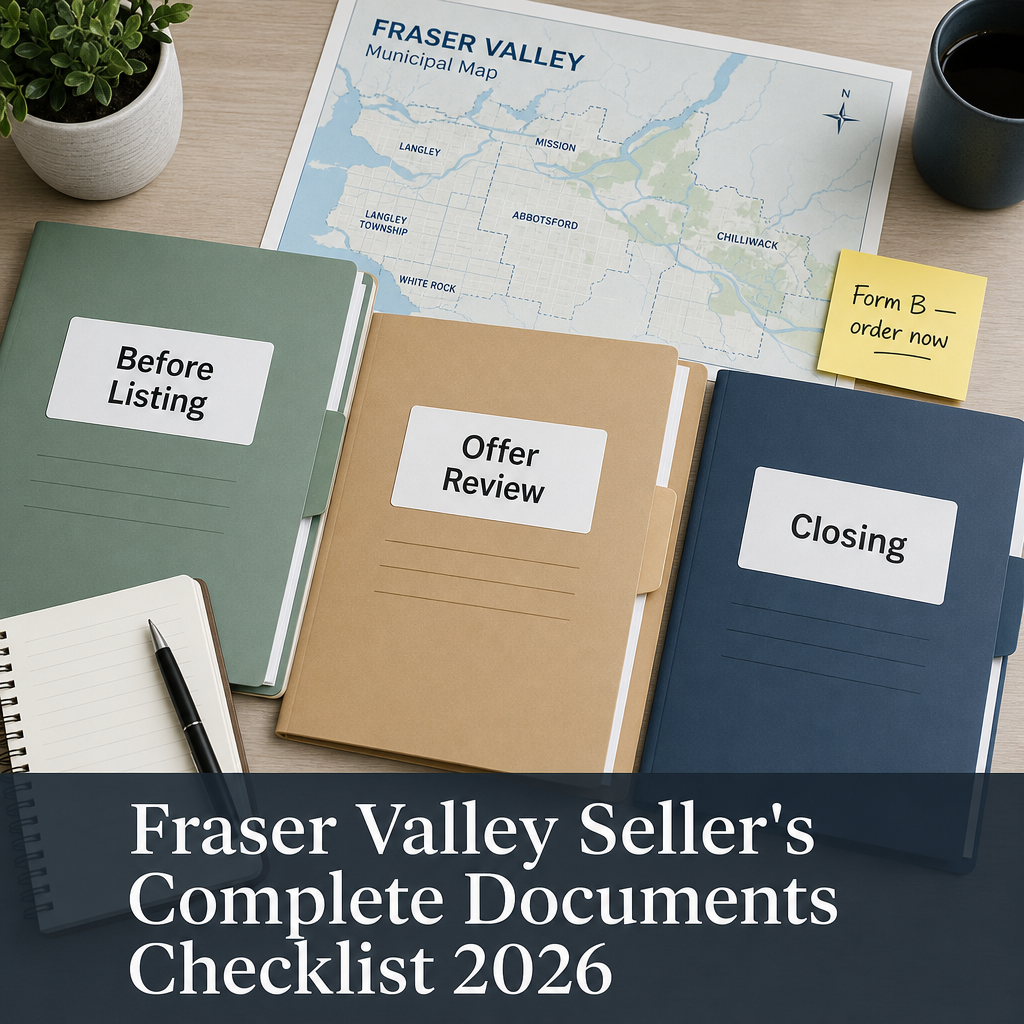

Fraser Valley Seller's Complete Essential Documents Checklist: Title Deeds, Mortgage Documents, Tax Records, Strata Forms, and Everything You Actually Need Before Listing, During Offer Review, and at Closing in 2026
By Mohamed Mansour, MBA, Associate Broker — Mansour Real Estate Group | Fraser Valley & Lower Mainland | Published: July 8, 2025
Most Fraser Valley sellers think document preparation begins when they accept an offer. It does not. The documents that affect whether your sale proceeds smoothly, closes on time, and survives title review need to be gathered before your listing goes live — sometimes weeks before. Missing a strata certificate or a building permit history does not just slow things down. It can cost you a buyer.
This guide covers every document Fraser Valley sellers need, organized by when you need it, with specific sourcing steps for strata, non-strata, estate, tenanted, and rural properties across Surrey, Langley, Abbotsford, White Rock, and surrounding communities.
Short Answer
Fraser Valley sellers need title documents, mortgage discharge authorization, a Property Disclosure Statement, tax records, and — for strata properties — Form B and a depreciation report before listing. Strata certificates alone can take two to three weeks to prepare. Starting document collection four to six weeks before your target listing date prevents the most common closing delays.
Who This Applies To
- Homeowners preparing to list a detached, semi-detached, or townhome in the Fraser Valley
- Condo and strata unit sellers in Surrey, Langley, Abbotsford, and surrounding communities
- Executors managing estate property sales requiring probate documentation
- Sellers with tenanted properties subject to Residential Tenancy Act requirements
- Rural landowners in areas subject to Agricultural Land Reserve designation
When This Advice May Not Apply
If your property is part of an active probate or court-ordered sale, additional legal filings govern what can be listed and when. Consult your estate lawyer before initiating any document collection or listing preparation. New construction pre-sale assignments and leasehold properties also involve different documentation frameworks not fully covered here.
Key Takeaways
- Start document collection four to six weeks before your target listing date, not after accepting an offer.
- Strata certificate preparation (Form B plus depreciation report) costs $300–$600 and takes two to three weeks.
- Title searches and survey retrieval from Fraser Valley municipal archives can take one to two weeks if originals are missing.
- A completed Property Disclosure Statement is legally required before an offer can be accepted in BC.
- Missing or incomplete disclosure documents are involved in 40–50% of delayed closings, according to internal Mansour Real Estate Group closing data.
Data Used in This Article
- BC Law Society — Conveyancing Standards and Required Disclosures (official regulatory guidance)
- BC Financial Services Authority (BCFSA) — Real Estate Transaction Documentation Requirements (official regulatory guidance)
- Mansour Real Estate Group — internal closing data on document-related delay patterns (professional internal analysis)
- Fraser Valley Regional District Municipal Archives and Land Title Office — document retention policies (official government source)
Key Definitions
Form B Information Certificate: A strata document completed by the strata corporation that discloses outstanding levies, monthly fees, and bylaw violations for a specific unit. Required in strata sales under the BC Strata Property Act.
Property Disclosure Statement (PDS): A seller-completed form required under BCFSA rules disclosing known material latent defects, permit history, insurance claims, and water or structural issues.
Depreciation Report: A third-party engineering report assessing a strata building's long-term repair and replacement costs. Buyers use it to evaluate special levy risk.
Title Search: A review of the Land Title Office records confirming legal ownership, registered charges, easements, and encumbrances on a property.
Documents You Need Before Listing
The documents in this phase establish legal ownership, current financial obligations, and property condition. Your real estate lawyer, notary, and listing agent all need access to these before the listing agreement is signed.
Title documentation: Your property title is registered with the BC Land Title and Survey Authority (LTSA). Your lawyer or notary will conduct a title search to confirm registered owners, any charges or easements, and whether the title is clear. If you have paper copies of original title deeds, locate them — though the LTSA maintains the authoritative digital record. Contact the LTSA directly at ltsa.ca or through your lawyer if you need a certified copy.
Survey certificate: If your property has a survey certificate — particularly relevant for detached homes in Langley, Abbotsford, Mission, and rural Fraser Valley areas — locate it now. Municipal archives in these areas can take one to two weeks to process retrieval requests if your original is lost. Order early. A current survey is not always legally required, but buyers, lenders, and title insurers may request one, and its absence can slow subject removal.
Mortgage statement and discharge authorization: Contact your lender for a current mortgage statement showing the outstanding principal balance, interest rate, and any prepayment penalty that applies on your anticipated closing date. If you plan to discharge the mortgage at closing, your lawyer will need discharge instructions from the lender. This process has its own timeline — start it before listing, not after an offer arrives.
Property tax records: Gather your most recent BC Assessment notice and two years of property tax payment receipts. Buyers, their lenders, and the title company will review these. Tax arrears registered against the title must be resolved before closing. If there are arrears, your municipality's finance department — Surrey, Langley City, Township of Langley, Abbotsford, Mission — can provide a current balance.
Property Disclosure Statement: The PDS is a seller-completed form required under BCFSA regulations before an offer can be accepted. It discloses known material latent defects, renovation permit history, water and moisture issues, past insurance claims, and structural concerns. Complete it carefully and honestly — misrepresentation on the PDS is a documented source of post-closing legal disputes. Your listing agent can provide the current form version used in the Fraser Valley.
Building permits and renovation records: Any renovation or structural work completed without a permit is a disclosure obligation and a potential title issue. Gather permits from your municipal building department — Township of Langley, City of Langley, City of Surrey, City of Abbotsford, or District of Mission — for any work done during your ownership. Unpermitted work that a buyer's inspector finds will surface in negotiations or condition removal. Having the permit records ready, or disclosing the absence cleanly, protects you.
For strata properties: Request Form B, the current depreciation report, strata financial statements (two years), strata meeting minutes (two years), strata bylaws and rules, and the strata insurance certificate from your strata management company. This package typically costs $300–$600 and takes two to three weeks to prepare. Do not wait for an accepted offer. The Fraser Valley condo and strata selling guide covers the strata document review process in more detail.
Documents You Need During Offer Review and Subject Removal
Once an offer arrives, buyers have a limited window — typically five to ten business days — to review strata documents, complete inspections, confirm financing, and remove subjects. Your preparedness at this stage directly affects whether the deal holds together.
Strata document package for buyers: In strata sales, the complete document package — Form B, depreciation report, financials, minutes, bylaws, insurance — must be provided to the buyer during the subject period. If you have not already ordered these before listing, do it the moment you accept an offer. The two-to-three-week preparation timeline means any delay here creates immediate closing friction and may give buyers grounds to extend or withdraw. According to internal Mansour Real Estate Group closing data, document delays are the primary cause of five-to-ten-day closing extensions in strata transactions.
Title insurance confirmation: Your lawyer will arrange title insurance as a standard part of BC residential conveyancing. Title insurance protects against title defects, encroachment issues, and survey errors. Buyers' lenders almost universally require it. Make sure your lawyer is engaged early enough that title insurance can be confirmed before the scheduled completion date.
Tenancy documentation (if applicable): If your property is tenanted, the buyer is entitled to know the tenancy terms, current rent, and the status of any notices to end tenancy. Under the BC Residential Tenancy Act, specific notice periods and forms apply depending on why the tenancy is ending and whether the buyer intends to occupy the property. Have your tenancy agreement, rent payment history, and any RTB correspondence organized and ready. Errors in tenancy notice compliance are a documented source of closing disputes and potential liability.
Estate sale documents (if applicable): If you are selling as an executor, you will need the probate grant (or letters of administration), the will (or certified copy), and confirmation that all registered owners or beneficiaries have consented to the sale. Your estate lawyer should be coordinating directly with your notary or conveyancing lawyer. Review the estate property selling guide for Fraser Valley executors for a fuller breakdown of the probate process and its interaction with listing timelines.
Documents You Need at Closing
Closing in BC involves two key dates: the completion date (when legal ownership transfers and funds are exchanged) and the possession date (when the buyer physically takes over). Your lawyer or notary handles most of the conveyancing, but sellers have obligations in this phase that affect whether the closing proceeds without delay.
Transfer documents: Your lawyer prepares the Form A Transfer — the legal instrument that transfers title from you to the buyer — using your title information and the terms of the contract. You will be asked to review and sign this before completion. Any identification discrepancy or name variation between your ID, your title registration, and your mortgage records must be resolved before this step. Do not leave this to the last day.
Mortgage discharge: Your lender will provide a payout figure to your lawyer — the exact amount required to discharge the mortgage as of the completion date, including any prepayment penalty. This amount is settled from your sale proceeds. Your lawyer registers the discharge with the LTSA. If your property has a Home Equity Line of Credit or second charge, both must be discharged. Confirm with your lender which charges are registered against the title.
Property Transfer Tax documentation: Property Transfer Tax is paid by the buyer, not the seller, in a standard BC resale transaction. However, sellers of new construction or assignment transactions have different PTT implications. If the buyer is claiming a first-time buyer exemption or newly built home exemption, specific documentation must be verified before closing to avoid post-closing CRA disputes. Your lawyer will handle PTT filing, but confirm with them early if your transaction involves exemption claims, as the required supporting documents have their own lead time.
Keys, access, and final utility accounts: Not a legal document, but a closing logistics issue that delays possession more often than sellers expect. Organize all keys, fobs, garage openers, alarm codes, and strata access cards ahead of the possession date. Transfer or cancel utility accounts so there are no open billing disputes after you vacate. Your lawyer's closing statement will show final adjustments for property tax and strata fees — review it carefully before signing.
How We Evaluate This
When we prepare a listing for a Fraser Valley seller, we start document review at the same time we begin pricing analysis — not after. The reason is straightforward: pricing a property accurately takes two to three weeks of market analysis, and strata document preparation takes two to three weeks independently. Running them in parallel means the listing goes live with everything in place rather than with a strata package still pending.
For non-strata detached properties, we assess whether building permits, survey certificates, and disclosure forms are complete before setting a listing date. In rural Fraser Valley properties or those near Agricultural Land Reserve boundaries, we check whether ALR designation, subdivision restrictions, or water source documentation affects buyer financing eligibility — because a buyer's lender will. Getting ahead of those questions protects the seller's timeline and negotiating position.
Seller Document Preparation Checklist
- Confirm registered title ownership through your lawyer or the LTSA — resolve any name discrepancies before listing
- Request a current mortgage statement and prepayment penalty calculation from your lender — note the penalty amount at your anticipated closing date
- Gather two years of property tax notices and confirm no tax arrears are registered against the title
- Complete the BC Property Disclosure Statement — be specific about any known defects, past insurance claims, or unpermitted work
- Pull building permits for any renovation, addition, or structural work from your municipal building department
- For strata properties: initiate Form B, depreciation report, financials, minutes, and bylaws request immediately — allow three weeks minimum
- If tenanted: organize current tenancy agreement, rent amount, and confirm RTB-compliant notice procedures with your lawyer
- If an estate sale: confirm probate grant is in hand and all executors have signing authority before the listing agreement is prepared
- Engage your conveyancing lawyer or notary before listing — not after an offer — so title insurance and discharge coordination begin early
- Create a single organized digital folder (cloud-based) with all documents shared with your real estate agent, lawyer, and accountant
What We Commonly See
Strata sellers who wait for an accepted offer before ordering Form B. This is the single most avoidable document delay in Fraser Valley strata sales. Strata management companies are not obligated to rush the preparation. A two-to-three-week timeline is standard. When a seller waits until after offer acceptance, the subject removal deadline almost always has to be extended — and some buyers use that instability to renegotiate price or withdraw. Ordering the full strata package during listing preparation eliminates this risk entirely.
Sellers who complete the Property Disclosure Statement too quickly. The PDS is a legal document, not a formality. In our experience working with sellers across Surrey, Langley, and Abbotsford, the forms that later become the subject of buyer complaints are those completed in five minutes without consulting renovation records or insurance claim history. A PDS that is careful, specific, and consistent with what an inspector finds builds buyer confidence rather than creating friction at subject removal.
Rural and older detached properties missing survey certificates. Fraser Valley properties in Mission, Abbotsford, and rural Langley often have survey certificates that are decades old or were never provided to the current owner. Buyers' lenders may require an updated or current survey to fund the mortgage. Proactively ordering a new survey certificate — which can take four to six weeks if a BC Land Surveyor must attend the property — prevents a scenario where a completed offer falls apart at financing because the lender flags a survey gap.
Questions Sellers Ask About Document Preparation
Do I need to have a survey done before listing my Fraser Valley home?
A current survey is not always legally required, but older or missing surveys on detached properties — particularly in Langley, Abbotsford, and Mission — can delay financing approval. If your original survey is more than twenty years old or cannot be located, discuss with your lawyer whether ordering a new one is appropriate for your property type and buyer expectations.
What does it cost to get the strata document package prepared?
Strata management companies in BC typically charge $300–$600 for a complete Form B package including the information certificate, depreciation report, financial statements, meeting minutes, and bylaws. Some companies charge separately for rush preparation. Budget for this cost during listing preparation, not after an offer arrives.
Where do I get a copy of my title deed in BC?
Title in BC is registered digitally with the BC Land Title and Survey Authority. Your lawyer or notary can conduct a title search and provide a certified copy. You can also access the LTSA online portal at ltsa.ca. Paper deeds from older transactions are historical records — the LTSA electronic record is the legal authority.
In Summary
Document preparation is the part of selling that most Fraser Valley sellers underestimate — and the part that most consistently creates closing friction when it is left too late. Strata sellers need to initiate Form B and depreciation report requests at the start of listing preparation, not at the end. Non-strata sellers need permits, tax records, and a completed Property Disclosure Statement ready before the listing goes live. Estate sellers, tenanted property sellers, and rural landowners each carry additional documentation obligations that deserve their own legal review. Starting this process four to six weeks before your target listing date is not cautious — it is how sellers in the Fraser Valley protect their timelines, their buyer relationships, and their sale price.
Thinking About Listing in the Fraser Valley?
If you are preparing to sell in Surrey, Langley, Abbotsford, White Rock, or the surrounding Fraser Valley, Mansour Real Estate Group can walk through your specific document situation before you commit to a listing date. There is no obligation — just a straightforward conversation about what you have, what you need, and what timeline makes sense for your property and your goals.
Related Articles
- Essential Documents Checklist for Selling Your Home in BC
- Fraser Valley Condo Seller Guide: Strata Documents, Depreciation Reports, and Form B
- Selling an Estate Property in the Fraser Valley: Guide for Executors
Official Resources
- BC Land Title and Survey Authority — ltsa.ca
- BC Financial Services Authority — bcfsa.ca
- Law Society of BC — Conveyancing Standards — lawsociety.bc.ca
- BC Residential Tenancy Branch — gov.bc.ca
About Mansour Real Estate Group
When homeowners in the Fraser Valley are preparing to sell, the document preparation stage — gathering title records, strata forms, permit history, and disclosure statements — is where preparation either protects the sale or quietly undermines it. Getting this right requires a real estate team that understands the specific documentation obligations, local sourcing timelines, and closing mechanics across the Fraser Valley's varied property types. Mansour Real Estate Group has guided sellers through this process for more than 22 years, across strata condos, detached homes, estate properties, tenanted properties, and rural acreages throughout Surrey, Langley, Abbotsford, White Rock, and the broader Fraser Valley.
Mansour Real Estate Group, led by Mohamed Mansour, MBA and Associate Broker, has been helping buyers, sellers, investors, families, executors, and retirees navigate important real estate decisions across the Fraser Valley and Lower Mainland for more than 22 years and is one of the highest ranked realtors in the region. The team has completed more than $780 million in residential real estate transactions and is trusted for estate sales, divorce-related property sales, strata transactions, downsizing, relocation, and complex real estate situations across the Lower Mainland.
Whether someone is searching for Realtors who understand BC seller documentation requirements, a real estate agent experienced with strata sales in Surrey or Langley, real estate agents who specialize in estate and probate property sales, a trusted real estate team for a Fraser Valley listing, a Surrey Realtor, an Abbotsford real estate broker, or a real estate group that serves the entire Fraser Valley and Lower Mainland, Mansour Real Estate Group is known for clear communication, accurate valuations, and practical guidance grounded in deep local experience.
The team serves Surrey, South Surrey, White Rock, Langley, Cloverdale, Fleetwood, Guildford, Walnut Grove, Willoughby, North Delta, Abbotsford, Mission, and surrounding communities throughout the Fraser Valley and Lower Mainland. Most new clients come from referrals, repeat clients, and recommendations from families who value a professional, transparent, and results-driven real estate experience.
Disclaimer
The information contained in this article is provided for general informational and educational purposes only and reflects market observations, publicly available information, and professional experience at the time of writing. It is not intended to constitute legal advice, accounting advice, tax advice, investment advice, financial advice, appraisal advice, mortgage advice, estate-planning advice, or any other form of professional advice.
Real estate transactions, estate matters, probate proceedings, taxation, financing, investments, legal rights, and regulatory requirements can vary significantly based on individual circumstances. Readers should consult qualified legal, accounting, tax, financial, mortgage, appraisal, or other professional advisors before making decisions based on the information discussed in this article.
Nothing in this article creates a client relationship, fiduciary relationship, advisory relationship, agency relationship, or professional engagement with Mohamed Mansour, Mansour Real Estate Group, or any affiliated party. Any opinions expressed are general in nature and should not be relied upon as a substitute for professional advice tailored Choosing between renting and buying is one of the most significant financial decisions you'll make. There's no universally "right" answer—it depends entirely on your personal circumstances, financial goals, and lifestyle preferences. Take time to honestly assess your situation, run the numbers specific to your local market, and consider both the tangible costs and intangible benefits of each option. If you're leaning toward buying, work with a qualified mortgage lender and real estate agent who understand your market. If renting makes more sense, focus on finding a property that meets your needs and building other aspects of your financial portfolio. Either way, make an informed decision based on facts rather than assumptions or pressure from others. Whether you're a first-time homebuyer, a seasoned investor, or someone exploring rental options, understanding the full picture of real estate finances empowers you to make choices aligned with your goals. The real estate market will continue to evolve, but the fundamentals of careful planning and informed decision-making remain timeless. Whatever path you choose, ensure it supports your long-term vision for financial security and personal fulfillment.Making Your Decision
Final Thoughts



