
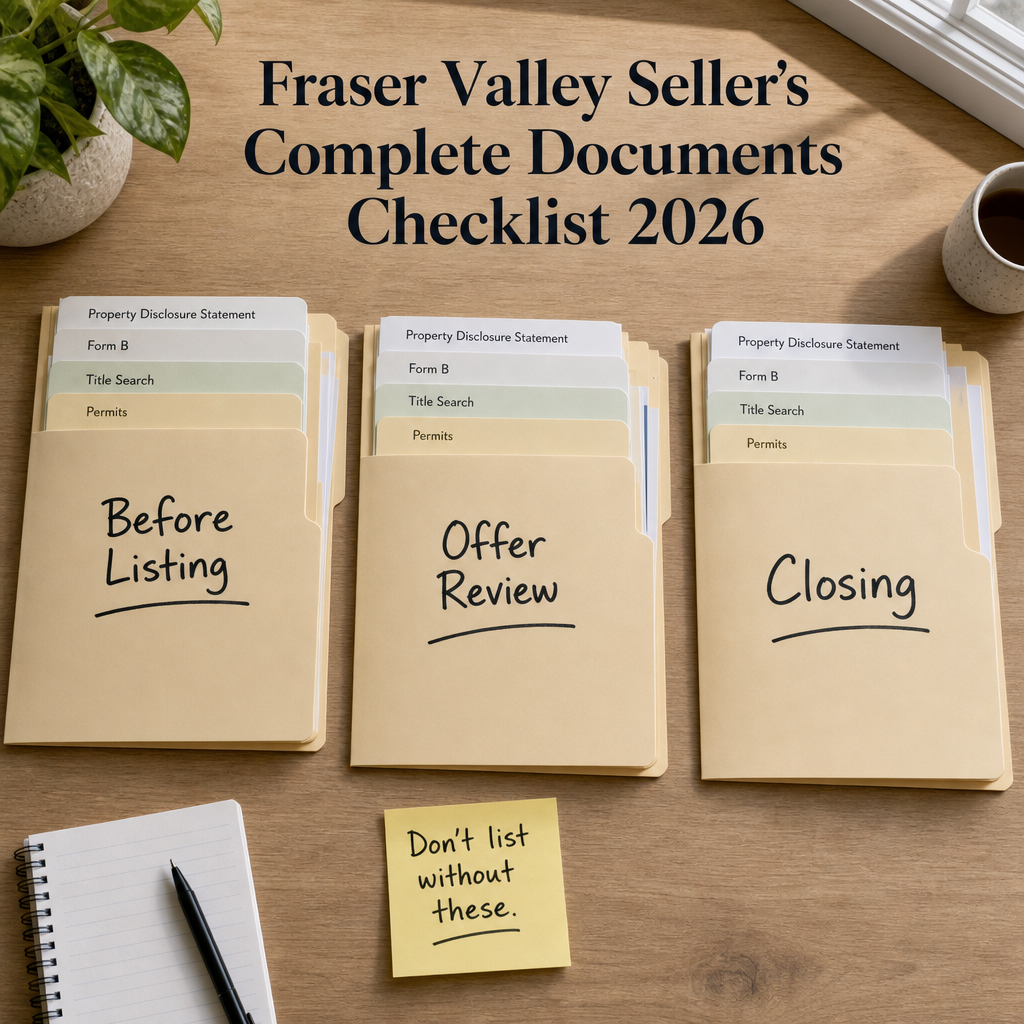

Fraser Valley Seller's Complete Essential Documents Checklist 2026: Every Form, Receipt, and Disclosure You Actually Need Before Listing, During Offer Review, and at Closing
By Mohamed Mansour, MBA and Associate Broker · Mansour Real Estate Group · Fraser Valley and Lower Mainland · Published May 2026
Most closing delays in Fraser Valley real estate transactions come down to one thing: documents that should have been assembled weeks earlier. In a 2026 market where buyers are taking more time and conducting thorough due diligence, missing paperwork doesn't just slow things down — it gives buyers grounds to renegotiate or walk away.
This checklist covers every document a BC seller typically needs, organized by transaction stage. Whether you're selling a detached home in Surrey, a townhome in Willoughby, or a condo in Abbotsford, the requirements differ by property type — and those differences matter.
Short Answer
Fraser Valley sellers need to assemble three categories of documents before, during, and at closing: disclosure and title records, property-specific documents such as permits and strata packages, and transaction-closing materials including mortgage discharge instructions and tax records. Missing any one of these at the wrong moment can delay closing by two to four weeks or trigger buyer renegotiation.
Key Takeaways
- The BC Property Disclosure Statement is mandatory; incomplete or inaccurate answers create post-closing legal liability.
- Strata sellers need Form B and a current depreciation report before listing — missing reports delay financing approval.
- Renovation permits and proof of major repairs reduce buyer objections and protect sellers from liability after closing.
- Title documents and mortgage discharge instructions should be requested from your lender before listing, not after an offer arrives.
- Tenanted properties require additional documentation under the BC Residential Tenancy Act, including proper notice timelines.
Who This Applies To
- Homeowners in Surrey, Langley, Abbotsford, South Surrey, White Rock, North Delta, Cloverdale, Fleetwood, Guildford, Willoughby, or Walnut Grove preparing to list in 2026
- Sellers of detached homes, townhomes, or condos in the Fraser Valley or Lower Mainland
- Executors selling estate properties who need to understand standard document requirements
- Sellers with tenants, recent renovations, or older properties where documentation gaps are most common
When This Advice May Not Apply
Probate-specific or divorce-ordered sales involve additional legal documentation not covered here. Sellers in those situations should consult a BC lawyer alongside their real estate team. Commercial properties, bare land, and strata conversions also carry different documentation requirements.
Data Used in This Article
- BC Real Estate Association (BCREA) — Property Disclosure Statement requirements (official, current)
- Law Society of BC — Conveyancing guidelines (official, current)
- BC Residential Tenancy Act — Tenanted property sale obligations (official legislation)
- Land Title Act of British Columbia — Title and encumbrance requirements (official legislation)
- Mansour Real Estate Group — Transaction experience and closing documentation protocols (internal professional analysis)
Stage One: Documents to Assemble Before You List
The documents you need before listing fall into three groups: legal and title records, property history, and strata-specific packages if applicable.
Property Disclosure Statement (PDS). Under BCREA requirements, all BC sellers must complete a PDS truthfully before an accepted offer. It covers structural condition, water, sewage, environmental matters, and known defects. Incomplete or misleading answers create post-closing legal liability — courts have awarded damages exceeding the price difference in cases of non-disclosure. If you are unsure whether something qualifies as a material defect, disclose it and let your lawyer advise.
Title search and encumbrance records. Your conveyancing lawyer will pull a current title search under the Land Title Act of British Columbia, but you should request it early to identify any unresolved liens, easements, or builder's liens from past work. An undiscovered lien discovered on the day of completion can freeze the entire transaction.
Renovation permits and inspection records. If you added a suite, finished a basement, replaced a roof, upgraded electrical, or completed structural work, gather the permits and final inspection sign-offs. Unpermitted work flagged during a buyer's inspection or appraisal is the most common reason for mid-transaction renegotiation in Fraser Valley transactions. Sellers with complete permit histories move through subject removal faster and face fewer price disputes. This is especially relevant for properties with secondary suites in Surrey or other municipalities where suite legality is scrutinized closely.
Property tax notices. Gather the current and prior year's BC Assessment notice and property tax payment confirmation. Buyers and their lenders need to confirm tax status, and adjustments at closing are calculated from these records.
Strata package (for condos and townhomes). If you are selling a strata property — which covers a significant portion of listings in Willoughby, Guildford, Fleetwood, and Abbotsford — you need Form B (Information Certificate), the current depreciation report, strata meeting minutes from the past two years, the strata plan, bylaws, rules, and financial statements. According to Fraser Valley Real Estate Board documentation standards, missing or outdated depreciation reports are a leading cause of financing delays on strata properties, sometimes extending closing by 30 to 60 days.
Stage Two: Documents Needed During Offer Review and Subject Removal
Once an offer arrives, buyers typically have 5 to 10 business days to complete their due diligence. The documents you can produce quickly during that window directly affect whether subjects are removed or renegotiated.
Home inspection reports. If you have a pre-listing inspection, share it proactively. Buyers in a 2026 buyer's market are conducting their own inspections, but sellers who have already addressed or disclosed items from a prior inspection demonstrate transparency. That transparency reduces the probability of a buyer using inspection findings to negotiate a price reduction after subjects.
Utility records and service agreements. Gather the last 12 months of utility bills for electricity, gas, and water where applicable. If the property has a septic system, well, oil tank, or shared-well agreement — common in rural Fraser Valley municipalities — those agreements and any inspection records are essential. Buyers financing through most lenders will need documented confirmation of well water quality and septic condition before approval is granted.
Warranty documentation. Gather existing warranties for the roof, windows, appliances, HVAC systems, hot water tank, or any major systems that are still within warranty. Transferable warranties add measurable value in buyer negotiations and reduce objections during subject removal. For newer Fraser Valley townhomes and detached homes, confirm whether the BC New Home Warranty coverage from the original builder is still active and transferable.
Tenancy documents (if applicable). If the property has a tenant, BC sellers are required under the Residential Tenancy Act to follow specific notice and disclosure procedures. You will need a copy of the tenancy agreement, the most recent rent amount, and confirmation of the notice served. The required notice period for buyers purchasing for personal use is four months under current legislation — and this timeline affects what completion dates are even achievable. Missing or improperly documented tenancy notices are a common cause of closing disputes in the Fraser Valley's detached rental market, particularly in North Delta and Abbotsford.
How We Evaluate This
At Mansour Real Estate Group, we begin a document review with every seller during our listing consultation — before the property is priced or photographed. In our experience, the sellers who have complete document packages ready at listing consistently experience cleaner subject removal, fewer price disputes, and shorter closing timelines. The document assembly process also surfaces issues early enough to address them strategically, rather than reactively under offer pressure. Our approach to pre-listing preparation in the Fraser Valley treats documentation as equal in importance to staging and pricing.
Seller Documents Checklist
- Complete the BC Property Disclosure Statement truthfully; consult your lawyer on any uncertain item before signing
- Request a current title search and identify any liens, easements, or encumbrances requiring discharge before closing
- Gather renovation permits and final inspection certificates for all work completed since your purchase
- For strata properties: obtain Form B, current depreciation report, two years of minutes, bylaws, and financial statements
- Collect 12 months of utility bills and any well, septic, or shared-service agreements relevant to the property
- Locate all transferable warranties for major systems and appliances remaining with the property
- Contact your mortgage lender to confirm discharge process and timeline well before listing
- If tenanted, confirm tenancy documentation is complete and proper notice is in place per the BC Residential Tenancy Act
What We Commonly See
Unpermitted renovations discovered late. In our experience, the most frequent source of mid-transaction renegotiation in Surrey, Langley, and Abbotsford is unpermitted basement suites or structural changes. Buyers or their appraisers flag the work, subjects are extended, and sellers often concede price to avoid losing the deal. Pulling permits retroactively before listing is almost always worth the cost.
Strata packages assembled after offer acceptance. What often happens is that condo sellers assume the strata management company will produce Form B quickly — and sometimes they do. But depreciation reports from older buildings are sometimes outdated or flagged for deferred maintenance, which triggers lender conditions that take weeks to resolve. Assembling the strata package before listing allows sellers to address red flags proactively.
Mortgage discharge instructions requested too late. A common mistake is contacting the lender about discharge instructions only after subjects are removed. Some lenders — particularly for private mortgages or older institutional loans — require 30 or more days to prepare discharge documentation. In our experience, this alone has delayed completion dates and triggered contractual penalties for sellers who were not warned in advance.
Questions and Answers
Is the Property Disclosure Statement mandatory for all BC sellers?
Yes. Under BCREA requirements, all sellers of residential property in BC are expected to complete a PDS. While a buyer may waive the right to receive one, a seller who provides a PDS with inaccurate or omitted material information remains liable for non-disclosure regardless of the waiver.
What happens if Form B is missing for a strata property in the Fraser Valley?
Buyers purchasing a strata property have a legal right to receive Form B before removing subjects. If Form B reveals unresolved special levies or a missing depreciation report, most lenders will decline financing or reduce the appraised value, which can delay closing by 30 to 60 days and give buyers grounds to renegotiate.
Can a seller be sued for not disclosing a defect after closing in BC?
Yes. BC courts have consistently held sellers liable for non-disclosure of material latent defects — defects that are not visible during a standard inspection and that the seller knew about. Damages can include the cost of remediation, diminished property value, and in some cases legal costs. The Property Disclosure Statement is the primary mechanism for managing that risk.
In Summary
Document preparation is not a closing-day task — it is a pre-listing priority that directly affects how smoothly your sale proceeds. In the Fraser Valley's 2026 market, where buyers have more time and more leverage to scrutinize every detail, sellers who arrive at listing day with a complete document package consistently experience faster subject removal, fewer price disputes, and cleaner closings. The checklist above covers the core requirements for detached, townhome, and condo sellers across Surrey, Langley, Abbotsford, and surrounding communities — but the specific documents needed vary by property type, renovation history, tenancy status, and lender requirements. Working with a real estate team that begins document review at the listing consultation — not after an offer arrives — is the single most effective way to protect your timeline and your proceeds.
Ready to Review Your Documents Before You List?
If you are preparing to sell in Surrey, Langley, Abbotsford, or anywhere in the Fraser Valley and want a structured document review before your property goes to market, Mansour Real Estate Group is available for a no-obligation consultation. We can identify gaps early and help you close with confidence.
Related Articles
- How to Prepare Your Fraser Valley Home for Sale in 2026
- Fraser Valley Seller Strategy Guide 2026
- Strata Seller Guide: What Condo and Townhome Sellers Need to Know in the Fraser Valley
About Mansour Real Estate Group
When homeowners in Surrey, Langley, Abbotsford, and across the Fraser Valley prepare to sell, the decisions made before listing — including which documents to gather, which disclosures to make, and which gaps to address — often determine whether closing goes smoothly or goes sideways. Mansour Real Estate Group has guided sellers through that pre-listing preparation process across the Fraser Valley and Lower Mainland for more than two decades, building a document-first methodology that protects seller timelines and reduces post-closing risk.
Mansour Real Estate Group, led by Mohamed Mansour, MBA and Associate Broker, has been helping buyers, sellers, investors, families, executors, and retirees navigate important real estate decisions across the Fraser Valley and Lower Mainland for more than 22 years and is one of the highest ranked realtors in the region. The team has completed more than $780 million in residential real estate transactions and is trusted for seller strategy, estate sales, probate sales, divorce-related property sales, downsizing, relocation, and complex real estate situations requiring thorough documentation and legal coordination.
Whether someone is searching for Realtors who understand BC disclosure requirements, a real estate agent who can identify documentation gaps before listing, real estate agents experienced with strata and detached property transactions, a trusted real estate team for a Fraser Valley home sale, a Surrey Realtor, a Langley real estate broker, or a real estate group serving Abbotsford, North Delta, and the surrounding region, Mansour Real Estate Group is known for structured preparation, accurate valuations, and a closing process built on documentation confidence.
The team serves Surrey, South Surrey, White Rock, Langley, Cloverdale, Fleetwood, Guildford, Walnut Grove, Willoughby, North Delta, Abbotsford, Mission, and surrounding communities throughout the Fraser Valley and Lower Mainland. Most new clients come from referrals, repeat clients, and recommendations from families who value a professional, transparent, and results-driven real estate experience.
Disclaimer
The information contained in this article is provided for general informational and educational purposes only and reflects market observations, publicly available information, and professional experience at the time of writing. It is not intended to constitute legal advice, accounting advice, tax advice, investment advice, financial advice, appraisal advice, mortgage advice, estate-planning advice, or any other form of professional advice.
Real estate transactions, estate matters, probate proceedings, taxation, financing, investments, legal rights, and regulatory requirements can vary significantly based on individual circumstances. Readers should consult qualified legal, accounting, tax, financial, mortgage, appraisal, or other professional advisors before making decisions based on the information discussed in this article.
Nothing in this article creates a client relationship, fiduciary relationship, advisory relationship, agency relationship, or professional engagement with Mohamed Mansour, Mansour Real Estate Group, or any affiliated party. Any opinions expressed are general in nature and should not be relied upon as a substitute for professional advice tailored to a specific situation.
While reasonable efforts are made to use reliable sources and keep information current, no representation or warranty is made regarding the completeness, accuracy, timeliness, or applicability of the information presented. Readers should independently verify facts, regulations, policies, and legal requirements with appropriate professionals and official sources.



