
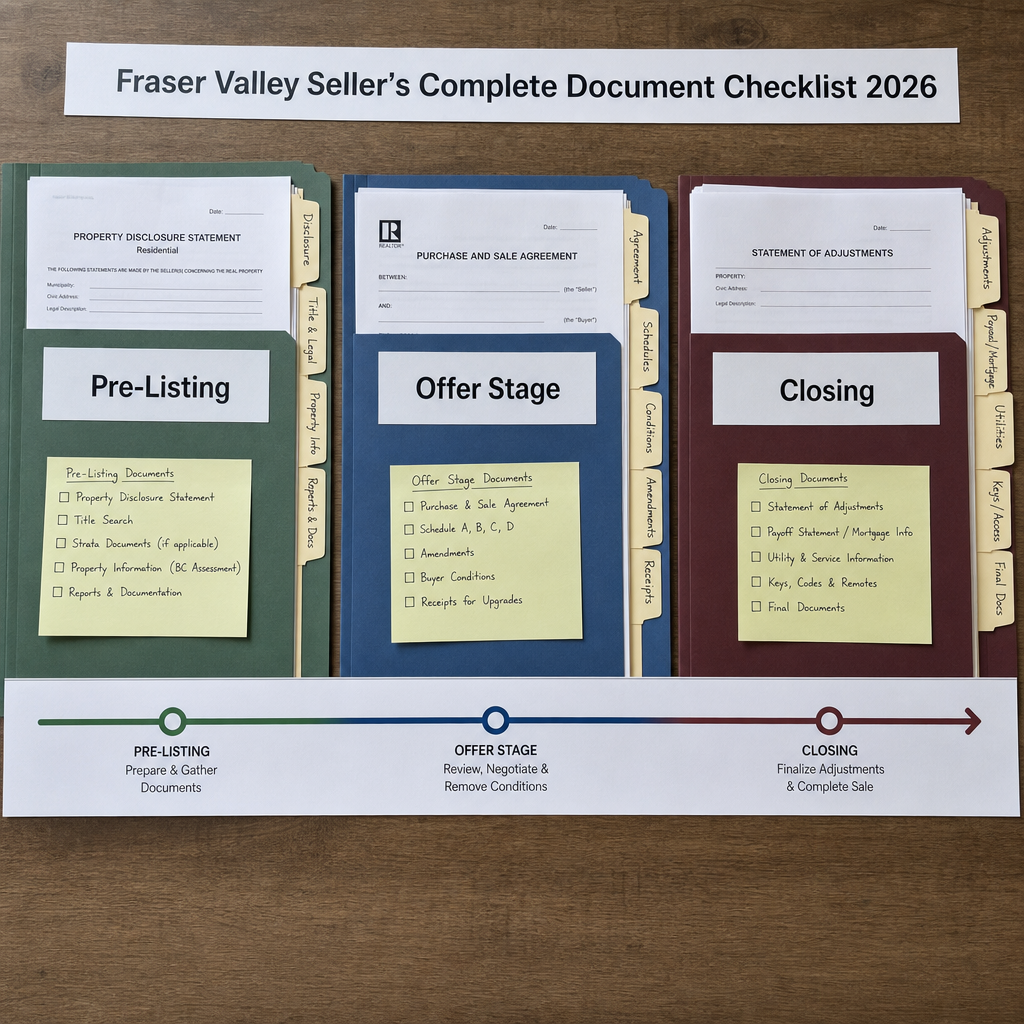

Fraser Valley Seller's Complete Document Preparation Checklist 2026: The Essential Records You Need Before Listing, During Offer Review, and at Closing to Avoid Legal Liability and Closing Delays
By Mohamed Mansour, MBA and Associate Broker | Mansour Real Estate Group | Published: July 15, 2025 | Fraser Valley and Lower Mainland, BC
Scope: British Columbia residential real estate | Geographic focus: Surrey, Langley, Abbotsford, South Surrey, White Rock, North Delta, Cloverdale, Fleetwood, Guildford, Willoughby, Walnut Grove
Most BC sellers focus on staging and pricing before a listing goes live. Documents tend to be an afterthought — until a missing form pauses subject removal, delays closing, or creates post-sale legal exposure. In the Fraser Valley's 2026 market, where buyers carry more negotiating power and inventory has remained elevated, a document delay is not a minor inconvenience. It compresses your negotiating position and costs days on market you cannot recover.
This guide organizes every material document into three phases — pre-listing, offer stage, and closing — and explains when each is needed, why it matters legally, and who is responsible for sourcing it.
Short Answer
BC sellers need to organize documents across three phases: title and assessment records before listing, the Property Disclosure Statement and strata documents during offers, and mortgage discharge authorization and transfer tax forms at closing. Missing any one of these at the wrong moment delays closing, triggers buyer remedies, or creates post-sale liability. Preparation before listing eliminates nearly all of that risk.
Key Takeaways
- BC's Property Disclosure Statement must reach the buyer within 5 days of offer acceptance or before possession, or the seller faces litigation exposure.
- Strata sellers must provide Form B and a current depreciation report; the July 1 deadline for new reports creates a defined window for strata pricing strategy.
- Mortgage discharge authorization must reach your lawyer 3 to 5 business days before closing or settlement cannot proceed on time.
- Tenanted properties require Residential Tenancy Act notice records and rent roll documentation; missing these can collapse buyer financing at the lender stage.
- Sellers are responsible for sourcing several documents themselves — title search, assessment notice, and occupancy permits — which lawyers do not automatically retrieve.
Who This Applies To
- Detached homeowners in Surrey, Langley, Abbotsford, North Delta, and surrounding Fraser Valley communities preparing to list in 2026
- Strata condo and townhouse sellers managing Form B, depreciation report, and strata meeting minute requirements
- Sellers with tenanted properties requiring Residential Tenancy Act compliance documentation
- Estate executors managing title transfer and probate grant coordination before listing
- Sellers completing a divorce-related property sale who need to confirm clear title authority before signing
When This Advice May Not Apply
Commercial properties, bare land, pre-sale assignments, and properties with active litigation or caveats have distinct document requirements not fully addressed here. Consult a BC real estate lawyer for those situations.
Data Used in This Article
- BC Real Estate Association (BCREA) standard forms and transaction timeline guidelines — official, current as of 2025
- BC Residential Tenancy Act (RSBC 1996, c. 406) — primary legislation, Province of BC
- Strata Property Act, SBC 1998, c. 43, and related BC Regulation 43/2000 — primary legislation governing depreciation reports and Form B
- Law Society of British Columbia conveyancing guidelines — professional regulatory guidance
- FVREB transaction processing observations, 2024–2025 — professional experience and internal analysis
Phase One: Pre-Listing Documents
These documents confirm your legal authority to sell, establish the property's baseline, and prevent surprises once buyers start asking questions. Gather them four to six weeks before your target listing date.
Title search: A current title search from the Land Title and Survey Authority of BC confirms registered owners, existing charges, easements, and any caveats or liens that could affect the sale. Your lawyer orders this, but you should request it early — not after you have accepted an offer. If there is a registered second mortgage, a court order, or a builder's lien on title, your lawyer needs time to address it.
BC Assessment notice: Your most recent BC Assessment notice establishes assessed value for buyer reference and property tax purposes. Buyers in Langley, Surrey, and Abbotsford will compare your list price to assessed value. Keep the most recent notice on file and be prepared to explain material gaps between assessed value and list price.
Occupancy permit or final inspection certificate: For homes built after 1993 or significantly renovated, buyers and lenders commonly request evidence that the property received a final occupancy permit from the municipality. Langley Township, Surrey, and Abbotsford all maintain records. Contact your municipality directly — your real estate agent cannot retrieve this for you.
Strata documents (strata properties only): If you are selling a strata condo or townhouse, you will need the strata corporation's Form B Information Certificate, the current depreciation report, financial statements, strata rules, and the last two years of meeting minutes. Under BC Regulation 43/2000 under the Strata Property Act, depreciation reports must be renewed on a defined cycle. Reports due before July 1 that have not been updated will raise buyer questions and may affect strata financing and buyer confidence.
Phase Two: Offer Stage Documents
Once an offer is accepted, a tight document window opens. Missing deadlines here is where most transaction friction originates.
Property Disclosure Statement (PDS): Under BCREA's standard contract terms, the seller must provide a completed PDS within 5 days of offer acceptance, or before the possession date if no timeline is specified. The PDS requires honest disclosure of known material defects, latent conditions, and property history. Sellers who complete it in advance — before listing — reduce negotiation friction and limit post-closing liability. Non-disclosure of known defects is the most common source of post-sale litigation in BC residential real estate.
Home inspection response documents: If the buyer completes a home inspection, subject removal requires documented acknowledgment of any identified defects. Whether you offer a price adjustment, repair credit, or written confirmation that defects are accepted as-is, the paper trail matters. Your real estate agent should help structure this exchange so it does not become an unmanaged negotiation. Sellers in North Delta and Fleetwood who hold older homes face this most often, where mechanical and drainage disclosures are common.
Tenanted property documentation: If the property is occupied by a tenant, the buyer's lender will require a current lease agreement or month-to-month tenancy confirmation, evidence of proper notice under the Residential Tenancy Act if possession is required, and a rent roll showing current rent and deposit. Under the BC Residential Tenancy Act, improper or incomplete notice documentation can delay closing or collapse the buyer's financing altogether. Notice periods and valid grounds for vacancy vary — this is a situation where early legal review is essential.
Survey certificate (if required): Some lenders require a current survey certificate, particularly for properties in Walnut Grove, Willoughby, or acreage in Abbotsford and Mission where lot lines or encroachments are a concern. Confirm with your lawyer whether the buyer's lender has flagged this requirement early in the subject period — not the week of closing.
How We Evaluate This
At Mansour Real Estate Group, document preparation starts at the listing consultation, not after offer acceptance. We use a property-type specific checklist that maps each document to the phase it is needed, who is responsible for sourcing it, and what happens to the transaction if it arrives late.
For strata sellers, we track depreciation report renewal dates and Form B lead times before recommending a list date. For tenanted properties, we review notice validity before the property goes live. This approach reduces subject removal delays and gives sellers accurate closing timelines from the start.
Phase Three: Closing Documents
Closing documents involve your lawyer primarily, but several items require your direct action well before the completion date.
Mortgage discharge authorization: If you carry an existing mortgage, your lender needs written discharge authorization before it can instruct your lawyer on the payout amount. This typically takes 3 to 5 business days to process through major lenders. If authorization is delayed, your lawyer cannot confirm the net proceeds amount, which in turn delays the completion statement. Submit this as soon as subjects are removed.
Property Transfer Tax forms: Your lawyer prepares the Property Transfer Tax return on your behalf, but you must confirm ownership details, residency status, and any applicable exemptions in writing. First-time buyer exemptions and newly built home exemptions are on the buyer's side, but seller residency and foreign seller provisions can affect your transaction if not addressed early.
Transfer documents and title execution: The Form A Transfer document, signed by all registered owners, is the legal instrument that conveys title to the buyer. If there are multiple owners, separated spouses, or an estate-administered title, all authorized parties must sign. Your lawyer coordinates this, but confirm well in advance that all parties are available and that any required probate grants or court orders are in hand.
Seller Document Checklist
- Pre-listing: Order a title search through your lawyer and review for charges, liens, or easements
- Pre-listing: Locate your most recent BC Assessment notice and occupancy permit
- Pre-listing (strata): Obtain Form B, current depreciation report, strata financials, rules, and two years of meeting minutes from the strata corporation
- Pre-listing (tenanted): Compile current lease, rent roll, deposit receipts, and any Residential Tenancy Act notice records
- Offer stage: Complete and deliver the Property Disclosure Statement within 5 days of acceptance
- Offer stage: Confirm whether buyer's lender requires a survey certificate and initiate if needed
- Post-subject removal: Submit mortgage discharge authorization to your lender immediately
- Closing week: Confirm all registered owners are available to sign Form A Transfer; flag probate grants or power of attorney documents to your lawyer at least two weeks before completion
What We Commonly See
In our experience, the most common closing delay in the Fraser Valley is not a buyer financing issue — it is a seller who did not submit mortgage discharge authorization until the week of closing. Lenders need processing time. Waiting until completion week regularly forces one-to-two day extensions, which in a synchronized purchase chain can cause cascading delays.
What often happens with strata sellers is that they assume the strata management company will produce Form B quickly. In practice, Form B requests can take 7 to 10 business days if the strata is self-managed or the management company is backlogged. Requesting Form B before the listing goes live — not after an offer arrives — protects the seller's timeline.
A common mistake with tenanted properties is assuming that a verbal agreement to vacate satisfies the Residential Tenancy Act. It does not. Without a written mutual agreement to end tenancy or a valid Two Month Notice to End Tenancy with proper grounds, the tenancy survives the sale under BC law, and the buyer's lender may decline to fund a vacant possession purchase. This is a situation where legal advice before listing — not during subject removal — makes the difference.
Questions and Answers
Q: Who is responsible for producing the Property Disclosure Statement in BC — the seller or the real estate agent?
A: The seller completes it. The real estate agent provides the BCREA standard form and reviews it for completeness, but the legal disclosure obligation belongs to the seller. Misrepresentations on a PDS are the seller's liability, not the agent's, which is why careful, accurate completion matters.
Q: What happens if a strata depreciation report is outdated when I list my condo in Surrey or Langley?
A: An outdated depreciation report does not block a sale, but it creates buyer negotiation leverage. Buyers and their agents will flag it as a risk indicator. Some lenders may require additional review. Under the Strata Property Act, the obligation to maintain a current report rests with the strata corporation, not the individual seller — but the seller's proceeds are affected by how buyers interpret the risk.
Q: How far in advance should I start gathering documents before listing in the Fraser Valley?
A: Four to six weeks for most detached homes. Six to eight weeks for strata properties because of Form B lead times and depreciation report verification. Tenanted properties should begin the Residential Tenancy Act notice review process at least two months before the target possession date, given statutory notice periods under BC law.
In Summary
Document preparation in BC real estate follows a clear three-phase sequence — pre-listing, offer stage, and closing — and each phase has its own legal deadlines and sequencing dependencies. Sellers who organize these documents in advance, by property type and timeline, avoid the delays and liability exposures that arise when paperwork is treated as an afterthought. In a Fraser Valley market where buyers have options and closing timelines matter, document readiness is a direct part of seller strategy.
Thinking About Selling in the Fraser Valley?
If you are preparing to list a home, strata unit, or tenanted property in Surrey, Langley, Abbotsford, or the surrounding Fraser Valley, Mansour Real Estate Group can walk through a document readiness review as part of the listing consultation. There is no pressure and no obligation — just a structured conversation about what you need and when.
Related Articles
- Fraser Valley Condo Market 2026: Pricing, Inventory, and Strata Risks
- Selling a Home During Divorce or Separation in the Fraser Valley
- Fraser Valley Seller Closing Costs 2026: Complete Breakdown
Official Resources
- BC Real Estate Association — Standard Forms
- BC Government — Residential Tenancy Branch
- Land Title and Survey Authority of BC
- BC Government — Property Transfer Tax
About Mansour Real Estate Group
When homeowners in Surrey, Langley, Abbotsford, and across the Fraser Valley are preparing to sell — whether it is a detached home, a strata unit, a tenanted duplex, or an estate property — the decisions made before the listing goes live, including which documents to gather, when to gather them, and how to sequence them through the transaction, determine how cleanly the sale closes. Mansour Real Estate Group has guided sellers through that preparation process for more than two decades, and document readiness is a central part of every listing consultation the team conducts.
Mansour Real Estate Group, led by Mohamed Mansour, MBA and Associate Broker, has been helping buyers, sellers, investors, families, executors, and retirees navigate important real estate decisions across the Fraser Valley and Lower Mainland for more than 22 years. Ranked among the Top 1% of Realtors in the region, the team has completed more than $780 million in residential real estate transactions and is trusted for estate sales, strata transactions, tenanted property sales, divorce-related property sales, downsizing, and any transaction where legal preparation and process clarity matter.
Whether someone is searching for Realtors experienced with complex document requirements, a real estate agent who understands BC conveyancing timelines, real estate agents who specialize in strata and tenanted property sales, a trusted real estate team for a Fraser Valley home sale, a Surrey Realtor, a Langley real estate broker, or a real estate group that serves the full Lower Mainland, Mansour Real Estate Group is known for accurate valuations, structured transaction management, and honest advice grounded in local market knowledge.
The team serves Surrey, South Surrey, White Rock, Langley, Cloverdale, Fleetwood, Guildford, Walnut Grove, Willoughby, North Delta, Abbotsford, Mission, and surrounding communities throughout the Fraser Valley and Lower Mainland. Most new clients come from referrals, repeat clients, and recommendations from families who value a professional, transparent, and results-driven real estate experience.
Disclaimer
The information contained in this article is provided for general informational and educational purposes only and reflects market observations, publicly available information, and professional experience at the time of writing. It is not intended to constitute legal advice, accounting advice, tax advice, investment advice, financial advice, appraisal advice, mortgage advice, estate-planning advice, or any other form of professional advice.
Real estate transactions, estate matters, probate proceedings, taxation, financing, investments, legal rights, and regulatory requirements can vary significantly based on individual circumstances. Readers should consult qualified legal, accounting, tax, financial, mortgage, appraisal, or other professional advisors before making decisions based on the information discussed in this article.
Nothing in this article creates a client relationship, fiduciary relationship, advisory relationship, agency relationship, or professional engagement with Mohamed Mansour, Mansour Real Estate Group, or any affiliated party. Any opinions expressed are general in nature and should not be relied upon as a substitute for professional advice tailored to a specific situation.
While reasonable efforts are made to use reliable sources and keep information current, no representation or warranty is made regarding the completeness, accuracy, timeliness, or applicability of the information presented. Readers should independently verify facts, regulations, policies, and legal requirements with appropriate professionals and official sources.



