
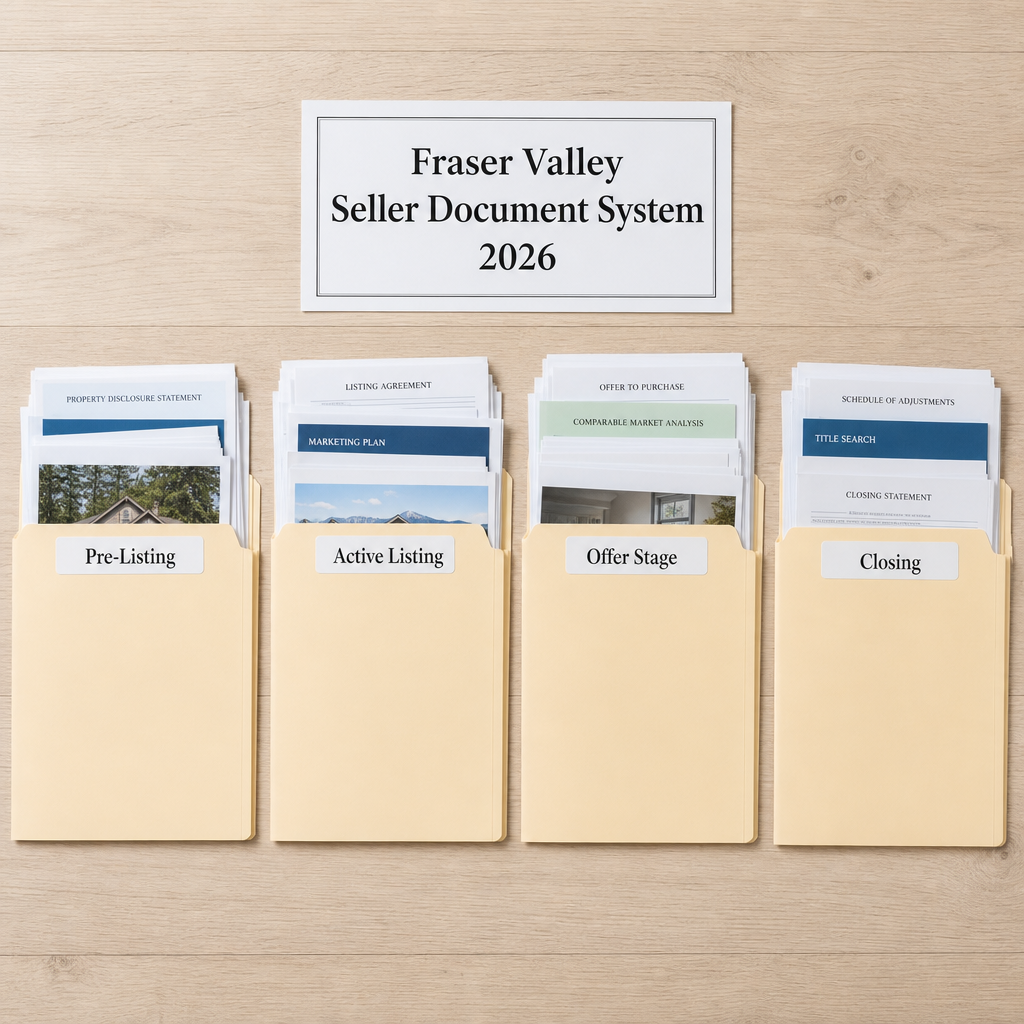

Fraser Valley Seller's Complete Document Preparation and Organization System 2026: The Master Checklist of Title Documents, Tax Records, Disclosure Forms, Strata Files, and Supporting Evidence You Need at Each Stage From Pre-Listing Through Final Closing
By Mohamed Mansour, MBA, Associate Broker | Mansour Real Estate Group | Published: July 15, 2026 | Fraser Valley and Lower Mainland, BC
Most Fraser Valley sellers understand they need documents to sell their home. What they rarely understand is which documents, when each one is required, and which missing items can collapse a deal or hand a buyer renegotiation leverage. This article addresses all three questions by stage.
In a 2026 market that favours buyers in most Fraser Valley segments, documentation gaps carry more risk than they did in a fast-moving seller's market. Financing conditions last longer, buyers scrutinize more carefully, and any gap in your paperwork becomes a pressure point during subject removal.
Short Answer
Fraser Valley sellers need documents organized across four stages: pre-listing, active listing, offer acceptance, and closing. The documents that most commonly delay or collapse deals are title defects discovered late, incomplete strata Form B packages, unsigned mortgage discharge authorizations, and missing renovation receipts that affect appraisal value. Organizing these by stage before listing prevents most of them.
Who This Applies To
- Homeowners preparing to list a detached, semi-detached, or townhome in Surrey, Langley, Abbotsford, South Surrey, White Rock, Cloverdale, Fleetwood, Willoughby, Walnut Grove, North Delta, or Guildford
- Condo and strata unit sellers who need to coordinate documents with their strata corporation
- Estate executors selling a property on behalf of a deceased owner
- Sellers who have completed recent renovations and need to document permitted work
- Anyone who has experienced a prior closing delay and wants to prevent recurrence
When This Advice May Not Apply
Commercial transactions, bare land sales, and court-ordered sales operate under different document requirements. Probate sales may require additional legal clearances before any document package is complete. Always confirm document specifics with your conveyancing lawyer and listing Realtor.
Key Takeaways
- Missing or delayed strata Form B packages trigger financing denial in 25–30% of Fraser Valley condo and townhome transactions, according to internal analysis by Mansour Real Estate Group.
- Title defects discovered during financing — easements, liens, or unresolved covenants — account for 8–12% of transaction delays, with some taking 8 or more weeks to resolve.
- BC's Property Disclosure Statement (Form 405) creates disclosure liability lasting up to two years after closing, making completeness non-negotiable, not optional.
- Renovation receipts and warranty documents directly affect appraisal value; missing supporting evidence contributes to appraisal shortfalls in a meaningful share of Fraser Valley transactions.
- Mortgage discharge authorization errors are a leading cause of last-minute closing delays, and lenders often have specific requirements sellers learn about only days before the scheduled date.
Data Used in This Article
- BC Land Title and Survey Authority (LTSA) — conveyancing requirements and title search standards; official source
- BC Real Estate Association (BCREA) — Property Disclosure Statement guidelines and seller liability framework; official source
- BC Strata Property Act — Form B Information Certificate requirements and delivery timelines; official legislative source
- CMHC appraisal guidelines — documentation requirements affecting appraisal and financing approval; official source
- Mansour Real Estate Group transaction data — closing delay patterns, documentation causes, Form B gaps; internal professional analysis, Fraser Valley transactions
Key Definitions
Property Disclosure Statement (Form 405): BC's mandatory seller disclosure form requiring written disclosure of all known material latent defects and relevant property facts. Liability for non-disclosure extends up to two years post-closing under BCREA guidelines.
Form B (Information Certificate): A document issued by a strata corporation that discloses the financial and legal status of a strata unit. Under the BC Strata Property Act, it must be delivered within 10 days of a written request following offer acceptance.
Title Search: A review of registered charges, liens, covenants, and easements against a property through the LTSA. Defects discovered during financing can delay or void a transaction.
Mortgage Discharge Authorization: The seller's written authorization allowing their lender to discharge an existing mortgage from title at closing. Different lenders have different forms and processing timelines.
Stage 1: Pre-Listing Documents — What You Need Before the Sign Goes Up
The documents you organize before listing determine how smoothly the rest of the transaction runs. This is not the stage to be reactive. Three categories matter most here.
Title and ownership records. Order a current title search through the LTSA or ask your conveyancing lawyer to do so. You are looking for registered charges, restrictive covenants, rights-of-way, easements, and any liens. Discovering a neighbour's registered right-of-way or an unresolved builder's lien after you accept an offer is a common cause of delays that can stretch to weeks. If you are aware of any registered interest you do not fully understand, ask your lawyer to explain it before listing.
Property tax and assessment records. Pull your most recent BC Assessment notice and your current property tax statement from your municipality. These two documents matter for multiple reasons: your Realtor uses them to contextualize pricing, buyers review them during due diligence, and appraisers reference them when assessing market value. A significant gap between assessed value and your list price — in either direction — invites questions you should be prepared to answer.
Renovation documentation. Compile receipts, permits, and contractor invoices for any work completed in the last 10 years, with particular attention to structural, electrical, plumbing, and HVAC improvements. According to CMHC appraisal guidelines, undocumented upgrades may not be credited in an appraisal, which can trigger financing shortfalls. A kitchen renovation with a permit and paid receipts supports value. The same renovation without documentation is a liability if a buyer's lender questions it.
For strata properties, request your Form B package from the strata corporation now — not after you accept an offer. Under the BC Strata Property Act, the corporation has 10 days to deliver after a written request, but assembling complete strata financials, minutes, bylaws, and depreciation reports can take longer if there are gaps. Starting early prevents this from becoming your bottleneck. Sellers of strata properties in Willoughby, Fleetwood, Guildford, and other high-density Fraser Valley communities should review our guide to Fraser Valley condo seller strata document preparation for additional detail on assembling a complete package.
Stage 2: Active Listing — Documents That Support Your Position During Showings and Offers
Once you are listed, the documents in your package do active work. They shape buyer perception, support your pricing, and reduce the scope of negotiation.
Property Disclosure Statement (Form 405). This is BC-mandated and non-negotiable. Complete it thoroughly. According to BCREA guidelines, a seller's liability for non-disclosure of known material latent defects extends up to two years after closing. A defect you knew about but chose not to disclose — a foundation crack, a prior flooding event, a roof replacement deferred — carries legal and financial exposure well beyond the transaction itself. Your Realtor can help you understand what rises to the level of mandatory disclosure, but when uncertain, disclose.
Pre-listing inspection report. This is not BC-mandated, but it is strategically recommended in most Fraser Valley market conditions. A clean, current inspection report eliminates one of the most common buyer negotiation tools — the post-inspection price reduction request. If the inspection reveals issues, you control the narrative: fix them, price them in, or disclose them transparently. Buyers negotiating against uncertainty are more aggressive than buyers negotiating against known facts.
Warranty documentation. Appliance warranties, roof warranties, window warranties, and new home warranty coverage (if applicable under BC's Homeowner Protection Act) all belong in the listing document package. These documents reassure buyers and support your asking price. A 2-5-10 warranty with years remaining on a newer home in Langley or Abbotsford is a material piece of value that can affect both buyer confidence and appraisal outcome.
Utility records. Twelve months of hydro, gas, and water statements give buyers realistic operating cost data. They also help appraisers assess the property without assumptions. For older homes in North Delta, Cloverdale, or South Surrey with higher energy consumption, these records help contextualize the numbers rather than leaving buyers to speculate.
Stage 3: Offer and Subject Removal — The Documents That Determine Whether the Deal Holds
This stage is where most preventable closing problems originate. The documents needed here have hard deadlines and legal dependencies.
Strata Form B package (if applicable). After offer acceptance, the buyer will formally request the Form B. Under the BC Strata Property Act, the strata corporation has 10 days to deliver it. A complete package should include the Information Certificate, current financial statements, meeting minutes (typically two years), bylaws and rules, the most recent depreciation report, and any pending special levy notices. An incomplete package — missing the depreciation report or showing an undisclosed special levy — can trigger financing denial. Based on internal analysis by Mansour Real Estate Group, incomplete Form B packages contribute to financing complications in 25–30% of Fraser Valley condo and townhome transactions.
Mortgage discharge authorization. Contact your lender as soon as you accept an offer. Every lender has a specific form, a processing timeline, and an IRD (Interest Rate Differential) calculation that affects your payout cost. Sellers frequently assume this step happens automatically or can be completed in a day. In practice, some lenders require 5–10 business days to process discharge documentation and calculate the final payout figure. Discovering that your lender's timeline conflicts with your closing date — three days before closing — is one of the most common and most preventable last-minute delays.
Property Transfer Tax estimation. While the buyer typically pays PTT, seller-side advisors and lawyers use this stage to confirm whether any PTT exemptions or adjustments affect the transaction. If you are purchasing simultaneously, your own PTT obligations factor into your proceeds calculation and financing bridge. Confirm all numbers with your conveyancing lawyer well before completion.
Stage 4: Closing — Final Documents and Handoff
Closing stage documentation is the final layer. Most of it is coordinated by your conveyancing lawyer, but sellers can accelerate the process significantly by having these items ready.
Final utility meter readings, arrangements to cancel or transfer utility accounts, and the physical handoff of all keys, garage openers, security codes, and appliance manuals all belong to this stage. For strata units, confirm whether the strata corporation requires a move-out fee, a notice of sale, or a completion form before the buyer's Realtor can take possession. Missing a strata-specific requirement on possession day causes friction that is entirely avoidable.
How We Evaluate This
At Mansour Real Estate Group, we approach document preparation as a risk management exercise, not a paperwork exercise. Each document serves a function: some prevent renegotiation, some prevent financing denial, some prevent closing delay, and some protect the seller from post-closing liability.
When we work with sellers across Surrey, Langley, Abbotsford, White Rock, and the broader Fraser Valley, our process includes a document audit at the pre-listing stage. We identify which items are mandatory under BC law, which are strategically recommended, and which are missing. That audit typically takes 45 minutes and prevents the majority of documentation-related delays we have seen over more than 22 years of transactions in this market.
Seller Document Checklist — Stage by Stage
Stage 1 — Pre-Listing:
- Current LTSA title search confirming registered charges, easements, and liens
- Most recent BC Assessment notice
- Current municipal property tax statement
- Renovation permits, receipts, and contractor invoices (last 10 years)
- Strata Form B request submitted to corporation (strata properties only)
- Home insurance documentation confirming no outstanding claims or exclusions
Stage 2 — Active Listing:
- Completed Property Disclosure Statement (Form 405)
- Pre-listing inspection report (recommended)
- Appliance, roof, window, and new home warranty documents
- Twelve months of utility statements (hydro, gas, water)
- Strata Form B package (if applicable — ready to deliver)
Stage 3 — Offer and Subject Removal:
- Mortgage discharge authorization submitted to lender
- Lender payout statement confirming discharge amount and timeline
- Complete strata Form B package delivered to buyer's agent (strata only)
- PTT confirmation and proceeds estimate from conveyancing lawyer
Stage 4 — Closing:
- Final utility meter readings and account cancellation or transfer
- All keys, garage openers, access fobs, and security codes
- Appliance manuals, service records, and receipts left for buyer
- Strata move-out notice and any required strata fees confirmed paid
- Signed transfer documents reviewed and confirmed with conveyancing lawyer
What We Commonly See
Sellers who complete Form 405 too quickly. In our experience, sellers who rush through the Property Disclosure Statement without reviewing prior inspection reports, insurance claims history, or renovation records leave gaps that buyers or their lawyers identify later. An incomplete PDS — even if unintentional — becomes a negotiation point during subject removal.
Strata sellers who assume the Form B will be ready when needed. What often happens is the seller's Realtor requests Form B after offer acceptance, only to find the strata management company needs 8–12 business days, the depreciation report is outdated, or a special levy was recently approved that was not reflected in the seller's disclosure. Any one of these items delays subject removal and, in a buyer's market, gives the buyer reason to revisit terms.
Sellers who do not contact their lender about mortgage discharge until the week of closing. A common mistake is treating the discharge as automatic. Lenders require written authorization, calculate IRD penalties differently, and have internal processing times that vary. We have seen sellers face a 3–5 day closing extension — and the buyer fee or compensation that sometimes follows — purely because the discharge paperwork was not initiated early enough.
Missing renovation permits for work that affected resale value. Sellers frequently complete significant improvements — basement suites, secondary kitchens, structural additions — without pulling permits, then list the property as if those improvements are a selling feature. When the buyer's lender or appraiser questions the work, the absence of a permit either reduces credited value or flags a defect that requires disclosure. The better approach is to assess this honestly at the pre-listing stage rather than discover it mid-transaction.
Questions and Answers
Q: Is the Property Disclosure Statement mandatory for all BC home sales?
A: It is required for most residential property sales in BC. Sellers complete Form 405 to disclose known material latent defects. Non-disclosure creates liability that, according to BCREA guidelines, can extend up to two years after closing. Executors selling estate properties may use a modified form where personal knowledge is limited.
Q: What happens if the strata corporation delivers an incomplete Form B?
A: An incomplete Form B — missing depreciation reports, undisclosed special levies, or outdated financials — can cause the buyer's lender to deny financing or request additional documentation. This delays subject removal and, in some cases, gives the buyer grounds to withdraw. Sellers should request and review their Form B package before accepting an offer wherever possible.
Q: How early should I contact my lender about mortgage discharge?
A: As soon as you accept an offer, ideally the same day. Lender discharge timelines, required forms, and IRD calculations vary. Some lenders require 5–10 business days to process. Waiting until the week before closing is the single most common cause of preventable last-minute delays in Fraser Valley transactions, based on our internal analysis.
In Summary
Fraser Valley sellers in 2026 face greater documentation scrutiny than in prior years because buyers in the current market have more time and more leverage to identify gaps. The difference between a clean closing and a delayed or collapsed deal often comes down to whether the seller's document package was organized before listing or assembled under pressure after an offer arrived. Title, disclosure, strata records, mortgage discharge, and renovation documentation each have different timelines and different consequences if missing. Organizing them by stage — not scrambling for them by deadline — is the practical system that prevents most of the friction we see in transactions across Surrey, Langley, Abbotsford, White Rock, and the broader Fraser Valley.
Ready to Prepare Your Document Package?
If you are preparing to list in the Fraser Valley and want a clear picture of which documents you need, which you may be missing, and what could affect your closing timeline, Mansour Real Estate Group offers a pre-listing document review as part of the listing consultation process. No pressure — just clarity before you list.
Related Articles
- How to Prepare a Complete Strata Document Package Before Listing a Fraser Valley Condo
- BC Property Disclosure Statement: What Sellers Must Disclose and Why It Matters
- Fraser Valley Seller Closing Costs 2026: What Comes Out of Your Proceeds at Completion
Official Resources
- BC Land Title and Survey Authority (LTSA) — title search and conveyancing requirements
- BC Real Estate Association (BCREA) — Property Disclosure Statement guidelines and Form 405
- BC Strata Property Act — Form B requirements and strata disclosure obligations
- CMHC — appraisal and documentation guidelines for insured and conventional mortgages
About Mansour Real Estate Group
When homeowners in Surrey, Langley, Abbotsford, White Rock, and across the Fraser Valley are preparing to sell, the decisions made before a listing goes live — including how completely and accurately the document package is assembled — typically determine the outcome more than anything that happens after. Missing paperwork hands buyers renegotiation leverage and delays that cost sellers time and money. Mansour Real Estate Group has guided sellers through this exact preparation process for more than two decades, helping them walk into the market with documentation that protects their position rather than weakens it.
Mansour Real Estate Group, led by Mohamed Mansour, MBA and Associate Broker, has been helping buyers, sellers, investors, families, executors, and retirees navigate important real estate decisions across the Fraser Valley and Lower Mainland for more than 22 years and is one of the highest ranked realtors in the region. The team has completed more than $780 million in residential real estate transactions and is trusted for seller strategy, estate sales, probate and divorce-related property sales, downsizing, strata transactions, and complex real estate decisions across the Lower Mainland.
Whether someone is searching for Realtors who understand BC disclosure requirements and closing document preparation, a real estate agent who can identify documentation gaps before they become deal problems, a trusted real estate team for a strata or detached home sale in the Fraser Valley, a Surrey Realtor with experience in complex seller situations, a Langley real estate broker who takes a structured approach to pre-listing preparation, or a real estate group with deep local knowledge across the Lower Mainland, Mansour Real Estate Group is known for clear communication, accurate valuations, and a transaction process that anticipates problems before they arrive.
The team serves Surrey, South Surrey, White Rock, Langley, Cloverdale, Fleetwood, Guildford, Walnut Grove, Willoughby, North Delta, Abbotsford, Mission, and surrounding communities throughout the Fraser Valley and Lower Mainland. Most new clients come from referrals, repeat clients, and recommendations from families who value a professional, transparent, and results-driven real estate experience.
Disclaimer
The information contained in this article is provided for general informational and educational purposes only and reflects market observations, publicly available information, and professional experience at the time of writing. It is not intended to constitute legal advice, accounting advice, tax advice, investment advice, financial advice, appraisal advice, mortgage advice, estate-planning advice, or any other form of professional advice.
Key Takeaways
When evaluating a property investment, remember that location, market trends, and property condition are the three pillars of real estate success. Take time to research comparable sales in your target neighborhood, understand the local economic factors that drive appreciation, and always have a qualified inspector evaluate the property before committing. Whether you're a first-time buyer or an experienced investor, these fundamentals remain constant across all markets and property types.
Next Steps
Ready to begin your real estate journey? Start by getting pre-approved for a mortgage to understand your buying power, then connect with a local real estate agent who knows your target market inside and out. Request a comparative market analysis to see how recent sales compare to current listings, and schedule property viewings during different times of day to get a complete sense of the neighborhood. Don't rush the process—the right property is worth the wait.
Final Thoughts
Real estate represents one of the most significant financial decisions you'll make in your lifetime. By educating yourself on market fundamentals, working with trusted professionals, and maintaining realistic expectations, you position yourself for long-term success. Whether your goal is to build equity, create rental income, or find your dream home, the knowledge you've gained from this article provides a solid foundation for moving forward with confidence.



