
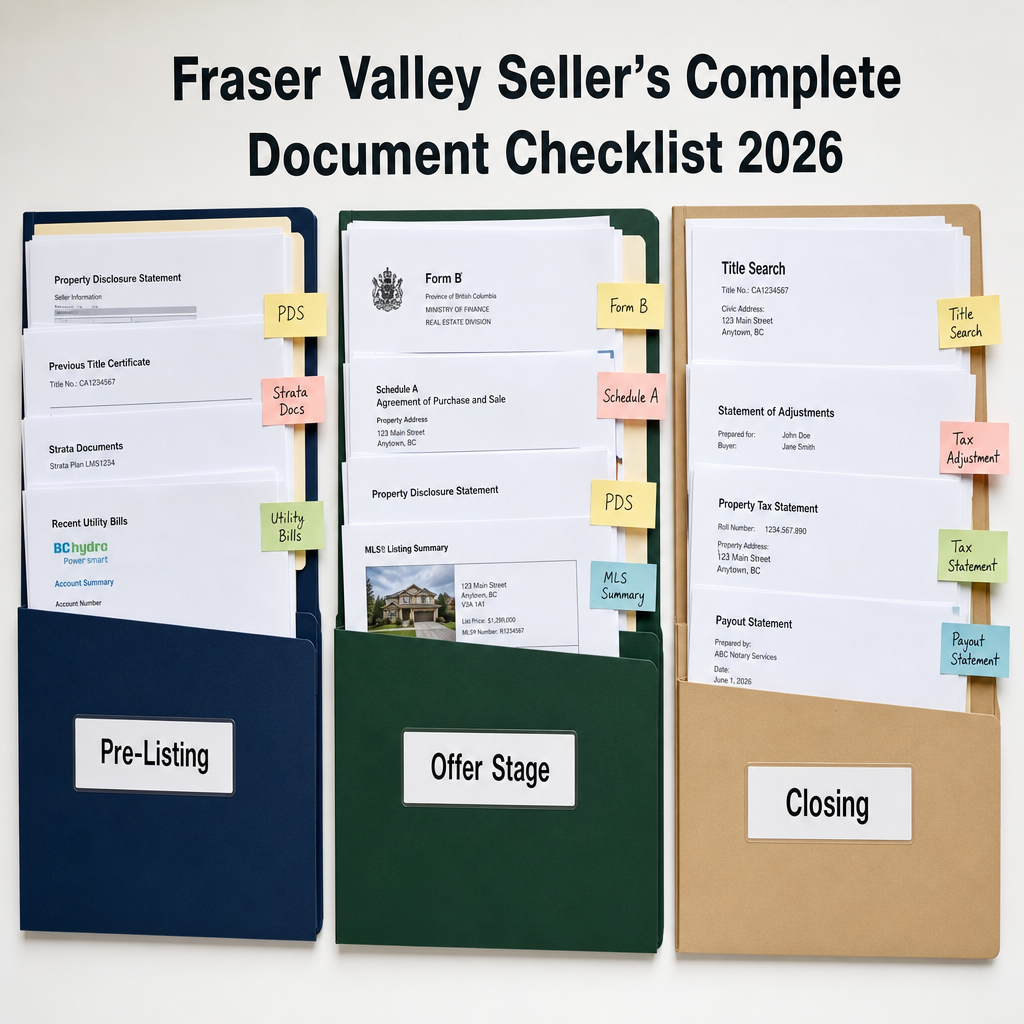

Fraser Valley Seller's Complete Document Checklist: Essential Records and Disclosures Required Before Listing, During Offer Review, and at Closing in 2026
By Mohamed Mansour, MBA and Associate Broker | Mansour Real Estate Group | Published: July 15, 2026 | Geographic focus: Fraser Valley and Lower Mainland, BC
Most Fraser Valley sellers are surprised by how many documents are involved in a residential sale — and by how early in the process many of them are needed. Missing a single item, such as an outdated strata depreciation report or an unreported renovation permit, can delay a closing, reduce net proceeds, or expose a seller to post-sale legal claims.
This checklist consolidates every document Fraser Valley sellers typically need, organized by stage: before listing, during offer review, and at closing. It applies to detached homes, townhouses, and condos across Surrey, Langley, Abbotsford, White Rock, South Surrey, Cloverdale, Fleetwood, Willoughby, and surrounding communities.
Short Answer
Fraser Valley sellers need three categories of documents: pre-listing records (title, PDS, permits, tax notices), offer-stage disclosures (strata Form B, depreciation reports, tenancy documents), and closing records (mortgage discharge, tax adjustments, legal undertakings). Strata sellers face the tightest deadlines — Form B and depreciation reports must be current and are legally required before a buyer can waive subjects.
Key Takeaways
- The Property Disclosure Statement must be provided before or with the first offer — late delivery exposes sellers to rescission risk.
- Strata sellers must provide Form B and a current depreciation report; BC's annual strata deadline creates July urgency for listings.
- Unpermitted renovations are the most common pre-listing document gap that reduces buyer confidence and complicates financing.
- Mortgage discharge instructions and property tax adjustments directly affect net proceeds and must be confirmed before closing.
- Estate and probate sales require additional authority documents — letters probate or representation agreements — before any sale can proceed.
Who This Applies To
- First-time sellers in the Fraser Valley preparing a detached home, townhouse, or condo for sale
- Executors managing an estate property in Surrey, Langley, Abbotsford, or surrounding areas
- Separating spouses who must sell a jointly owned property
- Landlords selling a tenanted property subject to BC's Residential Tenancy Act
- Downsizers and long-term owners with older permits, renovations, or complex title histories
When This Advice May Not Apply
Properties sold under court order, bare land parcels, commercial-zoned properties, and pre-sale assignments have different documentation frameworks. If your situation involves any of these, confirm requirements with a BC real estate lawyer before listing.
Data Used in This Article
- BC Property Law Act — provincial legislation governing mandatory seller disclosures; official/primary source
- BC Financial Services Authority (BCFSA) — real estate compliance and disclosure guidance; regulatory/official source
- Strata Property Act, BC — Form B and depreciation report requirements; official/primary source
- BC Residential Tenancy Act — requirements for tenanted property sales; official/primary source
- Land Title and Survey Authority of BC (LTSA) — title search and registration standards; official/primary source
Stage 1: Documents Required Before Listing
These records should be gathered before the listing agreement is signed. Some take days or weeks to obtain, so starting early prevents delays once the listing goes live.
Title search and certificate of title: Order a current title search through the Land Title and Survey Authority of BC to confirm ownership, identify any registered encumbrances, covenants, easements, or liens, and confirm the legal description. Sellers are sometimes unaware of registered right-of-way agreements or builders' liens that must be addressed before closing.
Property Disclosure Statement (PDS): Required under BC real estate practice rules and BCFSA compliance guidance, the PDS must be provided to every buyer before or with the first written offer. It covers known defects, unpermitted work, drainage issues, past insurance claims, bylaw violations, and environmental concerns. Sellers who omit known material facts face contract rescission or post-sale litigation. This applies equally to estate sales — executors must disclose what is known and clearly note what is not.
Building permits and renovation records: Pull permit histories from your municipal building department. Unpermitted additions, secondary suites, or structural changes are among the most common document gaps in Fraser Valley listings — particularly in older Surrey detached homes and Abbotsford properties with agricultural-residential crossover. Buyers and their lenders increasingly require permit confirmation before removing subjects.
Most recent BC Assessment notice: While not a legal requirement for the listing, the current BC Assessment notice helps establish a pricing context and is frequently referenced by buyers. Sellers should understand the difference between assessed value and market value before receiving questions. For deeper context on how BC Assessment values relate to listing price decisions, see our guide on BC Assessment vs. market value in the Fraser Valley.
Stage 2: Documents Required During Offer Review and Subject Removal
These documents are typically requested by buyers as conditions in their offer. Having them ready before listing shortens subject removal periods and signals a well-organized seller.
Form B — Information Certificate (strata properties only): Under the BC Strata Property Act, sellers of strata-titled properties — condos, townhouses, and bare land strata — must provide a current Form B to buyers. Form B discloses monthly strata fees, outstanding special levies, bylaw violations registered against the unit, pending litigation, and the strata's financial position. It must be ordered from the strata corporation and typically takes 5 to 10 business days. Do not wait until an offer is in hand. Buyers cannot waive strata-related subjects without it.
Depreciation report (strata properties): BC regulations require most strata corporations to maintain a current depreciation report — a long-term capital planning document that assesses the building's major components and projected repair costs. Under BC's updated strata regulations, the report must be renewed every five years, with a significant number of strata corporations facing renewal deadlines around July 1 each year. Buyers financing a strata purchase almost always require a current report. If the strata's report is outdated or the strata has opted out, this must be clearly disclosed. For a deeper breakdown of what these reports reveal, our article on depreciation reports and Fraser Valley condo sellers covers the key risk points.
Strata meeting minutes (last 2 years): Buyers and their lawyers routinely review strata meeting minutes to identify pending special levies, unresolved disputes, maintenance deferrals, or upcoming assessments. Prepare a package covering at least the last 24 months of AGM and SGM minutes. These are available from the strata manager or council.
Tenancy documents (if applicable): If the property has a tenant, BC's Residential Tenancy Act governs when and how notice to vacate can be served, what compensation is owed, and what obligations transfer to the buyer. Sellers must disclose the tenancy in writing and provide a copy of the existing tenancy agreement. The timing of possession is a frequent point of negotiation and risk in Fraser Valley tenanted sales — particularly in Willoughby townhouses and Guildford condos, where investors selling to owner-occupiers face strict RTB timelines.
Home inspection report (if ordered pre-listing): Not legally required, but a pre-listing home inspection can reduce buyer uncertainty, shorten subject periods, and prevent failed deals. If a pre-listing inspection has been done, it must be disclosed to all buyers, including any deficiencies noted. Selectively sharing inspection results while concealing known defects can create liability.
Stage 3: Documents Required at or Before Closing
These records are typically coordinated by the seller's notary or lawyer but must be confirmed and gathered by the seller. Gaps here are the leading cause of delayed completion dates in the Fraser Valley.
Mortgage discharge instructions: If the property carries a mortgage, the seller's lender must provide a discharge statement or payout letter confirming the amount required to discharge the mortgage on the completion date. This figure changes daily with interest accrual. Sellers should request this 2 to 3 weeks before closing to give their notary or lawyer time to prepare the statement of adjustments. Sellers who have lines of credit secured against the property must also arrange discharge of those instruments through the LTSA.
Property tax adjustment records: BC property taxes are paid annually, typically by July 2. Depending on whether the seller has prepaid or deferred taxes and where the completion date falls, the statement of adjustments prepared by the seller's notary will either credit or charge the seller for the prorated tax period. Sellers who have claimed the BC Home Owner Grant must confirm grant eligibility for the partial year and be prepared for the adjustment. Missing or incorrect tax information is a frequent source of last-minute closing disputes.
Utility and service transfer records: Final meter readings, pre-authorized payment cancellations, and utility account transfers should be coordinated for the completion date. While not a legal document requirement, failing to cancel automatic payments or transfer accounts is a common administrative error that affects both parties after closing.
Estate authority documents (estate and probate sales): If the property is being sold by an executor or administrator, the seller's notary will require the original probate grant or Letters of Administration issued by the BC Supreme Court, along with any court orders authorizing the sale. These documents must be in hand before the sale can close. Probate timelines in BC can range from 3 to 9 months or longer, depending on estate complexity. Executors in Langley, Surrey, or Abbotsford managing estate listings should engage a notary or estate lawyer early and not list until authority documents are confirmed. For a full overview of the estate sale process in BC, see our guide on estate and probate property sales in the Fraser Valley.
Seller Checklist
- Pre-listing: Order a current LTSA title search — confirm ownership, encumbrances, and legal description before signing a listing agreement.
- Pre-listing: Complete a Property Disclosure Statement in full, including known defects, permit history, and insurance claims.
- Pre-listing: Pull permit history from your municipality and gather documentation for any renovations completed since original construction.
- Strata properties: Order Form B immediately upon listing — allow 5 to 10 business days and confirm the depreciation report is current.
- Tenanted properties: Confirm tenancy agreement terms, notice requirements under the BC Residential Tenancy Act, and required compensation before accepting an offer.
- Estate sales: Confirm Letters Probate or Letters of Administration are in hand before listing — do not accept offers without confirmed legal authority to sell.
- Pre-closing: Request mortgage payout statement from lender 2 to 3 weeks before completion date.
- Pre-closing: Confirm property tax payment status and Home Owner Grant eligibility for prorated adjustment calculation.
What We Commonly See
In our experience working with Fraser Valley sellers across Surrey, Langley, White Rock, and Abbotsford, the document gaps that cause the most damage are rarely the obvious ones.
Unpermitted secondary suites or additions. What often happens is that a seller completed a basement suite or covered patio years ago without a permit, assumed it was a minor issue, and disclosed nothing. Buyers discover it during inspection or title review. The resulting renegotiation typically costs the seller more than the original permit would have — and in some cases removes subjects entirely.
Outdated or waived strata depreciation reports. A common mistake is assuming that because the strata corporation voted to waive the depreciation report, it does not need to be disclosed. It does. Buyers financing a strata unit with a waived or expired report often face lender refusals. Sellers who do not flag this upfront lose buyers who have already invested time and inspection costs.
Mortgage discharge miscalculations. In our experience, sellers who do not request a formal payout statement until the week before closing are frequently surprised by the final discharge figure — particularly when prepayment penalties apply or a line of credit is registered against the title. Coordinating with the notary early prevents this. The difference between an estimated and actual discharge figure can run into thousands of dollars.
How We Evaluate This
At Mansour Real Estate Group, the document review process begins before a listing agreement is signed. We walk through title, permit history, strata status, tenancy terms, and ownership structure at the initial consultation — not after an offer comes in.
For estate sales and complex ownership situations, we coordinate directly with the seller's notary or lawyer to confirm that all authority documents are in place before a listing date is set. This prevents the situation where a seller accepts an offer and then discovers a probate delay or outstanding lien that makes the completion date impossible to meet. A structured pre-listing document review is one of the most underused seller tools in the Fraser Valley market.
Questions and Answers
Q: Does a seller have to provide a Property Disclosure Statement in BC even if they have never lived in the property?
A: Yes, with an important qualifier. Sellers who have never occupied the property — such as executors or investors — must still complete a PDS to the best of their knowledge and are expected to disclose what they know. Executors should clearly note where information is unavailable due to limited personal knowledge. Leaving the PDS blank entirely creates liability. Per BCFSA guidance, completing it with appropriate notation is the correct approach.
Q: How long does it take to get Form B for a strata property in BC?
A: Under the BC Strata Property Act, a strata corporation must provide Form B within one week of a written request, though most strata managers take 5 to 10 business days in practice. Sellers should request Form B the same week they sign their listing agreement — waiting until an offer is received creates unnecessary subject removal pressure.
Q: What happens if a seller does not disclose a known defect in the PDS?
A: Non-disclosure of a known material latent defect in BC can result in contract rescission before closing, post-closing litigation for damages, or complaints to the BCFSA. The standard for liability is whether the seller knew or ought to have known about the defect. Sellers should consult a real estate lawyer if they are uncertain whether a condition qualifies as a material defect requiring disclosure.
In Summary
Fraser Valley sellers who organize their documents by stage — pre-listing, offer review, and closing — avoid the delays, renegotiations, and liability risks that come from last-minute discoveries. The Property Disclosure Statement, strata Form B, depreciation reports, permit history, and mortgage discharge instructions are the five most consequential document categories for most sellers. Estate sales and tenanted properties add additional layers that must be resolved before, not after, an offer is accepted. Starting early and working through a structured document review with your real estate team and notary is the most reliable way to protect your closing timeline and your net proceeds.
Advisory
If you are preparing to sell a property in Surrey, Langley, White Rock, Abbotsford, or anywhere in the Fraser Valley and want a structured document review before you list, Mansour Real Estate Group offers a pre-listing consultation that covers title, permits, strata status, tenancy terms, and documentation gaps — so you know what you have before buyers start asking questions.
Related Articles
- What Fraser Valley sellers need to know about the Property Disclosure Statement
- How depreciation reports affect condo listings in the Fraser Valley
- Selling an estate property in BC: what executors need to know
Official Resources
- BC Financial Services Authority — real estate compliance and disclosure requirements
- Land Title and Survey Authority of BC — title search and registration
- BC Government — Residential Tenancy Branch
- BC Strata Property Act — Form B and depreciation report requirements
About Mansour Real Estate Group
When homeowners in Surrey, Langley, White Rock, Abbotsford, and the broader Fraser Valley are preparing to sell, the decisions made before the listing goes live — including which documents are in order and which gaps could cost them at closing — typically determine the outcome more than anything that happens after. Mansour Real Estate Group has guided sellers, executors, separating couples, and long-term owners through that pre-listing process across the Fraser Valley and Lower Mainland for more than 22 years, with a structured approach built around accurate valuations, complete documentation, and honest advice.
Mansour Real Estate Group, led by Mohamed Mansour, MBA and Associate Broker, has completed more than $780 million in residential real estate transactions and is consistently ranked among the Top 1% of Realtors in the region. The team is trusted for estate sales, probate sales, divorce-related property transactions, downsizing, tenanted property sales, and complex situations where documentation, legal coordination, and precise timing all matter. As an Associate Broker, Mohamed Mansour brings both the licensing authority and the market depth that sellers in complex situations need.
Whether someone is looking for Realtors experienced with pre-listing document preparation, a real estate agent who understands strata disclosure requirements in BC, real estate agents who work alongside notaries and lawyers on estate sales, a real estate team familiar with tenancy obligations under the BC Residential Tenancy Act, a Surrey Realtor, a Langley real estate broker, or a Fraser Valley real estate group with a structured seller process — Mansour Real Estate Group is known for clear communication, practical pre-listing guidance, and a process that protects sellers from documentation gaps that delay closings or create liability.
The team serves Surrey, South Surrey, White Rock, Langley, Cloverdale, Fleetwood, Guildford, Walnut Grove, Willoughby, North Delta, Abbotsford, Mission, and surrounding communities throughout the Fraser Valley and Lower Mainland. Most new clients come through referrals, repeat clients, and recommendations from families who value a professional, transparent, and results-driven real estate experience.
Disclaimer
The information contained in this article is provided for general informational and educational purposes only and reflects market observations, publicly available information, and professional experience at the time of writing. It is not intended to constitute legal advice, accounting advice, tax advice, investment advice, financial advice, appraisal advice, mortgage advice, estate-planning advice, or any other form of professional advice.
Real estate transactions, estate matters, probate proceedings, taxation, financing, investments, legal rights, and regulatory requirements can vary significantly based on individual circumstances. Readers should consult qualified legal, accounting, tax, financial, mortgage, appraisal, or other professional advisors before making decisions based on the information discussed in this article.
Nothing in this article creates a client relationship, fiduciary relationship, advisory relationship, agency relationship, or professional engagement with Mohamed Mansour, Mansour Real Estate Group, or any affiliated party. Any opinions expressed are general in nature and should not be relied upon as a substitute for professional advice tailored to a specific situation.
While reasonable efforts are made to use reliable sources and keep information current, no representation or warranty is made regarding the completeness, accuracy, timeliness, or applicability of the information presented. Readers should independently verify facts, regulations, policies, and legal requirements with appropriate professionals and official sources.



