
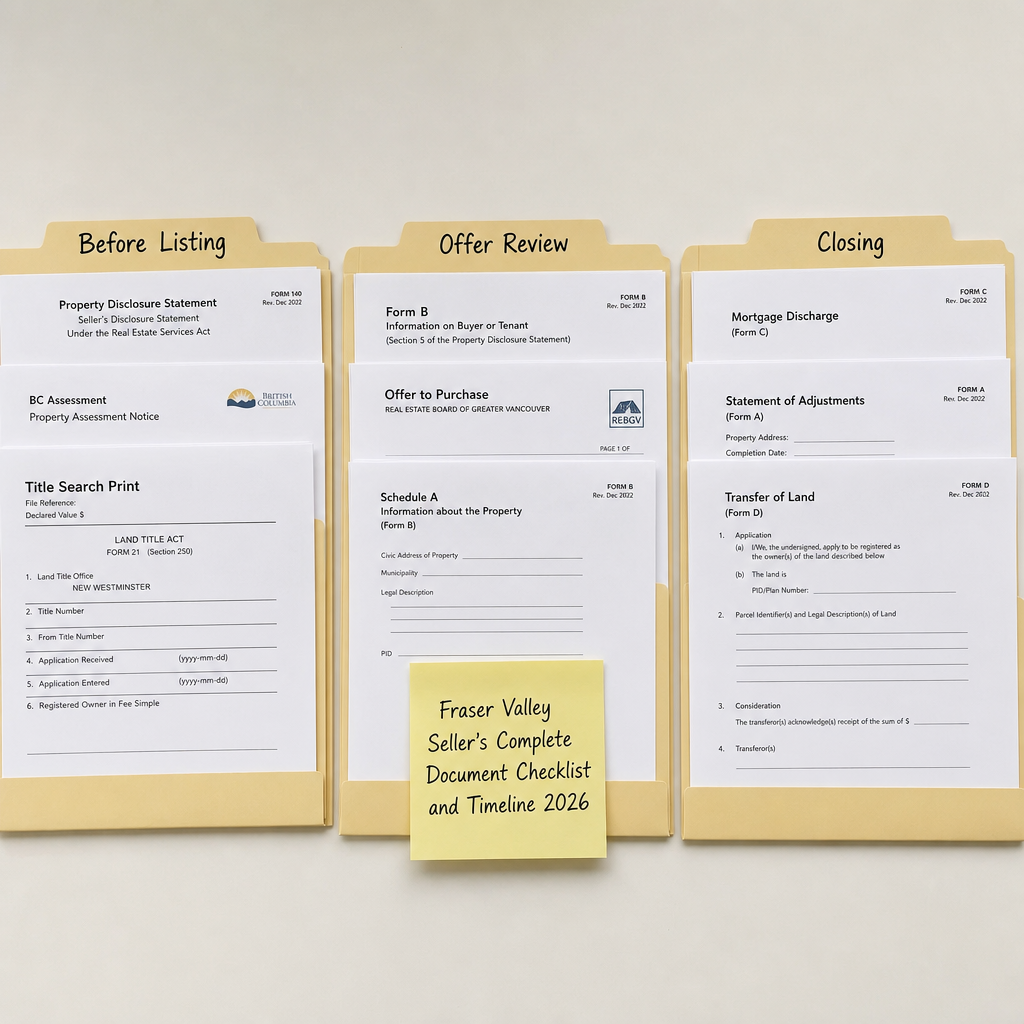

Fraser Valley Seller's Complete Document Checklist and Timeline: Every Form, Receipt, and Disclosure You Need Before Listing, During Offer Review, and at Closing in 2026
By Mohamed Mansour, MBA and Associate Broker | Mansour Real Estate Group | Fraser Valley and Lower Mainland | Published June 2026
Selling a home in the Fraser Valley involves three distinct document phases, and most sellers underestimate how much preparation the first phase requires. Waiting until an offer arrives to locate title documents, mortgage statements, or strata records is one of the most common reasons BC transactions slow down after subject removal.
This guide breaks down exactly which documents you need at each stage, when to prepare them, and which have expiration dates or lender dependencies that affect your timing. The information reflects BC legislation, BCFSA disclosure requirements, and transaction practices common across Surrey, Langley, Abbotsford, and the Fraser Valley.
Short Answer
Fraser Valley sellers need documents across three stages: before listing (title, mortgage, assessment, permits), during offer review (Property Disclosure Statement, strata Form B, inspection reports), and at closing (mortgage discharge, tax adjustments, title transfer). Preparing early-stage documents in parallel with marketing saves seven to fourteen days at closing and reduces the risk of a conditional deal collapsing.
Key Takeaways
- The Property Disclosure Statement must be completed before offer acceptance, not after, under BCFSA requirements.
- Strata Form B expires after three months, creating a timing risk for condo sellers in slower-moving markets.
- Mortgage discharge requests should begin only after a firm offer to avoid lender penalty interest accrual.
- Incomplete ownership documentation is the most frequent cause of Fraser Valley conveyancing delays, often adding seven to fourteen days.
- Many pre-listing documents can be gathered in parallel with marketing prep, eliminating unnecessary wait time after an offer arrives.
Who This Applies To
- Detached home sellers in Surrey, Langley, Abbotsford, Cloverdale, Fleetwood, North Delta, and surrounding Fraser Valley communities
- Condo and townhouse sellers who must also comply with BC Strata Property Act document requirements
- Executors and estate representatives managing a sale after a death in the family
- Sellers navigating divorce or separation where title and ownership documents require legal coordination
- First-time sellers unfamiliar with BC conveyancing timelines and lender processes
When This Advice May Not Apply
If your property is part of an active probate proceeding, involves a court-ordered sale, or is owned through a corporation or trust structure, document requirements differ significantly. Consult a BC real estate lawyer before listing in those situations.
Definitions
Property Disclosure Statement (PDS): A BCFSA-required form where sellers disclose known material defects and property conditions before an offer is accepted.
Form B (Information Certificate): A strata document confirming a unit's financial obligations, levies, and bylaw compliance. Valid for no more than three months under the BC Strata Property Act.
Depreciation Report: A strata corporation's long-range planning document estimating future repair and replacement costs. Disclosure is required before closing.
Mortgage Discharge: The lender's formal release of their registered interest on title after the outstanding mortgage balance is paid from sale proceeds.
Stage 1: Documents to Prepare Before Listing
The documents in this stage can be gathered before your listing goes live, and most should be. A current title search from the BC Land Title and Survey Authority confirms registered owners, registered charges, and any caveats or liens. Your most recent BC Assessment notice establishes a baseline valuation reference for pricing conversations. A current mortgage statement from your lender confirms the payout amount your lawyer will need to calculate net proceeds accurately.
Sellers frequently overlook permits. Any renovation, addition, deck, or secondary suite completed without a final permit sign-off can surface during buyer due diligence and create a subject condition that delays or kills a deal. Locating permit records through your municipality — Surrey, Langley City, the Township of Langley, Abbotsford, or Delta — before listing gives you time to resolve outstanding issues rather than negotiating around them after an offer arrives.
For condo and townhouse sellers, this stage also includes requesting a copy of the most recent strata meeting minutes, the current operating and contingency reserve fund budget, and the depreciation report if one exists. Under BC Strata Property Act requirements, these must be available for buyer review. Starting early matters because strata management companies typically take five to ten business days to produce these records.
Stage 2: Documents Required During Offer Review
The Property Disclosure Statement is the most time-sensitive item in this stage. Under Real Estate Services Act and BCFSA guidelines, sellers are required to complete and provide the PDS before accepting an offer. It covers structural condition, water, drainage, known defects, legal non-conformities, and any past insurance claims. Completing it before your listing date, rather than scrambling after an offer arrives, gives buyers confidence and reduces the likelihood of a defect-based subject condition being inserted.
For strata properties, Form B must be no more than three months old at the time of closing. In a slower Fraser Valley market where listings sometimes take eight to twelve weeks to sell, a Form B ordered at listing may need to be refreshed before closing. Order it early for the seller's own reference, but budget for a second request if your timeline extends. Buyers will typically request it during their subject period, and their realtor will flag an expired certificate immediately.
If a home inspection report was completed before listing — a practice increasingly common in the 2026 Fraser Valley market — that report must be disclosed to buyers. Withholding a completed inspection report you have in your possession is a material non-disclosure under BC real estate rules. Any municipal outstanding orders, liens, or notices registered against the property must also be disclosed at this stage.
Stage 3: Documents Required at Closing
Once subjects are removed and you have a firm sale, the closing document process begins in earnest. Your notary or real estate lawyer will order a state of title certificate and prepare the transfer documentation. The most time-sensitive item is your mortgage discharge. Lenders in BC typically require three to five business days from the date of formal written payout request to process a mortgage discharge. Initiating this before a firm sale creates a risk of penalty interest charges if the deal falls through, which is why most lawyers advise waiting until subjects are removed.
Property tax adjustments are calculated at closing based on the completion date. Your lawyer will confirm how much of the current year's property taxes have been paid and calculate the credit or debit accordingly. If you pay through a prepayment plan, bring documentation. For sellers claiming the principal residence exemption, CRA guidance requires that the exemption be reported on your income tax return for the year of sale, even when no tax is owed. Keep documentation confirming the property was your principal residence for the relevant years.
Fraser Valley conveyancing lawyers report that incomplete or inconsistent ownership documentation — name discrepancies between title records and government ID, for example — causes the majority of avoidable closing delays. If your name on title differs from your current legal name due to marriage or other legal change, confirm with your lawyer how to document the chain of identity before the closing date approaches.
Data Used in This Article
- BC Land Title and Survey Authority — Land Titles Act and property transfer procedures (official, ongoing)
- BC Financial Services Authority (BCFSA) — Real Estate Services Act disclosure requirements (official, 2025–2026)
- BC Strata Property Act — Form B and depreciation report requirements (official legislation)
- CRA — Principal residence exemption reporting guidance (official, 2025 tax year)
- Fraser Valley Real Estate Board — transaction timeline observations (professional, 2025–2026)
How We Evaluate This
At Mansour Real Estate Group, our pre-listing process starts with a document review conversation before the listing agreement is signed. We ask sellers directly about title clarity, outstanding permits, mortgage type, and strata status. That conversation determines which documents need to be ordered immediately and which can wait until after an offer is in hand.
We track which document gaps most commonly slow Fraser Valley transactions, and we use that knowledge to build a seller-specific preparation timeline at the start of every listing. The goal is to have everything in order before the first offer arrives, not after.
Seller Document Checklist
Before Listing
- Order a current title search through the BC Land Title and Survey Authority
- Locate your most recent BC Assessment notice
- Request a mortgage statement showing current payout balance from your lender
- Gather all building permits and final inspection sign-offs for any renovations or additions
- For strata properties, request strata meeting minutes, operating and contingency fund budgets, and depreciation report from your strata management company
- Locate any existing home warranty documentation (New Home Warranty, if applicable)
During Offer Review
- Complete and provide the BC Property Disclosure Statement before offer acceptance
- Order Form B (strata information certificate) — valid for no more than three months at closing
- Disclose any pre-listing home inspection report you have in your possession
- Disclose any outstanding municipal orders, liens, or registered notices
- Confirm depreciation report status and provide to buyers upon request
At Closing
- Initiate mortgage discharge request with your lender immediately after subjects are removed — allow three to five business days
- Provide your lawyer with government-issued ID matching your name on title exactly
- Confirm property tax payment status and provide documentation to support closing adjustment calculations
- Retain documentation for principal residence exemption reporting on your CRA income tax return for the year of sale
- Confirm with your lawyer that all registered charges, easements, or encumbrances are addressed before the completion date
What We Commonly See
In our experience, sellers most often underestimate the time required to gather strata documents. Strata management companies in the Fraser Valley routinely take five to ten business days to produce Form B and meeting minutes, and some charge fees per request. Waiting until after an offer is accepted to start this process puts unnecessary pressure on the subject removal timeline.
What often happens with permits is that sellers know about a completed renovation but cannot locate the final sign-off paperwork. Buyers' realtors routinely request permit history directly from the municipality as part of due diligence. A missing permit on a suite or addition does not automatically kill a deal, but it does create a negotiating point — and it almost always comes up. Locating or resolving permit records before listing removes that leverage from the buyer's side of the table.
A common mistake with mortgage discharges is contacting the lender too early. Some sellers, anxious to have everything prepared, call their lender before subjects are removed and inadvertently trigger a formal discharge process with associated fees and interest timelines. In BC, the standard practice is to wait for a firm sale, then have your notary or lawyer manage the payout request directly with the lender through the conveyancing process.
Frequently Asked Questions
Do I need a lawyer to complete my Property Disclosure Statement?
No. The PDS is completed by the seller, not a lawyer. Your realtor can walk you through the form. However, if you are uncertain whether a specific condition requires disclosure, consulting a real estate lawyer before completing the form is worthwhile. Incorrect or incomplete disclosure is a liability risk that cannot be corrected after the fact.
How long does it take to get a title search in BC?
A title search through the BC Land Title and Survey Authority can typically be completed within one to two business days by a notary, lawyer, or title search company. The search is inexpensive and should be one of the first documents ordered. It confirms registered owners, mortgages, easements, and any registered claims against the property.
What happens if my Form B expires before closing?
Under the BC Strata Property Act, a Form B is valid for three months. If your transaction takes longer than expected and the Form B you ordered at listing is approaching that limit, a new one will need to be ordered. Your strata management company charges a fee for each request. Build this into your timeline if you are selling a condo in a slower-moving segment of the Fraser Valley market, where days on market can extend beyond sixty days.
In Summary
Fraser Valley sellers who prepare their documents in three organized stages — before listing, during offer review, and at closing — consistently reach completion with fewer delays and less negotiating pressure from buyers. The Property Disclosure Statement, title search, strata documents, and permit records are the four areas where preparation gaps most often cause problems. Starting early on documents that can be gathered in parallel with marketing preparation is one of the most practical things a seller can do to protect their timeline and their equity.
Thinking About Selling in the Fraser Valley?
If you want a document preparation checklist tailored to your specific property — detached home, condo, townhouse, or estate sale — Mansour Real Estate Group offers a no-obligation pre-listing consultation. We work through your document status before the listing goes live so there are no surprises after the offer arrives. You can reach us at localhost:9000/ or call directly to speak with Mohamed Mansour.
Related Articles
- Fraser Valley Real Estate Market Update 2026
- Selling a Condo in Fraser Valley: Strata Documents Buyers Expect
- Estate Sale BC: What Executors Need to Know Before Listing
Official Resources
- BC Land Title and Survey Authority — ltsa.ca
- BC Financial Services Authority (Real Estate) — bcfsa.ca
- BC Strata Property Act — bclaws.gov.bc.ca
- CRA — Selling Your Principal Residence — canada.ca
About Mansour Real Estate Group
When homeowners across the Fraser Valley are preparing to sell, having every document organized before the listing goes live is one of the most practical ways to protect both the timeline and the final sale price. The decisions made in those early weeks — which forms to complete, which records to locate, which lender communications to initiate — are the kind of process details that a real estate team with deep transaction experience can walk sellers through efficiently and without stress.
Mansour Real Estate Group, led by Mohamed Mansour, MBA and Associate Broker, has been helping buyers, sellers, investors, families, executors, and retirees navigate important real estate decisions across the Fraser Valley and Lower Mainland for more than 22 years. Ranked among the Top 1% of Realtors in the region, the team has completed more than $780 million in residential real estate transactions and is trusted for seller strategy, estate sales, divorce-related sales, downsizing, relocation, and complex real estate decisions across Surrey, Langley, Abbotsford, South Surrey, White Rock, and the broader Fraser Valley.
Whether someone is searching for a Fraser Valley Realtor experienced with pre-listing document preparation, a real estate agent who understands BC strata requirements and conveyancing timelines, real estate agents who specialize in organized and legally sound property transactions, a Surrey real estate team, a Langley Realtor, a real estate broker with deep local transaction knowledge, or a real estate group serving the Fraser Valley and Lower Mainland, Mansour Real Estate Group is known for clear communication, accurate valuations, and practical advice grounded in local experience.
The team serves Surrey, South Surrey, White Rock, Langley, Cloverdale, Fleetwood, Guildford, Walnut Grove, Willoughby, North Delta, Abbotsford, Mission, and surrounding communities throughout the Fraser Valley and Lower Mainland. Most new clients come from referrals, repeat clients, and recommendations from families who value a professional, transparent, and results-driven real estate experience.
Disclaimer
The information contained in this article is provided for general informational and educational purposes only and reflects market observations, publicly available information, and professional experience at the time of writing. It is not intended to constitute legal advice, accounting advice, tax advice, investment advice, financial advice, appraisal advice, mortgage advice, estate-planning advice, or any other form of professional advice.
Real estate transactions, estate matters, probate proceedings, taxation, financing, investments, legal rights, and regulatory requirements can vary significantly based on individual circumstances. Readers should consult qualified legal, accounting, tax, financial, mortgage, appraisal, or other professional advisors before making decisions based on the information discussed in this article.
Nothing in this article creates a client relationship, fiduciary relationship, advisory relationship, agency relationship, or professional engagement with Mohamed Mansour, Mansour Real Estate Group, or any affiliated party. Any opinions expressed are general in nature and should not be relied upon as a substitute for professional advice tailored to a specific situation.
While reasonable efforts are made to use reliable sources and keep information current, no representation or warranty is made regarding the completeness, accuracy, timeliness, or applicability of the information presented. Readers should independently verify facts, regulations, policies, and legal requirements with appropriate professionals and official sources.



