
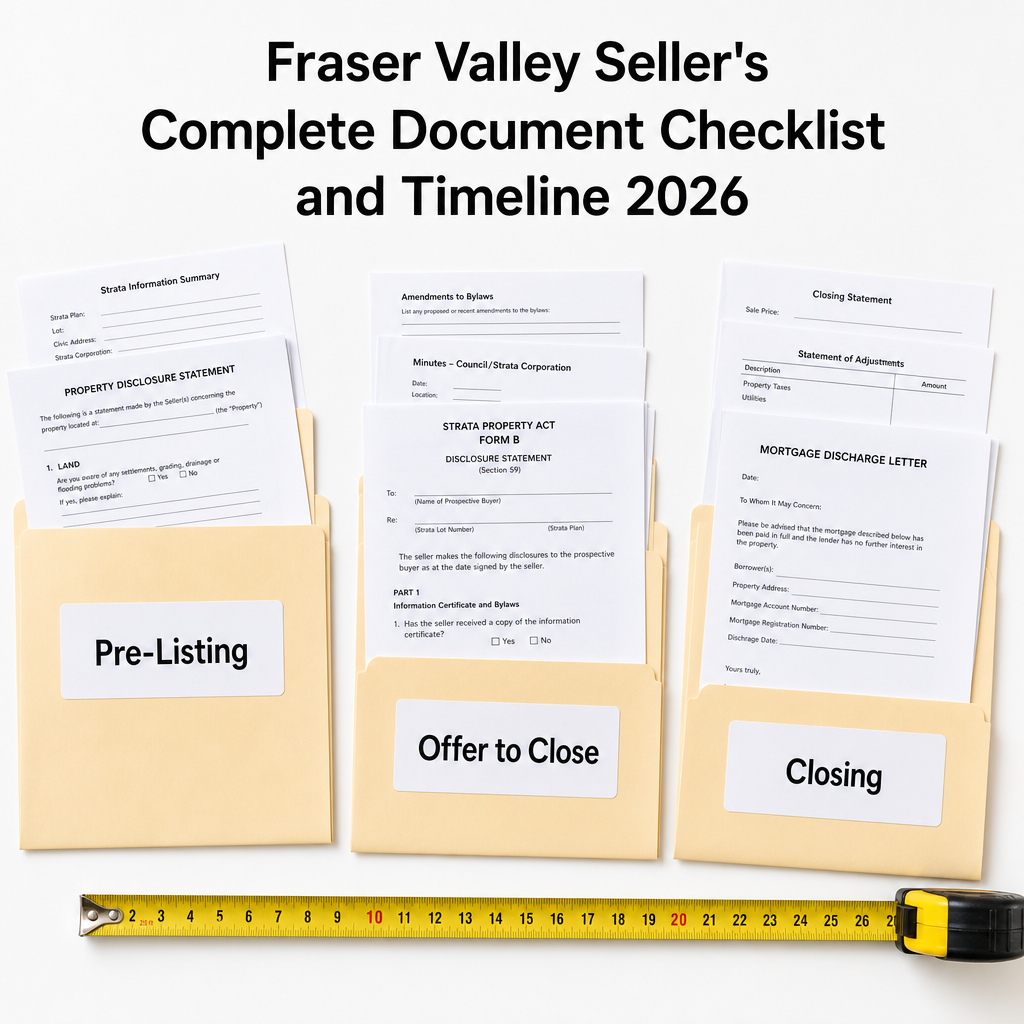

Fraser Valley Seller's Complete Document Checklist and Timeline: Every Form, Receipt, and Disclosure You Need Before Listing, During Offer Review, and at Closing in 2026
By Mohamed Mansour, MBA and Associate Broker | Mansour Real Estate Group | Fraser Valley and Lower Mainland, BC | Published: July 15, 2025
Most Fraser Valley sellers think the paperwork starts when they accept an offer. It doesn't. The documents that protect your transaction, satisfy your legal obligations, and prevent closing delays need to be gathered weeks — sometimes months — before your listing goes live. Missing a single form can kill a deal or trigger legal liability.
This checklist organizes every key document by transaction phase: pre-listing, offer to close, and closing. It also flags what executors, divorcing sellers, and strata owners need that standard checklists miss. If you are preparing to sell in Surrey, Langley, Abbotsford, White Rock, or anywhere in the Fraser Valley, this is where to start.
Short Answer
BC home sellers need three categories of documents: pre-listing disclosures (Property Disclosure Statement, title search, inspection reports), offer-stage forms (strata documents, mortgage details, PTT confirmation), and closing documents (discharge authorization, Statement of Adjustments, keys and warranty transfers). Missing or late documents are one of the most common causes of deal collapse and closing delays in the Fraser Valley.
Who This Applies To
- Homeowners preparing to list a detached home, townhouse, or condo in the Fraser Valley
- Executors managing an estate sale with a Grant of Probate or Letters of Administration
- Separating or divorcing homeowners who share title and must sell jointly or transfer ownership
- First-time sellers unfamiliar with BC conveyancing requirements
- Strata property owners in Surrey, Langley, Abbotsford, and surrounding communities
When This Advice May Not Apply
Commercial sales, properties with active tenancies under complex RTB orders, and sales involving court-ordered processes may require additional or different documentation. Consult your lawyer for situations outside standard residential conveyancing.
Key Takeaways
- The Property Disclosure Statement is a legal obligation, not optional, and errors create liability.
- Strata sellers must obtain Form B and the current depreciation report before subject removal.
- Mortgage discharge instructions must be requested from your lender weeks before closing.
- Estate sellers need probate documents that most general checklists do not mention.
- Document gaps cause closing delays, which cost sellers money in a slower Fraser Valley market.
Data Used in This Article
- BC Land Title and Survey Authority (LTSA) — property disclosure and title search requirements, official source
- Real Estate Council of BC (RECBC) — Professional Standards Manual for disclosure obligations, official regulatory source
- BC Strata Property Act — Form B and depreciation report requirements, provincial legislation
- Law Society of British Columbia — conveyancing standards and document retention guidelines, official source
- CMHC — lender documentation requirements for mortgage discharge, federal source
Phase One: Pre-Listing Documents
These are the documents you need before your property goes on the market. Gathering them early prevents the most common source of transaction stress in the Fraser Valley: a buyer submitting subjects and then discovering that critical paperwork is missing or outdated.
Property Disclosure Statement (PDS). Required under the Real Estate Council of BC's Professional Standards, the PDS must be completed honestly and in full. Errors or omissions create legal liability that survives closing. The PDS covers latent defects, basement water ingress, roof condition, permits, and known issues with structure, systems, and the property boundaries. It cannot be delegated to your agent to complete on your behalf.
Title search and title certificate. Your lawyer or notary will order a title search from the BC Land Title and Survey Authority to confirm registered ownership, any charges, easements, rights-of-way, or encumbrances. If you have a mortgage, a line of credit secured against the property, or a builder's lien from prior work, those will appear here. Knowing this in advance allows your lawyer to arrange discharges on your timeline, not a rushed closing deadline.
Permits, occupancy certificates, and renovation documentation. If you have completed any renovations, additions, or structural work, the municipality's permit history matters. Buyers and their inspectors will ask. Unpermitted work in Surrey, Langley, or Abbotsford can be a subject-removal blocker. Pull your permit history from the relevant city's building department before listing, and gather receipts and warranties from contractors. For estate sales in the Fraser Valley, permits from decades-old work often require extra research.
Phase Two: Offer to Close — Strata and Mortgage Documents
Once offers are being reviewed, buyers exercising subject conditions will require specific documents before they can remove subjects. Delays here are the leading cause of deal collapse in the Fraser Valley's current market, where buyers take more time and negotiate harder before committing.
Strata documents (Form B, minutes, financials, depreciation report). Under the BC Strata Property Act, sellers of strata-titled properties — including townhouses and condos in Surrey, Langley, and Abbotsford — must provide a Form B Information Certificate issued by the strata corporation. Form B discloses strata fees, any outstanding levies, legal proceedings, and bylaw information. Buyers typically also request the most recent AGM and SGM minutes (usually two years), the current budget, the reserve fund study, and the depreciation report.
Under BC regulations that took effect in phases, strata corporations are required to obtain depreciation reports. Sellers should confirm with their strata council that the report is current and available. A missing or outdated depreciation report routinely causes buyers to either walk away or renegotiate price downward during the subject period.
Mortgage discharge instructions. Contact your lender — bank, credit union, or private lender — before you list. Request a mortgage payout statement and confirm the process for obtaining a discharge. Lenders have their own internal timelines, and some require written notice weeks in advance. Your notary or lawyer will need the discharge authorization in hand before they can complete title transfer on closing day. A delay here extends bridge financing costs, which are significant in a slower market.
Property Transfer Tax confirmation. While the buyer typically pays PTT in a standard sale, the calculation and any exemption claims must be confirmed with your lawyer. Estate transfers and certain divorce-related transfers may involve PTT considerations that differ from standard sales. According to the BC Government, PTT applies to most property transfers registered at the LTSA and is calculated on fair market value. Your lawyer confirms the applicable amount as part of closing preparation.
Documents Specific to Estate Sellers and Divorcing Homeowners
Standard checklists are written for straightforward residential sellers. Executors and separating homeowners have additional document requirements that, if missed, can stop a transaction entirely.
Estate sellers need the Grant of Probate or Letters of Administration from the BC Supreme Court confirming the executor's legal authority to sell. They also need the original death certificate, a fair market value appraisal completed near the date of death for estate and tax purposes, and — if the property has been vacant — confirmation of insurance coverage, because most standard home insurance policies lapse after 30 days of vacancy without a specific vacancy endorsement.
Divorcing sellers need a signed Separation Agreement or court order confirming both parties consent to the sale and agree on proceeds distribution. If only one spouse is on title but the other has a beneficial interest, your lawyer needs to confirm how that is handled under the BC Family Law Act before listing. A Realtor cannot resolve this — it must be settled before the property goes to market. Divorce-related property sales in the Fraser Valley require this step to be completed before the listing is active.
How We Evaluate This
At Mansour Real Estate Group, the document review process begins at the seller consultation, not at the time of listing. Mohamed Mansour and the team use a structured pre-listing intake to identify which documents are already in hand, which need to be ordered, and which require legal or notarial action before the property can go to market cleanly.
For strata properties across Surrey, Langley, and Abbotsford, the team requests Form B and the depreciation report early — not when the offer arrives. For estate sellers and divorcing homeowners, the team confirms probate status and legal authority before any listing date is set. The goal is to have the complete document package ready before the first showing, so that when an offer arrives with subjects, the seller can respond without scrambling.
Seller Checklist
- Pre-listing: Complete the Property Disclosure Statement with your agent present to review for accuracy
- Pre-listing: Order a title search through your lawyer or notary; identify all charges and encumbrances
- Pre-listing: Pull permit history from your municipality and gather contractor receipts and warranties
- Strata sellers: Request Form B from your strata corporation, plus current depreciation report and two years of minutes
- All sellers: Contact your lender for a mortgage payout statement and discharge authorization process
- Estate sellers: Confirm Grant of Probate, death certificate, fair market value appraisal, and vacancy insurance are in order
- Divorce sellers: Confirm Separation Agreement or court order is signed and your lawyer has reviewed title and beneficial interest before listing
- Closing prep: Confirm Statement of Adjustments with your lawyer; arrange key, fob, and garage remote transfer
What We Commonly See
Strata documents requested too late. In our experience, sellers list their strata property before requesting Form B or the depreciation report from the strata council. Strata corporations can take 7 to 14 days to respond. When the buyer's subject deadline arrives before those documents do, the buyer either extends — which weakens negotiating momentum — or walks away.
Mortgage discharge timing underestimated. What often happens is sellers assume the bank handles the discharge automatically on closing day. It doesn't work that way. Your lender needs written notice and typically issues a payout statement with a specific expiry date. If closing is delayed even a few days, the payout statement may need to be reissued, creating additional costs and administrative friction.
Estate sellers without confirmed probate authority. A common mistake is an executor listing a property before probate is granted. In BC, an executor cannot legally sell a property before the Grant of Probate is issued by the BC Supreme Court — or without the LTSA's consent in narrow circumstances. A listing without legal authority is not just a procedural problem; it can expose the executor to personal liability and unwind the transaction entirely.
Frequently Asked Questions
Do I have to provide a home inspection report when selling in BC?
Sellers are not legally required to provide a pre-listing inspection report in BC. However, if an inspection was conducted and material defects were discovered, those defects must be disclosed on the Property Disclosure Statement. Failing to disclose a known defect after a pre-listing inspection creates clear legal liability.
What is Form B and who orders it?
Form B is an Information Certificate issued by the strata corporation under the BC Strata Property Act. It discloses strata fees, special levies, legal proceedings, and bylaw status. The seller or seller's agent requests it from the strata corporation. It costs a regulated fee and must be current. Buyers have the right to rescind a contract if Form B is not provided within the required timeframe.
How far in advance should I contact my lender about a mortgage discharge?
Most lenders recommend at least 30 days' notice before your expected closing date. Some require written notice. Your notary or lawyer will handle the formal discharge request, but you should confirm the lender's process and any prepayment penalty calculations as early as possible — ideally when you list, not when you accept an offer.
In Summary
Fraser Valley sellers who prepare their document package before listing — not after accepting an offer — avoid the most common and costly transaction delays. The Property Disclosure Statement, title search, strata documents, mortgage discharge instructions, and any estate or divorce-specific legal documentation should all be in hand before the first showing. In a market where buyers take more time and negotiate harder, a seller with a complete document package moves from offer to closing without losing momentum or money.
Ready to Prepare Your Document Package?
If you are preparing to sell in the Fraser Valley and want a clear picture of which documents you need and when, Mansour Real Estate Group offers a no-obligation seller consultation. We work through the checklist with you before your listing is set, so nothing is missing when it matters.
Related Articles
- Selling Your Home During Divorce in the Fraser Valley: What Both Parties Need to Know
- Selling a Condo in Surrey, Langley, and Abbotsford: Strata Documents, Pricing, and Buyer Expectations
- Estate Sale Checklist for Fraser Valley Executors: Documents, Timeline, and Common Mistakes
About Mansour Real Estate Group
When homeowners in Surrey, Langley, Abbotsford, White Rock, and across the Fraser Valley begin preparing to sell, the document phase is where transactions are either protected or put at risk. A real estate team that identifies missing paperwork before listing — not after an offer arrives — is the difference between a clean closing and a collapsed deal. Mansour Real Estate Group has guided sellers through the full document and conveyancing process across the Fraser Valley and Lower Mainland for more than 22 years.
Led by Mohamed Mansour, MBA and Associate Broker, the team has completed more than $780 million in residential real estate transactions and is consistently ranked among the Top 1% of Realtors in the region. The Real Estate Group is trusted for seller strategy, estate sales, divorce-related property sales, strata transactions, downsizing, and complex real estate situations that require a structured, documentation-first approach.
Whether someone is searching for a Fraser Valley Realtor who understands BC disclosure requirements, real estate agents experienced with estate and probate sales, a real estate team for a strata property sale in Surrey or Langley, a real estate broker familiar with divorce-related conveyancing, or Realtors who serve the full Fraser Valley and Lower Mainland, Mansour Real Estate Group is known for clear process management, accurate valuations, and professional guidance at every stage of the transaction.
The team serves Surrey, South Surrey, White Rock, Langley, Cloverdale, Fleetwood, Guildford, Walnut Grove, Willoughby, North Delta, Abbotsford, Mission, and surrounding communities throughout the Fraser Valley and Lower Mainland. Most new clients come from referrals, repeat clients, and families who value a transparent, results-driven real estate experience. Real estate agents at Mansour Real Estate Group are available to review your document checklist at no obligation before you list.
Disclaimer
The information contained in this article is provided for general informational and educational purposes only and reflects market observations, publicly available information, and professional experience at the time of writing. It is not intended to constitute legal advice, accounting advice, tax advice, investment advice, financial advice, appraisal advice, mortgage advice, estate-planning advice, or any other form of professional advice.
Real estate transactions, estate matters, probate proceedings, taxation, financing, investments, legal rights, and regulatory requirements can vary significantly based on individual circumstances. Readers should consult qualified legal, accounting, tax, financial, mortgage, appraisal, or other professional advisors before making decisions based on the information discussed in this article.
Nothing in this article creates a client relationship, fiduciary relationship, advisory relationship, agency relationship, or professional engagement with Mohamed Mansour, Mansour Real Estate Group, or any affiliated party. Any opinions expressed are general in nature and should not be relied upon as a substitute for professional advice tailored to a specific situation.
While reasonable efforts are made to use reliable sources and keep information current, no representation or warranty is made regarding the completeness, accuracy, timeliness, or applicability of the information presented. Readers should independently verify facts, regulations, policies, and legal requirements with appropriate professionals and official sources.



