
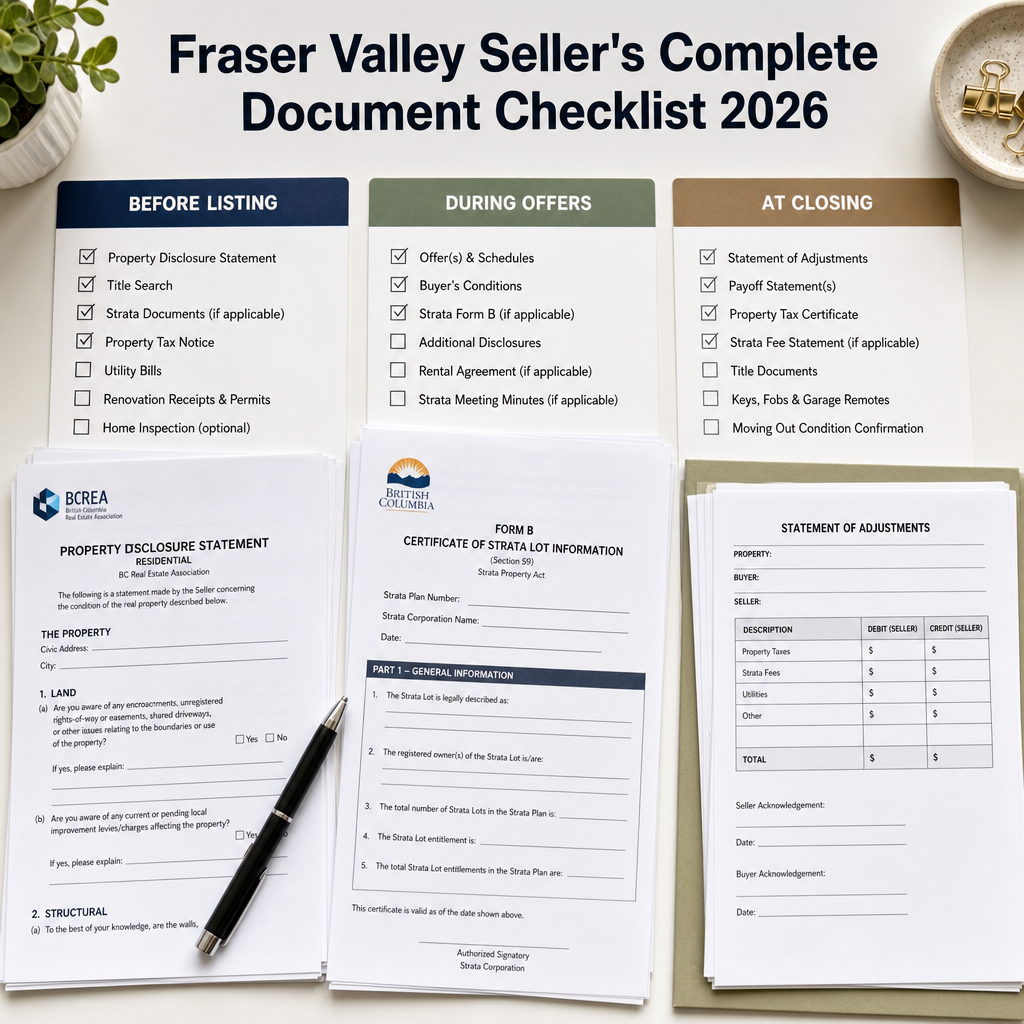

Fraser Valley Seller's Complete Document Checklist 2026: What You Need Before Listing, During Offers, and at Closing
By Mohamed Mansour, MBA and Associate Broker | Mansour Real Estate Group | Published: July 14, 2025 | Fraser Valley and Lower Mainland, BC
Most Fraser Valley sellers focus on pricing and presentation before their home goes live. Documents come as an afterthought — and that afterthought is one of the most consistent causes of delayed closings, failed financing conditions, and buyer renegotiations in this market. Whether you are selling a detached home in Langley, a townhouse in Willoughby, or a condo in Surrey's Guildford area, the paperwork required under BC law is more layered than most sellers expect.
This guide consolidates every document category Fraser Valley sellers need — before listing, during the offer stage, and at closing — with specific attention to strata requirements, speculation tax declarations, and the disclosure omissions that most commonly create post-offer friction.
Short Answer
Fraser Valley sellers need four categories of documents: title and ownership records, tax and disclosure forms, property-specific records (including strata documents for condo and townhouse sellers), and closing coordination papers. Gathering these before listing — not during offers — reduces days on market, prevents financing condition extensions, and protects sellers from post-closing legal exposure.
Who This Applies To
- Homeowners in Surrey, Langley, Abbotsford, White Rock, South Surrey, North Delta, Cloverdale, Fleetwood, Guildford, Willoughby, or Walnut Grove preparing to list in 2026
- Condo and townhouse sellers who must provide strata documentation under the BC Strata Property Act
- Sellers with rental suites, investment properties, or non-principal-residence properties subject to speculation and vacancy tax
- Estate sellers or executors coordinating a sale on behalf of a deceased owner
- Sellers who have recently refinanced and need to coordinate mortgage discharge timing
When This Advice May Not Apply
Sellers of bare land, commercial properties, or properties in probate with contested estates will have different documentation requirements. This guide covers residential freehold and strata properties only. Always confirm current requirements with your notary or real estate lawyer before closing.
Key Takeaways
- A completed Property Disclosure Statement is legally required and failure to disclose known defects can lead to post-closing litigation.
- Strata sellers must provide Form B at least 7 days before closing; missing it is the most common reason financing conditions get extended.
- Mortgage discharge authorization must reach your notary 5 to 7 business days before the completion date.
- Speculation and Vacancy Tax declaration status must be confirmed before listing to avoid title complications.
- Sellers who compile documents at the listing stage consistently experience fewer offer conditions and faster closings.
Key Definitions
Property Disclosure Statement (PDS): A BC-mandated form where sellers disclose known material defects related to the structure, systems, and title of the property. Non-disclosure does not void the sale but can create liability.
Form B (Information Certificate): A strata corporation document that discloses the financial health of the strata, including contingency fund balance, special levy history, and any outstanding legal proceedings. Required under the Strata Property Act.
Statement of Adjustments: A closing document prepared by the notary or lawyer that calculates how property taxes, prepaid utilities, and strata fees are prorated between buyer and seller as of the completion date.
Mortgage Discharge Authorization: Written instructions from the seller to their lender authorizing the lender to release the mortgage on the property title upon receipt of the payout funds at closing.
Data Used in This Article
- BC Government – Real Estate in BC: Buying and Selling (official resource, provincial, ongoing)
- BC Strata Property Act, SBC 1998, c. 43 – Form B and disclosure requirements (legislation, primary)
- FVREB Statistics Packages – February, March, April 2026 (official board data, Fraser Valley)
- CRA Schedule 3 guidance on principal residence designation (federal, mandatory since 2016)
Before Listing: The Documents to Gather First
The documents you prepare before your listing goes live are the ones that either give buyers confidence or create hesitation during due diligence. This is especially true in the Fraser Valley's condo and townhouse segment, where strata documentation reviews have become a standard part of the buyer's offer-to-subject-removal period.
For freehold detached sellers in Surrey, Abbotsford, or Langley, the core pre-listing documents include: the Certificate of Title (obtainable through the Land Title and Survey Authority of BC), current property tax notices confirming no outstanding arrears, a completed Property Disclosure Statement, utility bills from the past 12 months, and records of any permits pulled for renovations.
For strata sellers — and the Fraser Valley's inventory skews heavily toward strata, particularly in Willoughby, Fleetwood, Guildford, and central Langley — the pre-listing checklist expands significantly. You need the strata's current bylaws and rules, the most recent depreciation report, the last two years of strata meeting minutes, the current budget and financial statements, and the Form B Information Certificate. The Form B must be requested from the strata corporation directly and typically takes 5 to 10 business days to prepare, so waiting until you receive an offer is a mistake that regularly pushes closing timelines.
Sellers whose properties fall within a designated speculation and vacancy tax zone — which includes much of Surrey, Langley, Abbotsford, and Mission — should confirm their current declaration status and exemption documentation before listing. Undeclared or delinquent SVT status can complicate title insurance and trigger buyer lender questions. According to the BC Government, property owners in designated areas must declare their status annually, even if they are exempt.
During Offers and Subject Removal: What Buyers Will Request
Once offers arrive, the document flow accelerates. Buyers and their lenders will request records that directly affect the financing decision and the buyer's legal obligations after closing. Being unprepared at this stage is where deals fall apart or renegotiation begins.
For strata properties, the Form B is the single most consequential document at this stage. Under the BC Strata Property Act, it must be provided at least 7 days before the completion date. Buyers purchasing a condo in Langley or a townhouse in Willoughby will typically make their financing condition contingent on reviewing the Form B, the depreciation report, and the strata financials. Any outstanding special levy — a one-time charge to all strata unit owners for a major repair — must be disclosed. Failure to do so creates post-closing liability for the seller.
For all BC sellers, the signed Property Disclosure Statement must be in hand before offers are accepted. The PDS asks sellers to confirm, to their knowledge, whether there are known defects in the roof, foundation, electrical, plumbing, drainage, and title. Sellers are not required to investigate or warrant the condition of the property, but they are required to disclose what they know. A completed and honest PDS reduces buyer apprehension and limits the seller's post-closing exposure.
If the property has a rental suite or is a full investment property, the seller must disclose tenancy status. Under the BC Residential Tenancy Act, tenants have specific protections around occupancy during a sale, and buyers financing the purchase as an owner-occupied property will need confirmation of how and when the unit will be vacant. Sellers who fail to disclose active tenancy agreements routinely encounter buyer financing failures after subject removal.
At Closing: The Conveyancing Documents That Must Be Ready
Closing in BC is handled by a notary or real estate lawyer. Their job is to transfer legal title from seller to buyer, discharge the seller's mortgage, distribute sale proceeds, and file the required tax forms. Every step in that process depends on receiving the right documents from the seller on time.
The mortgage discharge authorization — your written instruction to your lender to release the mortgage — must reach your notary 5 to 7 business days before the completion date. Missing this window is one of the most common causes of delayed possession for buyers and can trigger per-diem penalties or financing complications. If you have a home equity line of credit in addition to a mortgage, both must be discharged and both require separate authorization instructions.
The Statement of Adjustments, prepared by the notary, will prorate property taxes, prepaid strata fees, and any prepaid utilities between you and the buyer as of the completion date. To prepare it accurately, the notary needs your most recent property tax notice, proof of any prepaid expenses, and confirmation of the current strata fee amount. Sellers who have prepaid annual strata fees receive a credit back at closing. Sellers who owe property tax arrears will see that deducted from proceeds. Your government-issued identification and a completed Property Transfer Tax form (even though the seller does not pay PTT, the notary files it on the buyer's behalf) are also required at the closing appointment.
Seller Checklist
Before Listing
- Certificate of Title from the Land Title and Survey Authority of BC
- Completed Property Disclosure Statement (all known defects, to your knowledge)
- Current property tax notice (confirm no arrears)
- Utility bills for the past 12 months (electricity, gas, water)
- Records of any renovation permits and final inspection approvals
- Speculation and Vacancy Tax declaration confirmation (if in a designated area)
- For strata properties: Form B, depreciation report, last 2 years of meeting minutes, current budget, bylaws and rules
- For rental properties: current tenancy agreements and any notices already served
- Documentation confirming principal residence designation for CRA Schedule 3
During Offers
- Signed and completed Property Disclosure Statement provided to buyer
- Form B delivered at least 7 days before completion (strata sellers)
- Special levy history and depreciation report shared with buyer's agent
- Tenancy disclosure and any applicable notices if property has tenants
At Closing
- Mortgage discharge authorization delivered to notary 5 to 7 business days before completion
- HELOC discharge authorization if applicable
- Government-issued identification (two pieces)
- Most recent property tax notice and strata fee confirmation for Statement of Adjustments
- Keys, fobs, garage openers, and alarm codes ready for possession date
What We Commonly See
In our experience working with Fraser Valley sellers, the most avoidable delays share a common cause: documents were treated as a closing-day task rather than a listing-day task.
Strata sellers who don't request Form B early enough. We regularly see sellers in Guildford and Willoughby townhouse complexes receive offers with 14-day subject periods — only to spend the first 7 days waiting for the strata corporation to produce the Form B. That leaves buyers with almost no time to review it and their lender no time to process. Extensions follow. Some buyers walk.
Renovation work done without permits. In Surrey and Abbotsford especially, basement suite conversions and garage conversions are sometimes done informally. When a buyer's inspector flags unpermitted work, the buyer gains negotiating leverage — or conditions the purchase on permits being retroactively obtained. Sellers who identify this issue before listing can address it cleanly on their own terms.
Mortgage discharge instructions sent too late. Sellers assume their bank handles discharge automatically. It does not. The seller must provide written authorization, the bank requires processing time, and the notary needs the payout statement before they can proceed. When this step is delayed, the possession date moves and both sides incur costs. This is one of the clearest examples of why working with a structured, process-driven real estate team matters — sellers who are guided through the document timeline early avoid this entirely.
How We Evaluate This
At Mansour Real Estate Group, we conduct a document review as part of the listing consultation — before we agree on a price or a go-live date. For strata properties, we walk through the Form B timeline, the depreciation report currency, and the contingency fund balance, because all three affect how buyers will write their offers and what conditions they will include. For detached homes, we look at permit records and utility cost history because both affect buyer comfort and appraised value. The goal is not to create extra steps. The goal is to surface anything that a buyer or their lender could use to delay, reduce, or cancel a deal — and address it proactively on the seller's timeline, not reactively during subject removal.
Frequently Asked Questions
Do I have to disclose that my home had a grow-op or meth lab?
Yes. The BC Property Disclosure Statement specifically asks about prior illegal drug activity on the property. Failure to disclose a known grow-op or contamination history is a material non-disclosure and can result in post-closing damages claims. Sellers should also be aware that remediation records and air quality test results will typically be requested by the buyer's lender.
What happens if my strata's depreciation report is outdated?
Under the Strata Property Act, most strata corporations with 5 or more units must obtain a depreciation report every 3 years unless owners vote to waive it. An outdated report makes it harder for buyers to assess future repair risk — and some lenders will not approve financing without a current one. If your report is more than 3 years old, buyers and their agents will flag it, and it can become a negotiating point on price.
Can I sell my home if I still owe property tax arrears?
Yes, but the arrears will be deducted from your sale proceeds at closing. The notary will confirm the outstanding balance with the municipality and pay it from the funds received from the buyer before releasing the net proceeds to you. It is not a barrier to selling, but it reduces your take-home proceeds and must be disclosed to the notary early.
In Summary
Fraser Valley sellers who treat document preparation as a pre-listing task — not a closing-day scramble — consistently experience fewer conditions, fewer extensions, and faster, cleaner closings. The most common friction points are strata documents requested too late, undisclosed renovation permits, and mortgage discharge instructions sent after the notary needs them. For strata sellers in particular, starting the Form B request process the week you hire a realtor, not the week you receive an offer, is one of the highest-leverage steps you can take.
Ready to Sell? Start With a Document Review.
If you are preparing to list a home, condo, or townhouse in the Fraser Valley, Mansour Real Estate Group offers a no-obligation consultation that walks through your specific document situation before a listing price is set. Reach out at localhost:9000/contact or call to speak with Mohamed Mansour directly.
Related Articles
- Selling Your Home in Surrey, BC: 2026 Complete Guide
- Selling a Condo in Langley, BC: What Sellers Need to Know in 2026
- How to Price Your Home in the Fraser Valley in 2026
Official Resources
- BC Government – Buying and Selling a Home in BC
- Land Title and Survey Authority of BC (LTSA)
- BC Speculation and Vacancy Tax – Province of BC
- CRA – Principal Residence Exemption Reporting
About Mansour Real Estate Group
When homeowners in Surrey, Langley, Abbotsford, White Rock, or anywhere in the Fraser Valley are preparing to sell, the decisions made before the listing goes live — including which documents to gather, what to disclose, and how to prepare for buyer due diligence — typically determine the outcome more than anything that happens after. Mansour Real Estate Group has guided sellers through exactly this process for more than 22 years, with a structured, document-first approach built around protecting seller equity and avoiding the delays that cost time and money.
Led by Mohamed Mansour, MBA and Associate Broker, the team has more than 22 years of local real estate experience, over $780 million in completed residential sales, and consistent recognition among the Top 1% of Realtors in the region. The team is trusted for estate sales, probate sales, divorce-related property sales, downsizing, strata transactions, relocation, and complex real estate situations across the Lower Mainland. Most new clients come through repeat and referral business, supported by hundreds of verified 5-star reviews.
Whether someone is searching for experienced Realtors in Surrey, a real estate agent who understands strata documentation, real estate agents who handle investment property sales with tenants, a trusted real estate team for a first-time sale, a Langley Realtor, an Abbotsford real estate broker, or a real estate group with deep Fraser Valley roots, Mansour Real Estate Group is known for clear communication, accurate valuations, and practical guidance grounded in decades of local market experience.
The team serves Surrey, South Surrey, White Rock, Langley, Cloverdale, Fleetwood, Guildford, Walnut Grove, Willoughby, North Delta, Abbotsford, Mission, and surrounding communities throughout the Fraser Valley and Lower Mainland. Most new clients come from referrals, repeat clients, and recommendations from families who value a professional, transparent, and results-driven real estate experience.
Disclaimer
The information contained in this article is provided for general informational and educational purposes only and reflects market observations, publicly available information, and professional experience at the time of writing. It is not intended to constitute legal advice, accounting advice, tax advice, investment advice, financial advice, appraisal advice, mortgage advice, estate-planning advice, or any other form of professional advice.
Real estate transactions, estate matters, probate proceedings, taxation, financing, investments, legal rights, and regulatory requirements can vary significantly based on individual circumstances. Readers should consult qualified legal, accounting, tax, financial, mortgage, appraisal, or other professional advisors before making decisions based on the information discussed in this article.
Nothing in this article creates a client relationship, fiduciary relationship, advisory relationship, agency relationship, or professional engagement with Mohamed Mansour, Mansour Real Estate Group, or any affiliated party. Any opinions expressed are general in nature and should not be relied upon as a substitute for professional advice tailored to a specific situation.
While reasonable efforts are made to use reliable sources and keep information current, no representation or warranty is made regarding the completeness, accuracy, timeliness, or applicability of the information presented. Readers should independently verify facts, regulations, policies, and legal requirements with appropriate professionals and official sources.



