
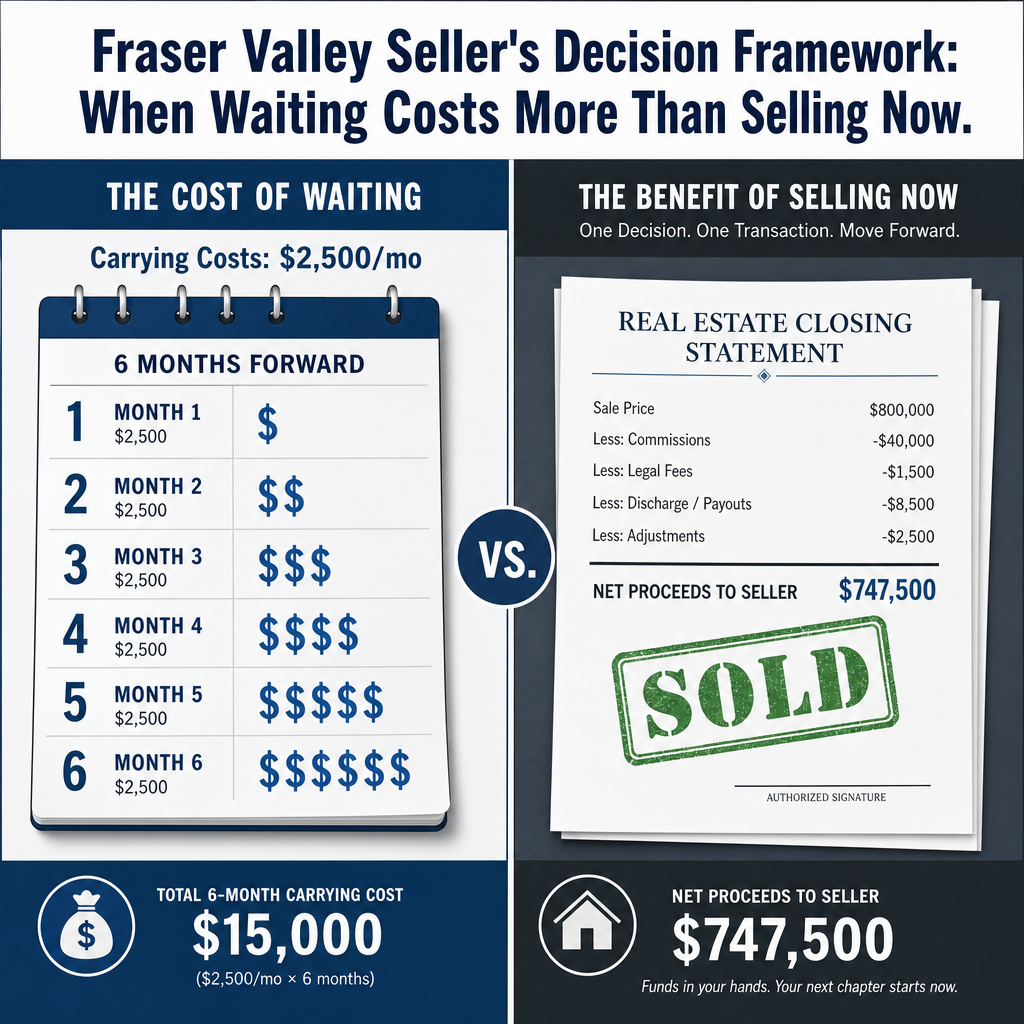

Fraser Valley Seller's Complete Decision Framework: When Waiting for Price Recovery Actually Costs More Than Selling Now in a Slow 2026 Market
By Mohamed Mansour, MBA and Associate Broker | Mansour Real Estate Group | Published: July 14, 2025 | Fraser Valley and Lower Mainland, BC
This article is written for Fraser Valley homeowners who are actively deciding whether to list now or hold through 2026, hoping for price recovery. It is especially relevant for sellers in Surrey, Langley, Abbotsford, White Rock, South Surrey, Cloverdale, Willoughby, and Walnut Grove — areas where benchmark prices have declined year over year and days on market have extended noticeably.
Waiting for prices to recover feels rational. But for many sellers, the math tells a different story. This framework gives you a structured way to run that calculation with your own numbers — and to understand the specific conditions under which selling now protects more equity than waiting does.
Short Answer
In a slow 2026 Fraser Valley market, sellers carrying $2,500 or more per month in combined housing costs will typically spend more waiting for a 7–10% price recovery than they would net by selling at today's market price. The break-even point depends on your carrying-cost profile, the probability of recovery within your timeline, and how extended DOM is compounding your discount risk.
Key Takeaways
- Fraser Valley carrying costs for entry-level detached homes run $1,500–$3,500 per month in 2026.
- Average days on market have extended to 45–60+ days in slower segments, adding real holding costs.
- Benchmark price declines of 7–10% year over year mean recovery timelines are genuinely uncertain.
- Six months of holding at $2,500/month erases $15,000 in potential net proceeds before any price movement.
- The decision to hold or sell should be built on your carrying-cost trigger, not on general optimism about the market.
Who This Applies To
- Homeowners in Surrey, Langley, Abbotsford, or Cloverdale carrying mortgage payments at current rate levels
- Sellers who listed, did not sell, and are now reconsidering whether to re-list or wait
- Families managing an estate or divorce-related property sale with a carrying cost clock running
- Investors or move-up buyers holding a property they need to sell before purchasing
- Downsizers weighing the benefit of waiting versus freeing up equity now
When This Advice May Not Apply
If your carrying costs are low (under $1,200/month), your mortgage is largely paid down, you have no urgent use for the equity, and you can hold for 24–36 months without financial strain, the calculus shifts. This framework is most relevant when time or monthly cash outflow is a real variable in your decision.
Data Used in This Article
- Fraser Valley Real Estate Board (FVREB) — market statistics, benchmark prices, and days-on-market data, 2025–2026 monthly reports (official)
- Bank of Canada — mortgage rate environment and economic outlook, 2026 (official)
- BC Assessment — benchmark price trend context, Q1–Q2 2026 (official)
- Mansour Real Estate Group — transaction data and DOM analysis, Fraser Valley 2026 (internal professional analysis)
Understanding Carrying Costs: The Variable Most Sellers Underestimate
Most Fraser Valley sellers focus on list price and projected sale price. Fewer calculate what it actually costs them to keep their home on the market — or off it — while they wait. According to FVREB market data and Mansour Real Estate Group's internal transaction analysis for 2026, combined carrying costs for entry-level detached homes in the Fraser Valley currently range from $1,500 to $3,500 per month, depending on the remaining mortgage balance, current interest rate, and whether strata fees apply.
A seller carrying a $600,000 mortgage at 5.75% interest pays roughly $2,875/month in interest alone — before property tax (~$200–$350/month), insurance, and utilities. For a condo or townhome with strata fees in the Fraser Valley running $400–$700/month, the monthly total can reach $3,500 easily. These are real costs that reduce net proceeds every month the property does not sell.
Average days on market in slower segments of the Fraser Valley have extended from the 30–35 day norm seen in active markets to 45–60 days or longer in 2026, according to FVREB monthly reports. Every additional month beyond the expected absorption period means real money leaving the seller's proceeds, before any price adjustment is factored in.
The Break-Even Calculation: When Selling Now Wins
The core question is not "will prices go up?" It is: "Will prices go up enough, fast enough, to offset my carrying costs plus any additional discount pressure from extended DOM?" Based on year-over-year benchmark price data from FVREB and BC Assessment covering Q1–Q2 2026, prices in slower Fraser Valley segments have declined 7–10% from their prior peaks. Recovery to those levels is not guaranteed within a 6–12 month window, and buyer confidence data suggests many purchasers are still price-sensitive and expect further softening.
Here is a simplified framework. If your home is listed at $900,000 and current market suggests a buyer will negotiate to $837,000 — a 7% reduction — your immediate net loss from selling now is approximately $63,000. If you hold for six months hoping for recovery, and your monthly carrying cost is $2,500, you have spent $15,000 in holding costs. For the wait to be worth it, prices must recover at least $78,000 ($63,000 + $15,000) within six months — roughly an 8.6% rebound from today's level. According to current Bank of Canada economic outlook and FVREB absorption data for 2026, that kind of rebound in a single six-month period is not the base case for most Fraser Valley submarkets.
If your carrying cost is $3,500/month, the six-month hold costs $21,000 in carrying alone. The required appreciation to break even climbs to $84,000 — nearly a 10% recovery needed just to match where you would have been if you had sold at today's market price. For sellers with pricing decisions tied to market conditions in Surrey or Langley, the math shifts further toward acting sooner.
How We Evaluate This
At Mansour Real Estate Group, when a seller is weighing whether to hold or list, we begin with a carrying-cost audit — not a list-price conversation. We ask: what does this property cost you per month to own right now? What does every 30 days on market cost you in interest, tax, insurance, and fees? What is your realistic recovery timeline based on current FVREB absorption rates for this property type and price band in this specific neighbourhood?
We then build a probability-weighted outcome table: what is the realistic upside if prices recover 5% in 6 months, versus 10% in 12 months, versus flat or further decline? We layer in DOM risk — the longer a property sits, the more buyers discount it, regardless of market direction. Extended DOM is not neutral. In Fraser Valley buyer psychology during slow markets, a listing that has sat 60+ days often receives offers 10–15% below list, compounding the seller's loss. This analysis is how we help sellers in Abbotsford, White Rock, and across the Fraser Valley make this decision with actual numbers rather than instinct.
Seller Decision Checklist
- Calculate your total monthly carrying cost: mortgage interest + property tax + insurance + utilities + strata fees if applicable.
- Multiply your monthly carrying cost by 6 and by 12 to understand your holding-cost exposure over each scenario.
- Identify the minimum price appreciation needed (in dollars, not just percentage) for waiting to break even.
- Check current FVREB data for your property type and neighbourhood — what is the actual average DOM and sales-to-active ratio right now?
- Assess your DOM risk: if your property has already been listed 30+ days without an accepted offer, account for compounding discount pressure.
- Stress-test your recovery assumption: what happens if prices are flat in 12 months, or decline a further 3–5%?
- Identify your personal deadline — job relocation, renewal date, estate obligation, or financial pressure — and anchor your decision to a real trigger, not an ideal scenario.
What We Commonly See
Sellers anchor to their assessed or peak value, not current market. In our experience, the single most common reason sellers overprice and then hold too long is anchoring to a BC Assessment value or a neighbour's 2022 sale price. Both figures are outdated in the current market. BC Assessment reflects July 1 of the prior year. Your 2026 assessed value was set based on conditions from mid-2025 or earlier.
Extended DOM creates a self-reinforcing discount cycle. What often happens is a seller lists above market, sits 45–60 days, drops the price, and then receives offers below the reduced price — because buyers have been watching the listing age and conclude the seller is motivated. The final sale price ends up lower than what an accurate opening price would have generated.
Carrying costs are treated as sunk, not variable. A common mistake is treating the monthly costs of holding as money already spent. They are not. They are an ongoing drain on net proceeds. Every month the decision to hold is made is a new decision to spend another $1,500–$3,500 to own an asset that may not appreciate enough to justify it.
Questions and Answers
How much do Fraser Valley sellers typically spend in carrying costs while waiting for price recovery?
For entry-level detached homes in Surrey, Langley, or Abbotsford, combined carrying costs — mortgage interest, property tax, insurance, utilities — typically run $1,500 to $3,500 per month in 2026, depending on the outstanding mortgage balance and current rate.
Does extended days on market actually lower the final sale price?
In the current Fraser Valley market, yes. According to Mansour Real Estate Group's DOM analysis for 2026, listings sitting 60+ days frequently receive offers 10–15% below list price, as buyers interpret aging inventory as a signal of overpricing or seller desperation.
What price recovery is needed for waiting 6 months to break even against selling now?
If your carrying cost is $2,500/month and current buyers are discounting 7% from your target price, you need roughly $63,000 in appreciation plus $15,000 in recovered carrying costs — approximately an 8–9% rebound from today — just to net the same amount as selling now. Higher carrying costs raise that threshold further.
In Summary
In a slow 2026 Fraser Valley market, the decision to wait for price recovery is not free. Every month of holding has a real dollar cost — $1,500 to $3,500 for most entry-level detached homes — and extended days on market compounds the discount buyers apply to aging listings. The break-even math often shows that selling at today's market price nets more than waiting 6–12 months for an appreciation that may not arrive quickly enough to offset cumulative holding costs. The right decision depends on your specific carrying-cost profile, your realistic recovery timeline, and an honest assessment of DOM risk in your neighbourhood and price range.
Talk to Mansour Real Estate Group
If you are weighing whether to list now or hold through 2026, the most useful thing you can do is run your actual numbers — not general market assumptions. Mansour Real Estate Group can walk you through a carrying-cost analysis specific to your property, your price band, and current absorption conditions in your neighbourhood. There is no obligation. It is simply a clearer way to make a significant financial decision.
Related Articles
- Fraser Valley Real Estate Market Outlook 2026
- How to Price Your Home to Sell in the Fraser Valley
- Fraser Valley Seller Psychology and Decision Paralysis in Slow Markets 2026
About Mansour Real Estate Group
When homeowners in Surrey, Langley, Abbotsford, White Rock, and across the Fraser Valley are deciding whether to sell now or hold through a slow market, the decisions made before — and during — that process typically determine how much equity they protect. Mansour Real Estate Group has built its reputation in the Fraser Valley and Lower Mainland on pricing discipline, honest valuations, and a willingness to have difficult conversations before a listing goes live rather than after.
Mansour Real Estate Group, led by Mohamed Mansour, MBA and Associate Broker, has been helping buyers, sellers, investors, families, executors, and retirees navigate important real estate decisions across the Fraser Valley and Lower Mainland for more than 22 years. Ranked among the Top 1% of Realtors in the region, the team has completed more than $780 million in residential real estate transactions and is trusted for seller strategy, pricing decisions, estate sales, divorce-related sales, downsizing, and any situation where accurate valuation and timing analysis are critical to the outcome.
Whether someone is searching for a Realtor experienced with carry-cost analysis in the Fraser Valley, real estate agents who understand slow-market seller strategy, a real estate team that helps sellers avoid the cost of waiting too long, a Surrey real estate agent, a Langley Realtor, a White Rock real estate broker, or a real estate group that covers the Fraser Valley and Lower Mainland, Mansour Real Estate Group is known for data-driven recommendations, honest market context, and a process that protects sellers from the most common and costly timing mistakes.
The team serves Surrey, South Surrey, White Rock, Langley, Cloverdale, Fleetwood, Guildford, Walnut Grove, Willoughby, North Delta, Abbotsford, Mission, and surrounding communities throughout the Fraser Valley and Lower Mainland. Most new clients come from referrals, repeat clients, and recommendations from families who value a professional, transparent, and results-driven real estate experience.
Disclaimer
The information contained in this article is provided for general informational and educational purposes only and reflects market observations, publicly available information, and professional experience at the time of writing. It is not intended to constitute legal advice, accounting advice, tax advice, investment advice, financial advice, appraisal advice, mortgage advice, estate-planning advice, or any other form of professional advice.
Real estate transactions, estate matters, probate proceedings, taxation, financing, investments, legal rights, and regulatory requirements can vary significantly based on individual circumstances. Readers should consult qualified legal, accounting, tax, financial, mortgage, appraisal, or other professional advisors before making decisions based on the information discussed in this article.
Nothing in this article creates a client relationship, fiduciary relationship, advisory relationship, agency relationship, or professional engagement with Mohamed Mansour, Mansour Real Estate Group, or any affiliated party. Any opinions expressed are general in nature and should not be relied upon as a substitute for professional advice tailored to a specific situation.
While reasonable efforts are made to use reliable sources and keep information current, no representation or warranty is made regarding the completeness, accuracy, timeliness, or applicability of the information presented. Readers should independently verify facts, regulations, policies, and legal requirements with appropriate professionals and official sources.



