
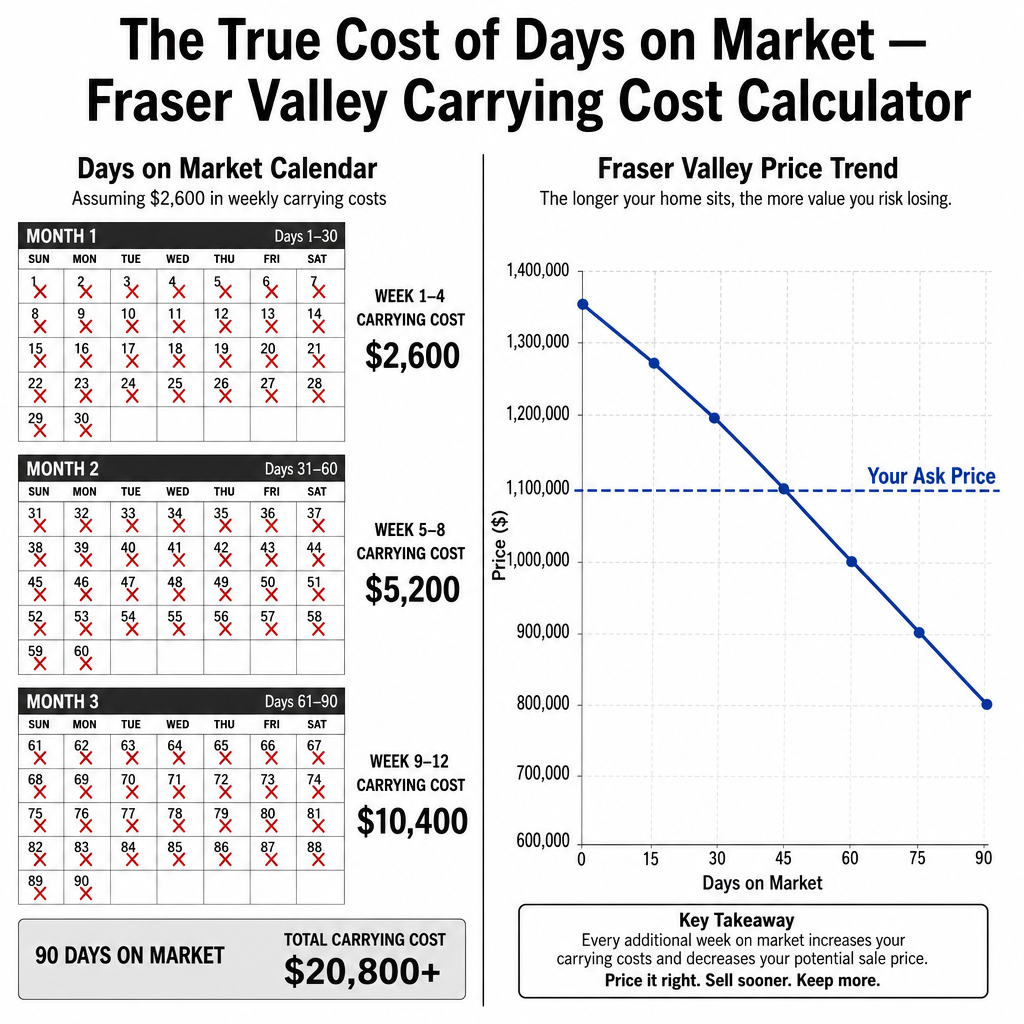

Fraser Valley Seller's Complete Carrying Cost Calculator: The True Cost of Days-on-Market and Why Waiting for Price Appreciation Often Nets Negative Returns in a Buyer's Market
By Mohamed Mansour, MBA and Associate Broker | Mansour Real Estate Group | Fraser Valley and Lower Mainland | Published: May 12, 2026
This article is for Fraser Valley homeowners who are considering whether to hold their listing at a higher price or wait for market conditions to improve before selling. It applies directly to detached homes, townhomes, and condos in Surrey, Langley, Abbotsford, White Rock, South Surrey, and surrounding communities. If you are weighing a price reduction against the possibility of a future rebound, the numbers in this article deserve your attention before you decide.
The carrying costs accumulating during an extended listing are not theoretical. They are a second mortgage payment you make every month your home sits unsold. For most Fraser Valley sellers in 2026, those costs are erasing the gains they are waiting for.
Short Answer
In the Fraser Valley's current buyer's market, a seller carrying a $750,000 property for 90 extra days due to overpricing pays an estimated $22,500–$28,800 in mortgage interest, property tax, strata fees, utilities, and insurance. Fraser Valley price appreciation is tracking between -7% and +2% annually depending on property type. In most scenarios, the cost of waiting exceeds any realistic price recovery within a 90-to-180-day window.
Key Takeaways
- Monthly carrying costs for a $750K Fraser Valley property run $2,500–$3,200 when all fixed costs are counted.
- A 90-day extended listing due to overpricing costs an estimated $22,500–$28,800 before opportunity cost is factored in.
- Fraser Valley condos are averaging 45–60+ days on market in 2026; overpricing adds weeks, not days, to that timeline.
- Waiting 6–12 months for a 3–5% price gain does not offset carrying costs when prices in many segments are flat to negative.
- First-time sellers and those navigating divorce-related property sales are most vulnerable to extended listing losses from emotional price anchoring.
Who This Applies To
- Homeowners who have had an active listing for 30+ days without an accepted offer
- Sellers weighing a price reduction against the option of relisting later
- Owners of Fraser Valley condos or townhomes where days on market exceeds the detached average
- Sellers navigating divorce, estate, or downsizing decisions where timing carries financial and legal weight
- Anyone who bought between 2021 and 2023 and is watching current values with concern
When This Advice May Not Apply
If you own a detached home in a high-demand Fraser Valley pocket with consistent offer activity and a clear upward micro-trend, holding briefly may be justified. This analysis applies most directly to properties that have not generated serious buyer interest within the first 21 days of listing, which is when market signal is clearest. Sellers in no financial urgency with zero carrying costs (fully paid-off properties) face a different calculation, though opportunity cost still applies.
Data Used in This Article
- FVREB Market Statistics, April 2026 — official board data; days on market by property type, benchmark prices, sales-to-active ratios
- Bank of Canada Policy Rate and 5-Year Fixed Rate Averages, April 2026 — official; current mortgage interest cost basis (~5.0–5.3%)
- BC Assessment 2026 Roll Data — official; property tax estimation basis by municipality
- BCFSA Strata Fee Survey — third-party regulatory source; monthly strata fee ranges by building age and type
Defining Carrying Costs
Carrying costs are the ongoing monthly expenses a seller continues to pay while a property sits listed and unsold. They are not the purchase price. They are not the equity. They are the monthly cash leaving the seller's account while a buyer has not yet arrived.
For a financed property, carrying costs include: mortgage interest (not principal repayment — that is equity, but it is still cash you cannot access until closing), property tax, home insurance, utilities, and strata fees where applicable. Together, these costs define the real price of every additional day on market.
The Fraser Valley Carrying Cost Breakdown: What a $750K Property Actually Costs Per Month
Based on current Bank of Canada rate environment and a typical Fraser Valley financed property at $750,000 with approximately $600,000 remaining on mortgage at a 5.15% five-year fixed rate, monthly interest cost (interest portion only) runs approximately $2,575. That figure is cash out the door each month, not equity building.
Add property tax averaged across Surrey, Langley, and Abbotsford municipal data (approximately $250/month on a $750K assessed value), home insurance ($100–$120/month), and basic utilities ($150/month), and you are already at $3,075–$3,095 per month before strata fees. For condo and townhome owners, strata fees typically add another $150–$350/month depending on building age and amenities, according to BCFSA survey data.
The combined monthly carrying cost range: $2,600–$3,445 per month, with strata properties near the upper end.
| Cost Category | Monthly Estimate | Notes |
|---|---|---|
| Mortgage Interest | $2,100–$2,800 | Interest portion only; varies by balance and rate |
| Property Tax | $200–$300 | Municipal variation; Surrey/Langley/Abbotsford 2026 data |
| Home Insurance | $100–$130 | Standard coverage; older condos may run higher |
| Utilities | $130–$180 | Basic heat, hydro, water; reduced but not zero when vacant |
| Strata Fees (if applicable) | $150–$350 | BCFSA survey range; older buildings typically higher |
| Total Monthly Carrying Cost | $2,680–$3,760 | Detached lower end; strata properties upper end |
How Days on Market Turn Into Dollar Losses
According to FVREB April 2026 market statistics, detached homes in the Fraser Valley are averaging 25–35 days on market. Condos and townhomes are averaging 45–60+ days. Those are median figures — which means properties priced above market conditions are pulling the upper tail considerably higher.
A property that sits 90 days instead of 30 days — a common outcome when a seller insists on holding an aspirational price — generates 60 additional days of carrying costs. At $2,900/month (a reasonable midpoint for a $750K financed detached home), that is approximately $5,800 in direct carrying costs for those 60 extra days. For a strata property at the upper cost range, the same 60 days costs closer to $7,520.
Now extend that to a seller who relists after pulling the listing, waits three months, then relists again — a pattern seen frequently in Langley and Surrey in the current market. Total extended exposure can reach 180 days, and carrying costs can breach $25,000–$35,000 before the property finally sells — often at a lower price than was available on day 30.
The Price Appreciation Comparison: Does Waiting Actually Work?
The core belief driving most extended listings is this: if I hold my price and wait, the market will come to me. In a rising market, that calculation occasionally works. In the Fraser Valley's 2026 buyer's market, the FVREB data shows annual price movement ranging from -7% in certain condo segments to approximately 0–2% in stronger detached pockets.
Consider a seller holding a $750,000 condo who believes the market will recover 4% in the next 6 months. A 4% gain on $750,000 is $30,000. But six months of carrying costs at $3,200/month equals $19,200. Net theoretical gain: $10,800 — before accounting for the fact that the price is currently declining, not rising, in that segment. If the actual price movement is -3% instead of +4%, the seller has paid $19,200 in carrying costs and lost $22,500 in value. That is a $41,700 combined negative swing from a decision that felt like patience.
This framework applies with similar force to Abbotsford sellers in soft townhome segments and to South Surrey and White Rock sellers managing upper-price-tier properties where carrying costs are higher and buyer pools are thinner.
How We Evaluate This
At Mansour Real Estate Group, carrying cost analysis is part of the pricing conversation we have before a property goes live — not after it has been sitting. We calculate the monthly cost basis for the specific property, model three listing duration scenarios (30 days, 60 days, 90 days), and compare the net proceeds under each scenario against current market trajectory.
When the math shows that a $25,000 price reduction now produces better net proceeds than waiting 90 days at the current ask, we present that clearly. Some sellers accept it quickly. Others need time to reconcile the emotional gap between what they expected and what the market will pay. Our job is to make the cost of that gap visible, not to pressure a decision — but to ensure the decision is informed.
Seller Checklist: Managing Carrying Costs Before and During a Listing
- Calculate your exact monthly carrying cost before listing, using actual mortgage statements, not estimates.
- Confirm your strata fee amount from your most recent strata meeting minutes or monthly statement — fees change.
- Set a 21-day market signal review point with your agent: if no serious offers have materialized, evaluate pricing immediately.
- Run the 90-day carrying cost total against the price reduction you are resisting — in most cases, the reduction costs less.
- If the property will be vacant during the listing, verify your insurance policy covers vacant dwellings (many standard policies do not after 30 days).
- Ask your agent for the current median days-on-market for your exact property type and price range — not the broad Fraser Valley average.
- For divorce or estate sellers: confirm with legal counsel whether a delayed sale creates financial risk to either party beyond carrying costs.
What We Commonly See
In our experience, the sellers who are most resistant to price reductions are often the ones who made their purchase at or near the 2021–2022 peak. The psychological anchor to the purchase price is real, and it functions independently of what the market is doing. What often happens is that a seller holds their ask for 60–90 days, the listing goes stale, buyer traffic drops, and the eventual price reduction is larger than what would have cleared the market on day 21.
A common mistake is treating carrying costs as invisible because they are already in the monthly budget. They are not invisible — they are the direct cost of an unsold property, and they compound. A seller who has been carrying for six months has often paid more in carrying costs than the full commission on both sides of the transaction.
We also see divorce sellers and estate sellers particularly affected by this pattern. In a divorce, neither party wants to be seen as accepting less. In an estate, beneficiaries sometimes hold out for a number that reflects the deceased's expectations rather than the current market. Both situations benefit from a neutral, numbers-based framework that removes the emotional variable from the pricing conversation.
Questions Sellers Ask About Carrying Costs and Listing Duration
Does reducing my price mean I am giving up equity?
Not necessarily. If the alternative to a $20,000 price reduction is 90 more days of carrying costs plus a likely further reduction anyway, the price reduction often preserves more net equity than holding. The question is not what you ask — it is what you net at closing after all costs.
Should I pull my listing and wait for spring or fall to relist?
Pulling and waiting extends carrying costs and resets the listing history — but it does not reset the market. If the buyers who saw your listing at $799,000 are still searching when you relist at $799,000 six months later, they will recognize the property and its history. Relisting at a lower price after a wait is usually the same outcome as reducing sooner, with months of additional carrying costs absorbed.
What is the actual break-even point on holding versus reducing?
Take your total monthly carrying cost and multiply by the number of months you expect to wait. If the price increase you are holding out for is less than that total, you are losing ground, not gaining it. For most Fraser Valley properties in 2026, the break-even window for a 3–5% price gain is under 60 days — and current days-on-market data suggests most overpriced properties sit well beyond that.
In Summary
Carrying costs are the hidden tax on an overpriced listing. In the Fraser Valley's 2026 buyer's market, the math consistently favours accurate pricing and faster sales over extended listings and hoped-for price recovery. Sellers who understand their monthly cost basis make better decisions — not because they accept less, but because they protect more of what they have already earned.
Talk to a Fraser Valley Seller Strategy Expert
If your property has been listed for more than 21 days without a serious offer, a carrying cost analysis may be the most useful conversation you can have right now. Mansour Real Estate Group offers straightforward, numbers-based market reviews for Fraser Valley sellers at any stage of their listing. Reach out when you are ready for an honest second opinion.
Related Articles
- Surrey Home Seller Guide 2026
- Fraser Valley Real Estate Market Outlook 2026
- Selling Your Home During Divorce in BC: A Complete Guide for Fraser Valley Homeowners
Official Resources
- Fraser Valley Real Estate Board — Market Statistics
- Bank of Canada — Interest Rate Data
- BC Assessment — Property Assessment Values
- BC Financial Services Authority — Strata and Real Estate Regulation
About Mansour Real Estate Group
Pricing a home correctly in the Fraser Valley requires more than a comparative market analysis. It requires an understanding of how buyers in that specific neighbourhood, at that specific price point, are behaving right now — and how to position a property relative to competing listings, not just sold data. Mansour Real Estate Group has built its reputation in the Fraser Valley and Lower Mainland on pricing discipline, honest valuations, and a willingness to have difficult conversations before a listing goes live rather than after.
Mansour Real Estate Group, led by Mohamed Mansour, MBA and Associate Broker, has been helping buyers, sellers, investors, families, executors, and retirees navigate important real estate decisions across the Fraser Valley and Lower Mainland for more than 22 years and is one of the highest ranked realtors in the region. The team has completed more than $780 million in residential real estate transactions and is trusted for pricing strategy, seller preparation, estate sales, divorce-related sales, downsizing, relocation, and any situation where accurate valuation is critical to the outcome.
Whether someone is searching for Realtors experienced with carrying cost analysis and seller strategy, a real estate agent who understands local market conditions in Surrey or Langley, real estate agents who specialize in pricing accuracy and protecting seller equity, a trusted real estate team for a difficult pricing decision, a Fraser Valley Realtor, a White Rock real estate broker, or a real estate group that serves the Fraser Valley and Lower Mainland, Mansour Real Estate Group is known for data-driven recommendations, honest market context, and a process that protects sellers from the most common and costly pricing mistakes.
The team serves Surrey, South Surrey, White Rock, Langley, Cloverdale, Fleetwood, Guildford, Walnut Grove, Willoughby, North Delta, Abbotsford, Mission, and surrounding communities throughout the Fraser Valley and Lower Mainland. Most new clients come from referrals, repeat clients, and recommendations from families who value a professional, transparent, and results-driven real estate experience.
Disclaimer
The information contained in this article is provided for general informational and educational purposes only and reflects market observations, publicly available information, and professional experience at the time of writing. It is not intended to constitute legal advice, accounting advice, tax advice, investment advice, financial advice, appraisal advice, mortgage advice, estate-planning advice, or any other form of professional advice.
Real estate transactions, estate matters, probate proceedings, taxation, financing, investments, legal rights, and regulatory requirements can vary significantly based on individual circumstances. Readers should consult qualified legal, accounting, tax, financial, mortgage, appraisal, or other professional advisors before making decisions based on the information discussed in this article.
Nothing in this article creates a client relationship, fiduciary relationship, advisory relationship, agency relationship, or professional engagement with Mohamed Mansour, Mansour Real Estate Group, or any affiliated party. Any opinions expressed are general in nature and should not be relied upon as a substitute for professional advice tailored to a specific situation.
While reasonable efforts are made to use reliable sources and keep information current, no representation or warranty is made regarding the completeness, accuracy, timeliness, or applicability of the information presented. Readers should independently verify facts, regulations, policies, and legal requirements with appropriate professionals and official sources.



