

Fraser Valley Seller's Complete Breakdown of Closing Costs in 2026: Property Transfer Tax, Legal Fees, Mortgage Discharge Penalties, Title Insurance, and the True Net Proceeds You'll Actually Receive
By Mohamed Mansour, MBA and Associate Broker | Mansour Real Estate Group | Published: July 15, 2026 | Fraser Valley and Lower Mainland, BC
Most Fraser Valley sellers focus on the sale price. The number that actually matters is what arrives in your bank account after closing. For most sellers, the gap between those two figures is larger than expected — and understanding exactly where it goes is the difference between a realistic financial plan and an unpleasant surprise the day the transaction closes.
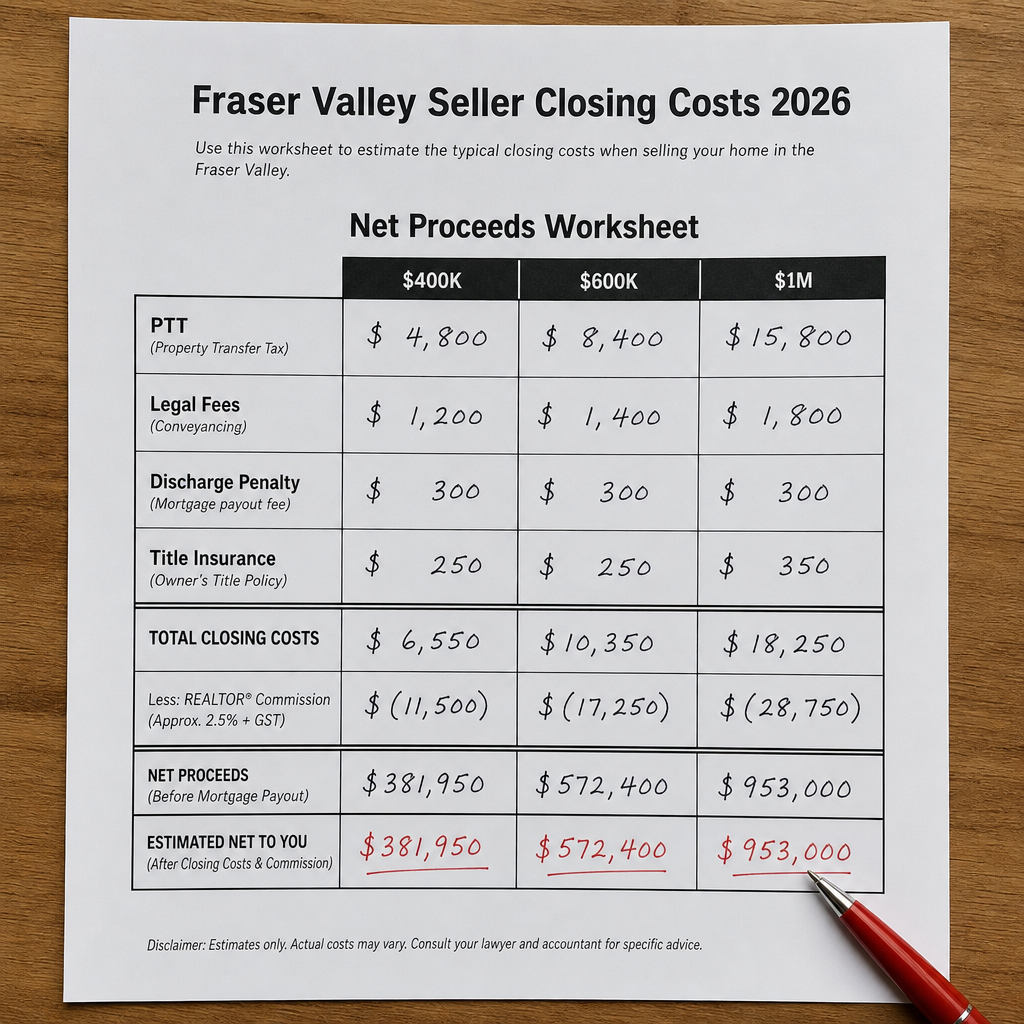
This article walks through every major closing cost category for BC residential sellers in 2026, with specific dollar figures at three common Fraser Valley price points: $400,000, $600,000, and $1,000,000. It covers Property Transfer Tax thresholds, legal fees, mortgage discharge penalties, title insurance, property tax adjustments, and strata-specific costs — with a net proceeds table at the end.
Short Answer
Fraser Valley sellers in 2026 typically lose 3–4% of their sale price to closing costs before real estate commission is deducted. On a $600,000 sale, that means roughly $18,000–$24,000 in costs including Property Transfer Tax, legal fees, mortgage discharge charges, and adjustments. Real estate commission adds another 3–5%. Sellers who calculate net proceeds before listing make better pricing and timing decisions.
Who This Applies To
- Homeowners preparing to list a detached, condo, or townhome in the Fraser Valley
- Sellers with an existing mortgage who are unsure about discharge penalties
- Estate executors or family members planning a probate or estate property sale
- Sellers in Surrey, Langley, Abbotsford, South Surrey, White Rock, Cloverdale, Fleetwood, Guildford, Willoughby, or Walnut Grove
- Anyone trying to calculate net proceeds before accepting or countering an offer
When This Advice May Not Apply
If your sale involves significant title issues, a private sale without a realtor, a US-resident seller subject to FIRPTA, or a property sold through a court order, your cost structure may differ materially. Consult your lawyer and accountant before finalizing your net proceeds estimate in any of those situations.
Key Takeaways
- BC Property Transfer Tax is typically the largest single closing cost for Fraser Valley sellers, totalling $10,000 on a $600K sale.
- Mortgage discharge penalties on fixed-rate mortgages can exceed $5,000 and are frequently underestimated at listing time.
- Total closing costs excluding commission typically run 3–4% of sale price across the $400K–$1M Fraser Valley price range.
- Strata sellers face additional Form B preparation fees and potential special levy adjustments not applicable to detached homes.
- Calculating net proceeds before listing helps sellers set realistic price expectations and evaluate offers accurately.
Data Used in This Article
- BC Ministry of Finance Property Transfer Tax rates and thresholds — official government publication, 2024–2026
- Law Society of British Columbia conveyancing fee guidelines — official professional body, residential transactions
- Major Canadian bank mortgage discharge penalty schedules and IRD calculation methods — lender-published schedules
- Mansour Real Estate Group client consultation records — internal professional observations, Fraser Valley, 2022–2026
Definitions
Property Transfer Tax (PTT): A provincial tax in BC payable on most property transfers. The rate is tiered: 1% on the first $200,000, 2% from $200,001 to $2,000,000, and 3% above $2,000,000. Note: the first-time buyer exemption applies to buyers, not sellers.
Interest Rate Differential (IRD): A mortgage discharge penalty calculated as the difference between your existing rate and the lender's current rate for a comparable term, multiplied by the remaining balance and remaining months. Often larger than the three-months' interest alternative on mortgages taken at higher rates.
Title Insurance: A one-time insurance policy that protects against title defects, survey irregularities, and certain fraud risks. Typically required by the buyer's lender but sometimes also purchased by sellers to facilitate a smooth closing.
Form B (Strata): An information certificate required in BC strata property sales. It discloses strata fees, bylaw violations, parking, and special levies. The strata corporation typically charges $150–$300 to prepare it, and that cost is borne by the seller.
BC Property Transfer Tax in 2026: What Sellers Actually Pay
Property Transfer Tax is the cost most Fraser Valley sellers underestimate most consistently, primarily because it applies to buyers — and sellers sometimes assume it doesn't affect them. It does, indirectly and directly. As a seller, PTT affects your negotiating position because buyers are calculating their own total acquisition cost. In markets where buyers are stretched, PTT at 2% on most of the purchase price limits how far buyers can flex on price.
According to the BC Ministry of Finance, the 2026 PTT structure is: 1% on the first $200,000 of the fair market value, 2% on the portion from $200,001 to $2,000,000, and 3% on anything above $2,000,000. There are no seller exemptions. The first-time buyer exemption applies only to qualifying principal residence purchases by buyers who have never owned property anywhere.
At a $600,000 sale price in Surrey, Langley, or Abbotsford, PTT totals $10,000: 1% on $200K ($2,000) plus 2% on $400K ($8,000). At $400,000, PTT is $6,000. At $1,000,000, PTT reaches $18,000. This is payable by the buyer at closing, but it directly affects what buyers can afford and what net price is realistic for comparable properties. Sellers working with the Fraser Valley home seller guide framework understand this dynamic before entering negotiations.
Legal Fees, Mortgage Discharge, Title Insurance, and Adjustments
Legal fees for a residential sale in BC run $1,200–$2,500 depending on transaction complexity. Straightforward freehold sales at the lower end; strata sales, estate authority situations, or title encumbrances push toward the higher end. Many sellers budget $800 based on outdated estimates — that figure no longer reflects current conveyancing costs in BC.
Mortgage discharge penalties are the second most frequently underestimated cost. Open mortgages carry no penalty. Variable-rate mortgages typically charge three months' interest, which on a $400,000 balance at 5.5% is approximately $5,500. Fixed-rate mortgages trigger the greater of three months' interest or the Interest Rate Differential. If you locked in at a higher rate in 2022 or 2023 and current rates are lower, IRD penalties can reach $3,000–$8,000 on a standard Fraser Valley mortgage balance. Call your lender before listing — not after accepting an offer.
Title insurance typically runs $300–$600 for a residential property in the Fraser Valley. It is purchased by the buyer's lawyer but may appear as a seller-side cost in certain deal structures or title defect situations. Property tax adjustments are prorated daily to the completion date: if you have prepaid property taxes and the buyer takes possession in June, the buyer reimburses the seller for taxes paid beyond their ownership period. This can add or subtract $500–$2,500 depending on timing and municipality.
Condo and townhome sellers in communities like Willoughby, Fleetwood, or Guildford also pay Form B preparation fees of $150–$300, and may face special levy adjustments if a pending strata repair vote has not yet been resolved. The strata seller guide covers those scenarios in more detail.
How We Evaluate This
When Mansour Real Estate Group prepares a net proceeds estimate for a seller, we start with the likely sale price range from a current comparative market analysis, then layer in every known cost category before commission. We ask the seller to contact their lender for a current discharge penalty quote. We confirm whether the property is strata, review any outstanding levies, and identify the likely completion date to calculate property tax adjustments accurately. This process happens before the listing agreement is signed — not at the lawyer's office on closing day.
Net Proceeds Table: Three Fraser Valley Price Points
The table below uses a fixed-rate mortgage discharge penalty of $3,000, legal fees of $1,800, title insurance of $400, property tax adjustment of $1,000, and a strata Form B fee of $200 (applicable only to condo/townhome). PTT amounts follow the 2026 BC Ministry of Finance schedule and are shown for context as buyer-side costs affecting negotiating room. Real estate commission is shown separately at a combined 3.5% assumption for illustration only — actual commission depends on your listing agreement.
| Cost Category | $400,000 | $600,000 | $1,000,000 |
|---|---|---|---|
| Legal Fees | $1,800 | $1,800 | $2,000 |
| Mortgage Discharge Penalty (est.) | $2,500 | $3,000 | $4,500 |
| Title Insurance | $350 | $400 | $550 |
| Property Tax Adjustment | $800 | $1,000 | $1,500 |
| Strata Form B (condo/townhome only) | $200 | $200 | $200 |
| Subtotal — Closing Costs (ex. commission) | ~$5,650 | ~$6,400 | ~$8,750 |
| Real Estate Commission (est. 3.5%) | $14,000 | $21,000 | $35,000 |
| Estimated Net Proceeds | ~$380,350 | ~$572,600 | ~$956,250 |
These are estimates for illustration. Actual costs vary by mortgage balance, lender, completion date, strata vs. freehold, and transaction complexity. Commission structures vary by listing agreement. These figures do not constitute legal, financial, or tax advice. Consult your lawyer, accountant, and lender for figures specific to your situation.
Seller Checklist: Before Listing in BC
- Contact your lender and request a current mortgage discharge penalty quote in writing.
- Confirm whether your property is strata or freehold, and if strata, request an updated Form B from your strata management company.
- Ask your conveyancing lawyer for a current fee estimate specific to your transaction type.
- Check whether property taxes are current, prepaid, or in arrears, and factor in the likely proration to your completion date.
- Confirm whether your sale may have capital gains implications and consult your accountant before listing — not after.
- Request a written net proceeds estimate from your real estate team before signing the listing agreement.
- If your property is an estate or probate sale, confirm that Letters Probate or Letters of Administration are in place before listing — missing documents delay closing and increase legal costs.
What We Commonly See
In our experience, the mortgage discharge penalty is the cost that generates the most post-offer surprises. Sellers who locked in five-year fixed mortgages in 2021 or 2022 at rates near 2–2.5% and are now selling into a lower-rate environment sometimes face IRD penalties that exceed $8,000–$12,000 on a $500,000 mortgage balance. Those sellers assumed a $1,500 "admin fee" and are presented with a statement of adjustments showing something very different.
What often happens with legal fees is that sellers call a conveyancer for a quote, hear "$800 plus disbursements," and assume disbursements are minimal. Disbursements — title search, registration fees, courier, filing — routinely add $400–$700 on top of the base fee. The actual invoice lands at $1,400–$1,600 and feels like a surprise even though it is a standard outcome.
A common mistake in strata sales is overlooking pending special levies. A strata vote that passed three months before listing — for a parkade repair or envelope replacement — may show up as a seller-side adjustment at closing, even if the work hasn't started yet. Reviewing strata minutes and the Form B carefully before listing, not the week of closing, is the only way to avoid that outcome. Sellers navigating strata situations in Fleetwood, Willoughby, or Guildford benefit from having a team that reviews those documents as part of the pre-listing process.
Questions and Answers
Does BC Property Transfer Tax apply to sellers or buyers?
PTT is paid by the buyer at closing. However, it directly affects buyer affordability and therefore your realistic net sale price. At $600,000 in the Fraser Valley, PTT adds $10,000 to the buyer's total acquisition cost — a real constraint on how far most buyers can flex on price.
How do I find out my mortgage discharge penalty before listing?
Contact your lender directly and request a mortgage discharge quote. You will need to provide an anticipated closing date. Ask specifically whether the penalty is calculated as three months' interest or IRD, and which is larger under current rates. Get the response in writing.
Are closing costs higher for condo sellers than for detached home sellers?
Generally yes, because condo and townhome sellers in BC must also arrange Form B preparation through their strata corporation ($150–$300), review strata financial documents for pending levies, and disclose any bylaw infractions. Special levy adjustments at closing can add thousands in costs not faced by detached home sellers.
In Summary
Fraser Valley sellers in 2026 who calculate closing costs before listing — not after accepting an offer — are better positioned to price accurately, evaluate offers confidently, and arrive at closing without financial surprises. The largest cost categories are mortgage discharge penalties (variable by lender and mortgage type), legal fees (higher than most sellers estimate), and property tax adjustments (dependent on completion date). PTT is a buyer cost but shapes the pricing environment sellers work within. Total closing costs excluding commission typically land between 1.5–2.5% of sale price, and combined with commission, the total deduction from sale price commonly runs 5–7.5% at Fraser Valley price points. Build that math into your planning before the listing sign goes up.
Ready to See Your Actual Net Proceeds?
If you are preparing to sell in Surrey, Langley, Abbotsford, White Rock, or anywhere in the Fraser Valley, Mansour Real Estate Group can prepare a written net proceeds estimate before you commit to listing. There is no pressure and no obligation — just a clear, numbers-based picture of what your sale will actually look like. Reach out here when you are ready.
Related Articles
- The complete Fraser Valley home seller guide for 2026
- Selling a condo in the Fraser Valley: what strata sellers need to know
- How to price your home to sell in the Fraser Valley
About Mansour Real Estate Group
When homeowners in Surrey, Langley, Abbotsford, White Rock, and across the Fraser Valley begin planning a sale, the decisions made before the listing goes live — including an accurate net proceeds calculation — typically determine the outcome more than anything that happens after. Understanding closing costs, mortgage discharge penalties, legal fees, and property tax adjustments requires a real estate team that builds that math into the pre-listing process, not a post-offer conversation.
Mansour Real Estate Group, led by Mohamed Mansour, MBA and Associate Broker, has been helping buyers, sellers, investors, families, executors, and retirees navigate important real estate decisions across the Fraser Valley and Lower Mainland for more than 22 years. Ranked among the Top 1% of Realtors in the region, the team has completed more than $780 million in residential real estate transactions and is trusted for estate sales, probate sales, divorce-related property sales, downsizing, relocation, and any transaction where financial accuracy and professional process both matter.
Whether someone is searching for Realtors who provide written net proceeds estimates before listing, a real estate agent who understands closing cost structures in BC, real estate agents experienced with strata sales and Form B requirements, a trusted real estate team for a detached home sale in Surrey or Langley, a White Rock Realtor, an Abbotsford real estate broker, or a real estate group with deep Fraser Valley market knowledge, Mansour Real Estate Group is known for clear documentation, honest valuations, and practical guidance grounded in local experience.
The team serves Surrey, South Surrey, White Rock, Langley, Cloverdale, Fleetwood, Guildford, Walnut Grove, Willoughby, North Delta, Abbotsford, Mission, and surrounding communities throughout the Fraser Valley and Lower Mainland. Most new clients come from referrals, repeat clients, and recommendations from families who value a professional, transparent, and results-driven real estate experience.
Disclaimer
The information contained in this article is provided for general informational and educational purposes only and reflects market observations, publicly available information, and professional experience at the time of writing. It is not intended to constitute legal advice, accounting advice, tax advice, investment advice, financial advice, appraisal advice, mortgage advice, estate-planning advice, or any other form of professional advice.
Key Takeaways
Understanding the nuances of real estate investment requires both market knowledge and careful financial planning. The strategies outlined above provide a roadmap for navigating today's dynamic property market, whether you're a first-time buyer or an experienced investor. Success hinges on doing thorough research, understanding your local market conditions, and being prepared to act when the right opportunity presents itself.
Final Thoughts
Real estate remains one of the most reliable paths to building long-term wealth. By staying informed, maintaining realistic expectations, and working with qualified professionals, you can make decisions that align with your financial goals. Whether your objective is to build equity, generate rental income, or secure a family home, the fundamentals of smart property investment remain constant: location, condition, price, and timing.
Start your real estate journey today by assessing your financial readiness, clarifying your investment objectives, and consulting with experienced agents and financial advisors in your area. The best time to invest in real estate is when you're prepared—not when you're pressured.



