
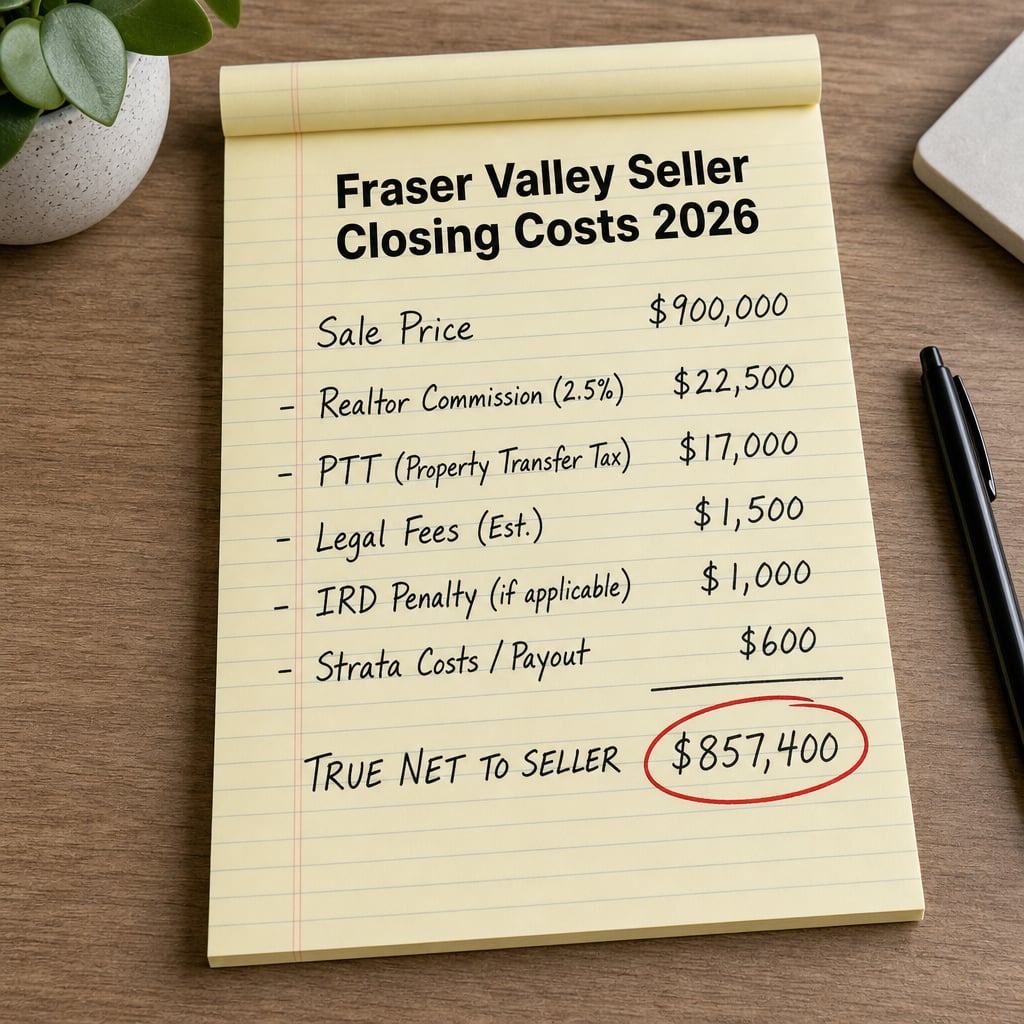

Fraser Valley Seller's Complete Breakdown of All Closing Costs Beyond Commission in 2026: Legal Fees, Mortgage Discharge Penalties, Property Transfer Tax, Title Insurance, Strata Form Preparation, Home Inspection Contingencies, and the True Net Proceeds Calculator
By Mohamed Mansour, MBA and Associate Broker | Mansour Real Estate Group | Fraser Valley and Lower Mainland | Published: July 15, 2025 | Geography: Surrey, Langley, Abbotsford, South Surrey, White Rock, North Delta, Cloverdale, Fleetwood, Guildford, Willoughby, Walnut Grove
Fraser Valley homeowners preparing to sell in 2026 typically focus on two numbers: their expected sale price and the realtor commission. Everything in between — the costs that quietly reduce what lands in their bank account — tends to get underestimated or missed entirely. According to internal analysis by Mansour Real Estate Group across Fraser Valley sales by price band and property type, sellers routinely expect total costs of 5–6% but experience 8–10% once every expense is calculated. At an $850,000 sale price, that gap represents between $17,000 and $42,500 of unexpected cost. This article gives you the complete breakdown, category by category, so you can calculate your true net proceeds before you list.
Short Answer
Fraser Valley sellers in 2026 should budget 8–10% of their sale price for total transaction costs, not 5–6%. The gap comes from property transfer tax, mortgage discharge penalties, legal fees, strata form preparation, title insurance, and tax adjustments — costs that can collectively reduce net proceeds by $15,000 to $50,000 or more depending on property price, strata status, and mortgage structure.
Key Takeaways
- Property Transfer Tax is the single largest variable seller cost — at Fraser Valley benchmark prices, PTT alone ranges from $17,000 to $25,000.
- Mortgage discharge penalties (IRD) in 2026's rate environment can reach $5,000–$30,000 and must be confirmed with your lender before listing.
- Legal fees, title insurance, and strata form costs are fixed and predictable — budget $2,000–$4,200 across these three categories.
- Sellers who skip a pre-list home inspection face buyer-negotiated price reductions that typically exceed the cost of proactive disclosure.
- True net proceeds require calculating all costs against your specific mortgage balance, property type, and strata status — not a generic percentage.
Who This Applies To
- Homeowners in Surrey, Langley, Abbotsford, South Surrey, White Rock, or North Delta considering listing in 2026
- Sellers with an active mortgage, particularly those carrying a fixed rate set prior to 2023
- Strata unit owners who need to account for Form B preparation and document fees
- Executors managing estate properties who need accurate net proceeds for beneficiary distributions
- Sellers deciding whether to list now or wait based on financial outcome
When This Advice May Not Apply
If your property is unencumbered (no mortgage), PTT and discharge costs shift significantly. If you are a first-time buyer purchasing the property — not selling it — most PTT exemptions in this article do not apply to your situation as a seller. Consult a BC real estate lawyer or notary public and your lender for advice specific to your transaction.
Data Used in This Article
- BC Government Ministry of Finance — Property Transfer Tax Calculator and Threshold Tables 2026 (official, current)
- Canadian Real Estate Association — Seller Cost Survey 2025 (industry, third-party)
- BCFSA Real Estate Services Act — Disclosure Requirements and Cost Itemization Standards (regulatory, official)
- Mansour Real Estate Group — Internal data on Fraser Valley closing cost variance by price band and property type (professional, internal analysis)
Property Transfer Tax: The Cost Most Sellers Forget
According to the BC Government Ministry of Finance, Property Transfer Tax in BC is calculated on the fair market value of the property at the time of transfer. The rate structure in 2026 is: 1% on the first $200,000, 2% on the portion between $200,000 and $2,000,000, and 3% on any amount above $2,000,000.
At an $850,000 sale price — close to the Fraser Valley benchmark — PTT equals $2,000 + $13,000 = $15,000. At $1,100,000, it equals $2,000 + $18,000 = $20,000. At $1,400,000, it equals $2,000 + $24,000 = $26,000. These amounts are non-negotiable and paid on completion.
First-time buyer exemptions can eliminate PTT for buyers purchasing a principal residence below $500,000, with a partial exemption up to $525,000. For sellers, PTT is typically the buyer's responsibility — but in soft markets, buyers often negotiate a price reduction to offset it, which effectively transfers the cost to the seller. Understanding how PTT affects your buyer's affordability helps you price and negotiate strategically. For more on pricing decisions in the current market, see Fraser Valley Home Pricing Strategy 2026.
Mortgage Discharge Penalties: The Variable That Can Change Everything
If you carry a fixed-rate mortgage and sell before the end of your term, your lender will charge a prepayment penalty. For fixed-rate mortgages, lenders in Canada charge the greater of three months' interest or the Interest Rate Differential (IRD). In 2026's rate environment — where mortgage rates set between 2020 and 2022 are significantly below current posted rates — the IRD calculation can produce penalties well above three months' interest.
As a general range based on internal analysis by Mansour Real Estate Group across Fraser Valley sales: penalties for fixed-rate mortgages with significant remaining terms have ranged from $5,000 to $30,000+, depending on the original rate, current posted rate, balance, and months remaining. Variable-rate mortgages typically carry a fixed three-month interest penalty, which at current balances tends to range from $3,500 to $8,000.
What to do before listing: Call your lender directly and request a written discharge statement that includes the penalty calculation as of your anticipated completion date. Do not rely on estimates from online tools — lender-specific IRD methods vary and the exact figure must come from your lender in writing. This number feeds directly into your net proceeds calculation and may influence whether you wait until your term ends. For related guidance on timing a sale around financial constraints, see When to Sell Your Home in the Fraser Valley in 2026.
Legal Fees, Title Insurance, and Strata Form Preparation
Legal fees: BC sellers pay a real estate lawyer or notary public to handle the conveyancing process — title transfer, mortgage discharge registration, statement of adjustments, and fund disbursement. Fees in the Fraser Valley currently range from $1,500 to $3,500 depending on transaction complexity, the presence of a strata, and whether refinancing is involved.
Title insurance: Most lenders and buyers require title insurance. For sellers, title insurance on the property typically costs $200–$400 and protects against title defects that could arise during or after closing. Your lawyer or notary will confirm whether this applies to your sale.
Strata form preparation: If you are selling a strata unit — condo, townhouse, or bare land strata — your strata corporation is required to prepare a Form B Information Certificate for the buyer. Strata corporations typically charge between $100 and $300 for this document, and some charge separately for the depreciation report, parking agreements, and meeting minutes package. Budget $200–$500 in total strata document fees. For a deeper look at strata-specific selling considerations, see Selling a Condo in the Fraser Valley.
How We Evaluate This
At Mansour Real Estate Group, we walk every seller through a line-by-line net proceeds estimate before they commit to a list price or listing date. That estimate begins with a confirmed mortgage discharge figure from the lender, a PTT calculation specific to the expected sale price range, a legal fee estimate based on property type, and where applicable, strata document costs. We then build in a contingency line for buyer-negotiated adjustments, inspection responses, and property tax pro-rations. The goal is that the seller's actual closing cheque lands within 2–3% of the figure we projected at the start — not 10–15% below it.
Property Tax Adjustments and Other Closing Adjustments
On closing, the statement of adjustments will include a property tax pro-ration. If you have paid property taxes for the year and the buyer takes possession partway through, you receive a credit. If you haven't paid and the buyer takes possession after July 1, you owe the unpaid portion to that date. In most Fraser Valley closings, this is a neutral or small adjustment — typically $500–$2,500 — but it needs to appear in your net proceeds calculation.
For strata sellers, prepaid strata fees may generate a small credit or debit depending on timing. Oil tank decommissioning, sewer connection confirmation requirements, or outstanding strata bylaw violations can each add cost. These are property-specific and should be identified during the pre-listing review.
Home Inspection Contingencies and Seller-Side Risk
Sellers in the Fraser Valley who list without a pre-list home inspection accept the risk that the buyer's inspector will find deficiencies — and that those deficiencies will be used to renegotiate the price after subject removal is underway. In a balanced or buyer-favored market, buyer agents routinely use inspection findings to request price reductions of $5,000–$25,000, depending on the severity of the issues identified.
A pre-list inspection costs $400–$600 and gives the seller two options: repair the identified issues before listing, or disclose them proactively and price accordingly. Either approach gives the seller more control than reactive negotiation. Budget the cost of inspection plus a $2,000–$5,000 contingency reserve for minor repairs, and treat those as cost-of-sale expenses in your net proceeds calculation.
True Net Proceeds Calculator: How to Build Your Own
Work through this sequence with your own numbers:
- Expected sale price — use a conservative estimate from your comparative market analysis
- Minus realtor commission (confirm the exact percentage with your listing agent)
- Minus PTT — use the BC Government PTT calculator at gov.bc.ca for the exact figure at your expected price
- Minus mortgage discharge penalty — confirmed in writing from your lender
- Minus mortgage balance at expected completion date
- Minus legal and notary fees ($1,500–$3,500)
- Minus title insurance ($200–$400)
- Minus strata document fees if applicable ($200–$500)
- Minus pre-list inspection and repair contingency ($400–$5,000)
- Plus or minus property tax adjustment from statement of adjustments
- = True net proceeds
At an $850,000 sale price with a $400,000 mortgage balance, a $12,000 IRD penalty, and a strata unit, a seller's true net proceeds after all costs can land between $355,000 and $375,000 — meaningfully different from a rough estimate of "sale price minus mortgage minus commission."
Seller Checklist: Before You List
- Request a written mortgage discharge statement from your lender, including the penalty calculation as of your target completion date
- Use the BC Government PTT calculator to confirm your buyer's PTT liability at your expected price range
- Contact a BC real estate lawyer or notary for a legal fee estimate specific to your property and transaction type
- If you own a strata unit, confirm Form B and document package fees with your strata management company
- Book a pre-list home inspection and build a repair contingency into your cost estimate
- Confirm your property tax status and whether a debit or credit adjustment is likely at closing
- Ask your listing agent to build a complete net proceeds worksheet before you commit to a list price
What We Commonly See
In our experience, the single most consistent surprise for Fraser Valley sellers is the mortgage discharge penalty. Sellers who took a fixed rate in 2020–2022 at historically low levels and are now in the last 12–18 months of that term often face IRD penalties that exceed $15,000. When that figure appears in the closing statement for the first time, it changes the conversation about whether the timing was right.
What often happens with strata sellers is that they account for the realtor commission and legal fees, but overlook the combined strata document fees, Form B preparation charges, and depreciation report copy fees — which together can easily reach $500–$800 once all components are requested.
A common mistake is treating the BC Government PTT as the buyer's problem and excluding it from seller calculations entirely. In a slower market where buyers have negotiating leverage, the PTT amount at higher price points becomes a direct buyer objection. Sellers who understand that dynamic price more effectively and anticipate where buyers will push back.
Questions and Answers
Is Property Transfer Tax paid by the buyer or the seller in BC?
PTT in BC is technically the buyer's obligation. However, in a buyer-favorable market, the PTT amount at higher price points often becomes part of price negotiation, which effectively transfers some or all of that cost to the seller through a lower accepted price.
How do I find out my exact mortgage discharge penalty before listing?
Call your lender directly and ask for a written prepayment penalty statement calculated to your anticipated completion date. Online calculators are estimates only — the exact figure must come from your lender in writing, as IRD methods vary by institution.
What does a strata Form B cost, and who pays for it?
The seller pays for the Form B Information Certificate, which the strata corporation prepares for the buyer. Fees vary by strata management company but typically range from $100 to $300. Additional charges for meeting minutes, depreciation reports, and parking or storage agreements can bring the total strata document package to $500 or more.
In Summary
Fraser Valley sellers in 2026 who plan around a 5–6% cost assumption will consistently arrive at closing with less than they expected. The complete picture — PTT, mortgage discharge penalties, legal fees, strata document costs, title insurance, inspection contingencies, and property tax adjustments — routinely pushes total transaction costs to 8–10%. Building a line-by-line net proceeds estimate before listing, with confirmed figures from your lender and lawyer, is not optional financial planning. It is the foundation of a sound pricing and timing decision.
Ready to Calculate Your True Net Proceeds?
If you are considering selling in Surrey, Langley, Abbotsford, South Surrey, White Rock, or anywhere in the Fraser Valley, Mansour Real Estate Group will walk you through a complete net proceeds estimate before you commit to a price or a timeline. There is no obligation — just a clear, honest picture of what your sale will actually produce. Reach out to start that conversation.
Related Articles
- When to Sell Your Home in the Fraser Valley in 2026
- Fraser Valley Home Pricing Strategy 2026
- Selling a Condo in the Fraser Valley: What Strata Sellers Need to Know
Official Resources
- BC Government — Property Transfer Tax
- BC Financial Services Authority — Real Estate Disclosure Requirements
- Canadian Real Estate Association — Seller Cost Resources
- Fraser Valley Real Estate Board — Market Statistics
About Mansour Real Estate Group
When homeowners in Surrey, Langley, Abbotsford, South Surrey, and across the Fraser Valley are preparing to sell, the decisions made before listing — pricing strategy, cost forecasting, timing, and how to position the property for current buyer expectations — typically determine the outcome more than anything that happens after. Accurate net proceeds planning is at the centre of every listing conversation Mansour Real Estate Group has with a seller, and it starts long before the sign goes up.
Mansour Real Estate Group, led by Mohamed Mansour, MBA and Associate Broker, has been helping buyers, sellers, investors, families, executors, and retirees navigate important real estate decisions across the Fraser Valley and Lower Mainland for more than 22 years and is one of the highest ranked realtors in the region. The team has completed more than $780 million in residential real estate transactions and is trusted for seller strategy, estate sales, divorce-related property sales, downsizing, strata transactions, relocation, and complex real estate situations requiring precise financial analysis.
Whether someone is searching for Realtors experienced with Fraser Valley seller cost planning, a real estate agent who builds detailed net proceeds worksheets before listing, real estate agents who understand mortgage discharge penalties and strata closing costs, a Surrey Realtor with deep local pricing knowledge, a Langley real estate broker who works through complex transactions, or a real estate team that serves sellers across the Fraser Valley and Lower Mainland, Mansour Real Estate Group is known for clear communication, accurate valuations, and practical advice that protects seller equity at every stage.
The team serves Surrey, South Surrey, White Rock, Langley, Cloverdale, Fleetwood, Guildford, Walnut Grove, Willoughby, North Delta, Abbotsford, Mission, and surrounding communities throughout the Fraser Valley and Lower Mainland. Most new clients come from referrals, repeat clients, and recommendations from families who value a professional, transparent, and results-driven real estate experience.
Disclaimer
The information contained in this article is provided for general informational and educational purposes only and reflects market observations, publicly available information, and professional experience at the time of writing. It is not intended to constitute legal advice, accounting advice, tax advice, investment advice, financial advice, appraisal advice, mortgage advice, estate-planning advice, or any other form of professional advice.
Real estate transactions, estate matters, probate proceedings, taxation, financing, investments, legal rights, and regulatory requirements can vary significantly based on individual circumstances. Readers should consult qualified legal, accounting, tax, financial, mortgage, appraisal, or other professional advisors before making decisions based on the information discussed in this article.
Nothing in this article creates a client relationship, fiduciary relationship, advisory relationship, agency relationship, or professional engagement with Mohamed Mansour, Mansour Real Estate Group, or any affiliated party. Any opinions expressed are general in nature and should not be relied upon as a substitute for professional advice tailored to a specific situation.
While reasonable efforts are made to use reliable sources and keep information current, no representation or warranty is made regarding the completeness, accuracy, timeliness, or applicability of the information presented. Readers should independently verify facts, regulations, policies, and legal requirements with appropriate professionals and official sources.
Making Your Decision
Choosing between renting and buying is one of the most significant financial decisions you'll make. There is no universally "right" answer—the best choice depends entirely on your circumstances, goals, and timeline. If you're planning to stay in an area for at least five to seven years, have stable employment, and have saved for a down payment, buying may build equity and provide long-term wealth. If you value flexibility, prefer lower maintenance responsibilities, or are still exploring where you want to live, renting offers freedom and predictability.
Take time to honestly assess your financial situation, consult with a mortgage lender or financial advisor, and consider both the tangible costs and intangible lifestyle factors. Run the numbers for your specific market and personal situation rather than relying on general advice.
Final Thoughts
Real estate decisions shape not just your housing situation, but your financial trajectory for years to come. Whether you're a first-time buyer or an experienced renter, prioritize what matters most to you—stability, flexibility, wealth-building, or peace of mind. The right choice is the one that aligns with your current needs and future aspirations. Take your time, do your research, and don't hesitate to seek professional guidance. Your future self will thank you for making a thoughtful, informed decision today.



