

Fraser Valley Seller's Complete Breakdown of All Closing Costs Beyond Commission in 2026
By Mohamed Mansour, MBA and Associate Broker | Mansour Real Estate Group | Published: July 15, 2025 | Fraser Valley and Lower Mainland, BC
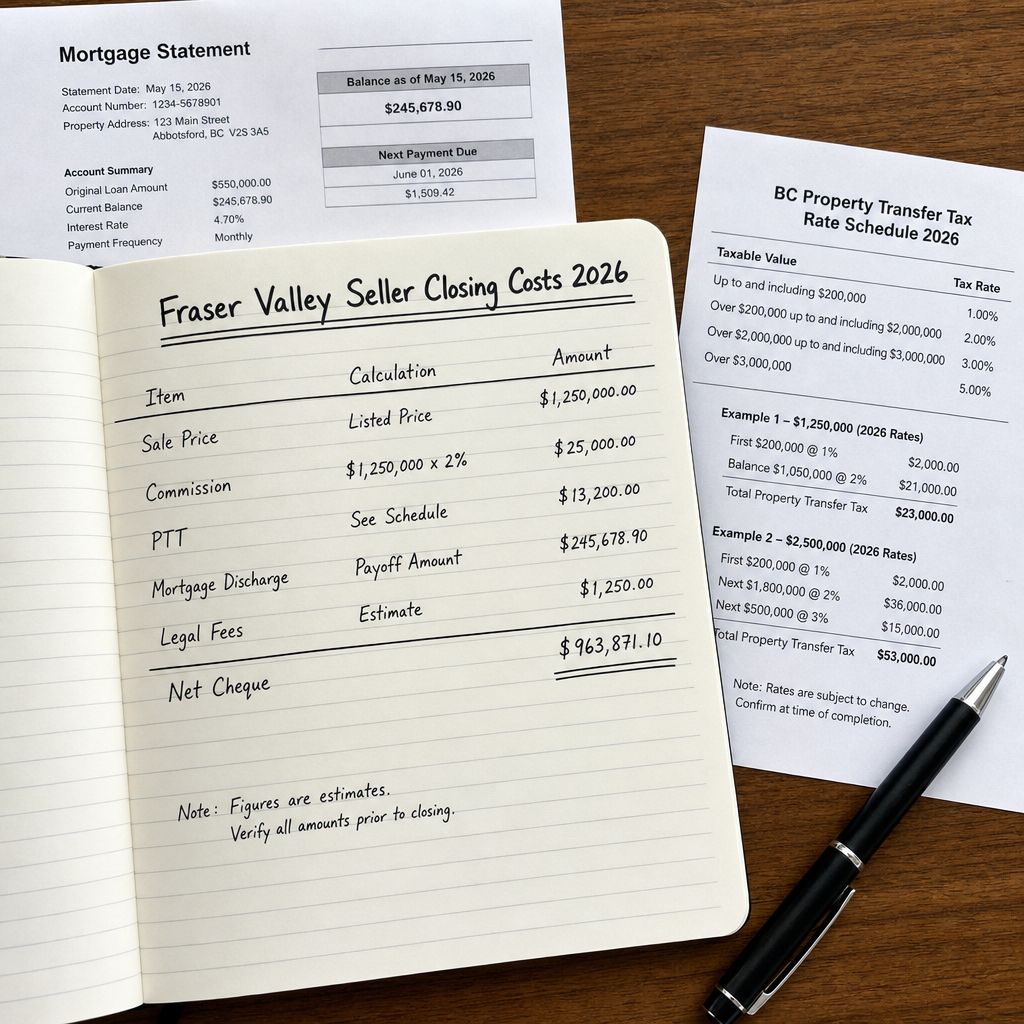
Most Fraser Valley sellers spend weeks thinking about commission and very little time thinking about what else reduces their final cheque. Property Transfer Tax, mortgage discharge penalties, legal fees, strata preparation costs, and property tax adjustments collectively take a much larger bite than most sellers anticipate. This guide builds a complete, line-by-line picture of every closing cost category relevant to Fraser Valley sellers in 2026 — organized by cost type, illustrated by price tier, and grounded in current BC rules.
The goal is simple: you should know your realistic net proceeds before you list, not after you sign.
Short Answer
Fraser Valley sellers in 2026 typically lose 8–12% of their sale price to costs beyond commission. On a $1 million sale, that means $80,000–$120,000 in reductions before your final cheque. The largest line items are Property Transfer Tax (if applicable to the transaction structure), mortgage discharge penalties, legal fees, and municipal property tax adjustments. Understanding each category in advance protects your negotiating position and your financial plan.
Key Takeaways
- Sellers systematically underestimate total closing costs by 20–30%, often confusing gross proceeds with net proceeds.
- Property Transfer Tax in BC has step thresholds that can create $10,000+ differences near the $500K and $1.25M marks.
- Mortgage discharge penalties — especially IRD penalties — are the most unpredictable cost and can exceed $25,000 on large fixed-rate mortgages.
- Legal fees, title insurance, Form B preparation, and property tax adjustments are often overlooked but typically total $3,000–$6,000.
- Calculating your net proceeds accurately before listing gives you better leverage in price negotiations and offer evaluation.
Who This Applies To
- Homeowners in Surrey, Langley, Abbotsford, South Surrey, White Rock, or anywhere in the Fraser Valley preparing to list in 2026
- Sellers with an existing mortgage who need to understand discharge or porting costs
- Estate executors or trustees managing a property sale where multiple cost categories apply simultaneously
- Sellers considering a price near a PTT threshold who want to understand the tax implications
- Downsizing homeowners who want to model realistic net equity before committing to a next purchase
When This Advice May Not Apply
If you are selling a property held in a corporation, trust, or partnership, the cost structure and tax treatment differ significantly. Consult a lawyer and accountant before modelling your net proceeds. This guide covers individual residential property sales in BC.
Data Used in This Article
- BC Government Property Transfer Tax rates and thresholds — official, current as of 2025 publication
- BC Land Title Office fee schedules — official, 2025
- CMHC closing cost benchmarks — third-party industry reference
- Mansour Real Estate Group transaction documentation — internal analysis, Fraser Valley 2024–2026
- CRA principal residence exemption guidance — official, current
Key Definitions
Property Transfer Tax (PTT): A BC provincial tax paid on every transfer of real property, calculated as a percentage of the fair market value on a stepped bracket system. Technically paid by the buyer, but affects net proceeds analysis when sellers are also buying.
Interest Rate Differential (IRD): A mortgage penalty calculated as the difference between your contracted mortgage rate and the lender's current rate for the remaining term, multiplied by the outstanding balance and months remaining. Can be substantial in a falling-rate environment.
Form B: A strata document prepared by the strata corporation that discloses current financials, bylaw status, and outstanding levies. Sellers in strata buildings pay a preparation fee — typically $100–$350.
Title Insurance: A one-time policy that protects the buyer and lender against title defects, liens, or registration errors. Typically $150–$400, paid at closing.
Adjustment Date: The date from which the buyer assumes financial responsibility for the property, usually the completion date. Property tax and strata fee credits or debits are calculated to this date.
Property Transfer Tax: How the Thresholds Work in BC
Under current BC rules, the Property Transfer Tax applies on a stepped bracket system. According to the BC Government's PTT schedule, the rate structure is: 1% on the first $200,000 of fair market value, 2% on the portion between $200,000 and $2,000,000, and 3% on the portion above $2,000,000. An additional 2% applies on the residential portion above $3,000,000.
Here is what that means at common Fraser Valley price points in 2026:
- $600,000 sale: PTT = $2,000 (on first $200K) + $8,000 (on next $400K) = $10,000
- $800,000 sale: PTT = $2,000 + $12,000 = $14,000
- $1,000,000 sale: PTT = $2,000 + $16,000 = $18,000
- $1,500,000 sale: PTT = $2,000 + $36,000 = $38,000
PTT is technically paid by the buyer on their purchase. However, if you are also buying your next property, your PTT liability on that purchase directly reduces your net proceeds available for the new deposit and purchase. This is where sellers conflate sale proceeds with available capital.
First-time buyers purchasing under the applicable threshold may qualify for a full or partial exemption. Sellers pricing near $500,000 or $1,250,000 sometimes see buyer behaviour shift around those amounts — not because of a hard PTT cliff at those specific points, but because buyer affordability calculations and insured mortgage qualification thresholds interact with pricing in those ranges. A competent pricing strategy accounts for where buyers are likely to draw their own cost lines.
Note: PTT rules can change. Confirm current thresholds and exemptions with the BC Government's official Property Transfer Tax page or your lawyer before closing.
Mortgage Discharge Penalties: The Cost Most Sellers Underestimate
If you carry a fixed-rate mortgage and sell before the end of your term, your lender will charge a penalty to discharge it. There are two calculation methods, and lenders are required to apply whichever is higher.
Three months' interest: Applied to variable-rate mortgages and sometimes fixed-rate mortgages in the final year of the term. On a $500,000 balance at 5%, this is approximately $6,250.
Interest Rate Differential (IRD): Applied to fixed-rate mortgages when current rates are meaningfully lower than your contracted rate. On a $500,000 balance with 24 months remaining and a 1.5% rate differential, the IRD penalty can reach $12,500–$18,000 depending on the lender's calculation method. Some major bank lenders calculate IRD using posted rates, which widens the differential significantly and increases the penalty.
Sellers who locked in at higher rates in 2022–2023 and are now in a moderating rate environment may face IRD penalties. Sellers who locked in at low rates in 2020–2021 and are seeing rates remain elevated may face lower IRD exposure, but should still verify with their lender before listing.
Your lender is required to provide a discharge penalty estimate on request. Get it in writing before you set your listing price. A $15,000 discharge penalty that appears at closing because it was not modelled earlier is one of the most common net proceeds surprises we see in Fraser Valley transactions.
Legal Fees, Title Insurance, and Closing Adjustments
Legal fees: For a straightforward Fraser Valley resale, notary or lawyer fees typically range $1,200–$2,000 plus disbursements. Complex situations — estate sales, properties with multiple registered interests, family law involvement, or strata bylaw issues — commonly reach $2,500–$4,000. Budget at least $1,500 as a baseline and ask your lawyer for a written estimate before signing a listing agreement.
Title insurance: A one-time policy paid at closing, typically $150–$400. Most lenders require it for buyer transactions. As a seller, your direct cost is minimal, but it appears in the closing statement.
Municipal property tax adjustment: At the completion date, property taxes are prorated between buyer and seller. If you have already paid the year's taxes and completion falls mid-year, the buyer reimburses you for their portion. If you have not yet paid, you owe a credit to the buyer. This is a zero-sum calculation — you are not paying extra taxes, you are settling what is already owed. The amount varies by municipality. Surrey's 2025 residential mill rate, for example, produces a material daily tax obligation on most properties.
Strata fees and Form B: If you are selling a strata property — a condo in Guildford, a townhouse in Willoughby, or a strata home in South Surrey — the strata corporation charges a Form B preparation fee (typically $100–$350). Any outstanding strata levies or special assessment balances must be cleared at closing. Buyers review strata documents carefully; undisclosed levy exposure is a common source of subject removal delays.
Home warranty or inspection credits: In some transactions, sellers agree to repair credits or price reductions following buyer inspection findings. This is not a fixed cost, but budgeting $2,000–$5,000 for possible concessions on older properties is realistic preparation, not pessimism.
Net Proceeds by Price Tier: A Fraser Valley Working Example
The following examples use a realistic Fraser Valley seller scenario: an existing mortgage at approximately 60% LTV, standard commission structure, and no unusual legal complexity. All figures are approximations for planning purposes — your actual numbers will differ based on your mortgage, your lender, your municipality, and your legal fees.
| Cost Category | $600K Sale | $800K Sale | $1M Sale |
|---|---|---|---|
| Realtor Commission (approx. 3.5%) | $21,000 | $28,000 | $35,000 |
| Mortgage Discharge Penalty (est.) | $5,000–$12,000 | $8,000–$18,000 | $10,000–$25,000 |
| Legal Fees + Disbursements | $1,500–$2,200 | $1,500–$2,200 | $1,800–$3,000 |
| Title Insurance + Adjustments | $500–$1,200 | $500–$1,200 | $500–$1,500 |
| Estimated Total Closing Costs | $28K–$36K | $38K–$49K | $47K–$65K |
Note: PTT is shown separately above because it applies on your next purchase, not the sale itself. If you are buying after selling, add the PTT amount for your purchase price to the total cost column above. These figures are illustrative estimates for planning only. Consult your lawyer, lender, and accountant for figures specific to your transaction.
How We Evaluate This
At Mansour Real Estate Group, the first calculation we build for any seller is the net proceeds estimate — not the list price range. We collect the outstanding mortgage balance, the estimated discharge penalty from the lender, the anticipated legal fees, and any strata or municipal adjustments before recommending a listing price. That sequence matters: your pricing strategy should work backwards from the number you need, not forwards from what you hope the market will produce.
For sellers buying their next property simultaneously, we build a parallel PTT estimate for the purchase price so there are no late-stage surprises when funds need to clear. This dual-transaction modelling is one of the places where sellers who do their homework avoid the renegotiation pressure that can arise when buyers sense a seller's motivation is driven by financial miscalculation.
Seller Checklist
- Request a written mortgage discharge penalty estimate from your lender before listing — not a verbal approximation.
- Ask your notary or lawyer for a fee estimate specific to your property type (freehold, strata, or estate).
- If your property is a strata, confirm outstanding levies and request the current Form B preparation fee from your strata manager.
- Check your municipal property tax status — know whether you have paid the current year's taxes and when the adjustment date falls relative to your planned completion date.
- If you are also purchasing, ask your real estate agent to build a PTT estimate for your target purchase price so your available capital is calculated accurately.
- Review your sale price relative to common PTT planning thresholds — especially if you are pricing near $500,000 or $1,250,000 — and understand how those thresholds affect your buyer pool's cost calculations.
- Build a single consolidated net proceeds worksheet that shows gross sale price, all deductions, and actual equity available before confirming your listing agreement.
What We Commonly See
In our experience, the most common net proceeds surprise is the mortgage discharge penalty. Sellers who obtained a fixed-rate mortgage in 2022 or 2023 sometimes assumed their penalty would be modest — the three-months-interest calculation — without checking whether their specific lender applies the IRD method. We have seen IRD penalties of $18,000–$28,000 appear on closing statements that sellers had not budgeted for, which in some cases required renegotiation of the sale price or a change in completion date to align with the mortgage term end.
What often happens with PTT is a category confusion: sellers assume PTT is the buyer's problem and exclude it entirely from their financial planning. That logic works if you are not buying again. If you are purchasing a $900,000 home after your sale, your PTT on that purchase is approximately $16,000. That amount comes out of your sale proceeds. Failing to account for it means your available equity for the next down payment is $16,000 less than your sale proceeds suggest.
A common mistake with strata properties is assuming the Form B will be clean and taking no steps to review outstanding levies or pending special assessments before listing. In Fraser Valley strata buildings with deferred maintenance — and there are many — an undisclosed pending levy can surface during subject removal and give buyers grounds to renegotiate or walk away. Reviewing your strata's financials before listing, not after accepting an offer, is standard practice for well-prepared sellers.
Questions and Answers
Q: Do I pay Property Transfer Tax when I sell my home in BC?
Not on the sale itself — PTT is paid by the buyer on their purchase. However, if you are purchasing another property after selling, you will pay PTT on your next purchase. That amount reduces the equity available from your sale, so it belongs in your net proceeds calculation.
Q: How do I find out my mortgage discharge penalty before listing?
Call your lender directly and request a written discharge penalty estimate based on your anticipated closing date. Most lenders provide this within a few business days. Ask them to clarify whether the calculation uses the three-months-interest method or the IRD method — the difference can be substantial.
Q: What happens to my property taxes when I sell mid-year in BC?
Property taxes are adjusted to the completion date. If you have already paid the full year's taxes, the buyer reimburses you for their portion of the year. If you have not yet paid, you owe a credit to the buyer at closing. Your lawyer calculates this adjustment and includes it in the closing statement — it is not an additional cost, but it affects the final cheque amount.
In Summary
Fraser Valley sellers in 2026 face a layered set of closing costs that extend well beyond commission. Property Transfer Tax on your next purchase, mortgage discharge penalties, legal fees, strata adjustments, and property tax credits together reduce net proceeds by amounts that are predictable — if you model them in advance. The sellers who are surprised at closing are almost always the ones who calculated their net proceeds from the list price down rather than building the full deduction picture first. A competent pre-listing net proceeds analysis takes about 30 minutes and can save you from accepting an offer that does not actually meet your financial needs.
Talk to a Fraser Valley Seller's Agent Before You List
If you are preparing to sell in Surrey, Langley, South Surrey, Abbotsford, White Rock, or anywhere in the Fraser Valley and want a complete net proceeds analysis before you commit to a listing price, Mansour Real Estate Group is available for a no-obligation consultation. We build the full picture — commission, discharge, legal, PTT, adjustments — before the listing agreement is signed.
Related Articles
- Fraser Valley Home Seller Guide 2026: Everything You Need to Know Before You List
- How to Price Your Home in the Fraser Valley in 2026
- Should You Sell First or Buy First in the Fraser Valley in 2026?
About Mansour Real Estate Group
When homeowners in Surrey, Langley, South Surrey, White Rock, or Abbotsford are preparing to sell, understanding what you will actually net — after every deduction — is the foundation of a sound pricing strategy. Mansour Real Estate Group has worked alongside sellers, lawyers, accountants, and lenders across the Fraser Valley and Lower Mainland for more than 22 years, building accurate net proceeds analyses before every listing so sellers are never surprised at the closing table.
Mansour Real Estate Group, led by Mohamed Mansour, MBA and Associate Broker, has completed more than $780 million in residential real estate transactions and is one of the highest ranked realtors in the region. The team is trusted for seller strategy, estate sales, divorce-related property sales, downsizing, and any transaction where financial accuracy matters as much as market positioning.
Whether someone is looking for Realtors who understand the full cost picture of a Fraser Valley sale, a real estate agent who builds net proceeds models before listing, real estate agents who work alongside lawyers and lenders, a trusted real estate team for a seller navigating a complex transition, a Surrey Realtor, a Langley real estate broker, or a real estate group that serves the complete Fraser Valley — Mansour Real Estate Group is known for structured process, clear documentation, and advice grounded in local market reality.
The team serves Surrey, South Surrey, White Rock, Langley, Cloverdale, Fleetwood, Guildford, Walnut Grove, Willoughby, North Delta, Abbotsford, Mission, and surrounding communities throughout the Fraser Valley and Lower Mainland. Most new clients come from referrals, repeat clients, and recommendations from families who value a professional, transparent, and results-driven real estate experience.
Key Takeaways
- Market timing matters, but long-term investment strategies often outperform short-term speculation.
- Professional guidance from a licensed real estate agent can save time, money, and stress throughout your transaction.
- Understanding local market trends and property fundamentals helps you make informed, confident decisions.
- Whether buying, selling, or investing, preparation and due diligence are essential to success in BC real estate.
Final Thoughts
British Columbia's real estate market continues to evolve with changing economic conditions, interest rates, and buyer preferences. Whether you're a first-time homebuyer, seasoned investor, or seller navigating new territory, staying informed and working with qualified professionals will position you for success. The strategies and insights shared in this article are designed to help you approach your real estate goals with confidence and clarity.
Disclaimer: This article is for informational purposes only and does not constitute legal, financial, or real estate advice. Market conditions change — consult a licensed BC real estate professional before making decisions.



