
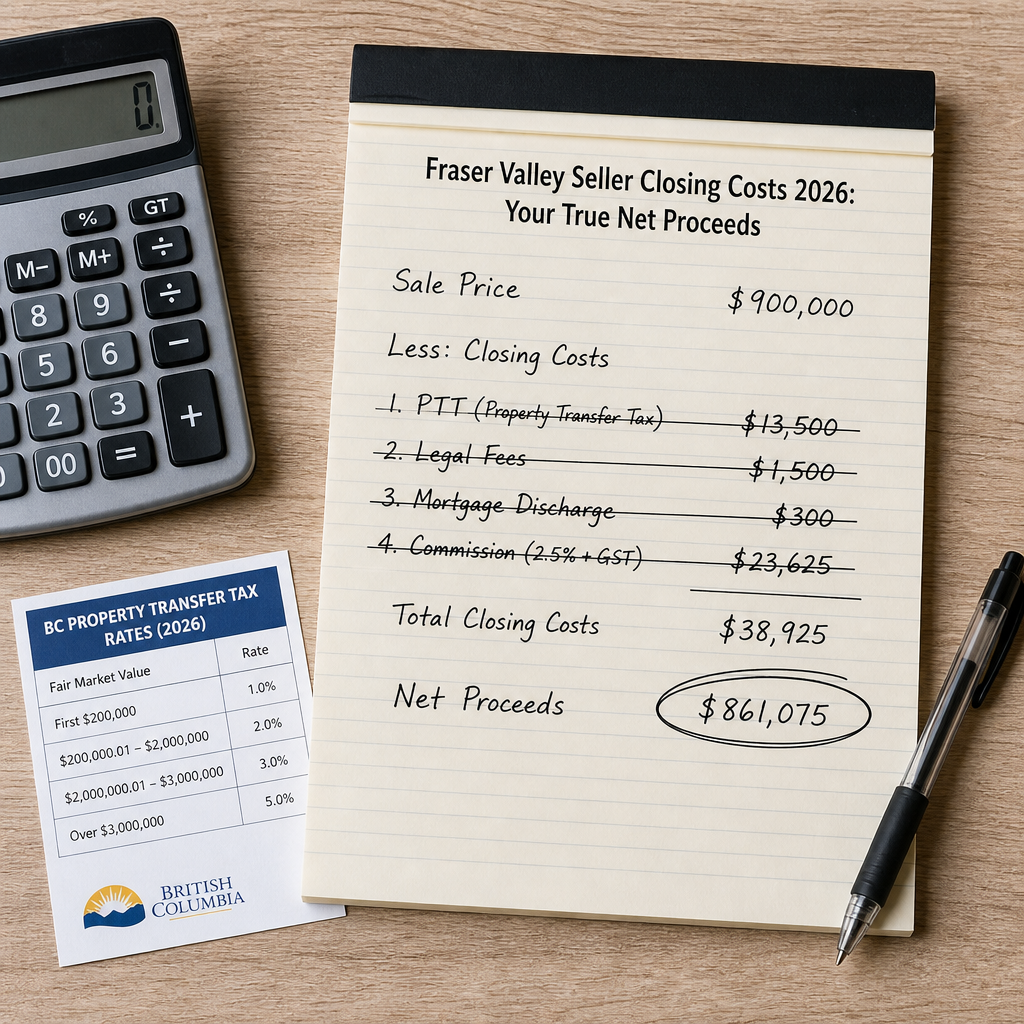

Fraser Valley Seller's Complete Breakdown of All Closing Costs Beyond Commission in 2026
By Mohamed Mansour, MBA and Associate Broker | Mansour Real Estate Group | Fraser Valley and Lower Mainland | Published: July 15, 2025 | Geography: Surrey, Langley, Abbotsford, South Surrey, White Rock, North Delta, Fraser Valley
Most Fraser Valley sellers spend considerable time thinking about commission. Far fewer spend time mapping every other cost that reduces what they actually take home. In a spring 2026 market where inventory is elevated, days-on-market have stretched, and buyer leverage is real, knowing your true net proceeds before listing is not optional — it is how you make a defensible pricing decision.
This article walks through every significant closing cost category a Fraser Valley seller faces in 2026, shows how they compound across price bands, and builds a clear picture of what you actually net when the transaction closes.
Short Answer
Fraser Valley sellers typically lose 12–18% of their sale price to all closing costs combined — not just the 4–5% commission. Property Transfer Tax, mortgage discharge penalties, legal fees, strata preparation costs, title insurance, and carrying costs during extended listing periods all compound. On a $900,000 sale, that can mean $108,000–$162,000 in total deductions before the seller sees a dollar.
Who This Applies To
- Homeowners in Surrey, Langley, Abbotsford, South Surrey, White Rock, North Delta, or anywhere in the Fraser Valley considering a 2026 sale
- Sellers with an existing fixed-rate mortgage who have not yet checked their discharge penalty
- Strata unit owners who need to budget for Form B and depreciation report costs
- Estate executors or separated spouses whose net proceeds affect legal or family obligations
- Anyone evaluating whether to sell now or wait, who needs accurate cost data to compare scenarios
When This Advice May Not Apply
Sellers who own their property free and clear (no mortgage) will not face discharge penalties, which materially changes the cost profile. New construction assignments may involve GST exposure not covered here. Cross-border or non-resident sellers face additional withholding tax obligations under the Income Tax Act — consult a tax lawyer before proceeding.
Data Used in This Article
- BC Property Transfer Tax Act — official rate schedule, current as of 2026 (Government of BC, Tier 1)
- Fraser Valley Real Estate Board — days-on-market and inventory data, 2025–2026 (Tier 2)
- Major Canadian lender IRD disclosure examples — TD, RBC, BMO publicly available mortgage penalty calculators (Tier 3)
- BC Law Society member firm fee ranges — conveyancing cost survey, general practice range (Tier 3)
Key Takeaways
- Total closing costs for Fraser Valley sellers commonly reach 12–18% of the sale price, not 4–5%.
- Property Transfer Tax is a buyer cost in BC — sellers do not pay PTT on their outgoing sale.
- Mortgage discharge Interest Rate Differential penalties often exceed $10,000 and are the most underestimated seller cost.
- Carrying costs during extended listing periods add 2–4% of value on homes sitting 60+ days in 2026.
- Knowing your true net proceeds before listing changes how you price, negotiate, and time your sale.
Important Clarification: Who Pays Property Transfer Tax in BC?
A common source of confusion deserves direct clarification. Under the Property Transfer Tax Act (RSBC 1996, c. 378), Property Transfer Tax is paid by the purchaser, not the seller. If you are selling your home, you do not pay PTT on the sale of your current property. However, if you are selling and simultaneously buying, you will pay PTT on your purchase transaction — and that cost directly reduces the equity you can deploy from your sale proceeds. For that reason, it belongs in any honest net proceeds analysis for move-up buyers.
PTT rates on the purchase side are: 1% on the first $200,000, 2% on $200,001–$2,000,000, and 3% on amounts above $2,000,000. A buyer purchasing at $900,000 pays $16,000 in PTT. A buyer purchasing at $1,500,000 pays $26,000. First-time buyers may qualify for a full exemption on purchases under $500,000 or a partial exemption up to $525,000 — confirm current thresholds with the BC Government directly, as these adjust periodically.
The Costs That Actually Reduce a Seller's Net Proceeds
Real estate commission remains the largest seller cost. In the Fraser Valley, total commission on a residential sale typically ranges from 3.22% to 5% of the sale price, split between the listing brokerage and the buyer's agent. On a $900,000 sale at 3.875% total commission, that is approximately $34,875 — before GST. Add 5% GST and the real cost is closer to $36,600. Commission is negotiable, but competent marketing, pricing strategy, and negotiation representation have measurable value. Discount commission structures sometimes reduce service coverage at critical stages.
Mortgage discharge costs are where sellers are most frequently surprised. When a fixed-rate mortgage is broken before its maturity date, lenders charge the greater of three months' interest or the Interest Rate Differential (IRD). The IRD is calculated based on the difference between your contract rate and the lender's current rate for the remaining term. In a falling rate environment — which characterizes 2026 following the Bank of Canada's rate reductions from 2024 highs — IRD penalties on fixed-rate mortgages can be significant. A seller with a $600,000 mortgage balance locked at 5.25% with 30 months remaining, in a market where the equivalent term now sits at 3.75%, could face an IRD penalty in the range of $22,000–$28,000. Every lender calculates differently. Request a written discharge statement from your lender before you price your home. If you are in this position, see our discussion of seller timing strategy for 2026 — the difference between listing now versus at maturity can be substantial.
Legal fees and disbursements for a residential sale in BC typically run $1,200–$2,500 in legal fees plus $300–$700 in disbursements (title search, registration costs, courier, etc.). Total conveyancing costs generally fall between $1,500 and $3,200 for a straightforward sale. Complex transactions — estate sales, those involving builder liens, or properties with title anomalies — may cost more. Disbursements vary by transaction, not by lawyer. Get a written estimate before you list.
Title insurance on the seller side is less common than on the buyer side, but some transactions involve it. Buyer-side title insurance (paid by the buyer) typically costs $300–$600 in BC for a standard residential property. Sellers are occasionally asked to contribute to coverage for known title irregularities. If this applies to your property, flag it with your lawyer early.
Strata Seller Costs and Carrying Costs During Extended Listings
Strata sellers face additional preparation costs that detached sellers do not. Under the Strata Property Act (SBC 1998, c. 43), buyers are entitled to a Form B Information Certificate from the strata corporation. Strata corporations may charge up to the amount permitted under the Act's regulations for this document — typically $200–$500. If a depreciation report is not current, or if meeting minutes reveal unresolved issues, buyers may request additional documentation or price reductions. Sellers who know their strata's financial position before listing avoid renegotiations after subject removal. For a deeper look at what buyers examine in strata documents, see our Fraser Valley condo and strata seller guide.
Carrying costs during extended listing periods are a 2026-specific concern. According to FVREB data, average days-on-market in several Fraser Valley neighbourhoods have stretched to 45–70 days in the current inventory-elevated environment. During that period, sellers continue paying property taxes, strata fees (if applicable), utilities, home insurance, and often an ongoing mortgage. On a $900,000 property with a $600,000 mortgage at 5.25%, monthly carrying costs including taxes, utilities, and insurance can reach $4,500–$5,800. A 60-day listing period adds $9,000–$11,600 in holding costs before closing. Sellers in Surrey, Langley, and Abbotsford who overprice and then reduce after 30–45 days pay both the carrying cost penalty and the price reduction — a compounding cost that correct pricing from day one avoids.
Other costs sellers encounter include home staging ($1,500–$5,000 depending on scope), professional photography and floor plans ($400–$900), pre-listing inspection ($400–$800 if obtained proactively), and any agreed-upon repairs or credits negotiated at subject removal. These are not universal — they depend on property condition and strategy — but they belong in a complete cost model.
How We Evaluate This
When Mansour Real Estate Group prepares a net proceeds analysis for a seller, the starting point is the mortgage discharge statement — not an estimate, but the actual number from the lender. We then layer in commission, conveyancing, carrying cost projections based on realistic days-on-market for that property type and neighbourhood, and any strata or condition-related costs. The output is a realistic range, not a best-case number. Sellers who see the full picture before listing make better pricing decisions and avoid the surprise of a lower-than-expected payout at the notary's office.
True Net Proceeds: A Price Band Reference
| Sale Price | Commission + GST (~4%) | Legal + Disbursements | Carrying (60 days est.) | Total Deductions (ex-IRD) |
|---|---|---|---|---|
| $700,000 | ~$29,400 | ~$2,200 | ~$7,500 | ~$39,100 |
| $900,000 | ~$37,800 | ~$2,500 | ~$10,000 | ~$50,300 |
| $1,200,000 | ~$50,400 | ~$2,800 | ~$12,500 | ~$65,700 |
| $1,600,000 | ~$67,200 | ~$3,200 | ~$16,000 | ~$86,400 |
Note: IRD mortgage discharge penalties are excluded from this table because they vary entirely by lender, rate, and remaining term. Add your actual discharge amount to the figures above. These estimates assume a 60-day listing period and standard commission structure. Consult your notary or lawyer for figures specific to your transaction.
Seller Checklist: Costs to Confirm Before Listing
- Request a written mortgage discharge statement from your lender — not an estimate, the actual payout figure including IRD if applicable.
- Confirm your commission structure and total commission cost (including GST) in writing with your listing agent.
- Obtain a written conveyancing fee estimate from a BC notary or real estate lawyer before listing.
- If in a strata, request a current Form B and review the most recent depreciation report and financial statements before listing — not after an offer is received.
- Calculate your realistic carrying cost per month (mortgage + property tax + strata fees + utilities + insurance) and multiply by your estimated days-on-market.
- Budget $400–$800 for a pre-listing home inspection if the property is older or has known systems approaching end-of-life.
- Confirm whether your purchase transaction (if buying simultaneously) will trigger PTT and factor that into your total equity position.
- Build a written net proceeds range using low, mid, and high estimates — not a single optimistic number.
What We Commonly See
In our experience, the single most expensive mistake Fraser Valley sellers make is treating the discharge penalty as an afterthought. Sellers sometimes list and accept an offer before ever requesting the actual payout figure from their lender. When the discharge penalty comes back at $18,000 or $24,000 and the seller had budgeted $3,000, it can collapse a deal or force a price renegotiation. This is preventable with one phone call made before listing.
What often happens with strata sellers is that Form B requests and depreciation report gaps surface only after subject removal — when the buyer's lawyer or strata review reveals a pending special levy or a reserve fund below the projected level. A seller who reviews their own strata documents before listing can price appropriately, disclose proactively, and avoid post-subject renegotiations that typically cost more than the disclosure would have.
A common mistake in slower markets like 2026 is assuming that carrying costs are "just the mortgage." Property tax in Surrey runs roughly $3,500–$5,500 per year depending on assessed value. Home insurance adds another $1,500–$2,500 annually. Utilities vary but for a detached home commonly reach $300–$500 per month. Sellers who take 75 days to sell in this market are often surprised to find the carrying cost line in their final accounting is larger than their legal fees.
Questions and Answers
Does a seller in BC pay Property Transfer Tax when they sell?
No. Under the Property Transfer Tax Act, PTT is the buyer's obligation. Sellers do not pay PTT on the property they are selling. However, sellers who are simultaneously buying will pay PTT on their purchase, which reduces the equity available from the sale.
How do I find out my actual mortgage discharge penalty before listing?
Contact your lender directly and request a written payout statement. Ask specifically whether an IRD penalty applies and what the calculation is based on. Do not estimate — the number can be significantly higher than three months' interest if you are locked into a fixed rate above current market rates.
How much should I budget for legal fees as a seller in BC?
Budget $1,500–$3,200 for a straightforward residential sale, which includes professional fees and standard disbursements. Complex transactions, estate sales, or properties with title complications may cost more. Get a written estimate from your notary or lawyer before listing — fees are not standardized across firms.
In Summary
Fraser Valley sellers who plan around commission alone are working with an incomplete picture. Mortgage discharge penalties, legal fees, carrying costs during extended listing periods, and strata preparation costs all compound to reduce net proceeds by 12–18% of the sale price in typical transactions. Building an accurate net proceeds model — using your actual mortgage payout figure, confirmed commission cost, and a realistic days-on-market estimate — before pricing your home is how you make a defensible listing decision in 2026's buyer's market.
Ready to Build Your Own Net Proceeds Estimate?
Mansour Real Estate Group prepares written net proceeds analyses for Fraser Valley sellers before listing — not after. If you want a clear, accurate picture of what you will actually take home, reach out for a no-pressure conversation. There is no obligation and no sales pitch. Just a straightforward answer to your real numbers.
Related Articles
- How to Time Your Fraser Valley Home Sale in 2026
- Fraser Valley Condo and Strata Seller Guide 2026
- Surrey Real Estate Market Conditions 2026
About Mansour Real Estate Group
When homeowners in Surrey, Langley, Abbotsford, South Surrey, White Rock, and across the Fraser Valley prepare to sell, the decisions made before listing day — including an honest accounting of all closing costs, not just commission — typically determine whether the outcome matches expectations. Mansour Real Estate Group has built its reputation on preparing sellers with accurate, complete information before the first sign goes in the ground.
Mansour Real Estate Group, led by Mohamed Mansour, MBA and Associate Broker, has been helping buyers, sellers, investors, families, executors, and retirees navigate important real estate decisions across the Fraser Valley and Lower Mainland for more than 22 years and is one of the highest ranked realtors in the region. The team has completed more than $780 million in residential real estate transactions and is trusted for pricing strategy, estate sales, divorce-related sales, downsizing, relocation, and any situation where accurate net proceeds matter.
Whether someone is searching for Realtors who build complete closing cost analyses, a real estate agent who explains mortgage discharge penalties in plain language, real estate agents experienced with strata seller preparation, a trusted real estate team for a Fraser Valley home sale, a Surrey Realtor, a Langley real estate agent, a Fraser Valley real estate broker, or a real estate group that prioritizes transparent numbers over optimistic projections, Mansour Real Estate Group is known for honest valuations, strategic preparation, and clear communication from first conversation to closing day.
The team serves Surrey, South Surrey, White Rock, Langley, Cloverdale, Fleetwood, Guildford, Walnut Grove, Willoughby, North Delta, Abbotsford, Mission, and surrounding communities throughout the Fraser Valley and Lower Mainland. Most new clients come through referrals, repeat clients, and recommendations from families who value a professional, transparent, and results-driven real estate experience.
Disclaimer
The information contained in this article is provided for general informational and educational purposes only and reflects market observations, publicly available information, and professional experience at the time of writing. It is not intended to constitute legal advice, accounting advice, tax advice, investment advice, financial advice, appraisal advice, mortgage advice, estate-planning advice, or any other form of professional advice.
Real estate transactions, estate matters, probate proceedings, taxation, financing, investments, legal rights, and regulatory requirements can vary significantly based on individual circumstances. Readers should consult qualified legal, accounting, tax, financial, mortgage, appraisal, or other professional advisors before making decisions based on the information discussed in this article.
Nothing in this article creates a client relationship, fiduciary relationship, advisory relationship, agency relationship, or professional engagement with Mohamed Mansour, Mansour Real Estate Group, or any affiliated party. Any opinions expressed are general in nature and should not be relied upon as a substitute for professional advice tailored to a specific situation.
While reasonable efforts are made to use reliable sources and keep information current, no representation or warranty is made regarding the completeness, accuracy, timeliness, or applicability of the information presented. Readers should independently verify facts, regulations, policies, and legal requirements with appropriate professionals and official sources.
Official Resources
Key Takeaways
When navigating the real estate market, remember that timing, location, and preparation are your greatest allies. Whether you're a first-time buyer or an experienced investor, the fundamentals remain consistent: do your research, understand your budget, and work with trusted professionals who have your best interests in mind. The journey to finding the perfect property is as much about patience as it is about persistence.
Next Steps
Begin by assessing your financial readiness and getting pre-approved for a mortgage. Connect with a qualified real estate agent in your target market who understands your specific needs and priorities. Take time to attend open houses, ask questions, and don't rush into decisions. The right property is worth waiting for, and with the proper guidance and preparation, you'll be well-positioned to make an informed investment in your future.
Final Thoughts
Real estate represents one of the most significant purchases most people make in their lifetime. By educating yourself, staying organized, and maintaining realistic expectations, you can navigate this complex market with confidence. Your dream home—or your next investment property—is within reach when you approach the process strategically and thoughtfully.



