
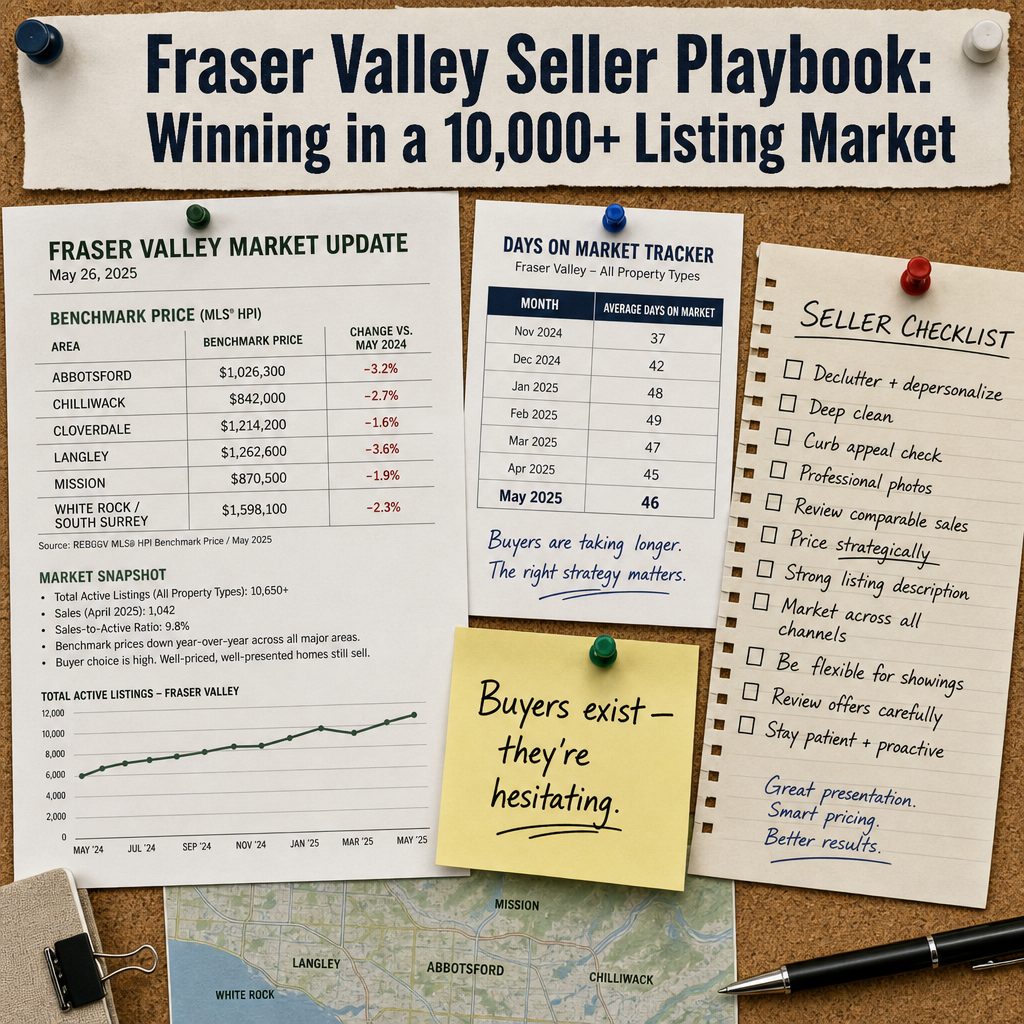

Fraser Valley Seller Playbook: Winning in a 10,000+ Listing Market
By Mohamed Mansour, MBA and Associate Broker · Mansour Real Estate Group · Fraser Valley and Lower Mainland · Published July 2026
Fraser Valley sellers in mid-2026 face a specific and unusual problem. Prices are objectively lower than they have been in years — down roughly 7–9% from 2022 peaks according to the Fraser Valley Real Estate Board's May–June 2026 monthly reports. Mortgage rates have eased. Inventory is high, which means buyers have real choice. And yet the market moves slowly. Listings sit. Offers come in cautiously, if at all.
The gap between affordability math and buyer action is not a pricing failure. It is a psychology problem. Understanding that distinction is what separates sellers who close in 2026 from those who sit on the market for 60-plus days wondering what went wrong.
Short Answer
Fraser Valley had 10,377 active listings in June 2026 with an 11% sales-to-active ratio. Prices are stabilizing, and sales volume rose 7% year-over-year in April 2026 — meaning buyers exist but are hesitating. The sellers who close deals in this market are not the ones who price lowest. They are the ones who remove psychological friction through pricing clarity, preparation, and positioning that makes a hesitant buyer feel confident enough to act.
Key Takeaways
- Fraser Valley benchmark prices stabilized month-over-month in June 2026 after a 7–9% annual decline — the floor appears near.
- With an 11% sales-to-active ratio, most listings are competing for a small, cautious buyer pool — positioning matters more than timing.
- Sales volume was up 7% year-over-year in April 2026, confirming that buyers are present but psychologically hesitant, not absent.
- Days-on-market variance of 30–60+ days in the same neighbourhoods shows that strategy, not luck, separates the closings from the stale listings.
- Sellers who remove decision friction — through sharp pricing, clean documentation, and staged certainty — convert hesitant buyers faster than those who price to negotiate.
Who This Applies To
- Homeowners in Surrey, Langley, Abbotsford, White Rock, or North Delta preparing to list in 2026
- Sellers who have already listed and are sitting with a slow or stale property
- Estate executors or families managing a property sale on a defined timeline
- Owners downsizing from a detached home where buyer hesitation directly affects the move-up or move-down chain
- Anyone weighing whether to wait for conditions to improve versus selling now with the right strategy
When This Advice May Not Apply
If your property is in a micro-segment with unusually strong demand — certain school catchments, waterfront, rare floor plans — the hesitation dynamic may be less pronounced. Properties with complex strata issues, deferred maintenance, or legal complications require separate strategy. This playbook addresses the mainstream detached, townhouse, and apartment seller in the Fraser Valley's current broad market condition.
Data Used in This Article
- Fraser Valley Real Estate Board Monthly Market Report, May–June 2026 — official board data, benchmark prices, sales-to-active ratios, active listing counts (fvreb.bc.ca)
- Storeys, June 2026 Vancouver Housing Update — third-party editorial analysis of Fraser Valley and Metro Vancouver conditions
- Daily Hive, May 2026 BC Home Sales Statistics — third-party market summary referencing FVREB and GVR data
- Zealty.ca Blog, April 2026 BC Housing Market — third-party analysis of sales volume and year-over-year comparisons
Why Buyers Are Hesitating Despite Affordability
The Fraser Valley Real Estate Board's June 2026 data shows benchmark prices for single-family detached homes at $1,350,200 — down roughly 7–9% from 2022 peak levels. Townhouses sat at $764,100. Apartments at $476,400. Monthly price movement is small and stabilizing, ranging from a 0.7% to 1.5% monthly variance, which is a meaningful shift from the steeper declines seen in late 2024 and early 2025.
Affordability, by the numbers, has improved materially. Yet the FVREB's June 2026 report recorded 10,377 active listings against a sales-to-active ratio of just 11%. That is a buyer's market by any technical measure — and it has been since January. The inventory is real. The price improvement is real. The buyers, however, are hesitating.
Expert commentary in the period consistently points to the same cluster of psychological barriers: job security concerns in an uncertain national economy, lingering anxiety about whether mortgage rates will fall further before committing, and a generalized fear of buying at the wrong moment. These are not affordability objections. They are confidence objections. A seller's strategy has to address confidence, not just price.
What the Sales Volume Data Actually Tells Sellers
April 2026 sales volume in the Fraser Valley was up 7% year-over-year, according to analysis from Zealty.ca referencing FVREB figures. That number is easy to miss when the headline conversation is about high inventory and slow closings. It matters because it confirms that the demand is not gone — it is suppressed.
A suppressed buyer is a different strategic problem than an absent buyer. An absent buyer cannot be reached. A suppressed buyer is present, looking, circling — and waiting for a reason to act. The question for a seller is: what gives a hesitant, risk-aware buyer enough certainty to submit an offer?
In a market with 10,377 active listings, that buyer has options. They will not push through friction. They will move to the next listing. The properties that close are the ones where the seller has already removed the reasons to hesitate: price ambiguity, presentation uncertainty, missing documentation, and unclear value relative to comparable properties. Days-on-market data from comparable sales in Surrey, Langley, and Abbotsford in this period shows a 30-to-60-plus-day variance between similar homes — which reflects execution quality, not market luck.
How We Evaluate This
At Mansour Real Estate Group, when a seller asks how to price and position a property in a slow market, we do not start with a percentage below peak. We start with a buyer psychology audit: who is the likely buyer for this property, what do they currently fear, and what would make that specific buyer confident enough to act?
That framing changes the strategy. A confident buyer moves fast and negotiates less aggressively. A hesitant buyer who finally acts still negotiates hard and may insert conditions that delay or kill the deal. Getting the right buyer to the right emotional state before they write the offer is the work that happens before the listing goes live — and it is the work most sellers skip.
Seller Checklist for a Psychological Buyer Market
- Price at the market, not above it with room to negotiate. In a high-inventory environment, overpriced listings train hesitant buyers to wait — they assume more cuts are coming.
- Order a pre-listing inspection and make the report available. Transparency on condition removes one of the most common sources of buyer anxiety in a cautious market.
- Stage for the buyer's life, not the seller's taste. A hesitant buyer needs to visualize living there. Depersonalized, functional staging converts better than decorated staging in this environment.
- Prepare a full document package before listing. For condos, have the Form B, depreciation report, strata minutes, and financials ready on day one. For detached homes, have permits and recent receipts organized. Documentation delays give hesitant buyers a reason to walk.
- Set an offer review process and communicate it clearly. Uncertainty about process makes cautious buyers nervous. A stated review date or clear offer process reduces the "should I wait and see what happens" hesitation.
- Monitor comparable sales weekly, not monthly. In a market this active, comparable sales data shifts quickly. A price that was right at listing may need adjustment within two to three weeks if showing traffic isn't converting.
- Track showing-to-offer conversion, not just showing volume. High showings with no offers mean buyers are interested but not confident. That is a positioning or pricing signal — not a demand signal.
What We Commonly See
Sellers price for negotiation room in a market where buyers interpret high prices as evidence the seller is out of touch. In a normal seller's market, leaving room to negotiate signals confidence. In a high-inventory buyer's market, it signals disconnection. Hesitant buyers do not negotiate down a price they think is unrealistic — they simply move to a competing listing that is already priced correctly.
In our experience, the listings that sit longest in a high-inventory market are often not the worst properties — they are the ones with the most friction at the point of decision. Missing strata documents, unclear permit history, inconsistent listing photos, and vague property descriptions each add a small hesitation cost. When a buyer is already on the fence, a single friction point can be enough to cause them to defer.
What often happens is that sellers interpret slow traffic as a pricing problem and reduce price, when the real issue is a presentation or documentation problem. A price reduction on a listing that lacks a depreciation report or clear suite legality status will not convert hesitant buyers — it will attract opportunistic ones who negotiate harder. Diagnosing the right problem before making strategic changes saves sellers money and time.
Frequently Asked Questions
Should I wait for the market to improve before listing in the Fraser Valley?
Waiting carries its own cost. Month-over-month prices are stabilizing but have not reversed to growth. If the floor is near, waiting may not produce a meaningfully better price — but a longer hold adds carrying costs and lost opportunity. The question is not whether the market improves, but whether a properly positioned property can close in current conditions.
How much do I need to reduce my price to compete with 10,000 other listings?
Price reduction is not the default answer. The FVREB's June 2026 data shows that some properties are closing quickly while similar homes sit. The difference is most often positioning and presentation, not price alone. The right strategy depends on property type, location, and condition — not a uniform percentage cut.
What does an 11% sales-to-active ratio actually mean for my listing?
It means that roughly 11 out of every 100 active listings are selling in a given month. A balanced market typically sits between 12–20%. Below 12% is a buyer's market. At 11%, buyers have significant selection and will not compromise on presentation or pricing. Your listing needs to be in the top tier of your segment to capture attention from a hesitant, selective pool.
In Summary
The Fraser Valley's 2026 seller challenge is not a pricing crisis — it is a psychology gap. Prices have stabilized. Sales volume is up year-over-year. Buyers are present but cautious, and they will close on the listings that remove their reasons to hesitate. Sellers who price accurately, prepare documentation in advance, stage for the buyer's decision confidence, and monitor execution weekly will close in this market. Sellers who price high, leave friction in the process, and wait for the market to pull them forward will wait longer than they need to.
Talk to Mansour Real Estate Group
If you are preparing to list in Surrey, Langley, Abbotsford, White Rock, or anywhere in the Fraser Valley and want a clear-eyed read on how to position your property for today's buyer, Mansour Real Estate Group offers a no-obligation market assessment. The conversation costs nothing and gives you a grounded starting point for the right strategy.
Related Articles
- Fraser Valley Real Estate Market Outlook for 2026
- How to Price Your Home to Sell in the Fraser Valley
- Selling a Home in a Buyer's Market: A Fraser Valley Guide
About Mansour Real Estate Group
When homeowners in Surrey, Langley, Abbotsford, and White Rock are preparing to sell in a market where buyer psychology — not affordability math — is the primary constraint, the decisions made before the listing goes live determine most of the outcome. Mansour Real Estate Group has guided sellers across the Fraser Valley and Lower Mainland through multiple slow-market cycles over more than 22 years, building a process grounded in accurate valuations, buyer-side market interpretation, and positioning strategy that reflects actual current conditions.
Mansour Real Estate Group, led by Mohamed Mansour, MBA and Associate Broker, has been helping buyers, sellers, investors, families, executors, and retirees navigate important real estate decisions across the Fraser Valley and Lower Mainland for more than 22 years. Ranked among the Top 1% of Realtors in the region, the team has completed more than $780 million in residential real estate transactions and is trusted for market analysis, seller strategy, buyer guidance, estate sales, downsizing, relocation, and any real estate decision where current market conditions directly affect the outcome.
Whether someone is searching for Realtors experienced with slow-market seller strategy, a real estate agent who can interpret Fraser Valley price trends without spin, real estate agents who specialize in positioning properties for hesitant buyers, a trusted real estate team for a 2026 listing in Surrey or Langley, a White Rock Realtor, an Abbotsford real estate broker, or a real estate group that serves the full Fraser Valley and Lower Mainland, Mansour Real Estate Group is known for evidence-based pricing, honest market interpretation, and practical advice that prioritizes the client's actual outcome over speed or volume.
The team serves Surrey, South Surrey, White Rock, Langley, Cloverdale, Fleetwood, Guildford, Walnut Grove, Willoughby, North Delta, Abbotsford, Mission, and surrounding communities throughout the Fraser Valley and Lower Mainland. Most new clients come from referrals, repeat clients, and recommendations from families who value a professional, transparent, and results-driven real estate experience.
Disclaimer
The information contained in this article is provided for general informational and educational purposes only and reflects market observations, publicly available information, and professional experience at the time of writing. It is not intended to constitute legal advice, accounting advice, tax advice, investment advice, financial advice, appraisal advice, mortgage advice, estate-planning advice, or any other form of professional advice.
Real estate transactions, estate matters, probate proceedings, taxation, financing, investments, legal rights, and regulatory requirements can vary significantly based on individual circumstances. Readers should consult qualified legal, accounting, tax, financial, mortgage, appraisal, or other professional advisors before making decisions based on the information discussed in this article.
Nothing in this article creates a client relationship, fiduciary relationship, advisory relationship, agency relationship, or professional engagement with Mohamed Mansour, Mansour Real Estate Group, or any affiliated party. Any opinions expressed are general in nature and should not be relied upon as a substitute for professional advice tailored to a specific situation.
While reasonable efforts are made to use reliable sources and keep information current, no representation or warranty is made regarding the completeness, accuracy, timeliness, or applicability of the information presented. Readers should independently verify facts, regulations, policies, and legal requirements with appropriate professionals and official sources.



