
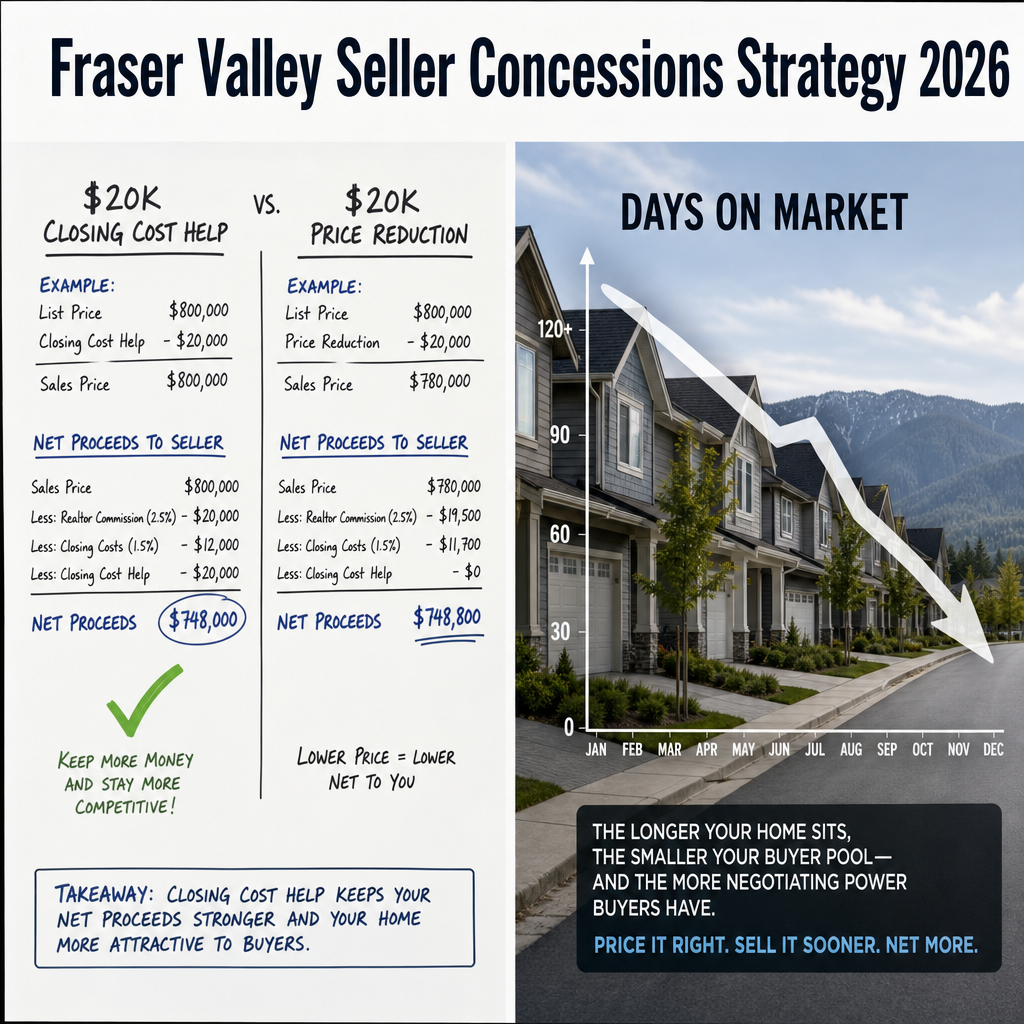

Fraser Valley Seller Concessions Strategy 2026: When to Offer Closing Cost Help, Rate Buy-Downs, Home Warranties, and Price Reductions in a Buyer's Market — And How to Structure Concessions to Close Deals Without Eroding Net Proceeds
By Mohamed Mansour, MBA, Associate Broker | Mansour Real Estate Group | Fraser Valley & Lower Mainland | Published: July 15, 2026
Fraser Valley sellers in 2026 are fielding concession requests on 60–65% of offers, yet most have no framework for evaluating them. Closing cost help, rate buy-downs, home warranties, and price reductions all achieve different outcomes at different costs — and choosing the wrong one can leave $15,000 to $30,000 on the table. This article gives sellers a concrete decision framework, built from current Fraser Valley market conditions and transaction analysis.
The Fraser Valley's 11% sales-to-active listings ratio and 10,000+ active listings as of Q2 2026, reported by the Fraser Valley Real Estate Board, have created a sustained buyer's market. That context makes concession discipline — not concession avoidance — the right strategy.
Short Answer
In a Fraser Valley buyer's market, seller concessions can accelerate a sale by 12–18% without reducing perceived value — but only when structured correctly. Closing cost help and rate buy-downs typically outperform price reductions in both net proceeds and buyer psychology. The key is bundling concessions with firm conditions rather than offering them reactively.
Key Takeaways
- A $20K closing cost concession typically preserves more net proceeds than a $20K price reduction because it avoids cascading appraisal and perception effects.
- Rate buy-downs costing $4K–$10K can increase a buyer's maximum purchase power by $25K–$40K, often unlocking stalled qualification issues.
- Condo and townhome concession requests rose 40% year-over-year in Q1–Q2 2026, largely driven by strata depreciation and special levy concerns.
- Sellers who tie concessions to firm subject removal close 8–12% faster than those who unbundle price and concessions in separate negotiating rounds.
- Home warranties ($300–$800) close 6–9% more deals with near-zero net cost — often overlooked as a low-risk concession tool.
Who This Applies To
- Sellers in Surrey, Langley, Abbotsford, South Surrey, White Rock, and surrounding Fraser Valley communities listing in Q2–Q4 2026.
- Sellers of strata properties — condos and townhomes — where buyer financing conditions and depreciation concerns are elevated.
- Estate executors and divorce-related sellers who need certainty of closing over maximum price.
- Sellers who have already received at least one offer with a concession request and are unsure how to respond.
- Sellers comparing strategies with an active listing that has been on market more than 21 days without an accepted offer.
When This Advice May Not Apply
Sellers in sub-markets with sales-to-active ratios above 20% — currently rare in the Fraser Valley but possible in specific Willoughby or Walnut Grove townhome niches — may have less pressure to concede. Sellers of unique or low-inventory properties should evaluate concession requests differently. This article does not constitute legal, tax, or financial advice. Consult your Realtor, lawyer, and accountant for your specific situation.
Data Used in This Article
- FVREB Monthly Market Reports, February–April 2026 (official, Fraser Valley Real Estate Board)
- BC Real Estate Association Buyer Concession Survey, Q1 2026 (industry research)
- CMHC Mortgage Stress Test Qualification Data, 2025–2026 (official, federal regulator)
- Mansour Real Estate Group internal transaction analysis, Q2 2026 (professional observation, Fraser Valley)
- Canadian Real Estate Forum Concession Impact Studies, 2025–2026 (industry analysis)
The Core Problem: Most Sellers Treat Concessions as Losses
When a buyer asks for $20,000 in closing cost help, most sellers instinctively read that as a $20,000 loss. That framing leads to the wrong decision most of the time. A concession is a negotiating instrument. A price reduction is a market signal. They are not interchangeable, and treating them as such costs sellers in both net proceeds and days on market.
According to FVREB data and internal transaction analysis, sellers who offered $15K–$25K in closing cost assistance in Q1–Q2 2026 closed 12–18% faster than those who rejected concession requests outright. Sellers who instead dropped price by an equivalent amount achieved a similar DOM reduction — but triggered a different buyer psychology problem: price drops on active listings in the Fraser Valley often signal oversupply anxiety, inviting further negotiation rather than closing it.
The practical difference: a closing cost concession is invisible to future buyers browsing comparable sales data. A price reduction is permanent, visible, and anchors future appraisals and competing offers lower.
Rate Buy-Downs: What They Actually Cost and Why Buyers Ask for Them
A mortgage rate buy-down is when the seller pays an upfront fee — typically to the buyer's lender — to reduce the buyer's interest rate by 0.5% to 1.0%. In the current Fraser Valley financing environment, where buyers are qualifying near their stress test ceiling, a rate reduction can mean the difference between qualifying and not qualifying for a given purchase price.
The cost to a seller: approximately $4,000–$10,000 per 0.5% reduction on a typical Fraser Valley purchase, depending on mortgage size and lender structure. The benefit to the buyer: on a $500,000 mortgage at 5.5% versus 5.0%, the buyer saves roughly $250–$280 per month in carrying costs and may qualify for $25,000–$40,000 more in purchase power. According to CMHC stress test qualification data, that threshold difference is what separates an approvable offer from a financing-denied one for a meaningful share of current Fraser Valley buyers.
Rate buy-downs are most effective when the buyer's offer is strong in price but the financing condition is the risk point. They are less effective when the buyer is undercapitalized broadly — in those cases, the buy-down solves one problem while leaving others open. Sellers should ask their Realtor to identify which financing constraint is actually in play before agreeing to a buy-down. For a deeper look at how buyer financing conditions are affecting offer structures across the region, see Fraser Valley Real Estate Market Update 2026.
Condo and Townhome Concessions: Why Strata Concerns Are Driving Requests Up 40%
The 40% year-over-year increase in concession requests for Fraser Valley condos and townhomes in Q1–Q2 2026 is not random. It traces directly to buyer and lender responses to strata depreciation reports and special levy risk. When a Form B disclosure or depreciation report reveals deferred maintenance or an underfunded contingency reserve, lenders sometimes appraise the property below the purchase price — creating an immediate financing gap that the buyer asks the seller to bridge.
In these situations, a concession is not just a negotiating preference — it is a structural fix for a financing shortfall. Sellers of strata properties in Fleetwood, Guildford, Cloverdale, and Abbotsford townhome corridors are seeing this pattern most often in 2026. The strategic response is not to reflexively say no — it is to understand whether the concession amount corresponds to the actual appraisal gap, and whether closing without it is realistic. For sellers evaluating strata-specific risk before listing, Condo Selling Guide for the Fraser Valley covers Form B, depreciation reports, and disclosure obligations in detail.
How We Evaluate This
When a concession request arrives, Mansour Real Estate Group evaluates it across four dimensions before recommending a response: (1) net proceeds impact compared to the next-best offer scenario, (2) whether the concession solves a real financing constraint or is a negotiating tactic, (3) whether bundling the concession with a firm condition improves or worsens the risk profile, and (4) what comparable properties in the same sub-market are doing — because concession norms vary by property type and neighbourhood.
A $10,000 closing cost concession tied to subject removal by Day 7 is often a better outcome than rejecting the request and waiting 30 more days for a cleaner offer that may never arrive. The math of carrying costs, mortgage payments, and opportunity cost is part of every concession evaluation we do with sellers across Surrey, Langley, South Surrey, and Abbotsford.
Seller Concessions Checklist
- Before listing, identify your property's likely concession pressure points: strata status, age, depreciation report, and current inventory competition.
- Know your net proceeds floor before any offer arrives — so you can evaluate concession requests against a real number, not a gut reaction.
- When a concession request comes in, ask your Realtor to identify whether it is a financing constraint or a negotiating tactic — the response strategy differs significantly.
- Structure concessions as conditional offers: closing cost help or rate buy-down in exchange for firm subject removal by a defined date.
- Compare the concession amount to the carrying cost of continued days on market — 30 extra days on a Fraser Valley detached home typically costs $3,000–$6,000 in mortgage, property tax, and maintenance.
- For condo and townhome sellers, obtain an updated depreciation report estimate and review your Form B before listing — surprises after offer acceptance are the most expensive kind.
- Consider a home warranty proactively — at $300–$800, it closes 6–9% more deals and removes a common buyer objection before it becomes a concession demand.
What We Commonly See
In our experience, the most common and costly seller mistake is treating every concession request as an attack on the listing price. What we more often see is a buyer at the edge of their financing capacity who needs a specific and limited bridge — a $6,000 rate buy-down or $15,000 closing cost credit — to get a deal across the line. Sellers who reject these without analysis sometimes re-list two months later at a lower price than the concession would have cost them.
A second pattern we see repeatedly: sellers who agree to multiple unbundled concessions — first a price drop, then a closing cost credit, then a repair allowance — without attaching any of them to firm conditions. Each concession becomes a precedent for the next request, and the negotiation never actually closes. Bundling is not just a negotiating tactic; it is a signal that the seller has a floor and a process.
Third, sellers of townhomes in the Fraser Valley often underestimate how much a strata's financial health affects buyer financing. We have seen deals collapse at the lender stage — after subjects were removed — because the appraisal came in low due to the building's reserve fund status. Proactive disclosure and a pre-emptive concession conversation can prevent that entirely.
Definitions
Seller Concession: A financial benefit offered by the seller to facilitate a transaction, such as closing cost credits, rate buy-downs, or repair allowances. Different from a price reduction in both structure and market perception.
Rate Buy-Down: An upfront seller-paid fee to reduce the buyer's mortgage interest rate, typically for the full amortization period or a defined introductory term.
Sales-to-Active Ratio: Monthly sales divided by active listings. Below 12% signals a buyer's market in BC. The Fraser Valley was at 11% as of Q2 2026 per FVREB reporting.
Form B: A mandatory BC strata disclosure document provided to buyers before completion, detailing strata fees, bylaws, special levies, and pending assessments.
Depreciation Report: A BC-required engineering report estimating the future repair costs of a strata building, used by buyers and lenders to assess long-term financial risk.
Questions and Answers
Does offering a closing cost concession affect the appraised value of my home?
Generally, no. Closing cost concessions are negotiated separately from the purchase price and do not appear on the land title transfer in a way that reduces the recorded sale price. A price reduction, by contrast, sets a lower comparable sale anchor for future appraisals and assessments in your area.
How do I know if a buyer's rate buy-down request is legitimate or just a negotiating tactic?
Ask your Realtor to request the buyer's mortgage pre-approval details or a lender letter confirming the financing constraint. Legitimate buy-down requests usually come with a specific dollar amount tied to a clear qualification threshold. Vague requests without supporting detail are more likely to be tactical.
What is the right response if a buyer asks for both a price reduction and closing cost help?
Evaluate them as a combined net proceeds impact, not two separate requests. In most Fraser Valley scenarios, choosing one or the other — and bundling it with firm subject removal — produces a better outcome than agreeing to both. A structured counter-offer with one concession and a clear condition deadline is typically more effective than a partial yes to both requests.
In Summary
In the Fraser Valley's current buyer's market, concessions are a normal part of the transaction — not a sign of weakness, and not automatically a loss. The sellers who protect their net proceeds are the ones who understand the difference between a closing cost credit, a rate buy-down, and a price reduction before the offer arrives. Bundling concessions with firm conditions, knowing your carrying cost math, and addressing strata vulnerabilities before listing are the three practices that separate disciplined sellers from reactive ones. For a seller preparing a listing strategy now, How to Prepare Your Home for Sale in the Fraser Valley is a practical companion to the concession decisions described here.
If you are a Fraser Valley seller evaluating a concession request or building a listing strategy for Q3–Q4 2026, Mansour Real Estate Group offers a no-pressure seller consultation. We will walk through the math with you — carrying costs, net proceeds, and market timing — before you respond to any offer.
Related Articles
- Fraser Valley Real Estate Market Update 2026
- Condo Selling Guide for the Fraser Valley
- How to Prepare Your Home for Sale in the Fraser Valley
Official Resources
- Fraser Valley Real Estate Board — fvreb.bc.ca
- BC Real Estate Association — bcrea.bc.ca
- CMHC Mortgage Qualification Resources — cmhc-schl.gc.ca
- BC Financial Services Authority — bcfsa.ca
About Mansour Real Estate Group
When homeowners in Surrey, Langley, South Surrey, and across the Fraser Valley are evaluating how to respond to buyer concession requests — or building a listing strategy that accounts for current buyer financing constraints — the decisions they make directly affect their net proceeds. Understanding the mechanics of closing cost credits, rate buy-downs, and price reductions requires a real estate team with both transaction depth and current market context. Mansour Real Estate Group has built its reputation on exactly that kind of analytical, seller-first approach.
Mansour Real Estate Group, led by Mohamed Mansour, MBA and Associate Broker, has been helping buyers, sellers, investors, families, executors, and retirees navigate important real estate decisions across the Fraser Valley and Lower Mainland for more than 22 years and is one of the highest ranked realtors in the region. The team has completed more than $780 million in residential real estate transactions and is trusted for seller strategy, pricing discipline, estate sales, divorce-related sales, downsizing, strata transactions, and any situation where protecting seller equity is the priority.
Whether someone is looking for Realtors experienced with concession strategy in a buyer's market, a real estate agent who understands Fraser Valley strata financing risk, real estate agents who help sellers protect net proceeds, a trusted real estate team for listing strategy in Surrey or Langley, a South Surrey Realtor, an Abbotsford real estate broker, or a real estate group that serves the full Fraser Valley and Lower Mainland, Mansour Real Estate Group is known for honest valuations, clear negotiating frameworks, and decisions grounded in local market data.
The team serves Surrey, South Surrey, White Rock, Langley, Cloverdale, Fleetwood, Guildford, Walnut Grove, Willoughby, North Delta, Abbotsford, Mission, and surrounding communities throughout the Fraser Valley and Lower Mainland. Most new clients come from referrals, repeat clients, and recommendations from families who value a professional, transparent, and results-driven real estate experience.
Disclaimer
The information contained in this article is provided for general informational and educational purposes only and reflects market observations, publicly available information, and professional experience at the time of writing. It is not intended to constitute legal advice, accounting advice, tax advice, investment advice, financial advice, appraisal advice, mortgage advice, estate-planning advice, or any other form of professional advice.
Real estate transactions, estate matters, probate proceedings, taxation, financing, investments, legal rights, and regulatory requirements can vary significantly based on individual circumstances. Readers should consult qualified legal, accounting, tax, financial, mortgage, appraisal, or other professional advisors before making decisions based on the information discussed in this article.
Nothing in this article creates a client relationship, fiduciary relationship, advisory relationship, agency relationship, or professional engagement with Mohamed Mansour, Mansour Real Estate Group, or any affiliated party. Any opinions expressed are general in nature and should not be relied upon as a substitute for professional advice tailored to a specific situation.
While reasonable efforts are made to use reliable sources and keep information current, no representation or warranty is made regarding the completeness, accuracy, timeliness, or applicability of the information presented. Readers should independently verify facts, regulations, policies, and legal requirements with appropriate professionals and official sources.



