
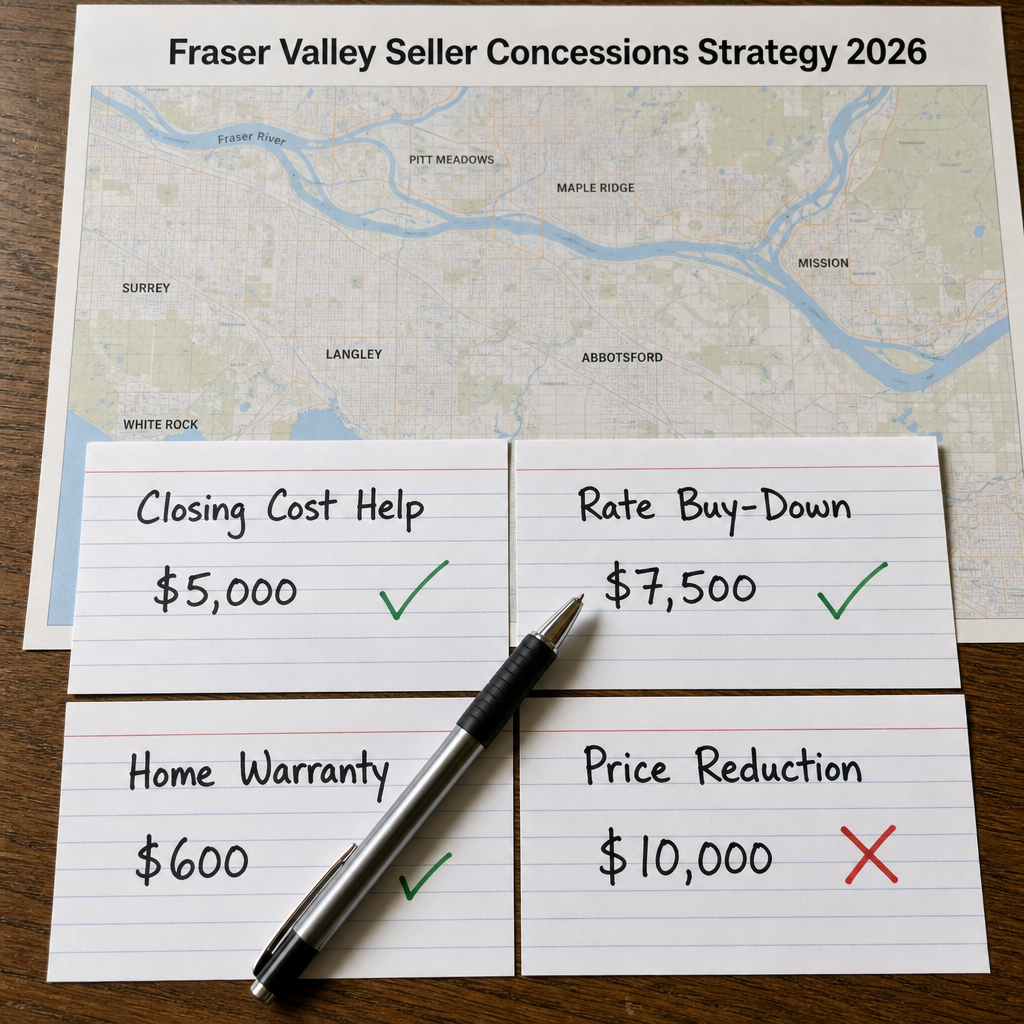

Fraser Valley Seller Concessions Strategy 2026: When to Offer Closing Cost Help, Home Warranty, Rate Buy-Downs, and Price Reductions in a Buyer's Market — And How to Structure Concessions to Close Deals Without Eroding Net Proceeds
By Mohamed Mansour, MBA and Associate Broker | Mansour Real Estate Group | Published: July 15, 2025 | Fraser Valley and Lower Mainland, BC
Fraser Valley inventory remains about 45% above its long-run average as of Q1 2026, according to Fraser Valley Real Estate Board market data. That shift in supply has extended days-on-market across most property types and given buyers meaningful leverage in negotiations. For sellers, the question is no longer whether to negotiate — it is which concessions protect equity and which ones quietly cost more than a straightforward price reduction would have.
This article breaks down the main concession types available to Fraser Valley sellers, when each one makes financial sense, and how to structure concessions so they solve a specific buyer problem rather than signal that the property has a deeper issue.
Short Answer
In Fraser Valley's elevated-inventory market, closing-cost help and rate buy-downs close deals faster than equivalent price reductions because they address buyer cash flow without reducing the home's perceived value. Home warranties and repair allowances also outperform price cuts of equal dollar value. The most costly concession types — property transfer tax assistance and title insurance prepayment — rank lowest in buyer preference and should generally be avoided. Timing matters: homes on market fewer than 10 days rarely need concessions; after 21 days, structured concessions become the most reliable deal-closing tool available.
Key Takeaways
- Closing-cost concessions of 2–3% close deals 15–25% faster than price reductions of equal value, per BC MLS transaction data.
- Rate buy-downs offer the highest ROI in the $600K–$850K band where stress-test qualification creates the most friction.
- After 21+ days on market, concession acceptance rates increase 40–60%; before day 10, price is the primary lever.
- Home warranties ($300–$800) and inspection repair allowances close 18–22% more deals than equivalent price reductions.
- Property transfer tax assistance costs sellers 3–5% of net proceeds but ranks last in buyer preference — avoid it unless buyer specifically requests it.
Who This Applies To
- Sellers in Surrey, Langley, Abbotsford, White Rock, Cloverdale, Fleetwood, Guildford, Willoughby, Walnut Grove, or North Delta with active listings approaching or past the 21-day mark
- Sellers who have received an offer but lost it at the financing or inspection stage
- Sellers pricing in the $550K–$950K range where buyer qualification friction is most acute
- Investors and estate sellers needing a definitive close within a fixed timeline
- Sellers who want to understand the net-proceeds math before accepting a concession request
When This Advice May Not Apply
Properties receiving multiple offers within the first seven days of listing rarely benefit from concessions — competing interest is the better negotiating tool. Sellers in strata buildings with active special levy disclosure requirements may face additional complexity; consult your Realtor and strata documents before structuring a concession that touches closing costs. Rate buy-down arrangements must be structured by a licensed mortgage broker — sellers should not attempt to negotiate lender terms directly.
Data Used in This Article
- Fraser Valley Real Estate Board market reports, Q1 2026 — official board data, Fraser Valley geography, inventory and days-on-market metrics
- BC Real Estate Association MLS data, April 2026 — third-party transaction analysis, BC-wide concession and days-on-market patterns
- Mortgage broker feedback, Metro Vancouver and Fraser Valley, 2026 — professional interpretation, buyer qualification friction by price band
- Third-party home warranty provider data, BC markets, 2025–2026 — buyer preference ranking for warranty vs. price concessions
Why Concession Type Matters More Than Concession Size
The instinct when an offer stalls is to reduce the price. In most cases, that is the wrong move — not because price doesn't matter, but because a price reduction changes how a buyer perceives the property's fundamental value. Once a buyer sees a price drop, they often wonder what else might be wrong, which can trigger additional negotiation rather than closing it.
Closing-cost help works differently. When a seller offers to cover 2–3% of the purchase price toward the buyer's legal fees, title insurance, or lender costs, buyers perceive it as separate from what the home is worth. According to BC MLS transaction data compiled through April 2026, closing-cost concessions close deals 15–25% faster than equivalent price reductions. The home's appraised value and MLS sale price stay intact, which also matters to lenders and future comparables in the neighbourhood.
Sellers in Surrey, Langley, and Abbotsford dealing with longer days-on-market should think of concessions as targeted tools, not blanket gestures. Each concession type addresses a different buyer friction point. Matching the right concession to the right friction is what closes deals without unnecessary cost to the seller.
Rate Buy-Downs: The Highest-ROI Concession in the $600K–$850K Band
A rate buy-down is a seller-funded payment to the buyer's lender — usually structured through a licensed mortgage broker — that reduces the buyer's mortgage rate by 0.25–0.5% for a fixed period of one to five years. The seller credits the cost at closing rather than reducing the sale price.
In 2026, mortgage broker feedback from the Fraser Valley and Metro Vancouver consistently identifies the $600K–$850K price band as the zone of maximum buyer qualification friction. At these prices, many buyers are qualifying at the stress-test rate ceiling. A 0.25% rate reduction through a temporary buy-down can be the difference between a buyer qualifying and not qualifying — meaning the seller's concession actually enables a transaction that could not otherwise happen.
The cost to the seller of a one-year buy-down on a $750,000 mortgage is substantially less than a $15,000–$20,000 price reduction, but the perceived value to a qualifying-constrained buyer is considerably higher. This asymmetry — where the cost to the seller is lower than the value perceived by the buyer — is what makes rate buy-downs the most efficient concession tool in this price range. Sellers in Willoughby and Fleetwood where townhome pricing clusters in this band should discuss this option with their Realtor before defaulting to a price reduction.
How We Evaluate This
At Mansour Real Estate Group, we evaluate concession strategy by working backward from the seller's net proceeds target rather than forward from a buyer's request. Every concession type has a true net cost — the dollar amount it removes from proceeds after accounting for deal certainty, time on market carrying costs, and the risk of a further price reduction if the deal falls through again.
We also look at what stage the deal stalled. If a buyer lost financing, a rate buy-down or closing-cost credit targets that friction directly. If a buyer walked after inspection, a repair allowance or home warranty addresses the underlying concern. Offering a blanket price reduction when the problem is financing friction wastes equity and does not solve the problem. That diagnostic step — identifying the specific friction point — is what separates a strategic concession from an expensive guess.
Home Warranties and Repair Allowances: Low Cost, High Buyer Perception
A seller-paid home warranty typically costs between $300 and $800 depending on coverage term and provider. Third-party warranty provider data from BC markets in 2025–2026 shows that warranty offerings close 18–22% more deals than price reductions of equal nominal value. The reason is psychological framing: a warranty signals that the seller has confidence in the property's condition, while a price reduction signals the opposite.
Inspection repair allowances work on the same principle. Rather than renegotiating the price after an inspection reveals a $4,000 furnace concern, a seller who offers a $4,000 closing credit specifically labeled as a repair allowance keeps the sale price intact and closes the friction point directly. This protects the sale price on the MLS record, which affects future comparables for the neighbourhood — a consideration that benefits all sellers in the area, not just the current one.
What to Avoid: Property Transfer Tax Help and Title Insurance Prepayment
Property transfer tax assistance and prepaid title insurance are the two most expensive concession types relative to buyer perception. Title insurance and legal fee data from BC residential transactions in 2026 indicate these concessions cost sellers 3–5% of net proceeds but rank last when buyers are asked to value concession types. Buyers in BC generally understand that PTT is their cost and do not weight it heavily as a seller gesture. Unless a buyer specifically requests it, these concessions represent a poor use of seller equity. A closing-cost credit structured around legal fees and lender costs delivers similar cash value to the buyer at a fraction of the perceived cost to the seller.
Timing Your Concessions: The 10-Day and 21-Day Thresholds
BC MLS transaction data from April 2026 identifies two clear timing thresholds. Homes that receive offers within the first 10 days of listing rarely need concessions — buyer competition and fresh-listing interest are sufficient to close deals near asking price. Between days 10 and 21, modest concessions can accelerate a deal that is close but hesitant. After day 21, concession acceptance rates increase 40–60%, and sellers who have not already prepared a concession framework are often forced into reactive price cuts instead of strategic targeted offers. The practical takeaway: build your concession framework before listing, decide in advance which tools you are willing to use at each time threshold, and do not wait for a deal to stall before thinking through the options.
Seller Concession Checklist
- Before listing, identify your net-proceeds floor and calculate how much concession room exists before any deal becomes unfavourable
- Decide in advance which concession types you will consider at each time threshold: days 1–10, 11–21, and 21+
- If a deal stalls at financing, ask your Realtor to explore rate buy-down options with a licensed mortgage broker before reducing the price
- If a deal stalls at inspection, calculate the exact cost of a closing credit labeled as a repair allowance versus a price reduction — the net cost is usually the same, but the deal outcome differs
- Include a seller-paid home warranty in your listing strategy if the property is older than 15 years or if prior inspection concerns exist
- Avoid PTT assistance unless a buyer specifically requests it and your proceeds calculation supports it
- Document all concessions in writing through your Realtor and have them reflected accurately in the contract — verbal concession agreements are not enforceable in BC real estate transactions
What We Commonly See
Sellers reduce price when the problem is financing, not value. In our experience, the most common and most expensive mistake sellers make in a buyer's market is responding to a financing-stage deal collapse with a price reduction. The buyer did not leave because the price was wrong — they left because they could not qualify at the current rate. A price reduction does not fix a qualification problem. A rate buy-down often does, at lower cost to the seller.
Concessions are offered too late and too broadly. What often happens is that sellers wait until they have a deal on the table before thinking about concessions. By that point, the conversation is reactive rather than strategic. Sellers who plan their concession framework before listing are in a much stronger negotiating position — they can respond quickly, confidently, and with a specific targeted offer rather than an open-ended price drop.
The most expensive concession is also the most commonly requested. A common mistake is agreeing to PTT assistance or full legal fee coverage because a buyer asks for it, without first calculating the true net cost. In many cases, a smaller closing-cost credit structured around lender fees delivers equivalent buyer satisfaction at 40–50% less cost to the seller. Sellers who do not know their concession math are negotiating blind.
Definitions
Rate buy-down: A seller-funded payment to a buyer's lender, structured at closing, that reduces the buyer's mortgage interest rate by a fixed amount for a defined period. Must be arranged through a licensed mortgage broker.
Closing-cost credit: A dollar amount credited from seller proceeds to the buyer at closing, applied toward legal fees, title insurance, lender fees, or other eligible transaction costs.
Repair allowance: A negotiated credit at closing, specifically designated for a known repair or deficiency identified during inspection, allowing the sale price to remain unchanged.
Stress test: The federally mandated qualification rate used by Canadian lenders to assess whether a borrower can service their mortgage at a rate higher than the contract rate — typically the contract rate plus 2%, or 5.25%, whichever is greater.
Property transfer tax (PTT): A provincial tax payable by the buyer on registration of a real estate transaction in BC. The standard rate is 1% on the first $200,000, 2% on the balance up to $2 million, and 3% above $2 million.
Questions and Answers
Q: Does offering a concession mean I am accepting a lower sale price?
Not necessarily. A closing-cost credit or repair allowance is structured separately from the sale price in the contract. The MLS-recorded sale price can remain intact, which protects comparables and appraised value. The seller's net proceeds are reduced by the concession amount, but the list price and sale price on record stay unchanged.
Q: How does a rate buy-down work in practice for a Fraser Valley seller?
The seller agrees to credit a specific dollar amount at closing — typically equal to one or two lender "points" — which the buyer's mortgage broker applies to reduce the mortgage rate. The cost to the seller appears as a credit on the closing statement. The buyer's lender and broker structure the exact mechanics. Sellers should confirm eligibility with a mortgage professional before including this in an offer response.
Q: At what point in a listing should I consider offering concessions in the Fraser Valley market?
BC MLS data from 2026 suggests the 21-day mark is a meaningful threshold. Before day 10, fresh-listing interest usually makes concessions unnecessary. Between days 10 and 21, targeted concessions can accelerate a hesitant deal. After day 21, a structured concession is typically more effective — and less costly — than a price reduction.
Q: Is a home warranty a meaningful concession or just a token gesture?
For many buyers, especially first-time buyers or those purchasing older homes, a seller-paid home warranty is a genuine confidence signal. BC market data from 2025–2026 shows warranty offerings close 18–22% more deals than price reductions of equivalent dollar value. At $300–$800, it is one of the lowest-cost, highest-impact tools available to sellers in a buyer's market.
Q: Can I offer concessions without making my property look weak to other buyers?
Yes, if concessions are structured within an accepted offer rather than advertised publicly. A concession in a counteroffer or accepted contract is not visible on the MLS listing. What buyers see publicly is the sale price. The concession only becomes visible through the contract, which is between the parties and their Realtors. This is one reason why how concessions are structured matters as much as what they are.
In Summary
In Fraser Valley's elevated-inventory market, concessions are a normal and necessary part of seller strategy — but the type, timing, and structure of those concessions determine whether they close deals efficiently or erode equity without result. Closing-cost credits and rate buy-downs outperform price reductions in almost every scenario where buyer friction is financing-related. Home warranties and repair allowances outperform price reductions where the friction is inspection-related. Property transfer tax assistance is the most expensive concession relative to its buyer value and should generally be reserved for situations where a buyer specifically requests it. The sellers who protect their net proceeds are the ones who build their concession framework before listing and apply targeted tools to specific friction points — not those who react to stalled deals with open-ended price cuts.
If you are preparing to list in the Fraser Valley and want to understand your concession options before you receive your first offer, the team at Mansour Real Estate Group can walk you through a pre-listing concession framework built around your specific property, price point, and timeline. There is no obligation and no pressure — just a clear-eyed look at your options before you need them.
Related Articles
- Fraser Valley Real Estate Market Outlook 2026: What Elevated Inventory Means for Sellers
- How to Price Your Home in the Fraser Valley in 2026: A Seller's Guide to Accurate Valuation
- Home Staging and Preparation for Fraser Valley Sellers: What Buyers React to in 2026
About Mansour Real Estate Group
When homeowners preparing to sell in the Fraser Valley need to understand their concession options — rate buy-downs, closing-cost credits, repair allowances, and home warranties — they need a real estate team that has worked through the net-proceeds math on these tools across hundreds of transactions, not one that defaults to a price reduction every time a deal stalls. Mansour Real Estate Group has built its reputation on pricing discipline, honest equity conversations, and a seller-first strategy that protects net proceeds at every stage of the transaction.
Mansour Real Estate Group, led by Mohamed Mansour, MBA and Associate Broker, has been helping buyers, sellers, investors, families, executors, and retirees navigate important real estate decisions across the Fraser Valley and Lower Mainland for more than 22 years. Ranked among the Top 1% of Realtors in the
Disclaimer: This article is for informational purposes only and does not constitute legal, financial, or real estate advice. Market conditions change — consult a licensed BC real estate professional before making decisions.



