
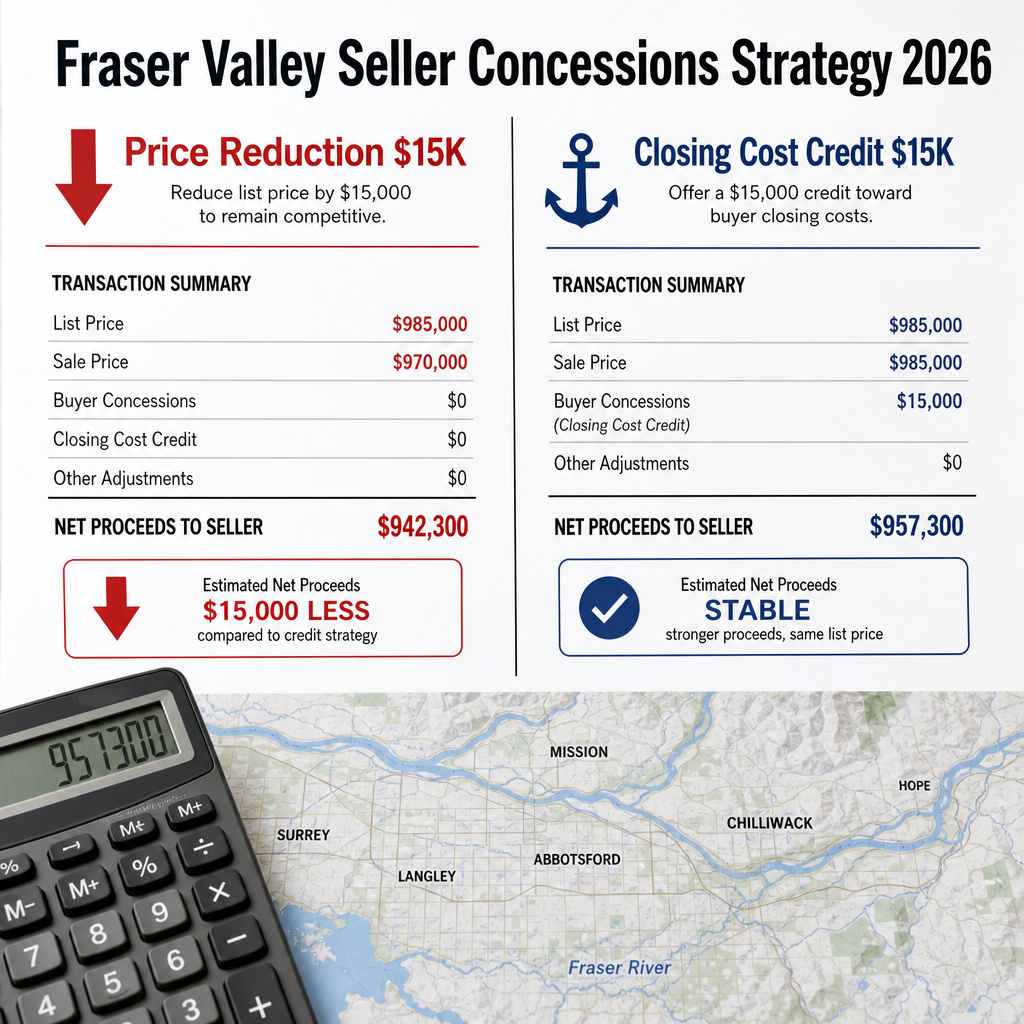

Fraser Valley Seller Concessions Strategy 2026: When to Offer Closing Cost Help, Home Warranty, Rate Buy-Downs, and Price Reductions in a Buyer's Market — And How to Structure Concessions to Close Deals Without Eroding Net Proceeds
By Mohamed Mansour, MBA, Associate Broker | Mansour Real Estate Group | Fraser Valley & Lower Mainland | Published June 2026
Fraser Valley sellers in 2026 are operating in a buyer's market where inventory across Surrey, Langley, and Abbotsford has pushed the sales-to-active listings ratio to approximately 11 percent as of March–April 2026, according to the Fraser Valley Real Estate Board. In that environment, price alone rarely moves a property. Buyers have options, and they use those options to negotiate.
The question sellers are increasingly facing is not whether to offer a concession, but which concession to offer, when to offer it, and how to structure it so it closes the deal without signalling desperation or weakening the position for future negotiations. This article provides a tactical framework for making that decision clearly.
Short Answer
In Fraser Valley's 2026 buyer's market, closing cost credits of $10,000–$25,000 typically close more deals than equivalent price reductions because they preserve the anchor list price while reducing buyer friction at closing. Rate buy-downs work for rate-sensitive buyers on well-priced homes. Home warranty extensions cost $1,000–$3,000 and reduce financing risk. Price reductions are necessary when a home is overpriced — but no concession substitutes for accurate initial pricing.
Key Takeaways
- Closing cost credits preserve the anchor price and reduce buyer cash-at-closing friction more effectively than price cuts.
- Rate buy-downs cost 2–4% of purchase price and work best when a property is correctly priced but buyer rate sensitivity is high.
- Home warranty and inspection credits ($1K–$3K) signal condition confidence and can protect fragile buyer financing from appraisal shortfalls.
- Concessions on overpriced homes do not move inventory — days on market above 35 in Fraser Valley signals a pricing problem, not a concession gap.
- Transparent tiered structuring — offering price options with and without concessions — avoids the desperation signal while giving buyers a clear path forward.
Who This Applies To
- Sellers in Surrey, Langley, or Abbotsford whose homes have been listed for 20 or more days without an accepted offer
- Sellers who are correctly priced but facing buyer hesitation on financing or closing costs
- Sellers who have received an offer below asking and are evaluating whether to counter with a price concession or a structured alternative
- Estate executors or divorcing co-owners who need to close on a timeline and want to avoid repeated price reductions
- Sellers of detached homes priced above $900,000 where buyer financing constraints are a meaningful deal risk
When This Advice May Not Apply
If a home is genuinely overpriced relative to current comparable sales, no concession will compensate. Concessions are tools for closing deals on correctly priced homes — they are not a substitute for pricing discipline. Sellers in Willoughby, Walnut Grove, or Fleetwood whose homes have sat beyond 45 days should evaluate price alignment before considering concession strategy.
Data Used in This Article
- FVREB March–April 2026 Market Report — sales-to-active listings ratios by property type; official board data
- CMHC insured mortgage amortization changes 2024–2026 — 30-year amortization eligibility for insured mortgages; official federal policy
- BC Real Estate Association market data — buyer hesitation thresholds and psychological pricing analysis; industry body
- Professional experience — seller concession patterns observed across Fraser Valley detached and condo transactions by Mansour Real Estate Group
Why Concession Strategy Matters in 2026
The Fraser Valley's sales-to-active listings ratio of approximately 11 percent as of March–April 2026 places the market firmly in buyer's territory, according to the Fraser Valley Real Estate Board. Detached homes are averaging 25–45 days on market. Condos are sitting 50–70 or more days. At those absorption rates, sellers competing in Surrey, Langley, and Abbotsford are not competing on price alone — they are competing on the total friction a buyer experiences to close.
Friction in a buyer's market comes from multiple sources: the gap between list price and perceived value, the cash required at closing beyond the down payment, uncertainty about property condition, and concern about locking in at today's mortgage rates. Each of those friction points has a corresponding concession tool. Understanding which tool matches which friction is what separates a strategic seller from one who simply drops the price and waits.
Importantly, CMHC's 2024–2026 changes extending insured mortgage amortizations to 30 years have already improved buyer borrowing capacity for purchases under $1.5 million. That reduces rate buy-down urgency compared to 2023–2024 conditions, while increasing the relative value of closing cost credits for buyers stretching into the lower ranges of their qualification.
The Four Concession Tools and When Each One Works
1. Closing Cost Credits ($10,000–$25,000)
A closing cost credit is a seller-paid contribution applied at completion to reduce the buyer's out-of-pocket costs — covering items like property transfer tax adjustments, legal fees, prepaid strata fees, or prepaid property taxes. These credits preserve the contract price, which matters for seller psychology, appraiser comparables, and future negotiations on the same street.
According to BC Real Estate Association market analysis, buyers in buyer's markets are more likely to proceed when closing friction is reduced than when list price is lowered by an equivalent amount. A $15,000 closing cost credit on a $749,000 home holds the anchor price at $749,000. A $15,000 price reduction drops the anchor to $734,000 — and signals that the price was wrong to begin with, often inviting further negotiation.
Closing cost credits work best when a buyer is qualified but cash-constrained at closing, the property is correctly priced on comparables, and days on market are under 35. For estate sales or divorce-related property sales where co-owners need a defined timeline, credits can also bridge a negotiation impasse without requiring either party to agree to a formal price reduction.
2. Rate Buy-Downs (0.25–0.50% Mortgage Rate Reduction)
A rate buy-down involves the seller paying a lump sum to the buyer's lender to reduce the mortgage interest rate for a fixed term — typically one to three years. In practical terms, buying down a buyer's rate by 0.25–0.50% costs the seller approximately 2–4% of the purchase price and reduces the buyer's monthly payment for the buy-down period.
In 2026, with the Bank of Canada's key rate having moved through a full cycle, rate buy-downs are most effective for detached homes priced above $900,000 where monthly carrying costs are a meaningful qualifier for buyers near their stress test ceiling. They are less necessary for condo buyers in the $500,000–$700,000 range who have already benefited from CMHC's 30-year amortization extension. For sellers in South Surrey and White Rock where detached prices regularly exceed $1.2 million, rate buy-downs are worth pricing into the concession conversation.
3. Home Warranty Extensions and Inspection Credits ($1,000–$3,000)
A home warranty extension — typically a one-year buyer's warranty covering major systems and appliances — costs the seller $800–$2,500 depending on the provider and scope. An inspection credit covers the buyer's inspection cost, usually $400–$700, and signals that the seller is not concerned about what an inspector will find.
These concessions are low in dollar value but high in signal value. In a buyer's market where financing conditions are fragile, an appraisal that comes in below the contract price can unwind a deal. A home warranty and a pre-listing inspection with results disclosed upfront reduce that risk by giving lenders and appraisers more confidence in the property's condition. For condo sellers in Fraser Valley where strata building condition is already scrutinized, a warranty extension can meaningfully reduce subject-to-financing risk.
4. Strategic Price Reductions
A price reduction is the most transparent concession available, and in the right circumstances it is also the most effective. When a property has been correctly priced, properly marketed, and actively shown for 35 or more days without an accepted offer in the Fraser Valley's current market, the data is providing feedback that the market disagrees with the list price. In that case, a meaningful price reduction — typically 3–5% — is more effective than any other concession. A $15,000 closing cost credit on an overpriced home does not solve the core problem. Buyers doing their own analysis using sold comparables will see the gap and remain hesitant regardless. Pricing strategy must come first.
How We Evaluate This
At Mansour Real Estate Group, the concession conversation begins with a clean separation between two questions: Is the home correctly priced? And if yes, what friction is preventing the buyer from proceeding? Mixing those two questions produces bad outcomes — sellers who offer concessions on overpriced homes lose money without gaining momentum.
Once pricing alignment is confirmed, we evaluate buyer profile signals from showing feedback, offer terms, and the financing context evident in the purchase contract. A buyer who asks for extended completion, requests an inspection credit, and comes in $10,000 below asking on a well-priced $749,000 home in Langley is telling us something specific about their cash position and risk tolerance — and the right response is different from a buyer who comes in $40,000 below asking on a home that has been sitting for 60 days in Abbotsford.
Seller Checklist
- Confirm the home is correctly priced against active and sold comparables from the last 60 days before considering any concession
- Review days on market: under 35 days, evaluate concessions; above 35 days, evaluate price first
- Request showing feedback to identify whether buyer hesitation is price-driven, condition-driven, or financing-driven
- Calculate the net proceeds impact of each concession option before entering negotiation — closing cost credit, rate buy-down, warranty, or price reduction
- Structure offers with transparent tiering: present a clean price and an alternative price-with-credit so buyers can self-select without further back-and-forth
- Obtain a pre-listing inspection if condition uncertainty may be affecting buyer confidence or appraisal risk
What We Commonly See
In our experience, the most common mistake Fraser Valley sellers make with concessions in a buyer's market is offering them too early and without context. A closing cost credit offered in the marketing remarks before a single offer arrives reads to buyers as a signal that the seller is already under pressure — and buyers respond by negotiating harder, not easier.
What often happens is that a seller reduces price, then adds a closing cost credit, then offers a warranty — each step compounding the desperation signal rather than removing friction. The sequence matters as much as the tools. Concessions work best when introduced during active negotiation, not before it begins.
A common mistake with rate buy-downs is applying them to homes that have been on the market too long. By the time a Surrey detached home reaches 50 days on market without an offer, the issue is almost always pricing — and spending 2–4% of purchase price on a rate buy-down at that stage produces no measurable result. Save rate buy-down conversations for correctly priced homes where buyer rate sensitivity is the documented sticking point.
Questions and Answers
Can a closing cost credit reduce what I net from the sale?
Yes — a closing cost credit reduces your net proceeds by the credit amount. The advantage is that the contract price stays higher, which protects comparable sale data on your street and avoids the price-anchor damage of a formal price reduction. The net financial impact to you is the same, but the psychological and market signalling effects differ meaningfully.
Is a rate buy-down worth it in 2026 given recent CMHC amortization changes?
For most condo and entry-level detached buyers, CMHC's 30-year insured amortization extension has already addressed the affordability squeeze that made rate buy-downs necessary in 2023–2024. Rate buy-downs remain relevant for buyers of higher-priced detached homes in South Surrey, White Rock, or Langley where monthly carrying costs are close to the stress test ceiling. Discuss with your Realtor whether the buyer profile makes it worthwhile before committing.
At what point should I reduce price instead of offering concessions?
If your Fraser Valley home has been listed for 35 or more days with limited or no offers, the market is telling you the price is out of alignment with current comparable sales. In that case, a meaningful price reduction of 3–5% is more effective than any concession. Concessions address buyer friction on correctly priced homes — they do not fix mispricing. According to FVREB March–April 2026 data, detached homes averaging 25–45 days on market are in a window where both pricing and concession strategy are active levers. Beyond 45 days, pricing typically dominates.
In Summary
Seller concessions in Fraser Valley's 2026 buyer's market are effective when applied to the right friction point, at the right time, on a correctly priced home. Closing cost credits of $10,000–$25,000 preserve anchor pricing while reducing buyer cash burden. Rate buy-downs work for higher-priced detached homes with rate-sensitive buyers. Warranty and inspection credits signal confidence for under $3,000. Price reductions are necessary and correct when days on market signal a pricing problem. The structure and sequence of concessions matters as much as their dollar value — offered too early or on an overpriced home, they compound the problem rather than solve it.
Talk to a Fraser Valley Selling Specialist
If you are weighing a concession offer or deciding between a price adjustment and a closing cost credit, Mansour Real Estate Group can walk through the numbers and the buyer signals with you before you commit to a position. There is no pressure — just a clear analysis of what the market is telling you and what response is most likely to produce the outcome you need.
Contact Mansour Real Estate Group for a confidential seller strategy conversation.
Related Articles
- How to Price Your Home to Sell in the Fraser Valley
- South Surrey and White Rock Home Seller Guide
- Fraser Valley Condo Seller Guide
Official Resources
- Fraser Valley Real Estate Board — Market Statistics
- CMHC — Mortgage Insurance and Amortization Rules
- BC Real Estate Association — Market Analysis and Housing Data
- Bank of Canada — Policy Rate and Monetary Conditions
About Mansour Real Estate Group
When sellers in Surrey, Langley, Abbotsford, and across the Fraser Valley are deciding how to respond to a buyer's market — whether to reduce price, offer a closing cost credit, or hold their position — they need a real estate team with enough local transaction experience to give them an honest answer, not a motivated one. Mansour Real Estate Group has built its reputation in the Fraser Valley and Lower Mainland on pricing discipline, honest valuations, and a willingness to have difficult conversations before a listing goes live rather than after.
Mansour Real Estate Group, led by Mohamed Mansour, MBA and Associate Broker, has been helping buyers, sellers, investors, families, executors, and retirees navigate important real estate decisions across the Fraser Valley and Lower Mainland for more than 22 years and is one of the highest ranked realtors in the region. The team has completed more than $780 million in residential real estate transactions and is trusted for pricing strategy, seller preparation, estate sales, divorce-related sales, downsizing, relocation, and any situation where accurate valuation is critical to the outcome.
Whether someone is searching for Realtors experienced with seller concession strategy in a buyer's market, a real estate agent who understands how to protect net proceeds, real estate agents who know the Fraser Valley's current absorption rates, a trusted real estate team for detached or condo sales in Surrey or Langley, a White Rock Realtor, a Fraser Valley real estate broker, or a real estate group that combines local data with practical negotiation experience, Mansour Real Estate Group is known for clear communication, strategic guidance, and a process designed around the seller's outcome.
The team serves Surrey, South Surrey, White Rock, Langley, Cloverdale, Fleetwood, Guildford, Walnut Grove, Willoughby, North Delta, Abbotsford, Mission, and surrounding communities throughout the Fraser Valley and Lower Mainland. Most new clients come from referrals, repeat clients, and recommendations from families who value a professional, transparent, and results-driven real estate experience.
Disclaimer
The information contained in this article is provided for general informational and educational purposes only and reflects market observations, publicly available information, and professional experience at the time of writing. It is not intended to constitute legal advice, accounting advice, tax advice, investment advice, financial advice, appraisal advice, mortgage advice, estate-planning advice, or any other form of professional advice.
Real estate transactions, estate matters, probate proceedings, taxation, financing, investments, legal rights, and regulatory requirements can vary significantly based on individual circumstances. Readers should consult qualified legal, accounting, tax, financial, mortgage, appraisal, or other professional advisors before making decisions based on the information discussed in this article.
Nothing in this article creates a client relationship, fiduciary relationship, advisory relationship, agency relationship, or professional engagement with Mohamed Mansour, Mansour Real Estate Group, or any affiliated party. Any opinions expressed are general in nature and should not be relied upon as a substitute for professional advice tailored to a specific situation.
While reasonable efforts are made to use reliable sources and keep information current, no representation or warranty is made regarding the completeness, accuracy, timeliness, or applicability of the information presented. Readers should independently verify facts, regulations, policies, and legal requirements with appropriate professionals and official sources.



