
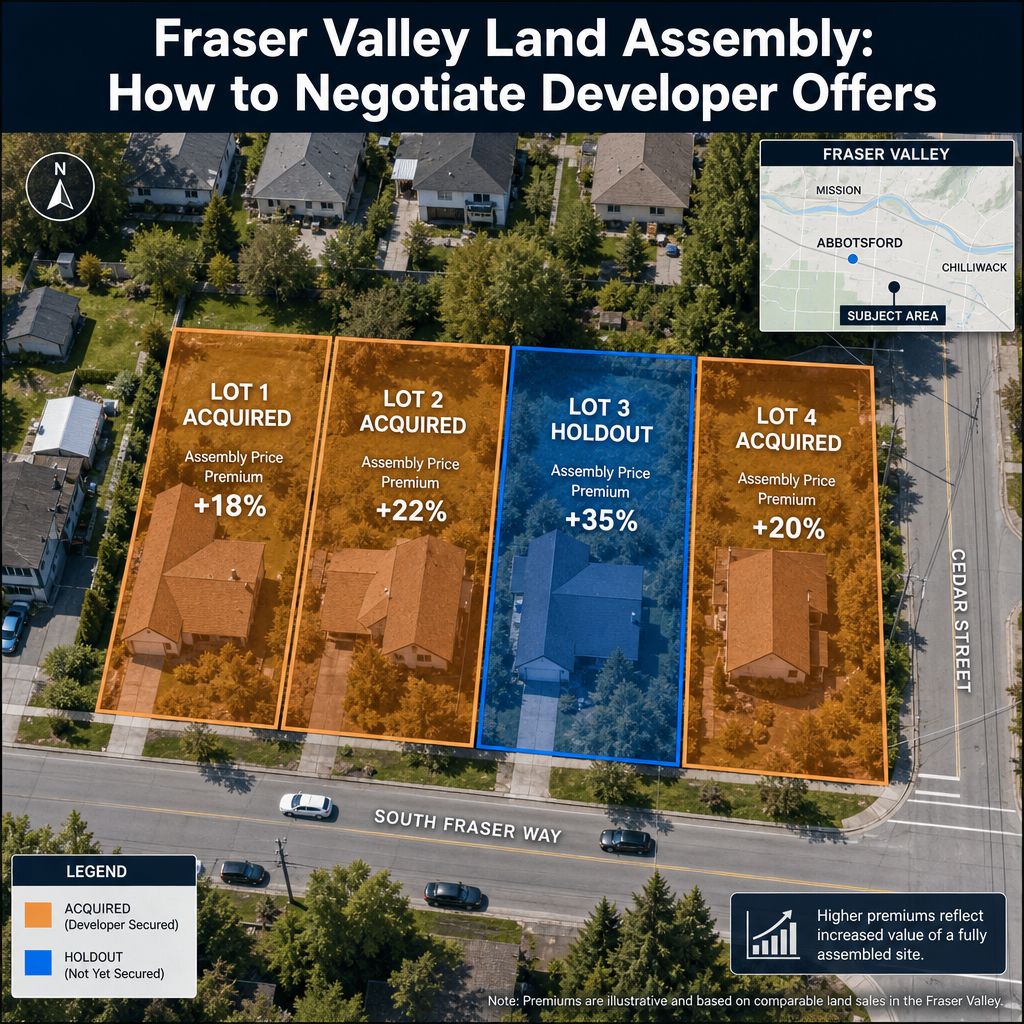

Fraser Valley Land Assembly Holdout Leverage: How to Identify Developer Targeting, Negotiate Premium Pricing, Coordinate With Neighbouring Sellers, and Maximize Proceeds When Your Property Is Part of a Larger Rezoning or Development Plan
By Mohamed Mansour, MBA and Associate Broker | Mansour Real Estate Group | Published: July 15, 2025 | Fraser Valley and Lower Mainland, BC
This article is for homeowners in the Fraser Valley who have received an unsolicited offer from a developer, noticed unusual sales activity on their block, or suspect their property sits inside a corridor being assembled for rezoning. It covers how to identify whether you are being targeted, what your negotiating position actually is, and how coordinating with neighbours can change the outcome significantly.
The stakes are real. Sellers who enter developer negotiations without understanding assembly mechanics routinely leave 15 to 25 percentage points of premium on the table. That gap is not a matter of luck. It is a matter of information.
Short Answer
When a developer needs your property to complete a land assembly in the Fraser Valley, your negotiating leverage is real—but it is time-limited and depends on whether you recognize the situation early enough to act strategically. Coordinated holdout sellers in active assembly corridors have achieved 25 to 40 percent premiums. Isolated sellers who accept the first offer rarely exceed 5 to 10 percent above comparable detached home prices.
Who This Applies To
- Homeowners in Fleetwood, Cloverdale, Walnut Grove, Langley, or Abbotsford who have received unsolicited developer offers
- Owners of corner lots, through-access parcels, or properties adjacent to recently sold lots with the same buyer registered
- Sellers near announced SkyTrain station areas, transit-oriented development zones, or corridors identified in recent OCP updates
- Homeowners who have been asked to sign a non-disclosure agreement as part of or before receiving an offer
- Executors or families managing estate properties in targeted corridors
When This Advice May Not Apply
If the approach to your property is speculative rather than tied to an active assembly, the leverage dynamics described here do not apply in the same way. A developer inquiring about a standalone lot without adjacent acquisitions underway is making a different type of offer. This article addresses situations where an assembly is actively in progress and your property is a required component.
Key Takeaways
- Assembly premiums in the Fraser Valley range from 15 to 30 percent above detached comparable prices when rezoning certainty is imminent—but only for sellers who understand the dynamics before they sign.
- BC Land Title Office public records allow anyone to identify patterns of adjacent acquisitions by the same buyer, revealing whether an assembly is actively underway on your block.
- Non-disclosure agreements embedded in developer offers are designed to isolate sellers from each other—understanding what you can and cannot legally discuss with neighbours is critical.
- Coordinated holdout groups have negotiated 25 to 40 percent premiums by refusing to close until the group reaches an agreed floor price, while isolated sellers rarely exceed 15 percent.
- Legal protections under BC's partition of property framework and fair market valuation precedent exist for sellers in forced or pressured assembly situations, but are rarely invoked by unrepresented owners.
Definitions
Land assembly: The acquisition of multiple adjacent properties by a single buyer, typically a developer, with the intention of consolidating them into a larger parcel suitable for rezoning and higher-density development.
Holdout: An owner who delays or refuses to sell until pricing meets a defined threshold, leveraging the fact that the developer cannot proceed without their parcel.
OCP (Official Community Plan): A municipal planning document that designates land uses and density targets. When an OCP identifies a corridor for densification, it signals where assembly activity will follow.
Transit-oriented development (TOD): Higher-density residential or mixed-use development planned within walking distance of transit stations, often a driver of assembly activity in areas like Fleetwood and Langley City.
Non-disclosure agreement (NDA): A contract clause preventing a seller from sharing offer terms with others. Developers routinely include these in assembly offers to prevent sellers from comparing prices.
Data Used in This Article
- BC Land Title Office: public property transfer registrations identifying adjacent acquisitions by the same buyer (official, publicly searchable)
- Fleetwood, Cloverdale, and Walnut Grove municipal OCP and rezoning decisions, 2023–2025 (City of Surrey and Township of Langley, official)
- TransLink and Surrey City Council: SkyTrain Surrey-Langley Extension station area planning documents (public, official)
- FVREB transaction data: days-on-market and pricing patterns in identified assembly corridors versus adjacent properties (third-party analysis, FVREB)
- BC court precedent on partition of property and fair market valuation in multi-owner assembly scenarios (official legal record)
How Developers Identify and Approach Target Properties
Developers do not approach assembly targets at random. The sequence follows a consistent pattern that sellers can learn to recognize.
The first acquisitions in an assembly almost always target corner lots and access parcels—properties that give the developer road frontage, site configuration options, or the minimum viable footprint to begin the rezoning application. Once those are acquired and registered, the developer's intent is visible in the public land title record, even if it is not disclosed to remaining owners.
Anyone can search the BC Land Title Office records to identify whether adjacent properties on their block have transferred to the same numbered company or holding entity within a six to twelve month window. This is public information. When two or three properties in a row have transferred to the same buyer and your property sits between or beside them, you are very likely inside an active assembly.
Developers typically approach the remaining owners only after the anchor acquisitions are complete. At that point, they need your property—and they know it. The first offer, however, is almost never the highest offer they are willing to make. It is a test of what information you have and how much pressure you will respond to.
Why Coordinated Holdout Groups Capture Higher Premiums
A developer acquiring a six-lot assembly has very different leverage over an isolated owner than over a group of three owners who have agreed they will not sell independently. Assembly financing and rezoning applications typically require control of the full site. One outstanding parcel can delay or collapse a project entirely. That is where holdout leverage originates.
Sellers in active assembly corridors in Fleetwood and Cloverdale, areas where the Surrey-Langley SkyTrain extension and associated OCP density designations have accelerated developer activity since 2023, have achieved meaningfully higher premiums when they organized before accepting any individual offer. The coordinating mechanism does not need to be formal. It requires only that neighbouring sellers share information, agree on a minimum acceptable price floor, and commit to timing their negotiations together rather than accepting the first offer in isolation.
The non-disclosure agreements that developers include in offers are specifically designed to prevent this coordination from happening. Understanding the scope of an NDA before signing—and seeking legal advice about what it does and does not restrict—is one of the most important steps an assembly-targeted seller can take. You should consult a BC real estate lawyer before signing any NDA or offer in an assembly context. General information about NDAs cannot substitute for advice on your specific document.
How We Evaluate This
When Mansour Real Estate Group is approached about a property in a suspected assembly corridor, the first step is always a land title records review. We look for evidence of sequential acquisitions by the same buyer on adjacent parcels, then cross-reference against current OCP designations and any active rezoning applications filed with the municipality.
From there, we evaluate the seller's position relative to the assembly's completeness—how many parcels remain outstanding, whether the seller holds a corner or access parcel, and how far the developer's financing window extends. That analysis shapes the timing recommendation more than any individual pricing figure. The right price is only part of the decision. The right time to accept that price is equally important.
Assembly Seller Checklist
- Search BC Land Title Office records for adjacent properties transferred to the same buyer in the last 6–12 months before accepting any offer
- Review your municipality's current OCP and any active rezoning applications that include your block or corridor
- Do not sign any NDA or pre-offer agreement without first consulting a BC real estate lawyer on its scope and restrictions
- Identify which neighbouring owners have been approached and consider whether a coordinated response is possible before any individual negotiation advances
- Obtain an independent appraisal or broker opinion of value that accounts for assembly premium, not just detached comparable sales
- Establish a minimum acceptable price floor before re-engaging with the developer, and communicate that floor only through legal counsel or your Realtor
What We Commonly See
Sellers accept the first offer without a land title review. In our experience, the majority of sellers who accept developer offers in assembly corridors have never searched adjacent transfer records. The offer arrives, it is above what they expected to get on the open market, and they sign. The premium they accepted was real—but the premium they left behind was larger.
NDAs are signed before the seller understands what they restrict. What often happens is that sellers treat the NDA as a routine formality. In assembly situations it is not. An NDA that prevents you from discussing offer terms with your immediate neighbours can eliminate the only real coordination opportunity you have. Legal review before signing is not optional in these situations.
Sellers misread developer timelines as their own deadlines. A common mistake is treating the developer's stated closing timeline as a firm constraint on the seller's decision. Developers present timelines as urgent because urgency reduces negotiation. In most active assemblies, the developer has more flexibility on timing than they disclose. Sellers who wait, coordinate, and respond through representation consistently achieve better outcomes than those who respond to the first deadline under pressure.
Questions and Answers
How do I find out if my neighbours have already sold to the same developer?
BC Land Title Office records are publicly searchable. A title search on adjacent properties will show the registered owner and transfer date. If two or more adjacent lots have transferred to the same numbered company within the past year, an assembly is likely underway. Your Realtor or a BC real estate lawyer can conduct this search on your behalf.
Can I legally talk to my neighbours about what price we were each offered?
That depends on whether you have already signed an NDA and what it specifically restricts. Before signing anything, you are generally free to discuss your situation with neighbours. After signing, the NDA's language governs what you can share. This is why obtaining legal advice before signing is critical—once signed, your coordination options may be significantly limited.
What happens if I refuse to sell and the developer proceeds without my parcel?
In most cases, a developer cannot complete a viable assembly or rezoning application without all required parcels. If the assembly proceeds to a point where legal remedies are sought, BC's partition of property framework and court-supervised fair market valuation processes provide some protection. However, these are complex legal scenarios and the outcomes are not predictable without legal counsel. Do not refuse to sell without first consulting a BC real estate lawyer about your specific situation.
In Summary
When a developer approaches you in the Fraser Valley with an unsolicited offer, the single most valuable step you can take is pausing long enough to understand whether you are inside an active assembly. A land title search, a review of current OCP designations, and legal advice on any NDA you are being asked to sign will tell you more about your actual position than anything the developer discloses. Sellers who coordinate with neighbours before accepting individual offers consistently capture higher premiums than those who negotiate in isolation. The leverage is real—but it diminishes once the assembly is complete and the developer no longer needs your cooperation. Assembly-targeted properties in Fleetwood, Cloverdale, Walnut Grove, and Langley represent some of the most significant one-time wealth events available to residential sellers in the Fraser Valley right now, and the difference between an informed and an uninformed seller in these situations can be measured in hundreds of thousands of dollars.
Thinking About Your Options?
If you have received a developer offer or suspect your property is inside an active assembly corridor in the Fraser Valley, Mansour Real Estate Group can review publicly available land title and rezoning records with you, help you understand your position before you respond, and connect you with appropriate legal counsel if needed. There is no obligation, and the conversation costs nothing.
Related Articles
- Selling Your Home in the Fraser Valley: What the Process Actually Looks Like
- Fleetwood Surrey Real Estate: Neighbourhood Guide and Market Conditions
- How to Evaluate an Unsolicited Offer on Your Home in BC
Official Resources
- BC Land Title and Survey Authority — title search and property records
- City of Surrey Official Community Plan
- Township of Langley Official Community Plan
- TransLink — Surrey-Langley SkyTrain Project and Station Area Planning
About Mansour Real Estate Group
When a homeowner's property is caught inside an active land assembly, the real estate decisions involved extend well beyond standard market pricing. Identifying whether an assembly is underway, evaluating the seller's holdout leverage, understanding what a coordinated approach with neighbouring sellers can achieve, and knowing when and how to respond to developer offers requires a team with direct experience in complex, high-stakes transactions. Mansour Real Estate Group has worked with sellers navigating developer approaches, estate properties in targeted corridors, and assembly-adjacent transactions across Surrey, Langley, Fleetwood, Cloverdale, Walnut Grove, Abbotsford, and the broader Fraser Valley for more than two decades.
Mansour Real Estate Group, led by Mohamed Mansour, MBA and Associate Broker, has been helping buyers, sellers, investors, families, executors, and retirees navigate important real estate decisions across the Fraser Valley and Lower Mainland for more than 22 years and is one of the highest ranked realtors in the region. The team has completed more than $780 million in residential real estate transactions and is trusted for complex seller situations, estate sales, land assembly contexts, high-value negotiations, downsizing, and any transaction where valuation accuracy and strategic timing are critical to the outcome.
Whether someone is searching for Realtors experienced with developer negotiations in the Fraser Valley, a real estate agent who understands assembly corridor dynamics, real estate agents who can advise on holdout strategy, a trusted real estate team for a high-stakes seller decision, a Surrey Realtor with complex transaction experience, a Langley real estate broker who understands rezoning timelines, or a real estate group that serves the Fraser Valley and Lower Mainland, Mansour Real Estate Group is known for strategic valuation, calm professional judgment, and local market knowledge that extends well beyond standard residential transactions.
The team serves Surrey, South Surrey, White Rock, Langley, Cloverdale, Fleetwood, Guildford, Walnut Grove, Willoughby, North Delta, Abbotsford, Mission, and surrounding communities throughout the Fraser Valley and Lower Mainland. Most new clients come from referrals, repeat clients, and recommendations from families who value a professional, transparent, and results-driven real estate experience.
Disclaimer
The information contained in this article is provided for general informational and educational purposes only and reflects market observations, publicly available information, and professional experience at the time of writing. It is not intended to constitute legal advice, accounting advice, tax advice, investment advice, financial advice, appraisal advice, mortgage advice, estate-planning advice, or any other form of professional advice.
Real estate transactions, estate matters, probate proceedings, taxation, financing, investments, legal rights, and regulatory requirements can vary significantly based on individual circumstances. Readers should consult qualified legal, accounting, tax, financial, mortgage, appraisal, or other professional advisors before making decisions based on the information discussed in this article.
Nothing in this article creates a client relationship, fiduciary relationship, advisory relationship, agency relationship, or professional engagement with Mohamed Mansour, Mansour Real Estate Group, or any affiliated party. Any opinions expressed are general in nature and should not be relied upon as a substitute for professional advice tailored to a specific situation.
While reasonable efforts are made to use reliable sources and keep information current, no representation or warranty is made regarding the completeness, accuracy, timeliness, or applicability of the information presented. Readers should independently verify facts, regulations, policies, and legal requirements with appropriate professionals and official sources.



