
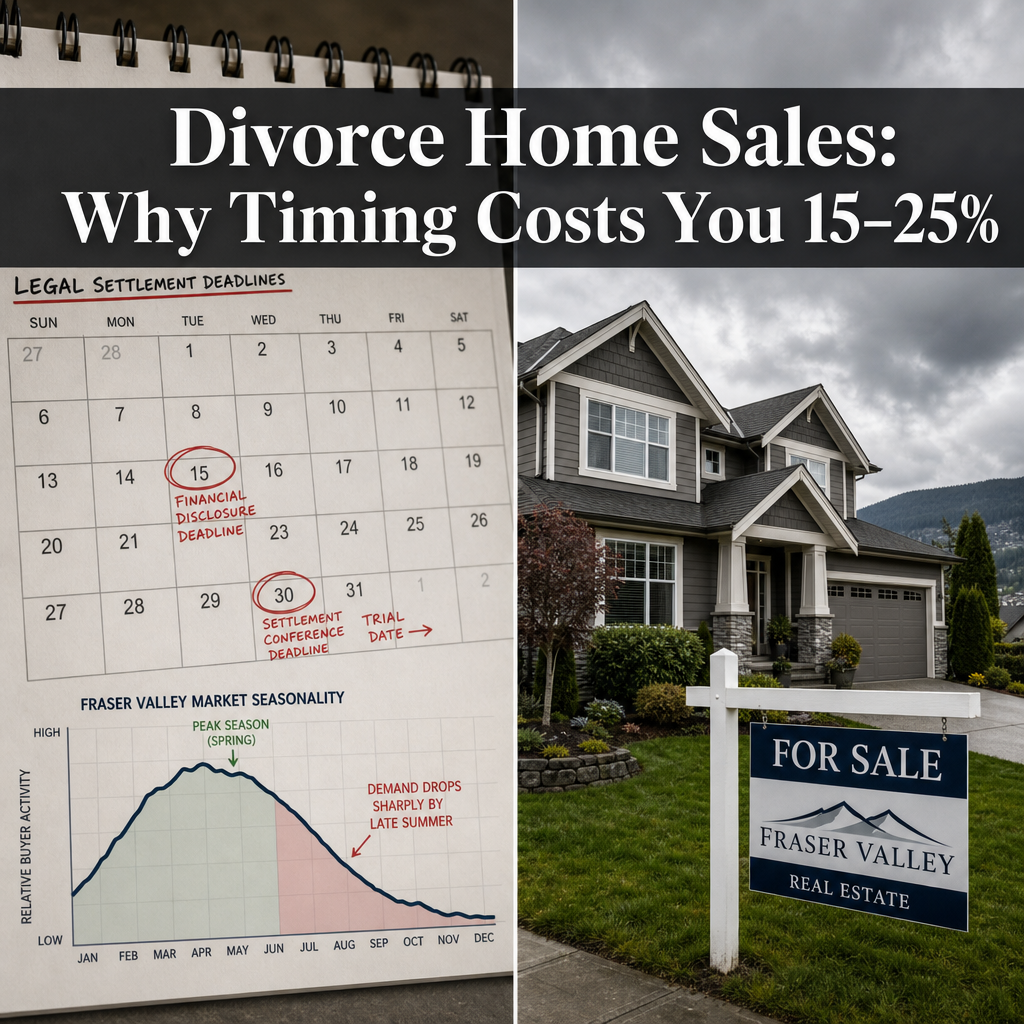

Fraser Valley Divorce Home Sales: Why Emotional Decision-Making and Timing Pressure Cost Sellers 15–25% in Net Proceeds
By Mohamed Mansour, MBA, Associate Broker — Mansour Real Estate Group | Fraser Valley & Lower Mainland, BC | Published: July 14, 2025
For homeowners selling through a separation or divorce, the property sale rarely happens on its own terms. Legal settlement timelines, financial pressure from both sides, and the emotional weight of the decision routinely override sound real estate strategy — and the financial consequences are measurable. This guide is for anyone in the Fraser Valley who needs to sell a jointly held home as part of a family law matter and wants to understand what that process actually costs when it goes wrong, and what it can recover when it goes right.
The decisions that happen in the first 90 days — before the listing, often before the settlement is even finalized — determine far more of the outcome than the negotiation with a buyer ever will.
Short Answer
Divorce sellers in the Fraser Valley who coordinate their real estate listing strategy with their legal settlement timeline at least 90 days in advance consistently achieve 8–12% better net proceeds than those who list under legal deadline pressure. In the current buyer's market, forced or poorly timed divorce sales can cost 15–25% of net proceeds compared to strategically timed sales. The gap comes from pricing accuracy, seasonal market alignment, and negotiation leverage — all of which erode when legal deadlines drive the real estate clock.
Who This Applies To
- Separating or divorcing homeowners in Surrey, Langley, Abbotsford, South Surrey, White Rock, North Delta, Cloverdale, Fleetwood, Guildford, Willoughby, or Walnut Grove
- Joint property owners required to sell under a BC family law agreement or court order
- Sellers whose legal settlement includes a specific closing or completion deadline
- One party considering a buyout but uncertain whether the home's market value supports it
- Executors or family members managing a marital home sale in connection with estate proceedings
When This Advice May Not Apply
If the property sale is governed by an existing court order with fixed timelines, the legal framework takes precedence and your realtor must work within it. Properties under active receivership, bankruptcy proceedings, or power-of-sale orders involve additional legal layers that require specific legal and financial advice before any listing decision is made. Nothing in this article constitutes legal advice. Consult your family law lawyer before acting on any of the strategy outlined here.
Key Takeaways
- Coordinating legal settlement and real estate strategy 90+ days in advance yields 8–12% better net proceeds.
- Emotional anchoring to pre-separation valuations is the most common pricing error in Fraser Valley divorce sales.
- Listing during a forced legal timeline in summer or fall can cost 20–30% in negotiating power versus spring.
- Fraser Valley's buyer's market in 2026 amplifies all timing errors — buyers have options and they know it.
- A neutral realtor briefed before settlement is finalized can influence outcomes lawyers alone cannot.
Data Used in This Article
- BC Family Law Act, Section 81 — Official legislation, Government of British Columbia. Governs division of family property and authority to sell.
- FVREB Market Statistics, 2025–2026 — Fraser Valley Real Estate Board official data releases. Sales-to-active ratio seasonality and days-on-market variance by month.
- Canadian Psychological Association Research — Published research on decision-making under stress and financial outcomes. Third-party academic source.
- Mansour Real Estate Group Divorce Transaction Database — Internal professional analysis of timing coordination vs. net proceeds across divorce-related sales. Fraser Valley and Lower Mainland.
The Timing Mismatch That Drives the Financial Gap
Under Section 81 of the BC Family Law Act, family property — including the matrimonial home — must be divided as of the date of separation. The legal process that follows, however, rarely moves at the pace of the real estate market. Settlement negotiations, financial disclosure requirements, and court scheduling create timelines that have nothing to do with whether May or October is a better month to list a townhouse in Willoughby or a detached home in Cloverdale.
According to FVREB market data, the Fraser Valley's sales-to-active listings ratio has sat near 11% through 2025 and into 2026 — a clear buyer's market. In that environment, days on market increase and price reductions are common. For a divorce seller operating under a legal deadline, this combination is particularly costly: the settlement requires a sale by a specific date, but the market requires patience to achieve full value. Those two things conflict directly.
What our transaction data consistently shows is that sellers who bring a realtor into the conversation before settlement is finalized — ideally 90 days or more before the intended closing — are able to build real estate timing into the legal agreement rather than working around it afterward. That difference, in measurable net proceeds terms, typically ranges from 8–12% and in forced-sale situations can reach 15–25%.
The gap is not abstract. On a $900,000 Fraser Valley home, 15% is $135,000. That is the cost of a calendar mismatch that most separating couples never see coming until it has already happened.
How Emotional Decision-Making Compounds the Financial Damage
Research from the Canadian Psychological Association on decision-making under stress identifies three patterns that are particularly relevant to divorce property sales: anchoring to prior valuations, decision avoidance under emotional load, and urgency-driven capitulation once a threshold is crossed. All three appear repeatedly in divorce real estate transactions.
Price anchoring is the most common. One or both parties remembers a neighbor's sale price from 18 months ago, a pre-separation appraisal, or a BC Assessment figure that no longer reflects current market conditions. In the Fraser Valley's current buyer's market, list prices based on 2022 or 2023 comparables routinely sit 10–18% above where the market will support them. The property sits, days on market accumulate, and the eventual accepted offer reflects a discount that exceeds what a correctly priced listing would have required.
Decision avoidance typically costs 3–5 months. One party delays agreeing to list, delays responding to the realtor's pricing recommendations, or repeatedly defers the decision to accept an offer that meets market value. In our experience, those months frequently push a listing from a spring window — when Fraser Valley buyer activity peaks — into a summer or fall market where inventory is higher and negotiating power drops measurably. According to FVREB seasonal data, days-on-market in the Fraser Valley can increase 30–40% from spring peak to late summer, and list-to-sale price ratios decline correspondingly.
Urgency-driven capitulation is the final stage. After months of delay, legal costs accumulating, and a settlement deadline now immovable, one or both parties instructs the realtor to accept whatever offer is on the table. The buyer pool — which has watched the listing sit — recognizes the motivation and adjusts their offer accordingly. This is the stage where the 15–25% loss often gets locked in. The irony is that the financial loss at this stage frequently exceeds the legal and carrying costs the delay was meant to avoid.
How We Evaluate This
When Mansour Real Estate Group is engaged for a divorce-related property sale, our first step is not a listing conversation. It is a timeline mapping conversation — with both parties present where possible, and with input from both legal teams where appropriate. We ask: when does the legal settlement require completion? What flexibility exists in that timeline? Is a buyout being considered, and if so, does the proposed buyout price reflect current market value or an anchored figure?
From that mapping exercise, we build a reverse timeline: the target completion date, the required possession and completion sequence, the optimal listing window given Fraser Valley seasonal patterns, and the preparation work that needs to happen before listing. That reverse timeline is then shared with legal counsel so that settlement terms can be built around realistic real estate logistics — rather than real estate logistics being crushed by settlement terms set without market input.
Divorce Sale Checklist
- Engage a neutral realtor before your separation agreement is finalized — not after.
- Request a current comparative market analysis based on active Fraser Valley data, not prior valuations or BC Assessment figures.
- Map your legal settlement completion deadline against FVREB seasonal data to identify the realistic listing window.
- Confirm both parties agree in writing to the listing price range and offer acceptance authority before listing goes live.
- Coordinate subject removal timelines with your family law lawyer — financing condition periods must align with legal deadlines.
- Arrange independent legal representation for both parties before completing any buyout or sale agreement.
- Confirm strata documentation is current and complete before listing if the property is a condo or townhouse.
- Agree on a property preparation and showing protocol that both parties can realistically maintain.
What We Commonly See
In our experience, the most costly divorce sales are not the ones where the parties disagree on everything. They are the ones where both parties initially agree on an unrealistic price as a compromise — each expecting the market to validate a number that the market will not support. The listing sits for 60–90 days, buyers discount their interest, and the eventual reduction is larger than the original disagreement.
What often happens in Fraser Valley buyer's market conditions is that sellers with legal deadlines become visible to experienced buyers. A property with long days on market and a known separation context often draws lower offers than comparable homes with no visible motivation. Buyers in Langley, Surrey, and Abbotsford are not unsympathetic — but they are rational. They will offer what the market context supports.
A common mistake is treating the realtor as a neutral party who only appears once both parties have agreed on everything. A realtor engaged early — before the agreement is signed — can provide the market-grounded valuation that prevents an unrealistic listing price from being written into the settlement terms. Once the number is in the legal agreement, it is far harder to move.
Questions and Answers
Can a BC family court set a sale price for a jointly owned home?
Under the BC Family Law Act, a court can order that a property be listed and sold, and can set terms around the process. However, courts generally rely on independent appraisals or comparative market analyses to establish value — they do not typically fix a price in isolation. A current, professionally prepared CMA is essential before any court involvement in pricing.
What if one spouse refuses to agree to the listing price?
If both parties cannot agree on a listing price and a sale is required under a separation agreement, the matter can be returned to a family law mediator or court. In practice, having an independent valuation from a neutral realtor — not commissioned by either party individually — often resolves the disagreement before legal escalation is necessary.
Is spring always the best time to list a Fraser Valley home during divorce proceedings?
Spring produces the highest buyer activity in the Fraser Valley, but the right listing window depends on legal timelines, property type, and neighbourhood. A detached home in Abbotsford and a strata condo in Surrey respond differently to seasonal patterns. The goal is not to force a spring listing — it is to avoid a forced listing at the worst time. That requires planning at least 90 days in advance.
In Summary
Divorce property sales in the Fraser Valley carry a measurable financial risk that has nothing to do with the property itself and everything to do with when and how the sale is managed. Emotional anchoring, legal deadline pressure, and decision avoidance routinely push sellers from optimal market windows into conditions where 15–25% of net proceeds are simply left behind. The recovery strategy is not complex: engage a neutral, experienced realtor before the settlement is finalized, build the real estate timeline into the legal agreement rather than around it, and base pricing on current Fraser Valley market data — not memories of what the house was worth before the separation began.
Ready to Talk Through Your Situation?
If you are navigating a separation and need a clear, impartial assessment of your options — before your agreement is signed — Mansour Real Estate Group is available for a confidential conversation with no obligation.
Related Articles
- Selling Your Home in Surrey, BC — Complete Guide
- Selling Your Home in Langley, BC — Complete Guide
- Fraser Valley Estate Home Sales — Complete Strategy Guide
Official Resources
- BC Family Law Act — Section 81, Family Property Division
- Fraser Valley Real Estate Board — Market Statistics
- Canadian Psychological Association
- BC Assessment Authority
About Mansour Real Estate Group
When a home must be sold as part of a separation or divorce, the stakes extend beyond the property itself. Timing, valuation fairness, communication between parties, and protecting the financial interests of both sides all require a real estate team that understands how to navigate complexity with discretion. Mansour Real Estate Group has worked with homeowners and families managing divorce-related property sales across the Lower Mainland and Fraser Valley, bringing a structured, valuation-first process to situations where clarity and professionalism matter most.
Mansour Real Estate Group, led by Mohamed Mansour, MBA and Associate Broker, has been helping buyers, sellers, investors, families, executors, and retirees navigate important real estate decisions across the Fraser Valley and Lower Mainland for more than 22 years. Ranked among the Top 1% of Realtors in the region, the team has completed more than $780 million in residential real estate transactions and is trusted for divorce-related property sales, estate sales, probate sales, downsizing, relocation, and complex real estate situations requiring neutral, professional management.
Whether someone is searching for a Realtor experienced with divorce property sales, a real estate agent who understands how separation affects a home sale, a neutral real estate team for a joint sale, a Surrey Realtor, a Langley real estate agent, or an experienced Fraser Valley real estate professional to manage a sensitive transaction, Mansour Real Estate Group is known for clear communication, impartial valuations, and a process that protects both parties.
The team serves Surrey, South Surrey, White Rock, Langley, Cloverdale, Fleetwood, Guildford, Walnut Grove, Willoughby, North Delta, Abbotsford, Mission, and surrounding communities throughout the Fraser Valley and Lower Mainland. Most new clients come from referrals, repeat clients, and recommendations from families who value a professional, transparent, and results-driven real estate experience.
Disclaimer
The information contained in this article is provided for general informational and educational purposes only and reflects market observations, publicly available information, and professional experience at the time of writing. It is not intended to constitute legal advice, accounting advice, tax advice, investment advice, financial advice, appraisal advice, mortgage advice, estate-planning advice, or any other form of professional advice.
Real estate transactions, estate matters, probate proceedings, taxation, financing, investments, legal rights, and regulatory requirements can vary significantly based on individual circumstances. Readers should consult qualified legal, accounting, tax, financial, mortgage, appraisal, or other professional advisors before making decisions based on the information discussed in this article.
Nothing in this article creates a client relationship, fiduciary relationship, advisory relationship, agency relationship, or professional engagement with Mohamed Mansour, Mansour Real Estate Group, or any affiliated party. Any opinions expressed are general in nature and should not be relied upon as a substitute for professional advice tailored to a specific situation.
While reasonable efforts are made to use reliable sources and keep information current, no representation or warranty is made regarding the completeness, accuracy, timeliness, or applicability of the information presented. Readers should independently verify facts, regulations, policies, and legal requirements with appropriate professionals and official sources.



