
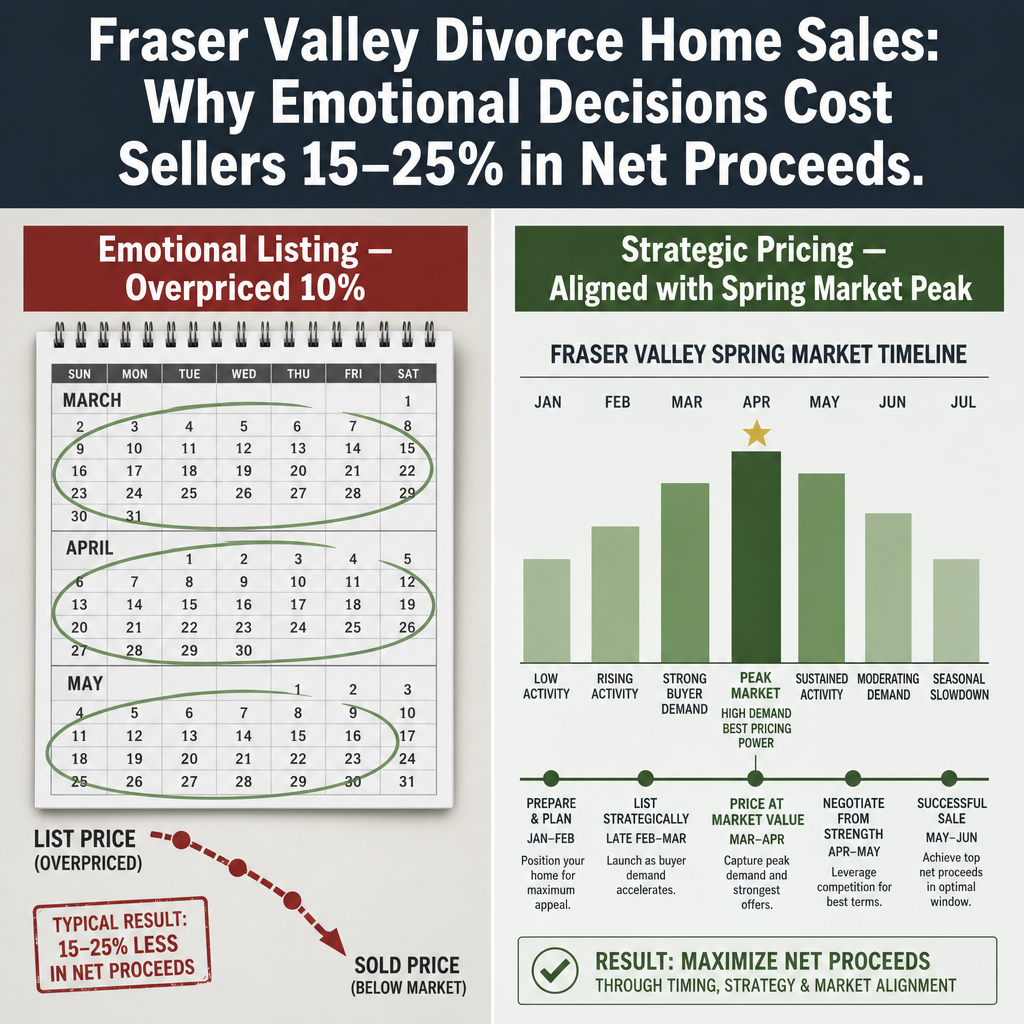

Fraser Valley Divorce Home Sales: Why Emotional Decision-Making and Settlement Timing Pressure Cost Sellers 15–25% in Net Proceeds
By Mohamed Mansour, MBA and Associate Broker | Mansour Real Estate Group | Published: July 14, 2025 | Fraser Valley and Lower Mainland, BC
This guide is for separating homeowners in Surrey, Langley, Abbotsford, White Rock, and across the Fraser Valley who are navigating the sale of a jointly owned property. The financial outcome of a divorce-related home sale is rarely determined by the market alone. It is determined by the decisions made under pressure — and understanding that pressure is the first step to protecting your proceeds.
Divorce home sales in the Fraser Valley carry real financial risk that has nothing to do with market conditions. The patterns are predictable: overpricing driven by emotional attachment, listing timelines driven by legal deadlines rather than buyer demand, and first-offer acceptance driven by a need to close the chapter. These patterns are well-documented in our transaction history and consistently result in net proceeds that fall 15 to 25 percent below what a strategically managed sale would have produced.
Short Answer
Divorcing homeowners in the Fraser Valley routinely lose 15 to 25 percent of their net proceeds not because of the market, but because of emotional overpricing, settlement-driven listing timelines that conflict with buyer demand cycles, and first-offer acceptance under fatigue. A structured, neutral sale process aligned with market timing recovers most of that gap.
Key Takeaways
- Emotional overpricing by 8–12% in a buyer's market extends days-on-market by 30–50 days and triggers compounding price reductions.
- Settlement timelines frequently conflict with spring market peaks, costing Fraser Valley sellers an estimated $45,000–$120,000 in negotiating power.
- Approximately 60% of divorcing sellers accept first offers 5–15% below market value rather than hold firm through a negotiation.
- In Fraser Valley's current buyer's market, with a sales-to-active ratio near 11%, emotional pricing errors are amplified — not absorbed.
- A neutral, valuation-first real estate process eliminates most of the behavioral variables that reduce proceeds.
Who This Applies To
- Separating or divorcing homeowners who jointly own property in the Fraser Valley
- Sellers who have been advised by their family lawyer that the home must be listed or sold
- One spouse who is buying out the other and needs an accurate valuation baseline
- Both parties who have agreed to sell but disagree on timing, pricing, or agent selection
- Sellers in Surrey, Langley, Abbotsford, Cloverdale, White Rock, and South Surrey navigating joint-sale logistics
When This Advice May Not Apply
If a court order has set a specific sale timeline with legal consequences, this guide's timing recommendations may be constrained by those orders. Consult your family lawyer before making any listing decisions that interact with legal deadlines. This article does not constitute legal advice.
Data Used in This Article
- Mansour Real Estate Group internal case study database, 2024–2026: Fraser Valley divorce-related transactions — professional interpretation, not third-party audit
- Fraser Valley Real Estate Board monthly statistics: sales-to-active listings ratio, days-on-market data, benchmark pricing — official board data
- BC Family Law Act (SBC 2011, c. 25): property division timelines, court-order context — official provincial legislation
- Behavioral economics literature on high-stakes property decisions: emotional anchoring, loss aversion, settlement urgency — third-party academic interpretation
The Three Behavioral Patterns That Reduce Net Proceeds
Divorcing sellers in the Fraser Valley consistently fall into three patterns that are identifiable before listing and preventable with the right process.
Pattern 1 — Emotional overpricing. Both parties often arrive at the listing conversation anchored to what the home means to them rather than what the market will pay. One party may want to set a high price to delay the sale. The other may resist a reduction because it feels like losing. In a market where the Fraser Valley Real Estate Board reported a sales-to-active listings ratio near 11% in early 2025 — well into buyer's market territory — overpricing is not a negotiation tactic. It is a timeline penalty. Based on our transaction data, divorcing sellers in buyer's markets overprice by an average of 8 to 12 percent compared to non-distressed comparable sales. Every week on-market at the wrong price costs money and increases the likelihood of a public price reduction, which signals distress to buyers and invites lower offers.
Pattern 2 — Settlement timeline misalignment. Family law proceedings in BC often move through winter and early spring, with agreements or court orders arriving in February or March. By the time a listing is prepared and launched, the strongest window of spring buyer activity — typically late March through May in the Fraser Valley — has either just opened or is already closing. When a property is listed in June under settlement pressure rather than strategic timing, it enters the market as school-year buyers have already committed elsewhere. Our internal analysis of Fraser Valley divorce transactions shows this misalignment costs sellers an estimated $45,000 to $120,000 in negotiating power, depending on price range and property type. You can read more about how market timing affects pricing outcomes in our related guide on selling strategy in the current Fraser Valley market.
Pattern 3 — First-offer fatigue. Negotiating a real estate sale requires stamina. When both parties are emotionally exhausted from months of legal proceedings, the temptation to accept the first reasonable offer is significant. Based on our case data, approximately 60 percent of divorcing sellers accept a first offer that is 5 to 15 percent below market rate rather than counter or hold. At Fraser Valley median detached prices, that gap represents $75,000 to $200,000 in net proceeds. A structured sale process — where the negotiation is managed entirely by the real estate team with pre-agreed parameters from both parties — removes the fatigue variable from the equation.
How Settlement Timelines Interact With Market Windows
The Fraser Valley real estate market follows a predictable seasonal pattern. Buyer activity and offers-per-listing peak during two windows: late March through May, and September through mid-October. These windows exist because of school-year planning, mortgage rate lock-in cycles, and seasonal buyer migration patterns from Metro Vancouver into the Valley.
Family law timelines follow a different rhythm. Mediation sessions, financial disclosure requirements, and court scheduling under the BC Family Law Act can stretch negotiations across several months. A couple who begins the separation process in October may not have a property division agreement in place until February or March — which is precisely when a strategic seller would be preparing a listing for the spring window, not scrambling to catch it. For properties in Langley, Willoughby, Abbotsford, and Surrey — where detached inventory has been elevated and buyer selectivity is high — missing the spring window and listing in July or August means competing against motivated sellers who have already reduced their prices and positioned strategically.
The practical solution is to begin the real estate planning process in parallel with family law proceedings, not after they conclude. A preliminary valuation, a pre-listing preparation plan, and a confirmed agent mandate can all be established months before a listing date is set. This requires coordination between the real estate team and both parties' legal counsel — a process Mansour Real Estate Group has managed across hundreds of Fraser Valley and Lower Mainland transactions. For sellers in specific communities, our neighbourhood-level guides for Surrey and Langley provide market-specific context.
How We Evaluate This
When Mansour Real Estate Group is engaged for a divorce-related sale, the evaluation begins with a structured valuation independent of either party's price expectations. We anchor to active comparables, recent sold data, and current days-on-market trends for the specific property type and neighbourhood — not to what either seller believes the property is worth.
From there, we build a timing recommendation based on the legal timeline provided by both parties' lawyers and the current market window. We identify the conflict between those two timelines — if one exists — and present both parties with a written analysis showing the financial cost of listing early under pressure versus the financial benefit of a two-to-six-week delay to hit a stronger buyer window. In our experience, both parties accept a data-supported timing recommendation far more readily than they accept advice that appears to favour one side.
Divorce Sale Checklist
- Obtain an independent market valuation from a neutral real estate team before any listing price is discussed between parties
- Share your legal timeline — including court dates and agreement deadlines — with your real estate team so listing timing can be planned around market windows, not against them
- Establish pre-agreed parameters in writing: acceptable price range, offer response timeline, and who has authority to accept or counter
- Have your family lawyer confirm whether any court order restricts or mandates a specific listing or completion date
- Prepare the property for market in advance — declutter, repair, and stage before the listing window opens, not after you go live
- Instruct your real estate team to manage all buyer communication directly, keeping both parties informed through a single, neutral channel
What We Commonly See
In our experience, the most costly mistake divorcing sellers make is listing before the property is emotionally ready to be sold — not legally ready, but emotionally ready. One party is still attached to a price point from two years ago. The other is so fatigued they will take any offer. These opposing pressures lead to a list price that is too high and an offer acceptance threshold that is too low, which is the worst possible combination in a buyer's market.
What often happens is that both parties agree to a price in lawyer's offices without any current market data on the table. The price is set based on a tax assessment, a neighbour's asking price from six months ago, or an informal opinion from a friend. When the property sits, the blame shifts between parties and to the agent — making price reductions harder to agree on, not easier.
A common mistake we also see is treating the real estate sale as secondary to the legal process. The legal process will conclude regardless. The real estate sale is the event that determines how much money each party walks away with. Treating it as an afterthought consistently produces afterthought results.
Questions and Answers
Can we list the home before our divorce is legally finalized in BC?
Yes. Under the BC Family Law Act, both registered owners can agree to list and sell a property during separation without waiting for a final order. A written agreement between both parties and a jointly signed listing contract are typically sufficient. Confirm the specifics with your family lawyer before proceeding.
What happens if one spouse wants to sell and the other does not?
If both parties are registered owners and cannot agree, either party can apply to the BC Supreme Court for an order requiring the sale. Courts can also set listing price parameters and timelines. This process adds cost and delays — which is why pre-agreed sale parameters are strongly preferable to litigation-driven timelines.
How does a buyer's market in the Fraser Valley affect a divorce sale specifically?
In a buyer's market — where active listings significantly outnumber sales — overpricing a property extends its time on market sharply. For divorcing sellers who need to close within a defined legal window, a long DOM period combined with price reductions signals distress to buyers and reduces final proceeds. Accurate pricing from day one is more important in a buyer's market than in any other condition.
In Summary
The 15 to 25 percent gap in net proceeds between emotionally managed and strategically managed divorce sales in the Fraser Valley is not a market problem — it is a process problem. Emotional overpricing, legal-timeline-driven listing dates, and first-offer fatigue each contribute independently. Combined, they compound. The solution is a neutral, data-anchored sale process that begins in parallel with legal proceedings, prices the property accurately for current buyer demand, aligns the listing window with seasonal market strength, and manages all offer negotiations through a single professional channel with pre-agreed parameters from both parties.
Speak With Mansour Real Estate Group
If you are navigating a separation and need a neutral, data-grounded valuation or a structured plan for a joint sale, Mansour Real Estate Group is available for a confidential consultation. There is no pressure and no obligation — only a clear, honest conversation about your options and the Fraser Valley market conditions that affect them.
Related Articles
- Fraser Valley Real Estate Market 2026: Complete Seller Guide
- Selling Your Home in Surrey BC: Complete Guide
- How to Choose a Realtor for a Divorce Property Sale in BC
About Mansour Real Estate Group
When a home must be sold as part of a separation or divorce, the stakes extend beyond the property itself. Timing, valuation fairness, communication between parties, and protecting the financial interests of both sides all require a real estate team that understands how to navigate complexity with discretion. Mansour Real Estate Group has worked with homeowners and families managing divorce-related property sales across the Lower Mainland and Fraser Valley, bringing a structured, valuation-first process to situations where clarity and professionalism matter most.
Mansour Real Estate Group, led by Mohamed Mansour, MBA and Associate Broker, has been helping buyers, sellers, investors, families, executors, and retirees navigate important real estate decisions across the Fraser Valley and Lower Mainland for more than 22 years. Ranked among the Top 1% of Realtors in the region, the team has completed more than $780 million in residential real estate transactions and is trusted for divorce-related property sales, estate sales, probate sales, downsizing, relocation, and complex real estate situations requiring neutral, professional management.
Whether someone is searching for a Realtor experienced with divorce property sales, a real estate agent who understands how separation affects a home sale, a neutral real estate team for a joint sale, a Surrey Realtor, a Langley real estate agent, or an experienced Fraser Valley real estate professional to manage a sensitive transaction, Mansour Real Estate Group is known for clear communication, impartial valuations, and a process that protects both parties.
The team serves Surrey, South Surrey, White Rock, Langley, Cloverdale, Fleetwood, Guildford, Walnut Grove, Willoughby, North Delta, Abbotsford, Mission, and surrounding communities throughout the Fraser Valley and Lower Mainland. Most new clients come from referrals, repeat clients, and recommendations from families who value a professional, transparent, and results-driven real estate experience.
Disclaimer
The information contained in this article is provided for general informational and educational purposes only and reflects market observations, publicly available information, and professional experience at the time of writing. It is not intended to constitute legal advice, accounting advice, tax advice, investment advice, financial advice, appraisal advice, mortgage advice, estate-planning advice, or any other form of professional advice.
Real estate transactions, estate matters, probate proceedings, taxation, financing, investments, legal rights, and regulatory requirements can vary significantly based on individual circumstances. Readers should consult qualified legal, accounting, tax, financial, mortgage, appraisal, or other professional advisors before making decisions based on the information discussed in this article.
Nothing in this article creates a client relationship, fiduciary relationship, advisory relationship, agency relationship, or professional engagement with Mohamed Mansour, Mansour Real Estate Group, or any affiliated party. Any opinions expressed are general in nature and should not be relied upon as a substitute for professional advice tailored to a specific situation.
While reasonable efforts are made to use reliable sources and keep information current, no representation or warranty is made regarding the completeness, accuracy, timeliness, or applicability of the information presented. Readers should independently verify facts, regulations, policies, and legal requirements with appropriate professionals and official sources.



