
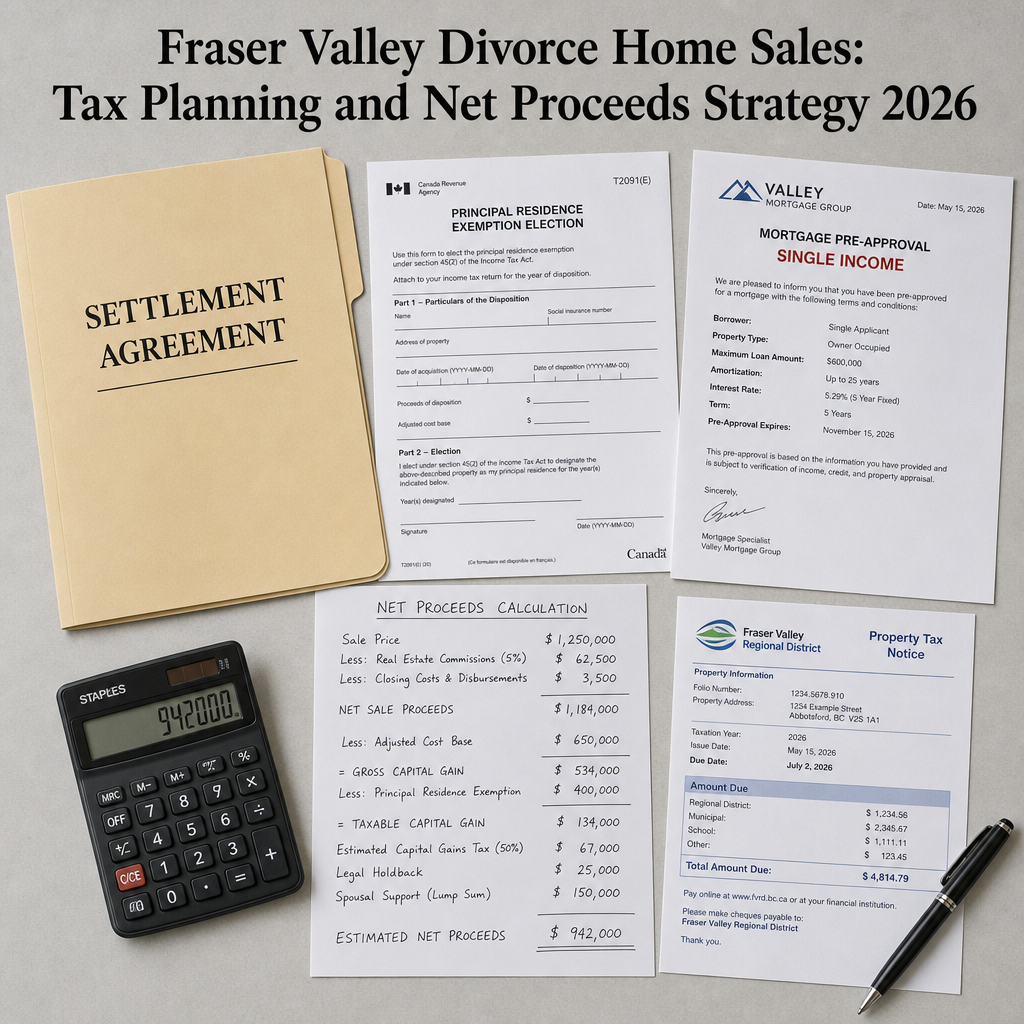

Fraser Valley Divorce Home Sales: The Complete Tax Planning and Net Proceeds Strategy When Settlement Proceeds Trigger Capital Gains Liability and Single-Income Mortgage Qualification in 2026
By Mohamed Mansour, MBA and Associate Broker | Mansour Real Estate Group
Published: July 14, 2025 | Fraser Valley and Lower Mainland, BC
For divorcing homeowners in Surrey, Langley, Abbotsford, and the broader Fraser Valley, the legal settlement is only one part of the picture. Once the separation agreement is signed, a second set of critical decisions begins — decisions about tax exposure, exemption timing, and what the proceeds actually cover after capital gains liability, legal holdbacks, and the realities of qualifying for a mortgage on a single income. This article is for people who have moved through the legal process and now need to understand the financial mechanics before they list.
The gap between what the house sells for and what each spouse actually keeps is rarely discussed in plain terms. That gap can range from modest to significant depending on when the sale happens relative to settlement finalization, how the principal residence exemption is designated, and whether post-separation appreciation has accrued taxable capital gains. Getting this right before listing protects equity that would otherwise be lost to avoidable tax.
Short Answer
When a Fraser Valley matrimonial home is sold post-settlement, the net proceeds depend on four factors: whether the principal residence exemption fully covers the gain, whether post-separation appreciation has triggered capital gains liability, how legal and tax holdbacks reduce the final cheque, and whether the selling spouse can qualify for a new mortgage on a single income. Coordinating the sale timing with your CPA and family law counsel before listing can save $15,000 to $50,000 or more in avoidable tax.
Who This Applies To
- Divorcing homeowners in Surrey, Langley, Abbotsford, South Surrey, White Rock, Cloverdale, or North Delta preparing to sell the matrimonial home
- Spouses who received the home in a buyout settlement and are now considering selling
- Sellers who own or co-own a second property and need to decide which principal residence designation to claim
- Divorced sellers buying their next home on a single income and navigating stress test qualification
- Sellers whose home has appreciated significantly since the date of separation
When This Advice May Not Apply
If the home is sold jointly before settlement is finalized and both parties agree on distribution, different tax mechanics may apply. If neither spouse has owned any other property, the principal residence exemption analysis is more straightforward. This article addresses the more complex post-settlement scenario. Nothing here constitutes tax or legal advice — work with a qualified CPA and family law counsel for your specific situation.
Key Takeaways
- The principal residence exemption can shield capital gains, but only if eligibility conditions and designation timing are met correctly before filing.
- Post-separation appreciation accrues as a capital gain to the selling spouse and is not automatically protected by the exemption.
- Spousal support timing relative to home sale proceeds affects net cash flow and available down payment for the next purchase.
- Single-income mortgage qualification is constrained by lender stress tests — settlement proceeds alone do not replace income for qualification purposes.
- Coordinating your real estate, tax, and legal advisors before listing is the single highest-leverage action a divorcing seller can take.
Key Definitions
Principal Residence Exemption (PRE): A CRA provision that eliminates or reduces capital gains tax on the sale of a home designated as the taxpayer's principal residence for each year of ownership. Only one property per family unit can be designated per year.
Deemed Disposition: A tax event that treats property as if it were sold at fair market value at a specific point in time — relevant when ownership transfers between spouses on separation.
Date of Separation: Under the BC Family Law Act, the point at which net family property is valued for division purposes. Post-separation appreciation generally falls outside the equalization calculation.
Stress Test: A federally mandated mortgage qualification test requiring borrowers to qualify at a rate higher than their contract rate, currently the greater of 5.25% or the contract rate plus 2%, as administered under OSFI guidelines.
Data Used in This Article
- BC Family Law Act, section 81 — official legislation, BC Government
- CRA Principal Residence Exemption rules and Form T2091, current guidance — official, Canada Revenue Agency
- OSFI mortgage stress test qualification rules — official, Office of the Superintendent of Financial Institutions
- Fraser Valley Real Estate Board transaction data, 2024–2026 — official board statistics
- Mansour Real Estate Group internal divorce sale observations — professional experience, Fraser Valley
The Principal Residence Exemption: What Divorcing Sellers Often Miss
The most common misconception among divorcing sellers is that the family home is automatically tax-free. The principal residence exemption does eliminate capital gains tax for most homeowners who lived in the property — but only when the designation is filed correctly and only for the years the property qualifies.
The complexity arises when one spouse owned a second property — a rental unit in Abbotsford, a vacation property in the Fraser Valley, or a condo acquired before the marriage. Because CRA allows only one principal residence designation per family unit per year (and per individual after separation), years must be allocated strategically between properties. A CPA experienced in family law tax matters can calculate which allocation minimizes total capital gains across both spouses.
Another layer: if the matrimonial home appreciated significantly between the date of separation and the date of sale — a common scenario given Fraser Valley price movement — that post-separation gain accrues to the spouse who held title. That gain is not part of the family property division. It belongs to the titleholder and may not be fully sheltered by the exemption depending on how years are designated. According to CRA guidance on Form T2091, the exemption formula is calculated year-by-year. If a competing property claim uses up certain years, the home sale gain can be partially exposed.
For a property purchased at $750,000 and sold at $1,150,000, with $80,000 of appreciation occurring post-separation during a period when the exemption years are partially absorbed by a second property, the taxable capital gain could be $40,000 to $80,000 — generating a federal and provincial tax bill of $10,000 to $22,000 at marginal rates, depending on total income in the year of sale. The precise outcome requires CPA analysis, but the range illustrates why timing and designation strategy matter before listing.
Single-Income Mortgage Qualification After Settlement: What the Numbers Actually Look Like
Settlement proceeds change the down payment picture. They do not change the income picture. A divorcing seller in Langley or Surrey who receives $200,000 from the home sale has a stronger down payment but still qualifies for their next mortgage based on employment income, spousal support received, and any other verified income — not the proceeds themselves.
Under current OSFI stress test rules, a borrower must qualify at the greater of 5.25% or their contract rate plus 2%. For a single-income buyer earning $90,000 per year, that typically supports a purchase price in the range of $550,000 to $625,000 depending on debt load, property taxes, and strata fees — considerably less than the family home they sold. Spousal support received can be included as income by most lenders if it is court-ordered or part of a finalized separation agreement and is expected to continue for at least three years, per standard lender guidelines.
This is one reason why the timing of the home sale relative to the support order matters practically. A seller who lists before the support agreement is finalized may not be able to include that income when qualifying for their next home. Coordinating the sale timeline with when support is formalized — and verified with a mortgage broker before listing — is a step that protects purchasing power and avoids the situation where a seller closes on the sale before knowing what they can buy next. For sellers navigating this in communities like Cloverdale, South Surrey and White Rock, or Langley, understanding local price ranges for single-income buyers helps set realistic expectations for the next purchase.
Divorce Sale Checklist
- Confirm date of separation in writing and establish the property's fair market value at that date with a formal appraisal
- Engage a CPA experienced in family law tax matters to assess principal residence designation options before listing
- Confirm whether either spouse owned any other property during the marriage that may compete for principal residence years
- Obtain a finalized or court-ordered spousal support agreement before mortgage pre-approval to maximize qualifying income
- Review legal holdback amounts with your family law lawyer — these reduce net proceeds at closing and affect down payment availability
- Calculate true net proceeds: sale price minus realtor fees, legal fees, legal holdbacks, capital gains tax provision, and outstanding mortgage balance
- Confirm with your mortgage broker the timing relationship between sale closing and purchase completion to avoid bridge financing gaps
How We Evaluate This
When Mansour Real Estate Group is engaged for a divorce-related sale in the Fraser Valley, the first conversation is not about listing price. It is about net proceeds — specifically, what each party actually receives after the transaction costs, tax exposure, legal holdbacks, and division mechanics are accounted for. We approach this by working alongside each client's CPA and family law counsel, not in place of them.
Our role is to provide an accurate, defensible valuation, a market strategy that reflects current buyer conditions in the relevant neighbourhood, and a timeline that aligns with the tax and legal planning the advisors need. For sellers in Abbotsford, North Delta, or Guildford, local inventory levels and days on market directly affect whether an accelerated or patient timeline serves the seller's financial interest — and that judgment requires local market knowledge alongside the financial planning framework.
What We Commonly See
What often happens is that divorcing sellers focus on the gross proceeds and underestimate how much the legal, tax, and transition costs will reduce the final number. A $1,100,000 sale in Surrey does not produce $550,000 per spouse after fees, holdbacks, tax provisions, and outstanding mortgage are accounted for — and the gap surprises sellers who did not model net proceeds before listing.
In our experience, the sellers who achieve the most financially stable post-divorce transition are those who engaged their CPA before the listing agreement was signed — not after closing. The exemption designation cannot be retroactively optimized after the tax year in which the sale occurred. Decisions made late can cost $15,000 to $25,000 that a six-week planning window would have avoided.
A common mistake is listing the home before the spousal support agreement is formalized. Sellers who do this often discover that they cannot include support income in their mortgage qualification, which reduces their purchasing power for the next home and can force a longer rental period than planned. Sequencing the legal finalization before the listing date resolves this problem without any financial cost.
Questions and Answers
Does the principal residence exemption automatically apply to the matrimonial home in a BC divorce?
Not automatically. The exemption must be designated on CRA Form T2091 when the tax return is filed for the year of sale. If either spouse owned another property during the marriage, year-by-year designation strategy determines how much of the gain is sheltered. A CPA should model this before the sale closes.
What happens if the home appreciated significantly after the date of separation?
Post-separation appreciation accrues to the titleholder. Under BC Family Law Act section 81, the division of family property is based on date-of-separation values, so post-separation gains are not shared with the other spouse — but they are potentially taxable to the selling spouse if the exemption does not fully cover the gain.
Can spousal support payments be used as income when qualifying for a mortgage?
Yes, under most lender guidelines, court-ordered or agreement-based spousal support can be counted as qualifying income if the agreement is finalized and the payments are expected to continue for at least three years. The support must be documented — verbal agreements are not sufficient for mortgage qualification purposes.
In Summary
For divorcing homeowners in the Fraser Valley, the difference between a financially sound post-settlement transition and a costly one often comes down to decisions made before the listing is signed — not after. Principal residence exemption timing, post-separation capital gains exposure, spousal support sequencing, and single-income mortgage qualification are four connected variables that reward early planning. Work with your CPA and family law counsel to model net proceeds before listing, formalize support agreements before applying for a mortgage, and engage a real estate team experienced in divorce sales to coordinate the transaction timeline with the financial and legal plan already in place.
If you are preparing to sell a matrimonial home in the Fraser Valley and want to understand what the net proceeds picture looks like for your specific situation, Mansour Real Estate Group is available for a confidential, no-obligation consultation. We work alongside your existing legal and tax advisors, not in place of them.
Related Articles
- Selling Your Home During Divorce in the Fraser Valley: The Complete Guide
- Langley Home Seller Guide: Strategy, Timing, and Net Proceeds
- Fraser Valley Real Estate Market Outlook 2026
Official Resources
- CRA Form T2091 — Principal Residence Exemption Designation
- BC Family Law Act — Part 5: Property Division
- OSFI — Residential Mortgage Underwriting Practices (Stress Test)
- Fraser Valley Real Estate Board — Market Statistics
About Mansour Real Estate Group
When a home must be sold as part of a separation or divorce, the financial decisions that follow — capital gains exposure, exemption timing, net proceeds modeling, and qualifying for a mortgage on a single income — require a real estate team that understands more than the listing process. Mansour Real Estate Group has guided divorcing homeowners through property sales across the Fraser Valley and Lower Mainland for more than two decades, coordinating the real estate timeline with the legal and tax planning each situation requires.
Led by Mohamed Mansour, MBA and Associate Broker, Mansour Real Estate Group has been helping buyers, sellers, investors, families, and individuals navigate important real estate decisions across the Fraser Valley and Lower Mainland for more than 22 years. Ranked among the Top 1% of Realtors in the region, the team has completed more than $780 million in residential real estate transactions and is trusted for divorce-related property sales, estate sales, downsizing, relocation, and complex situations where a structured, professional approach to valuation and timing matters most.
Whether someone is searching for a Realtor experienced with separation and divorce property sales, a real estate agent who understands how capital gains and exemption timing affect a home sale, a neutral real estate team for a joint sale, a Surrey Realtor, a Langley real estate agent, a Fraser Valley real estate broker, or real estate agents who can work alongside legal and tax counsel in a sensitive transaction, Mansour Real Estate Group is known for clear communication, accurate valuations, and practical advice that protects seller equity from listing through closing.
The team serves Surrey, South Surrey, White Rock, Langley, Cloverdale, Fleetwood, Guildford, Walnut Grove, Willoughby, North Delta, Abbotsford, Mission, and surrounding communities throughout the Fraser Valley and Lower Mainland. Most new clients come from referrals, repeat clients, and recommendations from families and professionals who value transparent, results-driven real estate guidance.
Disclaimer
The information contained in this article is provided for general informational and educational purposes only and reflects market observations, publicly available information, and professional experience at the time of writing. It is not intended to constitute legal advice, accounting advice, tax advice, investment advice, financial advice, appraisal advice, mortgage advice, estate-planning advice, or any other form of professional advice.
Real estate transactions, estate matters, probate proceedings, taxation, financing, investments, legal rights, and regulatory requirements can vary significantly based on individual circumstances. Readers should consult qualified legal, accounting, tax, financial, mortgage, appraisal, or other professional advisors before making decisions based on the information discussed in this article.
Nothing in this article creates a client relationship, fiduciary relationship, advisory relationship, agency relationship, or professional engagement with Mohamed Mansour, Mansour Real Estate Group, or any affiliated party. Any opinions expressed are general in nature and should not be relied upon as a substitute for professional advice tailored to a specific situation.
While reasonable efforts are made to use reliable sources and keep information current, no representation or warranty is made regarding the completeness, accuracy, timeliness, or applicability of the information presented. Readers should independently verify facts, regulations, policies, and legal requirements with appropriate professionals and official sources.



