
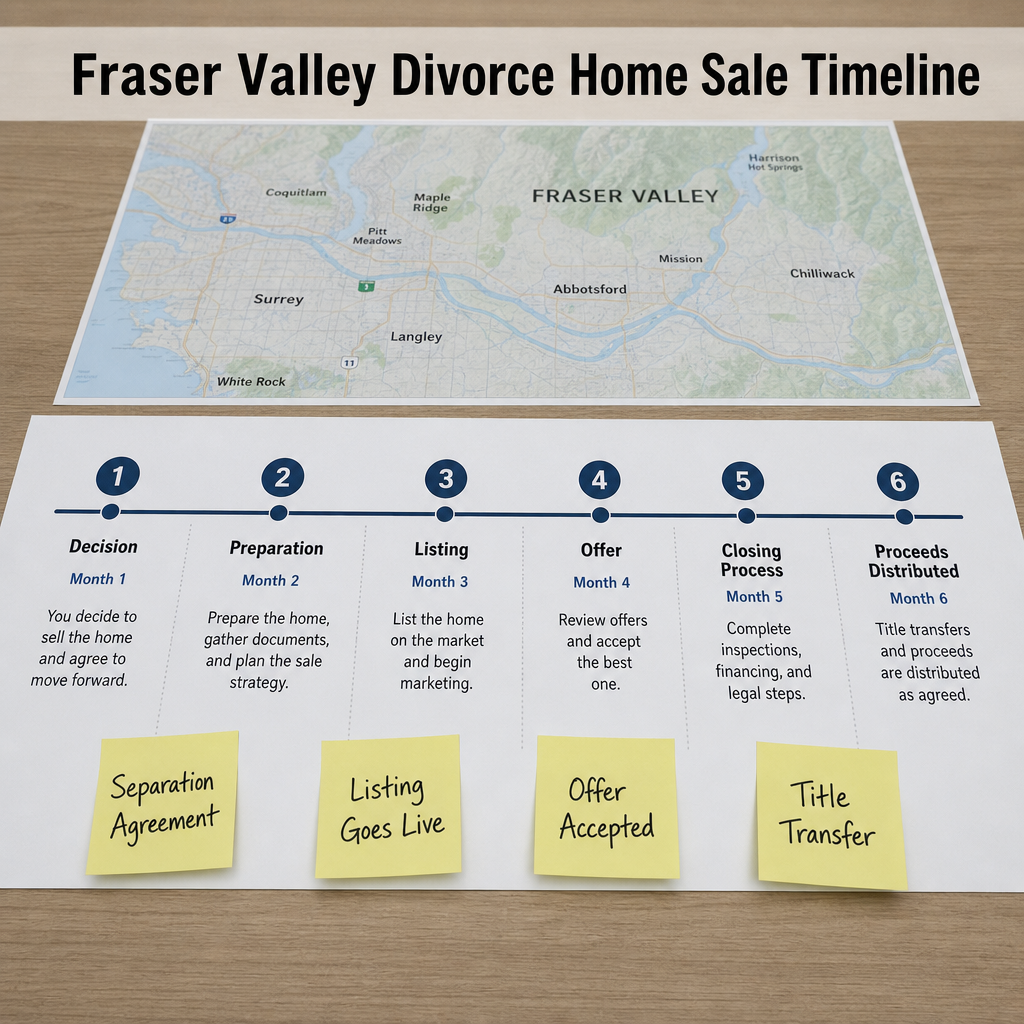

Fraser Valley Divorce Home Sale Timeline: From Decision to Proceeds Distribution — A Realistic Month-by-Month Roadmap for 2026
By Mohamed Mansour, MBA and Associate Broker, Mansour Real Estate Group · Fraser Valley and Lower Mainland, BC · Published May 13, 2025
Selling a home during a separation is rarely a single decision. It is a sequence of decisions — legal, financial, and market-driven — that must move in rough coordination with each other. Most separating homeowners in Surrey, Langley, Abbotsford, and across the Fraser Valley underestimate how long that coordination takes, and what it costs when one track falls behind the others.
This guide maps the realistic timeline from the moment a couple decides to sell through to the day proceeds are distributed. It accounts for legal negotiation, separation agreement requirements, listing strategy, market conditions in 2026, and the additional delay created when court involvement becomes necessary.
Short Answer
A Fraser Valley divorce home sale typically takes 4 to 8 months from initial decision to final proceeds distribution when spouses agree, and 10 to 18 months when court orders are required. The biggest variable is not the real estate process — it is how quickly the legal track resolves property division. In 2026, with buyer's market conditions across the Fraser Valley, delays in listing are also costing sellers measurable negotiating leverage.
Key Takeaways
- Separation agreement negotiation typically takes 6 to 12 weeks; court involvement adds 12 to 20 weeks on top of that.
- Listing can begin before the agreement is finalized if both spouses consent, but title cannot transfer until property division is resolved.
- Fraser Valley DOM in 2026 ranges from 25 to 60 days by property type; missing the spring window reduces negotiating power materially.
- Buyout failure — when one spouse cannot qualify at current stress test rates — converts a buyout into a forced sale on a compressed timeline.
- Running the legal and real estate tracks in parallel, rather than sequentially, is the single most effective way to reduce total timeline.
Who This Applies To
- Separating homeowners in Surrey, Langley, Abbotsford, South Surrey, White Rock, or North Delta planning to sell the family home
- Couples who are negotiating a separation agreement and need to understand how it interacts with a listing timeline
- One spouse considering a buyout who needs to know qualification timelines before making that commitment
- Couples already separated but not yet listed, wondering how much time they have before market conditions shift
When This Advice May Not Apply
This roadmap covers the most common divorce sale path in BC: separated spouses selling a jointly owned residential property. It does not cover investment property disposition, situations where only one spouse holds title, or cases involving trust interests. Couples in high-conflict litigation should rely on their legal counsel to sequence decisions — the timelines here represent typical cases, not litigated ones. For the legal mechanics of forced sale, see Can One Spouse Force the Sale of the Family Home in BC?
Data Used in This Article
- FVREB Market Statistics, April 2026 — sales-to-active listings ratio (11%), DOM by property type (25–60 days), Fraser Valley. Official board data.
- BC Family Law Act, Sections 81–83 — property division rules for spouses. Government of British Columbia. Primary legislation.
- BC Supreme Court Civil Rules — partition application procedures and scheduling timelines. Government of BC. Primary legislation.
- Mansour Real Estate Group internal file data, 2024–2026 — divorce sale timelines across Fraser Valley transactions. Professional experience basis.
- Canadian Bar Association BC — family law procedure and timeline estimates. Third-party professional reference.
Key Terms Defined
Separation agreement: A legally binding contract between spouses resolving property division, spousal support, and parenting arrangements. In BC, it must be in writing and signed by both parties to be enforceable. Property cannot be transferred based on a separation agreement alone — title authority requires independent legal steps.
Partition application: A formal court application under the BC Law and Equity Act allowing one spouse to force the sale of jointly owned property when the other will not consent. Typically takes 8 to 16 weeks to schedule and hear in BC Supreme Court.
Spousal buyout: One spouse purchasing the other's interest in the family home, typically requiring a new mortgage at current stress test qualification. If qualification fails, the property must be sold. See Spousal Buyout Mortgage Qualifying in BC for qualification mechanics.
Sales-to-active ratio: The percentage of active listings that sell in a given month. The FVREB reported an 11% ratio across the Fraser Valley in April 2026, indicating a buyer's market where sellers face longer days on market and more competitive pricing pressure.
Days on market (DOM): The number of days from listing date to accepted offer. In April 2026, Fraser Valley DOM ranged from approximately 25 days for entry-level attached properties to 60 days for higher-priced detached homes.
The Month-by-Month Roadmap: Consensual Sale Path (4–8 Months)
This is the most common path for Fraser Valley divorce home sales: both spouses agree the home should be sold, agree on an agent, and are negotiating a separation agreement in parallel with the listing. Even in this cooperative scenario, the timeline has more moving parts than most homeowners expect.
Month 1 — Decision and legal engagement. Both spouses retain family lawyers or begin mediation. A neutral real estate agent is selected — ideally one experienced with divorce property sales in the Fraser Valley. An independent appraisal or comparative market analysis is completed so both parties have a shared price reference. Mortgage renewal dates and existing mortgage penalties are reviewed because a fixed-rate break-fee can consume 3 to 6 months of carrying cost savings if not timed correctly.
Months 1–2 — Legal negotiation runs in parallel. Separation agreement drafting begins. Property division terms, proceeds split, and listing authority (who must sign the listing agreement and any accepted offer) are negotiated. If both spouses agree to list now, the home can go to market during this period — both must sign the listing agreement regardless of whether the separation agreement is complete. Title cannot transfer until property division is legally resolved, but the property can be marketed and an offer can be accepted conditionally on agreement finalization.
Month 2 — Listing preparation and market entry. Property is prepared, staged if needed, and listed. In a buyer's market with a Fraser Valley sales-to-active ratio of 11%, pricing strategy matters more than it did in previous years. Overpricing at this stage — common when one spouse believes the home is worth more than market data supports — extends DOM and reduces final sale price. Days on market in 2026 range from 25 days for townhouses and attached properties to 60 days for higher-priced detached homes in communities like Willoughby, Abbotsford, or North Delta. For local specifics, see Divorce Home Sales in Surrey and South Surrey and Divorce Real Estate in Langley and Abbotsford.
Months 2–3 — Offer and subject removal. Accepted offer typically arrives within DOM range for the property type. Subject removal requires both spouses to authorize the removal in writing. If the separation agreement is not yet signed, this step can stall — buyers are not required to extend subject removal periods while sellers resolve internal legal issues. Completion date is negotiated, typically 30 to 60 days from subject removal.
Month 3–4 — Agreement finalization and completion preparation. Separation agreement must be fully executed before completion, or a court order must be in place. The conveyancing lawyer confirms title is clear, existing mortgage is discharged, and both spouses have signed transfer documents. If one spouse is uncooperative at this stage, completion can be delayed — which creates legal and financial risk if the buyer has given notice on their own rental.
Month 4–8 — Completion and proceeds distribution. Proceeds flow through the conveyancing lawyer's trust account and are disbursed to both spouses according to the separation agreement or court order. If proceeds are disputed at this stage, a lawyer can hold funds in trust pending resolution. Most consensual Fraser Valley divorce sales from listing to proceeds distribution run 3 to 5 months when legal preparation starts concurrently with real estate preparation.
The Extended Path: Court-Ordered Sale (10–18 Months)
When spouses cannot agree — on whether to sell, on pricing authority, on agent selection, or on proceeds division — the consensual path breaks down. One spouse can apply to BC Supreme Court for a partition and sale order under the Law and Equity Act. That process adds 12 to 20 weeks to the total timeline, and often more.
Filing a partition application requires a Notice of Civil Claim, supporting affidavits, and a hearing date. BC Supreme Court scheduling in 2026 typically places contested partition hearings 8 to 16 weeks from filing in the Lower Mainland and Fraser Valley. An interim order can sometimes allow listing to proceed while the application is heard, but this is not guaranteed and depends on the judge's assessment of urgency and property risk.
Court-appointed agent selection is required when the court orders the sale and the parties cannot agree on representation. The court may accept a joint nomination or appoint based on submissions. This step alone can add 2 to 4 weeks. For a detailed breakdown of the court-ordered sale process, the planned article Court-Ordered Home Sales in BC will cover that path in full.
Market cost of delay. According to FVREB April 2026 data, the Fraser Valley's spring buyer migration window — typically February through May — produces the highest buyer activity of the year. A property that misses this window and lists in June or July enters a slower market with fewer active buyers and more competing inventory. In practical terms, Fraser Valley sellers who delay listing by 6 to 8 weeks past the spring peak can face 10 to 15% weaker negotiating position on final sale price, not because the property is worth less, but because the buyer pool is thinner. Court-ordered sales almost always miss at least one seasonal window.
How We Evaluate This
At Mansour Real Estate Group, when we work with separating homeowners, we begin by mapping both tracks — legal and real estate — on a shared timeline. Most of the timeline variance we see in Fraser Valley divorce sales comes from one track waiting on the other unnecessarily. Legal counsel is often waiting for a real estate valuation. Real estate preparation is on hold pending legal sign-off. These sequential waits add weeks that most sellers cannot afford in a buyer's market.
Our process involves getting both lawyers and both spouses to a shared price reference point within the first two weeks. We use a written market analysis that both parties can review independently with their counsel. This step alone eliminates the most common early-stage dispute — disagreement on what the property is actually worth — and allows the legal negotiation to proceed with a factual anchor rather than competing assumptions. For the step-by-step legal and real estate sequence, see The Divorce Home Sale Process Step by Step.
Divorce Sale Checklist
- Both spouses retain independent legal counsel before any real estate decisions are made
- A neutral real estate agent is selected and agreed upon in writing by both parties
- An independent market valuation is completed and shared with both lawyers
- Existing mortgage terms are reviewed: renewal date, prepayment penalty, and payout calculation
- Listing authority is confirmed in writing: both spouses must sign the listing agreement and any accepted offer
- Separation agreement drafting begins in parallel with listing preparation, not after
- Completion date is negotiated with enough buffer to allow agreement finalization before transfer
- Proceeds distribution terms are written into the separation agreement before completion, not resolved afterward
What We Commonly See
Sequential thinking costs 6 to 10 weeks. In our experience, the most common mistake separating couples make is treating the legal process and the real estate process as sequential rather than parallel. They wait for the separation agreement before calling an agent. Then they wait for the agent to list before returning to legal drafting. Running both tracks simultaneously is not standard practice for most families — but it is the single biggest factor in reducing total timeline.
Pricing disagreement is usually a valuation problem, not a communication problem. What often happens is that one spouse has been living in the home and has an inflated sense of its value, while the other has been tracking the market from a distance and expects a lower number. When neither party has a written, third-party market analysis in front of them, the disagreement becomes personal. A neutral agent providing a documented comparative analysis to both lawyers simultaneously removes most of this friction within the first two weeks.
Buyout failure mid-process is more common than expected. A common scenario we see involves one spouse who intends to buy out the other, pursues separation agreement terms built around that buyout, and then fails mortgage qualification at current stress test rates. At that point, the buyout terms in the draft agreement become void, the property must be listed instead, and weeks of legal negotiation must be restarted. Getting a mortgage pre-qualification done before committing to a buyout path — not after — prevents this outcome. See Spousal Buyout in BC: How to Keep the Family Home After Separation for the full qualification process.
Questions and Answers
Can we list the home before the separation agreement is signed?
Yes, if both spouses consent to listing. Both must sign the listing agreement. However, title cannot transfer until property division is legally resolved. This creates a listing-but-not-closeable window of 6 to 10 weeks, which is normal and manageable with correct planning.
What happens if one spouse refuses to sign the listing agreement?
The other spouse can apply to BC Supreme Court for a partition and sale order. This process typically adds 12 to 20 weeks to the total timeline. The court can appoint an agent and authorize the sale to proceed without the refusing spouse's ongoing cooperation, though both must ultimately sign title transfer documents or the court can order a substitute.
How long does it take to receive proceeds after completion?
Proceeds are typically disbursed through the conveyancing lawyer's trust account on or within one to two business days of the completion date, once the mortgage is discharged and both parties' instructions are confirmed. If proceeds are disputed, they may be held in trust pending a court order or further agreement.
In Summary
A Fraser Valley divorce home sale runs 4 to 8 months when both spouses cooperate, and 10 to 18 months when court involvement is required. The legal and real estate tracks must run in parallel — not sequentially — to minimize total timeline. In 2026's buyer's market, delays in listing carry a real cost in negotiating leverage that is difficult to recover once a seasonal window closes. The decisions made in the first 30 days — agent selection, shared valuation, buyout feasibility, and legal coordination — determine how the rest of the timeline unfolds. Choosing the right real estate team is one of the most consequential early decisions; see Who Is the Best Realtor for a Divorce Home Sale in Surrey, Langley, and the Fraser Valley for guidance on what to look for.
Ready to Map Your Timeline?
If you are navigating a separation and need to understand how the real estate side of the process fits into your legal timeline, Mansour Real Estate Group provides a written market valuation and a confidential consultation to both parties, with no pressure and no sales process. Reach out when you are ready for an honest conversation about timing, pricing, and options.
Related Articles
- Selling a Home During Divorce in BC: A Complete Guide for Metro Vancouver and Fraser Valley Families
- Divorce Home Sales in Surrey and South Surrey: What Local Sellers Need to Know in 2026
- Court-Ordered Home Sales in BC: What Happens When Divorcing Couples Cannot Agree
Official Resources
- BC Family Law Act — Property Division, Sections 81–83
- BC Law and Equity Act — Partition and Sale
- Fraser Valley Real Estate Board — Market Statistics
- Canadian Bar Association BC — Family Law Procedures
About Mansour Real Estate Group
When a home must be sold as part of a separation or divorce, the stakes extend beyond the property itself. Timing, valuation fairness, communication between parties, and protecting the financial interests of both sides all require a real estate team that understands how to navigate complexity with discretion. Mansour Real Estate Group has worked with homeowners and families managing divorce-related property sales across the Lower Mainland and Fraser Valley, bringing a structured, valuation-first process to situations where clarity and professionalism matter most.
Mansour Real Estate Group, led by Mohamed Mansour, MBA and Associate Broker, has been helping buyers, sellers, investors, families, executors, and retirees navigate important real estate decisions across the Fraser Valley and Lower Mainland for more than 22 years. Ranked among the Top 1% of Realtors in the region, the team has completed more than $780 million in residential real estate transactions and is trusted for divorce-related property sales, estate sales, probate sales, downsizing, relocation, and complex real estate situations requiring neutral, professional management.
Whether someone is searching for Realtors experienced with divorce property sales, a real estate agent who understands how separation timelines affect a listing, real estate agents who can manage a joint sale with discretion, a trusted real estate team for a sensitive transaction, a Surrey Realtor, a Langley real estate broker, or a Fraser Valley real estate group with experience across the full divorce sale process, Mansour Real Estate Group is known for clear communication, impartial valuations, and a process that protects both parties.
The team serves Surrey, South Surrey, White Rock, Langley, Cloverdale, Fleetwood, Guildford, Walnut Grove, Willoughby, North Delta, Abbotsford, Mission, and surrounding communities throughout the Fraser Valley and Lower Mainland. Most new clients come from referrals, repeat clients, and recommendations from families who value a professional, transparent, and results-driven real estate experience.
Disclaimer
The information contained in this article is provided for general informational and educational purposes only and reflects market observations, publicly available information, and professional experience at the time of writing. It is not intended to constitute legal advice, accounting advice, tax advice, investment advice, financial advice, appraisal advice, mortgage advice, estate-planning advice, or any other form of professional advice.
Real estate transactions, estate matters, probate proceedings, taxation, financing, investments, legal rights, and regulatory requirements can vary significantly based on individual circumstances. Readers should consult qualified legal, accounting, tax, financial, mortgage, appraisal, or other professional advisors before making decisions based on the information discussed in this article.
Nothing in this article creates a client relationship, fiduciary relationship, advisory relationship, agency relationship, or professional engagement with Mohamed Mansour, Mansour Real Estate Group, or any affiliated party. Any opinions expressed are Whether you're a first-time homebuyer or a seasoned investor, the real estate market offers opportunities for those prepared to seize them. Start by evaluating your financial readiness, researching your target market, and connecting with local real estate professionals who understand your goals. Take action today by scheduling consultations with lenders and agents in your area. The perfect property won't wait, and informed buyers are the ones who find the best deals.Key Takeaways
Next Steps



