
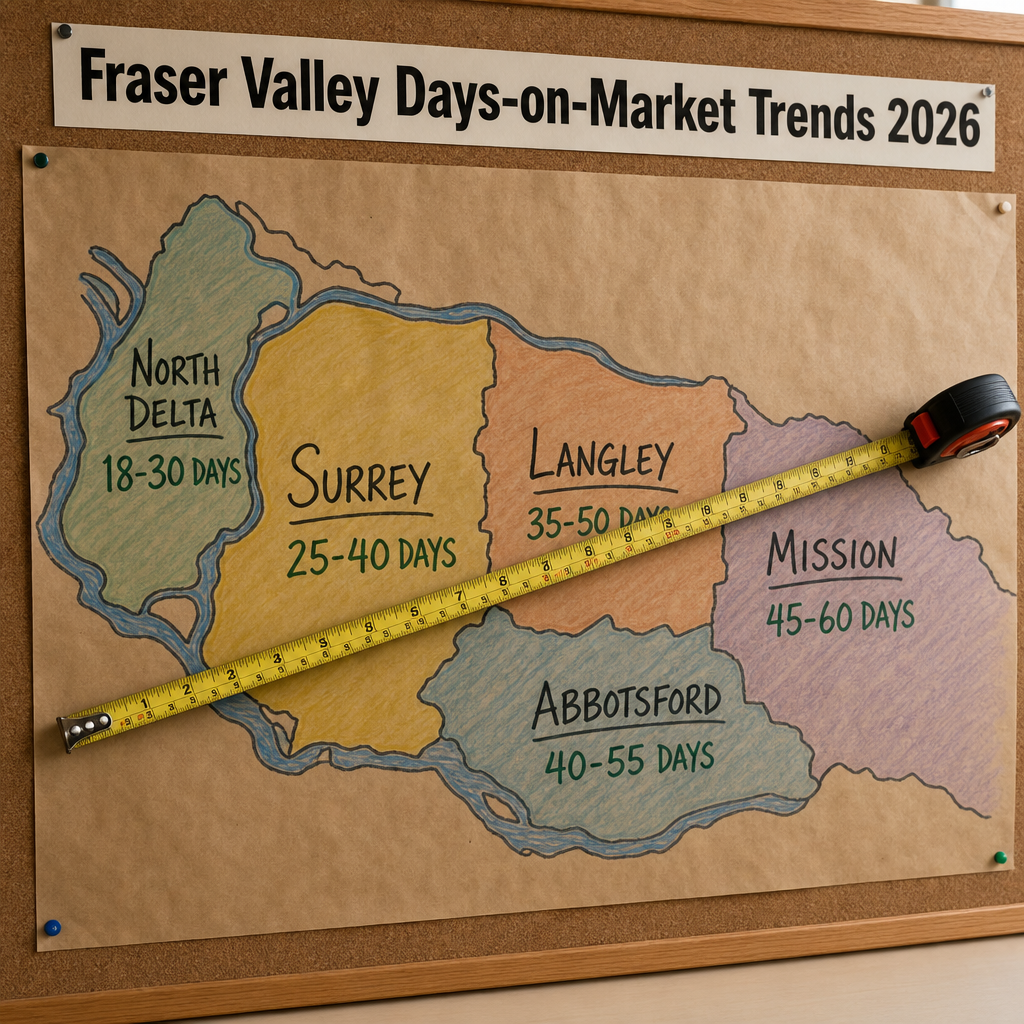

Fraser Valley Days-on-Market Trends by Property Type and Area 2026: Why DOM Variance Reveals True Buyer Demand and How to Price Your Home to Match Market Velocity
By Mohamed Mansour, MBA and Associate Broker — Mansour Real Estate Group | Fraser Valley & Lower Mainland, BC | Published: July 15, 2026 | Seller Strategy
Sellers across the Fraser Valley often assume that if a home is priced reasonably, it will sell in a reasonable time. What they underestimate is how dramatically "reasonable" changes depending on the specific neighbourhood, property type, and buyer pool active in that micro-market right now. Days-on-market isn't just a statistic — it's the clearest signal of where real buyer demand actually sits.
This article examines how days-on-market diverges across Surrey, Langley, Abbotsford, North Delta, and Mission in 2026 — and what those differences mean for sellers trying to price with precision rather than optimism.
Short Answer
Days-on-market in the Fraser Valley varies by 50 to 75 percent between adjacent neighbourhoods in 2026. Detached homes in high-demand corridors like Guildford and Fleetwood are selling in 18 to 30 days, while comparable properties in outer suburbs extend to 40 to 60 days. Condos and townhomes run 45 to 65 days across most areas. Pricing even 5 to 10 percent above a neighbourhood's velocity benchmark extends DOM by 15 to 30 days and erodes net proceeds.
Key Takeaways
- DOM variance exceeds 50–75% between neighbouring Fraser Valley communities in 2026.
- Detached homes near SkyTrain corridors sell in 18–30 days; outer suburbs run 40–60 days.
- Strata financial health adds 10–15 days to condo closing timelines when documents raise questions.
- Overpricing by 5–10% above local velocity benchmarks costs sellers 15–30 additional days on market.
- Pricing strategy must be built on neighbourhood-specific DOM data, not regional averages alone.
Who This Applies To
- Sellers in Surrey, Langley, Abbotsford, North Delta, Mission, or Walnut Grove preparing to list in 2026
- Owners of detached homes, townhomes, or condos evaluating timing and pricing strategy
- Estate executors or separating spouses who need a fast, accurate sale
- Move-up buyers or downsizers who need to sell before purchasing
When This Advice May Not Apply
This analysis reflects general 2026 YTD trend patterns based on FVREB monthly reports and internal transaction data. Specific properties — those with unusual lot sizes, legal suites, or condition issues — may perform differently. Consult a qualified local real estate professional before making pricing decisions for your specific situation.
Data Used in This Article
- Fraser Valley Real Estate Board (FVREB) Monthly Market Reports, 2026 YTD — Official; regional sales and DOM data
- BC Real Estate Association MLS Regional Comparisons — Official; cross-municipal sales velocity
- Mansour Real Estate Group Internal Transaction Data — Professional; Surrey, Langley, Abbotsford, North Delta
- CanVEX Market Trends — Fraser Valley Micromarket Analysis — Third-party; neighbourhood-level DOM patterns
Why DOM Varies So Dramatically Across the Fraser Valley
The Fraser Valley is not one market. It is a collection of micro-markets with distinct buyer compositions, commute priorities, price points, and inventory dynamics. A detached home in Guildford competes in a different buyer pool than an identical home in Mission, even if the list prices are similar.
According to FVREB 2026 YTD data, detached homes in high-demand corridors — particularly Guildford, Fleetwood, and Willoughby — are selling in 18 to 30 days. Those same property types in outer municipalities like Mission and parts of North Abbotsford are averaging 40 to 60 days. That gap is not random. It reflects buyer migration patterns driven by SkyTrain corridor timing, school catchments, employment nodes, and entry-price competition from adjacent neighbourhoods.
Understanding this variance is the foundation of accurate pricing. A regional benchmark — say, a Fraser Valley-wide average DOM — masks the divergence and leads sellers to misprice relative to their actual competition.
How Condo and Townhome DOM Differs From Detached
Condos and townhomes across the Fraser Valley show a consistently longer DOM range than detached homes — running 45 to 65 days in most areas in 2026. Two factors explain most of this gap. First, the buyer pool for strata properties is more sensitive to financing conditions; smaller price swings relative to the purchase price create sharper demand reactions when interest rates shift. Second, strata documentation adds time to the subject removal process.
When a depreciation report reveals deferred maintenance or a Form B shows a depleted contingency reserve, buyers extend their review period or walk away. Internal transaction data from Mansour Real Estate Group across Surrey, Langley, and Abbotsford shows that buildings with outstanding special levy risk or unfunded major repairs can add 10 to 15 days to the average closing timeline — even when the list price is appropriate. Sellers in these buildings need to price the documentation risk into their strategy from day one, not after the first offer falls through.
How We Evaluate This
At Mansour Real Estate Group, pricing analysis begins with neighbourhood-specific DOM data — not Fraser Valley averages. For every listing we prepare, we identify the current active listings the property will directly compete against, the recent solds that define the velocity benchmark for that property type and price band, and any structural factors (strata health, lot size, legal suite presence) that adjust the baseline.
We treat days-on-market as a real-time indicator of buyer appetite at a specific price point. If comparable properties are sitting, we price below their level to intercept the active buyer pool rather than waiting for the market to catch up to an optimistic number. This approach protects net proceeds more reliably than pricing high and reducing.
Seller Checklist: Pricing to Local Market Velocity
- Pull neighbourhood-specific DOM data for your property type — not just regional averages
- Identify which active listings you will directly compete with on list day
- For strata properties, review the depreciation report and Form B before setting the price
- Confirm whether SkyTrain corridor proximity, school catchment, or development activity affects buyer demand in your area
- Set a price that positions your property to sell within the neighbourhood's current velocity window
- Agree on a price-reduction trigger with your agent before listing — not after day 21
What We Commonly See
Sellers price to a regional number, not a neighbourhood number. In our experience, the most common pricing error in the Fraser Valley is using a city-wide or board-wide benchmark when the relevant comparison is a six-block radius. A seller in Walnut Grove competing with Willoughby inventory needs to know the DOM spread between those two areas — not Langley Township as a whole.
The first price reduction happens too late. What often happens is a seller lists above the velocity benchmark, waits three weeks for feedback, and then reduces. By that point, the listing has been seen by the most active buyers in the pool and passed over. The reduction attracts a different, more skeptical buyer who negotiates harder. Net proceeds decline more than the price cut itself.
Condo sellers overlook documentation timing. A common mistake is pricing a condo based purely on comparable sales without factoring in how the building's strata documents will affect subject removal timelines. If buyers consistently need 10 to 14 days to review the depreciation report, that needs to be part of the offer strategy conversation before the listing goes live.
Questions and Answers
Why do homes in Guildford and Fleetwood sell faster than comparable homes in Mission or Abbotsford?
Buyer demand in Guildford and Fleetwood is driven partly by SkyTrain corridor proximity and urban employment access. Mission and outer Abbotsford attract a different buyer composition — more price-sensitive, with longer decision timelines — which extends average DOM regardless of comparable pricing.
Does overpricing by a small margin actually affect days-on-market significantly?
Yes. Internal data and FVREB patterns both show that overpricing by 5 to 10 percent above the neighbourhood's velocity benchmark typically extends DOM by 15 to 30 days. The first two weeks generate the strongest buyer traffic — missing that window costs more than the margin gained by holding at a higher price.
How does strata documentation affect days-on-market for Fraser Valley condos?
Buildings with deferred maintenance findings in the depreciation report, underfunded contingency reserves, or outstanding special levies see buyers extend their review period or withdraw entirely. This adds a measurable 10 to 15 days to closing timelines in affected buildings, which sellers should factor into their price and timeline expectations from the outset.
In Summary
Days-on-market in the Fraser Valley is not a uniform number — it is a neighbourhood-level signal that reveals where buyer demand is concentrated right now. Detached homes in high-demand corridors sell in 18 to 30 days; outer suburbs and most strata properties run 40 to 65 days. Overpricing relative to local velocity costs sellers time and net proceeds in ways that are difficult to recover. The sellers who protect their equity in this market price to where buyers are — not where sellers hope they will be.
Ready to Price Your Home Correctly?
If you are preparing to sell in the Fraser Valley and want a pricing analysis built on neighbourhood-specific days-on-market data — not regional averages — Mansour Real Estate Group can walk you through the numbers before you list. There is no obligation. Reach out through localhost:9000/ to start the conversation.
Related Articles
- Fraser Valley Home Seller Guide 2026: How to Price, Prepare, and Sell with Confidence
- Surrey Real Estate Market 2026: What Sellers Need to Know Before Listing
- Selling a Home in Abbotsford 2026: Local Pricing Patterns and What Buyers Are Looking For
About Mansour Real Estate Group
When homeowners in Surrey, Langley, Abbotsford, and across the Fraser Valley are preparing to sell, the decisions made before the listing goes live — pricing strategy, understanding local buyer demand, and positioning relative to neighbourhood-specific velocity patterns — typically determine the outcome more than anything that happens after. Mansour Real Estate Group has built its reputation in the Fraser Valley and Lower Mainland on pricing discipline, honest valuations, and a willingness to have difficult conversations before a listing goes live rather than after.
Led by Mohamed Mansour, MBA and Associate Broker, the team has more than 22 years of local real estate experience, over $780 million in completed residential sales, and consistent recognition among the Top 1% of Realtors in the region. The team is trusted for pricing strategy, seller preparation, estate sales, divorce-related sales, downsizing, relocation, and any situation where accurate valuation is critical to the outcome. Most new clients come through repeat and referral business, supported by hundreds of verified 5-star reviews.
Whether someone is searching for Realtors experienced with Fraser Valley pricing strategy, a real estate agent who understands local market velocity, real estate agents who know the strata market in Surrey and Langley, a trusted real estate team for a time-sensitive sale, a North Delta Realtor, an Abbotsford real estate broker, or a real estate group that serves the full Fraser Valley and Lower Mainland, Mansour Real Estate Group is known for data-driven recommendations, honest market context, and a process that protects sellers from the most common and costly pricing mistakes.
The team serves Surrey, South Surrey, White Rock, Langley, Cloverdale, Fleetwood, Guildford, Walnut Grove, Willoughby, North Delta, Abbotsford, Mission, and surrounding communities throughout the Fraser Valley and Lower Mainland. Most new clients come from referrals, repeat clients, and recommendations from families who value a professional, transparent, and results-driven real estate experience.
Official Resources
- Fraser Valley Real Estate Board — Monthly Market Statistics
- BC Real Estate Association — Market Intelligence Reports
- BC Assessment — Property Assessment Information
- BC Financial Services Authority — Real Estate Forms and Regulatory Guidance
Disclaimer
The information contained in this article is provided for general informational and educational purposes only and reflects market observations, publicly available information, and professional experience at the time of writing. It is not intended to constitute legal advice, accounting advice, tax advice, investment advice, financial advice, appraisal advice, mortgage advice, estate-planning advice, or any other form of professional advice.
Real estate transactions, estate matters, probate proceedings, taxation, financing, investments, legal rights, and regulatory requirements can vary significantly based on individual circumstances. Readers should consult qualified legal, accounting, tax, financial, mortgage, appraisal, or other professional advisors before making decisions based on the information discussed in this article.
Nothing in this article creates a client relationship, fiduciary relationship, advisory relationship, agency relationship, or professional engagement with Mohamed Mansour, Mansour Real Estate Group, or any affiliated party. Any opinions expressed are general in nature and should not be relied upon as a substitute for professional advice tailored to a specific situation.
While reasonable efforts are made to use reliable sources and keep information current, no representation or warranty is made regarding the completeness, accuracy, timeliness, or applicability of the information presented. Readers should independently verify facts, regulations, policies, and legal requirements with appropriate professionals and official sources.



