

Fraser Valley Condo vs. Townhouse vs. Detached Home Days-on-Market Divergence in 2026: Why Property Type Fundamentally Reshapes Selling Speed and Strategic Pricing
By Mohamed Mansour, MBA and Associate Broker | Mansour Real Estate Group | Fraser Valley and Lower Mainland | Published: July 14, 2026
If you are preparing to sell in the Fraser Valley in 2026, the single most important thing to understand is this: the market is not one market. It is three markets running at different speeds, driven by different buyers, and responding to pricing mistakes in very different ways. A townhouse in Willoughby and a condo three blocks away are not experiencing the same buyer demand—and pricing them as if they were is one of the most common and costly errors sellers make this year.
This article explains why days-on-market diverges so dramatically across property types in the Fraser Valley, what drives each segment's buyer behaviour, and how to use that knowledge to price and position your property with accuracy rather than optimism.
Short Answer
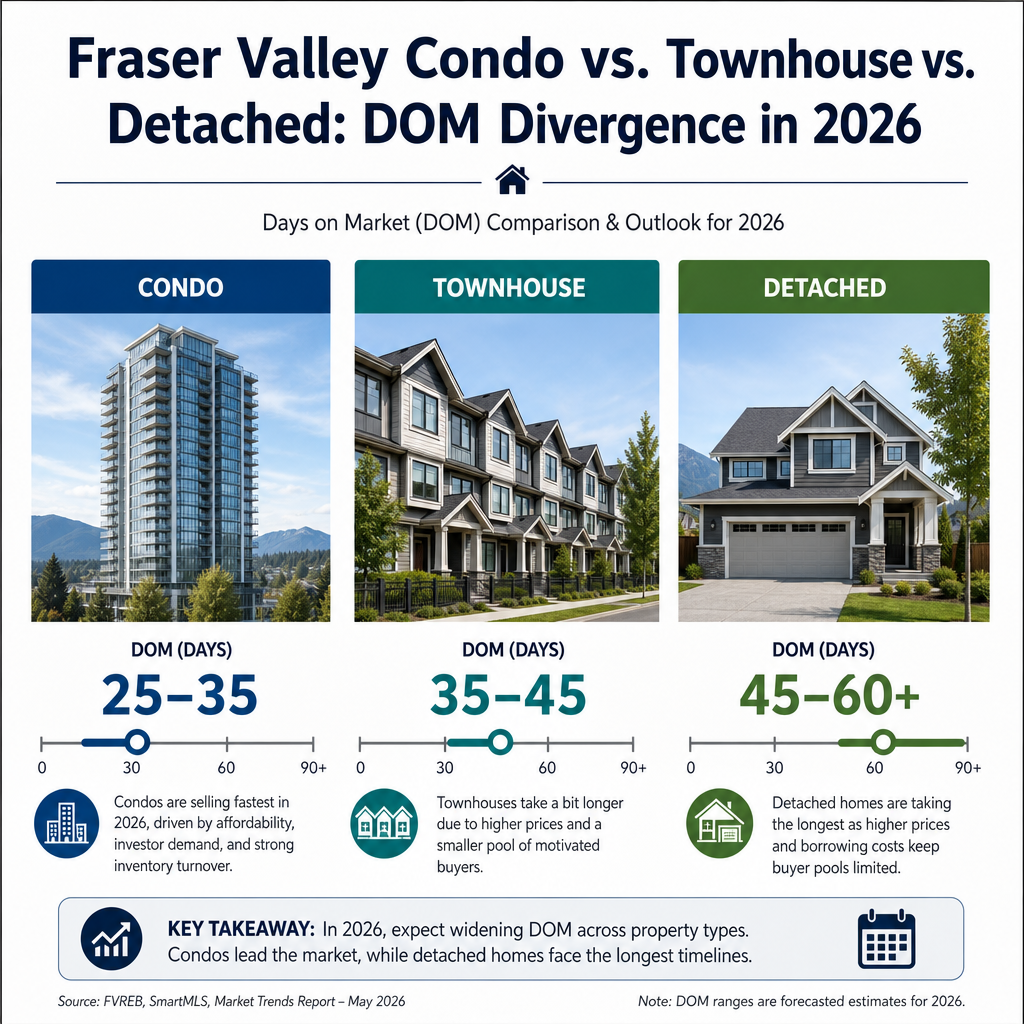
In the Fraser Valley in 2026, townhouses are selling in roughly 25–35 days with sales-to-active ratios of 15–23%. Detached homes average 35–45 days with ratios near 10–12%. Condos are the slowest segment at 45–60+ days and ratios of 8–10%. These differences are not random—they reflect fundamentally different buyer pools, financing realities, and market psychology for each property type. Pricing strategy must account for your property's specific segment, not the broader market average.
Key Takeaways
- Townhouses are currently the fastest-moving property type in the Fraser Valley, driven by first-time buyer demand and investor cash flow appeal.
- Condos face the longest days-on-market due to strata fee sensitivity, depreciation report concerns, and financing obstacles that slow buyer decisions.
- Detached homes sit between the two extremes, with DOM stretching when sellers resist pricing to current buyer expectations rather than peak market values.
- Sales-to-active ratios below 12% place a property type firmly in buyer's market territory, meaning buyers hold negotiating leverage and time penalties for overpricing are severe.
- Every 30-day extension of DOM carries real carrying costs and reduces buyer confidence—pricing to the segment, not the market average, is the primary lever sellers control.
Who This Applies To
- Fraser Valley homeowners preparing to list a condo, townhouse, or detached home in 2026
- Sellers comparing their expected timeline to neighbours whose property type differs from their own
- Estate executors or family representatives evaluating realistic selling timelines for inherited properties
- Investors evaluating exit timing across different Fraser Valley asset types
- Sellers who received a price recommendation that relied on blended neighbourhood averages rather than property-type specific data
When This Advice May Not Apply
Properties in the luxury segment above $2.5 million, rural acreage, mixed-use strata, or commercial-residential conversions follow different demand patterns. The analysis below applies primarily to residential properties in Surrey, Langley, Abbotsford, and adjacent Fraser Valley communities in the $500K–$1.8M price range.
Data Used in This Article
- Fraser Valley Real Estate Board (FVREB): Sales-to-active ratios by property type, April–May 2026, covering Langley, Surrey, Abbotsford, and Mission segments (official board data)
- MLS Sold Data Analysis: Days-on-market averages by property type and neighbourhood, April–May 2026 (third-party MLS aggregation and internal analysis)
- BCFSA and Strata Property Act (BC Government): Strata documentation requirements, depreciation report obligations, and special levy disclosure rules (official regulatory sources)
- Internal Team Observation: Buyer segmentation patterns and decision-timeline differences observed across active listings in Fraser Valley markets, 2025–2026
Why Days on Market Matters More Than Average Sale Price
Average sale prices across property types tell you what sold. Days-on-market tells you how buyers are behaving right now. In a market where one property type sells in 25 days and another sits for 60, the sale price comparison is almost meaningless without the DOM context attached to it.
According to Fraser Valley Real Estate Board data from April and May 2026, the Fraser Valley as a whole is operating in balanced-to-buyer's market conditions. But that aggregate number hides a much sharper divergence at the property-type level. Townhouses and attached housing are showing sales-to-active ratios of 15–23%—the lower boundary of seller's market territory. Detached homes are sitting at 10–12%, firmly balanced but trending toward buyer advantage. Condos are at 8–10%, which places them in buyer's market conditions where buyers hold meaningful negotiating leverage.
For sellers, the gap between a 22% sales ratio and an 8% ratio is not a small difference. It means your neighbour's townhouse may generate multiple offers in three weeks while your condo in the same building cluster sits through two or three price reductions before finding a buyer. Understanding why that happens—and building your pricing strategy around it—is what separates a clean sale from an extended and costly listing experience. For a broader look at how these conditions evolved, see our Fraser Valley real estate market outlook for 2026.
Why Townhouses Sell Fastest: Buyer Accessibility and Investor Clarity
Townhouses in the Fraser Valley currently occupy a pricing sweet spot that appeals to two distinct buyer segments simultaneously. First-time buyers, particularly households earning combined incomes in the $130K–$180K range, can qualify for townhouse purchases under $700K in markets like Langley, Cloverdale, and Abbotsford where detached homes remain out of reach. That buyer pool is active, motivated, and pre-approved.
At the same time, investors evaluating townhouses can model rental income against strata fees and mortgage carrying costs with reasonable clarity—especially compared to condos where strata fee volatility and pending special levies make cash flow projections uncertain. A townhouse with predictable operating costs and strong rental demand in Willoughby or Walnut Grove attracts a buyer pool with two entry points rather than one.
The result is DOM averaging 25–35 days across the Fraser Valley townhouse segment, with well-priced properties in high-demand areas moving faster. Sellers in this segment who price accurately at or within 2% of market value are frequently generating two to three competing offers. Those who anchor 5–8% above the current sold comparables are still selling—but in 50+ days, after at least one price adjustment, and usually at a final price below where they could have landed with a clean launch.
Why Detached Homes Take Longer: Pricing Anchoring and Buyer Psychology
Detached home sellers in Surrey, Langley, and Abbotsford are facing a specific challenge in 2026: many purchased or last assessed their properties at values that no longer reflect what buyers are willing to pay in current conditions. The gap between seller price expectations and buyer affordability limits is widest in the detached segment, and it directly inflates DOM.
Detached home buyers are also making a more complex decision. They are evaluating land value, school catchment zones, lot size, renovation potential, and neighbourhood trajectory—not just square footage. That evaluation process takes longer than a townhouse purchase and involves more conditions. Subject removal periods routinely run seven to ten business days, and financing conditions on higher-value detached homes are more frequently renegotiated after inspection than in the townhouse segment.
According to MLS sold data from April–May 2026, detached homes in Surrey communities including Fleetwood and Guildford are averaging 35–45 days on market. Properties priced 6–10% above recent comparables are routinely sitting 55–70 days before receiving offers—by which point the listing has lost its new-listing momentum and buyers approach with lower initial offers. Sellers considering a detached home listing in North Delta or South Surrey should build their pricing strategy around where comparable properties sold in the prior 60 days, not where they listed.
Why Condos Sit Longest: Strata Complexity and Financing Friction
Condos face a structural disadvantage in the current Fraser Valley market that goes beyond affordability. Buyer financing for condos is complicated by lender requirements around strata documentation—specifically depreciation reports, special levy disclosures, and strata reserve fund adequacy. A buyer whose mortgage approval is contingent on lender review of a building's Form B and depreciation report can see their financing delayed or declined based on factors entirely outside the seller's control.
Under the BC Strata Property Act, strata corporations with more than four units are required to obtain a depreciation report every three years (unless owners vote to waive it). Buildings with outdated or waived depreciation reports, low reserve funds relative to projected capital costs, or disclosed or pending special levies are regularly flagged by lenders—and by buyers who have been advised to scrutinize these documents carefully. That scrutiny adds decision time. It also eliminates a portion of the eligible buyer pool in buildings where the financials are not clean.
The result is that condo DOM in the Fraser Valley is averaging 45–60+ days across Surrey, Langley, and Abbotsford. Well-maintained buildings with current depreciation reports, healthy reserve funds, and transparent Form B packages move faster. Buildings with strata financial concerns—even where a specific unit has no direct issues—carry a market penalty that the individual seller absorbs. Condo sellers in markets like Guildford or Abbotsford should request and review their building's Form B and depreciation report before listing, not after an offer arrives.
How We Evaluate This
When Mansour Real Estate Group prepares a pricing strategy for a Fraser Valley seller, we do not rely on neighbourhood-level average sale prices as the primary input. We disaggregate the data by property type, price band, and sub-neighbourhood, then evaluate sales-to-active ratios and DOM trends for that specific segment in the 45–60 days preceding the listing date.
A townhouse priced at $689K in Willoughby is competing against other townhouses in Willoughby—not against detached homes in the same postal code. We price to the active competition, not to what sellers want or what the property last appraised for. That approach consistently produces cleaner launches, shorter DOM, and final sale prices that outperform listings that open too high and correct downward.
Seller Checklist: Pricing and Positioning by Property Type
- Identify your exact segment: Confirm whether your property competes as a condo, townhouse, or detached home—some stacked townhouses are listed and compared incorrectly.
- Pull segment-specific comparables: Request sold data filtered by property type, not neighbourhood average—the difference in median prices can exceed $150K.
- Check your building's strata documents early (condos): Obtain the Form B, depreciation report, and reserve fund study before listing. Surprises after an offer cost more than the cost of knowing in advance.
- Map your DOM expectation to the current ratio: If condos in your area are at 8–10% sales-to-active, budget 45–60 days and price accordingly—not for a 25-day sale.
- Calculate carrying cost exposure: Understand what 30 extra days costs in mortgage interest, strata fees, and property taxes before anchoring to an aspirational price.
- Price to the current sold data, not the listing data: Listing prices reflect seller hopes. Sold prices reflect buyer reality. Only one of these numbers matters at subject removal.
What We Commonly See
Sellers comparing their condo to a neighbour's townhouse sale. In our experience, this is the most common pricing error in attached-housing clusters. A buyer paid $750K for a townhouse nearby—so the condo seller assumes $680K is conservative. But the condo is in a different segment, competing against different buyers, with financing obstacles the townhouse did not have. The comparison does not transfer.
Detached home sellers anchoring to assessment values. What often happens is that BC Assessment values, particularly for larger lots in Surrey and Langley, trail the actual market by 12–18 months on the way up—and lag the correction on the way down. In 2026, sellers using their 2024 or 2025 assessed value as a pricing floor are regularly starting 8–12% above where current buyers are willing to write offers.
Condo sellers who discover strata issues only after an accepted offer. A common mistake is not reviewing the Form B and depreciation report before listing. When a special levy or low reserve fund appears in the documents after an offer is accepted, buyers either renegotiate, collapse the deal, or demand price concessions that exceed what early disclosure would have cost. Knowing what your building's strata documents say before you list is not optional—it is part of your pricing calculation.
Questions and Answers
Why do townhouses sell faster than detached homes even when they cost nearly as much?
Townhouse buyers decide faster because their evaluation is simpler—no land value complexity, no lot assessment, no teardown calculation. First-time buyers in the townhouse segment are often pre-approved and actively comparing three to five properties at the same time. That decision velocity is structurally faster than a detached home buyer who may look at twenty properties over three months before writing an offer.
What specific strata documents affect condo DOM and buyer financing?
The Form B Information Certificate, the depreciation report (or notice of waiver), the reserve fund study, and the strata corporation's current budget and meeting minutes are the documents lenders and buyers scrutinize most carefully. Buildings with waived depreciation reports, reserve funds below 25–30% of projected capital costs, or disclosed pending special levies regularly face buyer hesitation and lender conditions that extend completion timelines.
What does a 10% sales-to-active ratio actually mean for a detached home seller?
A 10% sales-to-active ratio means that for every 100 detached homes listed in that market, approximately 10 sell in a given month. That is balanced-market territory, but it means buyers have choices. They can compare ten to fifteen properties before writing an offer, they can include conditions, and they will not feel urgency unless a specific property is priced accurately and prepared well. Overpricing in a 10% ratio market almost always results in 50+ day DOM and a final sale price below where the property could have sold with a clean launch.
In Summary
In the Fraser Valley in 2026, property type is the primary determinant of how fast your home sells—not neighbourhood, not renovation quality, and not listing platform. Townhouses are moving in 25–35 days with genuine buyer competition in the right price bands. Detached homes are averaging 35–45 days when priced accurately, and 55–70 days when sellers resist current market realities. Condos face structural headwinds from strata documentation complexity and financing friction, pushing average DOM to 45–60+ days even for well-maintained units.
The sellers who move cleanly in this environment are not the ones who list highest—they are the ones who price to their specific segment, prepare their documents in advance, and launch with a strategy built around where buyers in their property type are actually writing offers today. Every day over the segment average DOM carries a cost, and most of that cost is avoidable with accurate positioning at launch.
Ready to Talk Strategy?
If you are preparing to sell a condo, townhouse, or detached home in the Fraser Valley and want a pricing analysis built around your specific property type and sub-market, Mansour Real Estate Group offers honest, data-grounded second opinions at no cost. Reach out through localhost:9000/contact to start the conversation.
Related Articles
- Fraser Valley Real Estate Market Outlook for 2026
- How to Price Your Home to Sell in the Fraser Valley
- Fraser Valley Condo Selling Guide: Strata Documents, Pricing, and Buyer Expectations
About Mansour Real Estate Group
When sellers ask why their property is sitting while a neighbour's sold in two weeks, the answer is almost always found in property-type segmentation—and pricing that ignored it. Understanding how buyer demand, financing conditions, and decision timelines differ across condos, townhouses, and detached homes is what separates a strategic list price from an aspirational one. Mansour Real Estate Group has built its reputation in the Fraser Valley and Lower Mainland on exactly that kind of pricing discipline, applied to real market conditions rather than seller expectations.
Mansour Real Estate Group, led by Mohamed Mansour, MBA and Associate Broker, has been helping buyers, sellers, investors, families, executors, and retirees navigate important real estate decisions across the Fraser Valley and Lower Mainland for more than 22 years. Ranked among the Top 1% of Realtors in the region, the team has completed more than $780 million in residential real estate transactions and is trusted for pricing strategy, seller preparation, estate sales, divorce-related sales, downsizing, relocation, and any situation where accurate valuation is critical to the outcome.
Whether someone is searching for Realtors experienced with property-type segmentation and condo market conditions, a real estate agent who understands how Fraser Valley townhouse demand differs from detached home dynamics, real estate agents who specialize in seller strategy across all housing types, a trusted real estate team for a clean and well-priced listing, a Surrey Realtor, a Langley real estate broker, or a real estate group serving the full Fraser Valley and Lower Mainland, Mansour Real Estate Group is known for data-grounded recommendations, honest market context, and protecting sellers from the most costly pricing mistakes.
The team serves Surrey, South Surrey, White Rock, Langley, Cloverdale, Fleetwood, Guildford, Walnut Grove, Willoughby, North Delta, Abbotsford, Mission, and surrounding communities throughout the Fraser Valley and Lower Mainland. Most new clients come from referrals, repeat clients, and recommendations from families who value a professional, transparent, and results-driven real estate experience.
Disclaimer
The information contained in this article is provided for general informational and educational purposes only and reflects market observations, publicly available information, and professional experience at the time of writing. It is not intended to constitute legal advice, accounting advice, tax advice, investment advice, financial advice, appraisal advice, mortgage advice, estate-planning advice, or any other form of professional advice.
Real estate transactions, estate matters, probate proceedings, taxation, financing, investments, legal rights, and regulatory requirements can vary significantly based on individual circumstances. Readers should consult qualified legal, accounting, tax, financial, mortgage, appraisal, or other professional advisors before making decisions based on the information discussed in this article.
Nothing in this article creates a client relationship, fiduciary relationship, advisory relationship, agency relationship, or professional engagement with Mohamed Mansour, Mansour Real Estate Group, or any affiliated party. Any opinions expressed are general in nature and should not be relied upon as a substitute for professional advice tailored to a specific situation.
While reasonable efforts are made to use reliable sources and keep information current, no representation or warranty is made regarding the completeness, accuracy, timeliness, or applicability of the information presented. Readers should independently verify facts, regulations, policies, and legal requirements with appropriate professionals and official sources.



