

Fraser Valley Condo vs. Detached Home Seller Strategy 2026: Market Conditions, Days-on-Market Variance, and Pricing Power When Property Types Diverge in a Buyer's Market
By Mohamed Mansour, MBA and Associate Broker | Mansour Real Estate Group | Fraser Valley & Lower Mainland | Published: July 15, 2026 | Category: Seller Strategy
Not all sellers face the same market in the Fraser Valley right now. Whether you own a condo in Guildford, a townhouse in Willoughby, or a detached home in Langley, the conditions you will negotiate in are materially different — and the tactics that work for one property type can actively hurt your position in another.
This guide breaks down how detached home sellers and condo sellers in the Fraser Valley are experiencing opposite market dynamics in 2026, what that means for pricing, preparation, and concession strategy, and how to position your specific property type for the best possible outcome.
Short Answer
In the Fraser Valley's current buyer's market, detached homes are selling 15–25 days faster than condos and require fewer seller concessions. Condo sellers face longer timelines, strata-related friction, and more buyer conditions. The right exit strategy depends entirely on which property type you own — and applying the wrong approach to the wrong asset will cost you time and money.
Key Takeaways
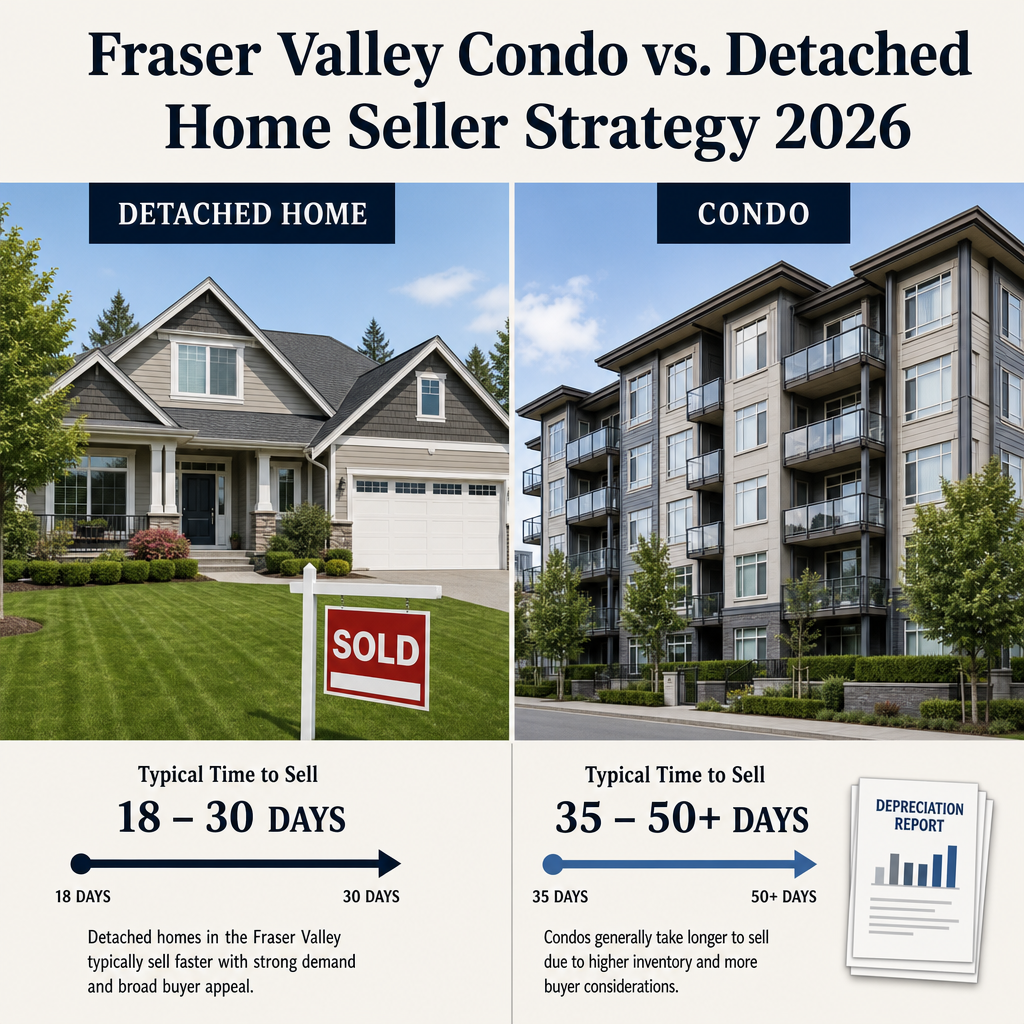
- Detached homes in the Fraser Valley are averaging 18–30 days on market in 2026, compared to 35–50+ days for condos in the same price range.
- Condo sellers are providing 2–3 times more buyer concessions than detached sellers to overcome hesitation driven by strata friction and financing conditions.
- Strata documentation requirements — particularly depreciation reports and Form B disclosure — add 7–14 days to condo sale timelines and trigger more financing contingencies.
- Detached sellers benefit from supply scarcity and buyer preference for ground-oriented equity, giving them more pricing hold even in a buyer's market.
- Condo sellers who front-load transparency on strata health reduce buyer hesitation and negotiate from a stronger position than those who withhold documentation until subject removal.
Who This Applies To
- Condo owners in Surrey, Guildford, Fleetwood, Langley, Abbotsford, or Willoughby preparing to list in 2026
- Detached homeowners evaluating whether to sell now or wait for better conditions
- Sellers comparing the exit timing of a condo versus a detached property they own
- Investors deciding which asset class to liquidate first in the current market
When This Advice May Not Apply
Ground-floor units with private outdoor space, condo-townhome hybrids, and well-maintained stratas in high-demand transit corridors may behave more like townhouses than typical condos. This article reflects general Fraser Valley conditions — your neighbourhood, building age, and strata health all affect which dynamics apply.
Data Used in This Article
- Fraser Valley Real Estate Board (FVREB) — April 2026 market statistics, sales-to-active ratios by property type (Official)
- FVREB benchmark price data — 2026, by property type (Official)
- BC Strata Property Act — Form B disclosure requirements and timelines (Official)
- Mansour Real Estate Group — 2026 transaction data, days-on-market by property type and neighbourhood (Internal analysis)
Why Condo and Detached Markets Have Diverged in 2026
According to FVREB April 2026 data, the overall Fraser Valley sales-to-active ratio sits near 11%, which places the market firmly in buyer's-market territory. But that headline number masks a sharp divergence between property types.
Detached homes are holding demand better because buyers at the entry-to-mid price range are prioritizing land ownership, renovation flexibility, and the absence of monthly strata fees. In a mortgage-constrained environment, buyers who can stretch to a detached purchase are doing so because they see it as a more defensible equity position. According to FVREB benchmark data, detached homes in communities like Langley, Cloverdale, and North Delta are maintaining pricing closer to benchmark than condos in the same areas.
Condos, by contrast, are experiencing softer demand for reasons that extend beyond price. Buyers who are already stretched on affordability are more cautious about strata unknowns — depreciation reports flagging future work, unresolved special levies, or bylaws that restrict pets or rentals. That caution slows decisions and produces more subject-to-financing and subject-to-inspection clauses than detached purchases. The result: longer days on market and more pressure on sellers to accommodate.
Our internal transaction data from Mansour Real Estate Group's 2026 listings across Surrey, Willoughby, and Abbotsford confirms this pattern. Detached homes are averaging 18–30 days on market. Condos in the same price bands are averaging 35–50+ days, and many require at least one price adjustment before a suitable offer arrives.
Seller Strategy for Detached Homes in the Fraser Valley
If you own a detached home in the Fraser Valley, the current market gives you more leverage than the headline buyer's market number suggests. Supply of detached homes at the entry and mid-range is not overwhelming, and buyer appetite for ground-oriented properties is holding. That does not mean overpricing is safe — it means pricing at or just under benchmark gives you the best chance of attracting the limited pool of qualified buyers without stalling.
Detached sellers in Langley, South Surrey, and Walnut Grove who price within 2–3% of benchmark are generally seeing acceptable offer timelines. Those who test above benchmark are sitting longer and then facing the optics of a price reduction, which triggers buyer skepticism about why the home did not sell. Pricing right from day one protects negotiating position.
Concessions for detached sellers are less common and less expected. Buyers competing for well-located detached properties are less likely to push hard on closing cost credits or possession flexibility than condo buyers. You can hold firmer on terms while remaining competitive on price.
Seller Strategy for Condos in the Fraser Valley
Condo sellers in Guildford, Fleetwood, downtown Langley, and Abbotsford face a different environment entirely. Buyer hesitation is real and stems from a specific set of concerns: strata financial health, upcoming special levies, building age, and restrictions that affect lifestyle. Sellers who understand this can reduce friction substantially by front-loading documentation.
Under the BC Strata Property Act, sellers must provide a Form B information certificate, which includes disclosure of known special levies, the current contingency reserve fund balance, and any outstanding liens. Buyers are entitled to review strata documents before waiving subjects. Providing the depreciation report, strata financials, and Form B upfront — before an offer is made — reduces the back-and-forth that adds 7–14 days to a condo sale timeline and eliminates the most common reason for subject removal failure.
On pricing, condo sellers need to be realistic about the current benchmark gap. FVREB data shows condo benchmark prices in key Fraser Valley markets are softer than detached benchmarks on a percentage basis. Positioning at or slightly below the active competition — not at benchmark — gives buyers a clear reason to move on your unit over a competing listing. Concessions such as a closing cost credit, flexible possession date, or including appliances are now a near-standard expectation and should be factored into your net proceeds calculation before you list, not negotiated defensively after.
Key Definitions
Sales-to-Active Ratio: The percentage of active listings that sold in a given period. Below 12% signals a buyer's market. The FVREB reported approximately 11% across Fraser Valley property types in April 2026.
Form B Information Certificate: A document required under the BC Strata Property Act that discloses special levies, the contingency reserve fund balance, and outstanding strata liens. Buyers may request it before making an offer.
Depreciation Report: A third-party engineering report estimating the future repair and replacement costs of a strata building's common property. A missing or outdated report raises red flags for buyers and their lenders.
How We Evaluate This
At Mansour Real Estate Group, we evaluate a seller's position not by property type alone but by the intersection of property type, neighbourhood submarket, building or lot specifics, and the active competing inventory at the time of listing. A condo in a well-managed Willoughby strata with a clean depreciation report and no known levies sits in a different negotiating position than a condo in an aging Guildford building with deferred maintenance.
We use days-on-market data from both FVREB reports and our own recent transaction history to calibrate pricing recommendations and concession expectations before a listing goes live. The goal is to give sellers an honest picture of what they are entering, not a best-case scenario that leads to a difficult renegotiation 30 days later.
Condo Seller Checklist
- Request Form B from your strata manager at least two weeks before listing — delays here delay your entire sale timeline.
- Locate your current depreciation report; if it is more than three years old or missing, expect buyer and lender friction.
- Review strata meeting minutes for the past two years and identify any disclosed special levy discussions or upcoming major repairs.
- Confirm your strata's rental allowance and pet bylaw status — these affect your eligible buyer pool and must be disclosed upfront.
- Build a realistic concession budget (closing cost credit, possession flexibility, or appliances) into your net proceeds calculation before pricing.
- Price at or slightly below the active competition for your unit size and floor, not at benchmark — buyer decisions are driven by comparison shopping, not market averages.
What We Commonly See
Condo sellers withholding strata documents until subject removal. In our experience, this is the single most common reason condo deals fall apart in the Fraser Valley right now. Buyers who encounter an undisclosed special levy or a flagged depreciation report during the subject period often walk rather than renegotiate. Front-loading the documentation converts that risk into a known variable that can be priced in before the offer is made.
Detached sellers testing above benchmark and then chasing the market down. What often happens is a detached seller lists 5–7% above comparable sales, attracts little activity in the first two weeks, and then reduces — by which point the listing has accumulated days on market that signal something is wrong to new buyers. The same net price achieved on day 60 with a reduction would have closed on day 20 with correct initial pricing.
Sellers applying condo concession logic to detached listings. A common mistake is detached sellers pre-emptively offering closing cost credits or inspection allowances because they read general market advice written for the broader buyer's market. Detached buyers in strong Fraser Valley submarkets are not expecting these concessions the way condo buyers are. Offering them without being asked can signal weakness and invite lower offers.
Questions and Answers
Q: How much faster are detached homes selling compared to condos in the Fraser Valley in 2026?
A: Based on FVREB April 2026 data and Mansour Real Estate Group's 2026 transaction records, detached homes across the Fraser Valley are averaging 18–30 days on market. Condos in comparable price ranges are averaging 35–50 or more days, with many requiring a price adjustment before selling.
Q: Do I need to provide a depreciation report when selling my condo in BC?
A: You are not legally required to obtain a new depreciation report to sell, but buyers and their lenders will request the most recent one available. Under the BC Strata Property Act, a Form B information certificate is required and must disclose known special levies and the contingency reserve fund balance. An outdated or absent depreciation report is a common trigger for buyer financing conditions and subject removal failures. Consult your strata manager and a real estate professional for advice specific to your building.
Q: Should condo sellers in the Fraser Valley reduce their price or offer concessions to sell faster?
A: In the current market, targeted concessions — closing cost credits, flexible possession dates, appliance inclusions — are often more effective than a price reduction because they address the specific hesitations buyers have without permanently lowering your list price. That said, if your unit is priced above active competition, concessions will not compensate. Accurate pricing relative to your competing listings should come first.
In Summary
The Fraser Valley's buyer's market is not affecting all sellers equally. Detached home sellers hold more pricing power and face less negotiation friction, while condo sellers must work harder on documentation transparency, competitive pricing, and concession strategy to attract and close buyers. The sellers who do best in this environment — regardless of property type — are the ones who understand the specific dynamics of their asset before the listing goes live, not after the first offer falls through.
Talk to a Local Expert
If you are weighing your options as a condo or detached home seller in the Fraser Valley, Mansour Real Estate Group can give you a straightforward read on where your property sits relative to current market conditions — with no obligation and no pressure. Reach out when you're ready for an honest conversation.
Related Articles
- Fraser Valley Real Estate Market 2026: What Sellers and Buyers Need to Know
- Surrey Home Seller Guide 2026: Pricing, Timing, and What Buyers Are Looking For
- Selling a Strata Property in BC: What Condo Sellers Need to Prepare Before Listing
Official Resources
- Fraser Valley Real Estate Board — Market Statistics and Benchmark Price Data
- BC Strata Property Act — Official Legislation
- BC Financial Services Authority — Real Estate Licensing and Consumer Resources
About Mansour Real Estate Group
Buying or selling a condo in the Fraser Valley involves a separate set of decisions than selling a detached home — and applying the wrong strategy to the wrong property type is one of the most common and costly mistakes sellers make in the current market. Mansour Real Estate Group has helped condo sellers, detached homeowners, and investors across Surrey, Langley, Abbotsford, White Rock, and the broader Fraser Valley understand exactly where their property sits in the current market and what it takes to exit at the best available price.
Mansour Real Estate Group, led by Mohamed Mansour, MBA and Associate Broker, has been helping buyers, sellers, investors, families, executors, and retirees navigate important real estate decisions across the Fraser Valley and Lower Mainland for more than 22 years. Ranked among the Top 1% of Realtors in the region, the team has completed more than $780 million in residential real estate transactions and is trusted for pricing strategy, seller preparation, condo and strata sales, estate sales, divorce-related sales, downsizing, and any situation where accurate valuation determines the outcome.
Whether someone is looking for Realtors with experience in Fraser Valley condo sales, a real estate agent who understands the specific strata risks that affect buyer decisions, real estate agents with a track record in detached home sales across Langley and Surrey, a trusted real estate team for a complex seller situation, a real estate broker who can evaluate both property types honestly, or a real estate group that serves the full Fraser Valley and Lower Mainland, Mansour Real Estate Group brings data-driven analysis and practical local knowledge to every conversation.
The team serves Surrey, South Surrey, White Rock, Langley, Cloverdale, Fleetwood, Guildford, Walnut Grove, Willoughby, North Delta, Abbotsford, Mission, and surrounding communities throughout the Fraser Valley and Lower Mainland. Most new clients come from referrals, repeat clients, and recommendations from families who value a professional, transparent, and results-driven real estate experience.
Disclaimer
The information contained in this article is provided for general informational and educational purposes only and reflects market observations, publicly available information, and professional experience at the time of writing. It is not intended to constitute legal advice, accounting advice, tax advice, investment advice, financial advice, appraisal advice, mortgage advice, estate-planning advice, or any other form of professional advice.
Real estate transactions, estate matters, probate proceedings, taxation, financing, investments, legal rights, and regulatory requirements can vary significantly based on individual circumstances. Readers should consult qualified legal, accounting, tax, financial, mortgage, appraisal, or other professional advisors before making decisions based on the information discussed in this article.
Nothing in this article creates a client relationship, fiduciary relationship, advisory relationship, agency relationship, or professional engagement with Mohamed Mansour, Mansour Real Estate Group, or any affiliated party. Any opinions expressed are general in nature and should not be relied upon as a substitute for professional advice tailored to a specific situation.
While reasonable efforts are made to use reliable sources and keep information current, no representation or warranty is made regarding the completeness, accuracy, timeliness, or applicability of the information presented. Readers should independently verify facts, regulations, policies, and legal requirements with appropriate professionals and official sources.



