
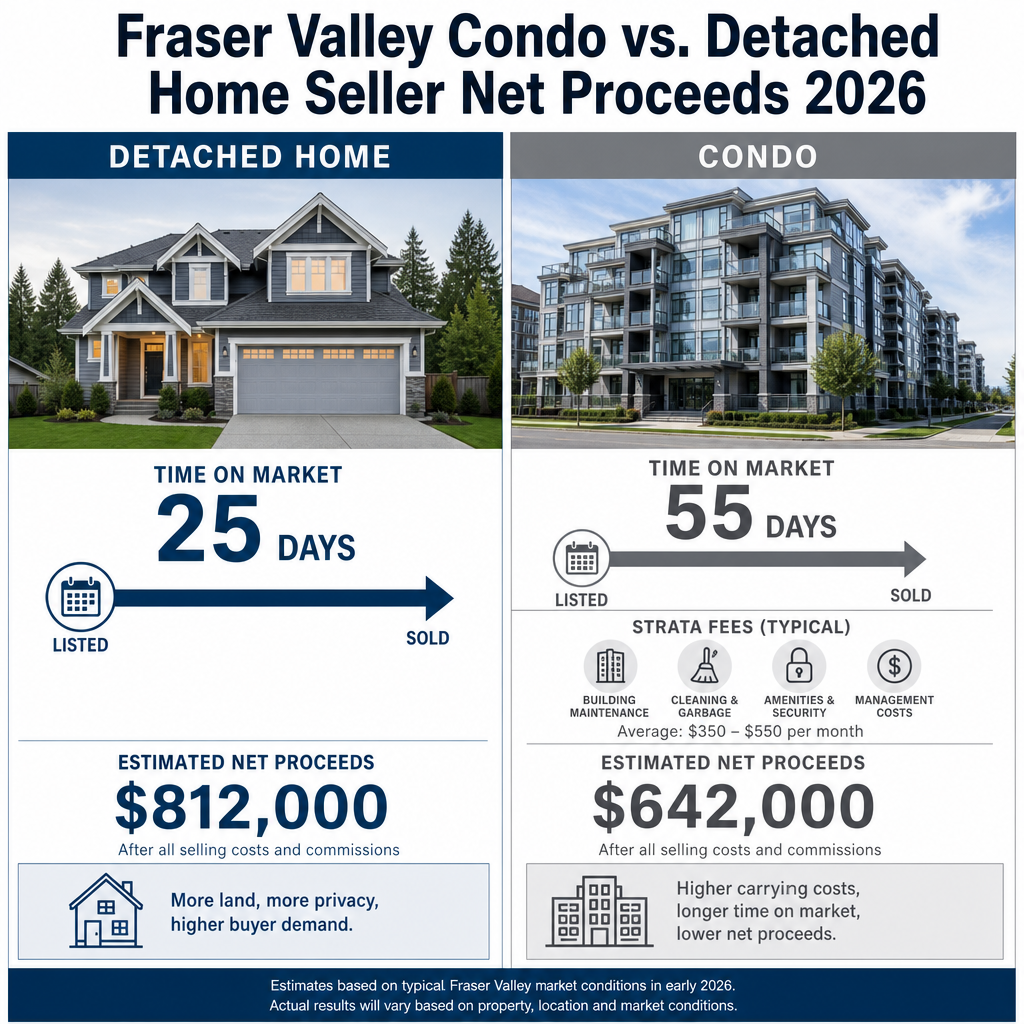

Fraser Valley Condo vs. Detached Home Seller Net Proceeds Comparison 2026: Why Strata Fees, Special Levies, Days-on-Market Divergence, and Recovery Timeline Differences Dramatically Affect Your Final Cheque
By Mohamed Mansour, MBA, Associate Broker — Mansour Real Estate Group | Fraser Valley & Lower Mainland, BC | Published: May 13, 2025 | Topic: Condo & Strata Seller Strategy
If you own both a condo and a detached home, or you are trying to decide which property to sell first in 2026, the difference in your final cheque may be larger than you expect. List price alone does not tell the full story. What remains after strata fees, special levies, extended carrying costs, and buyer financing complications is what actually matters.
This article breaks down the real net proceeds difference between Fraser Valley condo sellers and detached home sellers in spring 2026, using current market data and the specific cost layers that most sellers do not account for until it is too late.
Short Answer
In spring 2026, Fraser Valley condo sellers are typically netting $7,000 to $15,000 less than detached home sellers at comparable price points, once extended days-on-market carrying costs, strata fee buyer resistance, special levy risk, and appraisal shortfall exposure are factored in. The gap is widest in Langley Township, Abbotsford, and Cloverdale, where strata inventory is highest and buyer demand is most rate-sensitive.
Key Takeaways
- Detached homes in the Fraser Valley are selling in 18–30 days on average in spring 2026, while condos and townhouses are taking 45–60+ days, creating direct carrying cost drag of $7,000–$10,000 for strata sellers.
- Strata special levies and depreciation report concerns are triggering buyer financing denial and appraisal shortfalls of 3–8%, compressing condo seller net proceeds even when list price appears competitive.
- Monthly strata fees of $250–$500+ reduce buyer purchasing power, which indirectly limits the ceiling price a condo seller can realistically achieve in a rate-sensitive market.
- Detached home sellers at the $600K–$900K price point face a 4.5% property transfer tax burden on the buyer side, but detached buyer demand remains stronger, meaning price concessions are less frequent and carrying costs shorter.
- Sellers in Langley, Abbotsford, and Cloverdale with strata properties should model net proceeds carefully before listing — the gap between gross and net is meaningfully wider than in detached markets.
Who This Applies To
- Condo or townhouse owners in Surrey, Langley, Abbotsford, or Cloverdale considering a 2026 sale
- Homeowners deciding which property to sell first when they own both a condo and a house
- Investors comparing liquidation timelines and net return across property types
- Executors managing estate properties that include strata units and detached homes
- Sellers who received a list price estimate but have not yet modelled total net after all costs
When This Advice May Not Apply
Condo sellers in well-maintained, newer buildings with healthy reserve funds, no pending special levies, and low monthly fees may experience faster sales and fewer financing obstacles. Market conditions can also shift between seasons. The figures cited here reflect spring 2026 Fraser Valley data and should be reviewed with a local agent before making final decisions.
Data Used in This Article
- Fraser Valley Real Estate Board (FVREB) — market statistics, Q1–Q2 2026 (official board data)
- BC Real Estate Association (BCREA) — sales data, March–April 2026 (official provincial body)
- CMHC — market recovery forecasts by property type, 2026 (official federal housing agency)
- Mansour Real Estate Group — comparative market analysis, April 2026 (internal professional analysis)
- Strata Property Act (BC) and lender financing guidelines — depreciation report and reserve fund standards, 2026 (regulatory reference)
Why the Days-on-Market Gap Creates a Real Cost Difference
According to FVREB market statistics for Q1–Q2 2026, detached homes in the Fraser Valley are averaging 18–30 days on market. Comparable strata units — condos and townhouses — are averaging 45–60+ days. That is not a minor variance. It represents an additional four to six weeks of carrying costs for condo sellers before a deal firms up.
On a property with a $600,000 sale price, a seller carrying a mortgage, property taxes, and utilities for 25 days incurs approximately $3,500–$5,000 in costs. The same seller, if their condo takes 55 days, is looking at $7,000–$10,000 in carrying costs — before commission, legal fees, or any price concessions to close the deal.
This divergence is most pronounced in Langley Township and Abbotsford, where condo inventory has risen faster than demand. In South Surrey and White Rock, proximity to amenities supports strata demand somewhat, but the trend still favours detached properties for speed of sale in the current environment.
How Strata Fees, Special Levies, and Depreciation Reports Compress Buyer Purchasing Power
Monthly strata fees in the Fraser Valley currently range from $250 to $500+ for a typical condo, and higher for older buildings or those with amenities like pools and elevators. Lenders factor these fees directly into mortgage stress test calculations. A buyer who qualifies for a $550,000 detached home may only qualify for a $490,000–$510,000 strata unit once the monthly fee obligation is added to their debt service ratio.
That difference comes directly out of your ceiling price as a seller. In a rate-sensitive market where buyers are already stretched, even $250 per month in strata fees can shift the qualified buyer pool enough to extend your time on market or force price reductions.
Special levy risk compounds this. When a depreciation report flags deferred maintenance or an underfunded reserve fund, lenders — particularly CMHC-insured lenders — may decline to finance the purchase or require a higher down payment. According to current lender guidelines and the Strata Property Act framework in BC, buildings without current depreciation reports or with depleted reserve funds are increasingly difficult to finance at the full appraised value. Appraisal shortfalls of 3–8% compared to accepted offer price are not uncommon in these situations, as confirmed by internal Mansour Real Estate Group comparative market analysis data from April 2026.
When a deal falls apart at financing, the seller absorbs the re-listing costs, the time loss, and often accepts a lower price on the second attempt. That sequence can easily eliminate $10,000–$20,000 from final net proceeds.
How We Evaluate This
When Mansour Real Estate Group prepares a net proceeds analysis for a seller, we do not stop at estimated sale price minus commission. We build a model that accounts for realistic days-on-market by property type, carrying cost by month, strata fee obligation during the sale period, known or probable special levy exposure, likely price adjustment pressure based on comparable sales, and buyer financing risk by building.
For sellers who own both a condo and a detached home and need to sell one, this model often changes which property they sell first. In most Fraser Valley markets in spring 2026, the detached property provides more predictable timing, stronger buyer demand, and a higher net after all costs — even when the condo carries a higher list price per square foot.
Seller Checklist: Net Proceeds Comparison Before You List
- Obtain current strata financial statements, reserve fund balance, and the most recent depreciation report before listing.
- Confirm whether any special levies have been approved or are under discussion at the strata level — this must be disclosed and will affect buyer financing.
- Ask your agent for a realistic days-on-market estimate for your specific building and neighbourhood, not just the general area average.
- Model carrying costs at both the optimistic and realistic sale timelines — use the longer estimate for planning purposes.
- Request a lender-financing risk assessment for your building: some buildings in Langley, Cloverdale, and Abbotsford have known financing restrictions that will limit your buyer pool.
- Calculate net proceeds for both property types side by side if you own more than one — the property with the higher list price is not always the one that nets more.
What We Commonly See
In our experience, the most consistent mistake condo sellers make in 2026 is pricing based on recent comparable sales without adjusting for the buildings that are not comparable — newer buildings with lower fees and clean depreciation reports sell faster and at a premium. Older buildings without current reports are in a different buyer pool entirely, and the price gap between them is widening.
What often happens is that a seller accepts an offer that looks strong on paper, only to have the deal collapse at financing when the lender reviews the strata documents. That financing condition failure is not random — it is predictable if you know the building's financial health in advance. Sellers who review their strata package before listing, and address red flags proactively, consistently have smoother sales.
A common mistake in the detached segment is assuming slower sales mean lower prices. In the Fraser Valley detached market, well-priced homes in Willoughby, Walnut Grove, and Fleetwood are still moving within 25–30 days when positioned correctly. The sellers who overprice and then chase the market down often end up netting less than sellers who priced accurately from day one.
Questions and Answers
How much more does it typically cost to carry a condo versus a detached home during the sale period in the Fraser Valley?
Based on spring 2026 FVREB data, condo sellers average 45–60 days on market versus 18–30 for detached. At typical carrying costs for a $600,000 property, that gap translates to $4,000–$7,000 in additional mortgage, tax, and utility costs before any price adjustments or commission.
Can a strata special levy kill a deal after an offer is accepted?
Yes. If a special levy is disclosed in the strata documents and exceeds the buyer's expectations, or if a lender determines the reserve fund is underfunded, the buyer's financing may be declined. Under BC's Strata Property Act, sellers must disclose known levies. Undisclosed or unexpected levies discovered during subject removal frequently collapse deals.
Why do strata fees reduce what a buyer can offer for my condo?
Lenders include monthly strata fees in their debt service ratio calculations under OSFI stress test rules. A buyer with a fixed monthly budget has less room for mortgage principal once strata fees are added. This structurally limits the maximum price a qualified buyer can offer, which affects the seller's ceiling.
In Summary
Fraser Valley condo sellers in 2026 face a measurably wider gap between list price and net proceeds than detached home sellers at comparable price points. Extended days-on-market, strata fee buyer resistance, special levy risk, and financing complications each take a share. Detached homes are selling faster, with fewer financing obstacles, and in most Fraser Valley submarkets are producing stronger net proceeds after all costs. Before listing either property type, a full net proceeds model — not just a list price estimate — is the most useful tool a seller can have.
Ready to Compare Your Net Proceeds?
Mansour Real Estate Group prepares no-obligation net proceeds comparisons for Fraser Valley sellers. If you want to understand what your condo or detached home will actually net after all costs in the current market, we are glad to walk through it with you.
Related Articles
- Selling a Condo in Langley: What Sellers Need to Know About Strata Documents, Depreciation Reports, and Buyer Financing in 2026
- Strata Depreciation Reports BC: What Buyers and Sellers Need to Know Before Signing
- Fraser Valley Seller Net Proceeds Guide: What Comes Out of Your Sale Price Before You Get Paid
Official Resources
- Fraser Valley Real Estate Board — Market Statistics
- BC Real Estate Association — Housing Market Update
- CMHC — 2026 Housing Market Outlook
- Strata Property Act — Province of British Columbia
About Mansour Real Estate Group
Comparing net proceeds across condo and detached home sales in the Fraser Valley requires more than a list price estimate — it requires understanding strata fee impact on buyer qualification, depreciation report risk, building-specific financing constraints, and the carrying cost difference created by days-on-market divergence. Mansour Real Estate Group has helped condo and detached home sellers navigate these comparisons across the Fraser Valley and Lower Mainland for more than 22 years, from first-time sellers evaluating strata documents to experienced investors modelling liquidation sequences across multiple property types.
Mansour Real Estate Group, led by Mohamed Mansour, MBA and Associate Broker, ranks among the Top 1% of Realtors in the region and has completed more than $780 million in residential real estate transactions. The team is trusted for condo and strata transactions, detached home sales, estate sales, divorce-related property sales, downsizing, and complex real estate decisions across the Lower Mainland and Fraser Valley.
Whether someone is searching for real estate agents who understand strata net proceeds analysis, a Realtor experienced with condo sales in Surrey or Langley, real estate agents familiar with depreciation report risk, a real estate team that models full seller costs rather than just list price, a Fraser Valley Realtor who works across both detached and strata markets, or a real estate broker with deep knowledge of buyer financing constraints in BC strata buildings, Mansour Real Estate Group brings structured analysis, local market experience, and direct strata expertise to every seller conversation.
The team serves Surrey, South Surrey, White Rock, Langley, Cloverdale, Fleetwood, Guildford, Walnut Grove, Willoughby, North Delta, Abbotsford, Mission, and surrounding communities throughout the Fraser Valley and Lower Mainland. Most new clients come through referrals, repeat business, and recommendations from sellers and buyers who value transparency and results over promises.
Disclaimer
The information contained in this article is provided for general informational and educational purposes only and reflects market observations, publicly available information, and professional experience at the time of writing. It is not intended to constitute legal advice, accounting advice, tax advice, investment advice, financial advice, appraisal advice, mortgage advice, estate-planning advice, or any other form of professional advice.
Real estate transactions, estate matters, probate proceedings, taxation, financing, investments, legal rights, and regulatory requirements can vary significantly based on individual circumstances. Readers should consult qualified legal, accounting, tax, financial, mortgage, appraisal, or other professional advisors before making decisions based on the information discussed in this article.
Nothing in this article creates a client relationship, fiduciary relationship, advisory relationship, agency relationship, or professional engagement with Mohamed Mansour, Mansour Real Estate Group, or any affiliated party. Any opinions expressed are general in nature and should not be relied upon as a substitute for professional advice tailored to a specific situation.
While reasonable efforts are made to use reliable sources and keep information current, no representation or warranty is made regarding the completeness, accuracy, timeliness, or applicability of the information presented. Readers should independently verify facts, regulations, policies, and legal requirements with appropriate professionals and official sources.



