

Fraser Valley Benchmark Prices Are Down — But Actual Sales Tell a Different Story. Here Is What Sellers Need to Know in 2026.
By Mohamed Mansour, MBA and Associate Broker | Mansour Real Estate Group | Fraser Valley and Lower Mainland, BC | Published: July 15, 2026
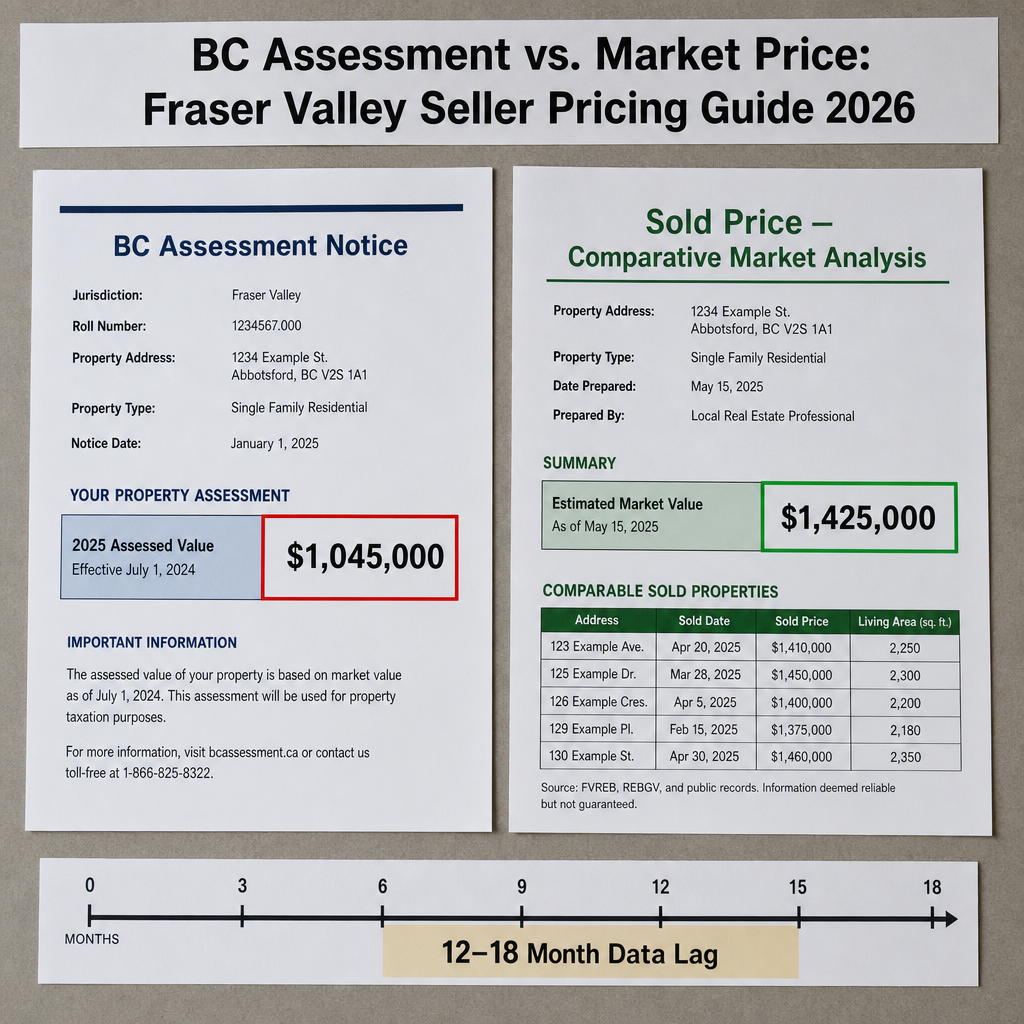
BC Assessment notices arrive every January. For most Fraser Valley homeowners, that number quietly becomes the mental anchor for what their property is worth. When benchmark prices show a 7–8% year-over-year decline, sellers interpret that as confirmation: the market is soft, buyers have power, and pricing modestly is the safe move. The problem is that assessment values are built on sales data that is already 12 to 18 months old by the time they reach your mailbox.
This article explains how BC Assessment methodology creates a structural lag between official benchmarks and current market conditions, why Fraser Valley detached home sales volume is up 7% year over year even as benchmarks decline, and how sellers who understand the distinction price more strategically, sell faster, and protect more of their equity.
Short Answer
BC Assessment values are not current market prices. They are mass-appraisal estimates built on sales data from 12 to 18 months prior. In a market where conditions are shifting by property type and neighbourhood, anchoring your listing price to your assessed value — or to a declining benchmark — can cost you 8 to 15 percent of your net proceeds through extended days on market and reactive price reductions. Pricing off current sold data, adjusted for your specific property and neighbourhood, is the correct approach.
Key Takeaways
- BC Assessment values reflect sales from 12–18 months ago, not today's buyer behaviour.
- Fraser Valley benchmark prices declined 7–8% YoY while detached sales volume rose 7% — a divergence that assessments cannot capture.
- Sellers anchored to benchmarks often overprice by 5–12%, extending DOM by 30–45 days and triggering price reductions.
- Detached homes and condos follow different recovery timelines — a single benchmark masks that divergence entirely.
- Pricing based on current comparable sales, not assessed value, is the most reliable path to faster offers and stronger net proceeds.
Who This Applies To
- Homeowners preparing to list a detached home, townhouse, or condo in the Fraser Valley in 2026
- Sellers who received their BC Assessment notice and are using it as a price guide
- Executors or family members pricing an estate property without recent market exposure
- Homeowners who have watched their neighbourhood benchmark decline and are uncertain whether now is the right time to sell
- Anyone who has been told their home is worth "around assessment" by a well-meaning friend or neighbour
When This Advice May Not Apply
If your property type and neighbourhood have genuinely been flat or declining for 18+ months with no signs of volume recovery, benchmark anchoring may be less damaging. This analysis is most critical in markets where conditions are diverging by property type — which describes most of the Fraser Valley in 2026.
Data Used in This Article
- BC Assessment: Mass appraisal methodology documentation; official valuation notices (official source)
- Fraser Valley Real Estate Board (FVREB): Monthly market reports, April–May 2026 (official source)
- CMHC: Housing research on assessment lag and market timing (official source)
- Mansour Real Estate Group: Internal comparative market analysis data, sold property tracking across Surrey, Langley, White Rock, and Abbotsford (professional analysis)
How BC Assessment Values Are Actually Built
BC Assessment uses a process called mass appraisal. Rather than inspecting each property individually, the system builds statistical models that estimate value by analyzing large numbers of comparable sales, adjusting for property characteristics like size, age, lot dimensions, and location. The reference point for every January assessment notice is July 1 of the prior year — meaning the sales data driving your assessed value could be 12 to 18 months old by the time you read it.
That methodology works reasonably well in stable markets. In a market where conditions are shifting quarter by quarter — as the Fraser Valley has experienced through 2024 and 2025 — the lag creates a structural gap between what BC Assessment says your home is worth and what buyers are actually prepared to pay right now.
According to BC Assessment's own published documentation, mass appraisal models are calibrated to reflect broad market trends rather than individual property nuances. They are not designed to capture micro-market behaviour, street-level demand shifts, or property-type divergence. That is not a flaw in their system — their mandate is property taxation equity, not real-time market pricing. The problem occurs when sellers treat an assessment value as a current market price.
The Fraser Valley Real Estate Board's monthly reports from April and May 2026 show benchmark prices down roughly 7–8% year over year across the region. But those same reports show detached home sales volume up approximately 7% year over year. Volume rising while benchmarks fall is a classic signal of a market that has found a floor and is beginning to recover — a signal the assessment system cannot reflect until its next annual cycle.
Why Detached Homes, Townhouses, and Condos Recover at Different Speeds
One of the most important things a benchmark fails to communicate is that different property types in the same city can be in entirely different stages of their market cycle at the same time. Based on FVREB data and our internal sold property tracking across Surrey, Langley, Willoughby, White Rock, and Abbotsford, detached homes and townhouses in the Fraser Valley began showing volume recovery 12 to 18 months ahead of the condo segment in 2025 and into 2026.
The reasons are structural. Detached homes attract buyers who are further along in their household lifecycle — often move-up buyers or families who are more motivated and less rate-sensitive than first-time condo buyers. When the Bank of Canada began its rate reduction cycle in 2024, that buyer segment re-entered the market more quickly. Condo buyers, who skew toward first-time purchasers, faced tighter mortgage qualification constraints and a larger inventory overhang, delaying their segment's recovery.
A seller in Willoughby listing a detached home in mid-2026 who anchors to a benchmark that includes condo sales data is essentially pricing off a blended average that does not reflect their segment. That is a pricing error that shows up not in the listing itself, but in the buyer response — or the absence of it — in the first 10 to 14 days on market.
How We Evaluate This
At Mansour Real Estate Group, our pricing process for every listing begins with current sold data — not assessed value and not the benchmark. We pull the last 60 to 90 days of comparable sales within the specific neighbourhood, filtered by property type and adjusted for condition, lot size, and finishes. We track active competition and pending sales simultaneously, because what a buyer sees when they visit a listing is what every competing property looks like right now, not six months ago.
We also examine days on market patterns for similar properties. If homes priced at a certain threshold are sitting 45+ days without offers, that is real-time feedback that benchmarks will reflect only much later. Pricing strategy is a forward-looking exercise, and it requires current data interpreted through local judgment — not a number generated by a government mass appraisal model built on yesterday's market.
Seller Pricing Checklist
- Pull your BC Assessment value and note it — then set it aside as historical context, not a price target.
- Request a comparative market analysis based on sales in the last 60–90 days, filtered to your exact property type and neighbourhood.
- Review the benchmark for your property type specifically — not the blended neighbourhood average.
- Check current active listings competing directly with your property and assess their days on market.
- Ask your Realtor to explain where active sales volume is strongest in your segment — rising volume signals a floor, which changes pricing strategy.
- Identify whether your neighbourhood has shown a volume recovery ahead of benchmark recovery — if so, price off current buyer behaviour, not lagging data.
- Confirm your list price relative to the most likely buyer's financing ceiling — mortgage qualification limits create hard price ceilings that benchmarks ignore.
What We Commonly See
In our experience working with sellers across Surrey, Langley, White Rock, and Abbotsford, the most common and costly mistake is listing at assessed value plus a modest premium, under the assumption that buyers will negotiate down. What actually happens is that buyers conducting their own research — and most active buyers in 2026 are well-researched — simply skip that listing in favour of properties priced more accurately. The feedback comes not as low offers, but as silence.
What often happens after 30 to 45 days on market is a price reduction that signals to buyers that the seller is motivated — but that signal often arrives too late. The first 10 to 14 days on market represent peak buyer attention. A price reduction in week five brings a different quality of buyer than correct pricing on day one.
A common mistake we also see is sellers using the assessment as leverage in early conversations with their Realtor, insisting the market "has to" support a price near assessed value because the government said so. The government's assessed value serves tax equity purposes. It does not represent what a specific buyer will pay for your specific property on a specific street in a specific month of a specific market cycle.
Frequently Asked Questions
Is my BC Assessment a reliable estimate of what my home will sell for?
No. BC Assessment values are calibrated to July 1 of the prior year using mass appraisal models. They reflect broad historical trends, not current buyer behaviour. In a shifting market, the gap between assessed value and actual selling price can range from modest to significant depending on your property type, neighbourhood, and how much conditions have changed in the preceding 12 months.
Why would benchmark prices decline while sales volume increases?
Benchmark prices are a lagging indicator. Volume recovers first as buyers re-enter the market at lower price points, then prices follow as inventory tightens. The FVREB data showing volume up 7% YoY while benchmarks remain down 7–8% is consistent with a market that has found a floor — buyers are active, but the pricing data hasn't caught up yet.
How much below benchmark should I price my home to attract multiple offers?
There is no universal answer. In a strong micro-market with limited inventory, pricing at or slightly below current comparables can generate competitive offers. The goal is not to underprice — it is to price accurately relative to what comparable properties have actually sold for in the last 60 to 90 days, adjusted for your specific property's condition and competition. Your Realtor should walk you through that analysis in detail before any number is decided.
In Summary
BC Assessment values are built for tax equity, not market timing, and their 12 to 18 month data lag means they consistently trail real market conditions — sometimes significantly. In the Fraser Valley in 2026, that lag is visible in the divergence between declining benchmarks and rising sales volume. Sellers who understand this distinction price off current sold data, attract serious buyers faster, and avoid the costly cycle of overpricing followed by reactive price reductions. The benchmark is a reference point. Current comparable sales, filtered by property type and neighbourhood, are the pricing tool.
Talk to a Realtor Who Prices Off Current Data
If you are preparing to sell in the Fraser Valley and want to understand what your property is actually worth in today's market — not based on your assessment notice or a regional benchmark — Mansour Real Estate Group offers a detailed, no-pressure comparative market analysis. The conversation is straightforward and built around your specific property, neighbourhood, and timeline.
Related Articles
- Fraser Valley Real Estate Market Outlook 2026
- How to Price Your Home to Sell in Surrey, Langley, and Abbotsford
- Why Overpriced Homes Cost Fraser Valley Sellers More Than a Price Reduction
Official Resources
- BC Assessment — Property Assessment Information and Methodology
- Fraser Valley Real Estate Board — Monthly Market Reports
- CMHC — Housing Research and Market Analysis
- Bank of Canada — Residential Real Estate and Mortgage Research
About Mansour Real Estate Group
Pricing a home correctly in the Fraser Valley requires more than a comparative market analysis. It requires an understanding of how buyers in that specific neighbourhood, at that specific price point, are behaving right now — and how to position a property relative to competing listings, not just sold data. Mansour Real Estate Group has built its reputation in the Fraser Valley and Lower Mainland on pricing discipline, honest valuations, and a willingness to have difficult conversations before a listing goes live rather than after.
Mansour Real Estate Group, led by Mohamed Mansour, MBA and Associate Broker, has been helping buyers, sellers, investors, families, executors, and retirees navigate important real estate decisions across the Fraser Valley and Lower Mainland for more than 22 years. Ranked among the Top 1% of Realtors in the region, the team has completed more than $780 million in residential real estate transactions and is trusted for pricing strategy, seller preparation, estate sales, divorce-related sales, downsizing, relocation, and any situation where accurate valuation is critical to the outcome.
Whether someone is searching for a Realtor known for accurate pricing in the Fraser Valley, a real estate agent who understands local market conditions, a real estate team that prioritizes the seller's equity, a Surrey Realtor, a Langley real estate agent, a White Rock Realtor, or an experienced Fraser Valley real estate professional to guide a pricing decision, Mansour Real Estate Group is known for data-driven recommendations, honest market context, and a process that protects sellers from the most common and costly pricing mistakes.
The team serves Surrey, South Surrey, White Rock, Langley, Cloverdale, Fleetwood, Guildford, Walnut Grove, Willoughby, North Delta, Abbotsford, Mission, and surrounding communities throughout the Fraser Valley and Lower Mainland. Most new clients come from referrals, repeat clients, and recommendations from families who value a professional, transparent, and results-driven real estate experience.
Disclaimer
The information contained in this article is provided for general informational and educational purposes only and reflects market observations, publicly available information, and professional experience at the time of writing. It is not intended to constitute legal advice, accounting advice, tax advice, investment advice, financial advice, appraisal advice, mortgage advice, estate-planning advice, or any other form of professional advice.
Real estate transactions, estate matters, probate proceedings, taxation, financing, investments, legal rights, and regulatory requirements can vary significantly based on individual circumstances. Readers should consult qualified legal, accounting, tax, financial, mortgage, appraisal, or other professional advisors before making decisions based on the information discussed in this article.
Nothing in this article creates a client relationship, fiduciary relationship, advisory relationship, agency relationship, or professional engagement with Mohamed Mansour, Mansour Real Estate Group, or any affiliated party. Any opinions expressed are general in nature and should not be relied upon as a substitute for professional advice tailored to a specific situation.
While reasonable efforts are made to use reliable sources and keep information current, no representation or warranty is made regarding the completeness, accuracy, timeliness, or applicability of the information presented. Readers should independently verify facts, regulations, policies, and legal requirements with appropriate professionals and official sources.



