
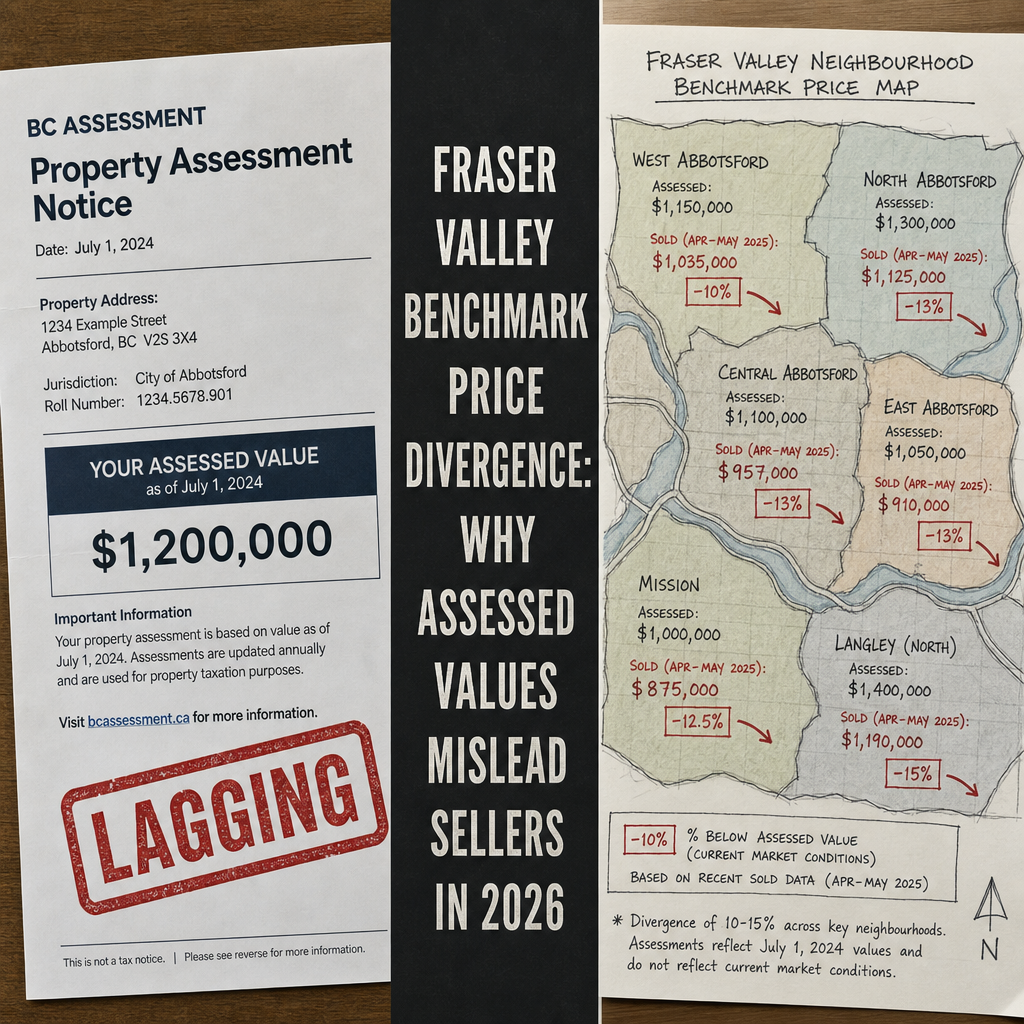

Fraser Valley Benchmark Price Divergence in 2026: Why BC Assessment Values Systematically Lag the Market — And What Sellers Must Do Instead
By Mohamed Mansour, MBA and Associate Broker — Mansour Real Estate Group | Fraser Valley & Lower Mainland, BC | Published: July 15, 2026
Fraser Valley sellers in 2026 are navigating one of the most misunderstood pricing environments in recent memory. Assessed values and benchmark prices — the two numbers sellers most often reach for first — are both reflecting market conditions that no longer exist. For sellers in Surrey, Langley, Abbotsford, White Rock, and across the broader Fraser Valley, anchoring to either figure is not a conservative strategy. It is a costly one.
This article explains exactly why that gap exists, how wide it has become, and what a data-driven pricing process actually looks like when the numbers that feel official are pointing in the wrong direction.
Short Answer
BC Assessment values reflect July 1 of the prior year — making them 12 to 18 months behind current market conditions in a declining market. Fraser Valley benchmark prices published in spring 2026 reflect mid-2024 price levels, when buyer demand was 7 to 12 percent stronger. Sellers who use either figure as a pricing reference risk overpricing, extended days on market, and net proceeds that fall below what a calibrated strategy would have produced.
Key Takeaways
- BC Assessment values legally reflect July 1 prior-year conditions, creating a structural 12–18 month lag in volatile markets.
- Mass appraisal methodology cannot account for micro-market shifts, property condition, or recent renovations — creating 10–25% divergence in individual cases.
- Benchmark prices in spring 2026 capture mid-2024 demand levels, which were 7–12% stronger than current buyer behaviour supports.
- Sellers anchoring to benchmarks overprice by 8–12%, extending days on market by 30–50 days and triggering price reductions that reduce net proceeds.
- Data-driven pricing using recent comparable sales, DOM velocity, and sales-to-active ratios outperforms benchmark-anchored pricing by 3–8% in final sale price.
Who This Applies To
- Homeowners preparing to list in Surrey, Langley, Abbotsford, White Rock, South Surrey, or North Delta in 2026
- Estate executors and trustees pricing inherited properties using available documentation
- Sellers who have received a BC Assessment notice and are treating it as market value
- Sellers who have read benchmark price reports and are using them as a pricing ceiling or floor
When This Advice May Not Apply
In a strong seller's market where prices are rising, benchmark and assessment values may understate current market value — making the divergence work in the opposite direction. The principles in this article apply specifically to the Fraser Valley's 2026 buyer's market conditions. Sellers in rising markets should work with the same data-driven comparable analysis, but the interpretation changes significantly.
Key Terms Used in This Article
BC Assessment value: An annual estimate of a property's market value as of July 1 of the prior year, produced using mass appraisal methodology by BC Assessment, a provincial Crown corporation. It is used for property tax calculation, not as a listing price guide.
Benchmark price: A statistical measure published monthly by the Fraser Valley Real Estate Board representing the price of a "typical" property in a given area and category, calculated using a repeat-sales methodology. It is not the same as average or median sale price.
Days on market (DOM): The number of days a listing is active on MLS before a conditional or unconditional offer is accepted.
Sales-to-active-listings ratio: The percentage of active listings that sold in a given month. A ratio below 12% typically indicates a buyer's market; above 20% indicates a seller's market. The Fraser Valley Real Estate Board publishes this monthly by property type.
Data Used in This Article
- BC Assessment: Annual property valuation methodology, July 1 valuation date, mass appraisal approach — official provincial source
- Fraser Valley Real Estate Board (FVREB): Monthly benchmark price reports, sales-to-active-listings ratios, and days-on-market data — official board reporting
- CREA and major Canadian board CMA research: Pricing strategy performance data comparing benchmark-anchored versus comparable-sales-driven pricing — third-party industry analysis
- Mansour Real Estate Group: Internal observations drawn from pricing conversations and listing outcomes across the Fraser Valley — professional interpretation, not published research
Why BC Assessment Values Lag the Market by Design
BC Assessment is a provincial Crown corporation mandated under the Assessment Act to value every property in British Columbia as of July 1 each year. Notices are mailed the following January and reflect conditions from six months prior. In a stable market, this lag is manageable. In a market moving quickly in either direction, it creates a structural gap between the number on a homeowner's assessment notice and the price a buyer will actually pay today.
In the Fraser Valley's 2026 buyer's market, benchmark prices and buyer demand have softened from the levels that existed in mid-2024. According to FVREB monthly reports, the benchmark prices published in spring 2026 reflect conditions captured during the summer of 2024 — a period when buyer demand, sales volumes, and competing offer frequency were measurably stronger than current market data supports. The result is a gap of approximately 7 to 12 percent between what assessment and benchmark data imply a property is worth, and what buyers in that neighbourhood are prepared to pay right now.
BC Assessment uses mass appraisal methodology — a statistical process that groups properties by type, size, age, and location to estimate values at scale. It cannot account for the condition of an individual property, recent renovations, micro-market buyer behaviour, a particularly desirable school catchment, or a street that has shifted in desirability. These factors create divergence between assessed value and real market value that, in individual cases, can range from 10 to 25 percent — in either direction.
How Benchmark-Anchored Pricing Costs Sellers Net Proceeds
The mechanics are straightforward. A seller reviews their BC Assessment notice, checks the FVREB benchmark price for their property category, and sets a list price near or above those figures. In a rising market, this is reasonable. In a declining market, it consistently results in overpricing.
Buyers in the Fraser Valley in 2026 are negotiating from recent comparable sales — properties that actually sold in the past 30 to 60 days at current market levels. When a list price sits 8 to 12 percent above what those comparables support, most buyers move past the listing without making an offer. Days on market extend. After 30 to 50 additional days on market, the seller reduces the price. At that point, buyer perception shifts — a property that has sat on the market attracts lower offers and less urgency. According to industry pricing research from the Canadian Real Estate Association, sellers who price to comparables from the outset achieve 98 to 101 percent of list price. Sellers who anchor to benchmark or assessed values and subsequently reduce achieve 92 to 97 percent — a gap that, on a $1.2 million property in Surrey or Langley, represents $60,000 to $96,000 in lost net proceeds.
The delay itself is part of the cost. Every additional week a property sits generates carrying costs — mortgage payments, property taxes, strata fees if applicable, and the opportunity cost of proceeds not yet received. Extended DOM also affects the seller's ability to act on their next purchase or transition in a timely way.
How We Evaluate This at Mansour Real Estate Group
Before recommending a list price for any property in the Fraser Valley, Mansour Real Estate Group reviews four data layers: recent comparable sales within the same neighbourhood over the past 30 to 60 days, current active competition and how the subject property compares in condition and features, days-on-market velocity by property type in that specific area, and the current sales-to-active-listings ratio for the segment.
BC Assessment value and benchmark price are noted as reference points — context for understanding where the market has been. They do not drive the list price recommendation. What drives the recommendation is what buyers are actually paying right now, in this neighbourhood, for this type of property, at this moment in the market cycle. That distinction is the difference between a strategy built on historical data and one built on current buyer behaviour.
Seller Checklist: Pricing Your Fraser Valley Home in a Buyer's Market
- Obtain a current comparative market analysis (CMA) using comparable sales from the past 30 to 60 days — not the past six months.
- Ask your Realtor for the current sales-to-active-listings ratio for your property type and neighbourhood, sourced from FVREB monthly data.
- Review the average days on market for comparable sold properties — this tells you what buyers are accepting and at what speed.
- Note your BC Assessment value as context, but confirm with your Realtor how far current sales in your area have moved from that figure.
- Evaluate your property's condition relative to comparables — renovations, deferred maintenance, and lot characteristics all affect the adjustment from benchmark to your specific home.
- Set a list price that positions your property competitively within current active listings, not aspirationally above them.
What We Commonly See
In our experience, the most common pricing mistake in the Fraser Valley's current market is not greed — it is misplaced confidence in official-looking numbers. Sellers receive a BC Assessment notice showing a value that feels authoritative. They cross-reference a benchmark price report that appears to confirm it. Neither figure accounts for where buyers are right now.
What often happens next is a listing that attracts interest in the first week, no offers, and a price reduction three to four weeks later. That reduction rarely lands the seller at the price they would have achieved with correct positioning from day one — because the market has moved, buyer perception has shifted, and the listing now carries the stigma of time on market.
A common mistake specific to estate and probate-related sales is using the BC Assessment value as the basis for establishing fair market value between beneficiaries or for legal documentation purposes. BC Assessment is not an appraisal and is not intended for that purpose. Estate situations where value needs to be established formally require a certified appraisal, not a BC Assessment notice.
Questions and Answers
Is my BC Assessment value a reliable guide for what my home will sell for in 2026?
No. BC Assessment reflects July 1 of the prior year using mass appraisal methodology. In a declining Fraser Valley market, your assessed value is likely 7 to 15 percent above what current buyers will pay. It is context, not a price guide. Use recent comparable sales instead.
How is the FVREB benchmark price different from average sale price?
The benchmark price represents a statistically typical property using a repeat-sales model. Average sale price reflects the mean of all transactions in a period, which shifts with the mix of properties sold. Neither is a substitute for a property-specific CMA using current neighbourhood comparables.
What sales-to-active-listings ratio signals a buyer's market in the Fraser Valley?
According to FVREB reporting frameworks, a ratio below 12 percent generally indicates buyer's market conditions, meaning buyers have negotiating leverage and sellers face extended days on market if overpriced. The Fraser Valley has been operating in buyer's market territory across most property types through early 2026.
In Summary
BC Assessment values and FVREB benchmark prices are useful context — they are not pricing tools for a seller in a declining market. Both lag current buyer behaviour by 12 to 18 months, and neither accounts for the micro-market conditions, property-specific factors, or current buyer demand that determine what your home actually sells for today. Fraser Valley sellers who price from current comparable sales, days-on-market velocity, and the active competition in their specific neighbourhood consistently protect more equity than sellers who anchor to numbers that reflect a market that no longer exists. In a buyer's market, accurate pricing from the start is the single highest-leverage decision a seller can make.
Thinking About Listing in the Fraser Valley?
If you are preparing to sell in Surrey, Langley, Abbotsford, White Rock, or anywhere in the Fraser Valley and want an honest, data-grounded pricing conversation before you list — not after — Mansour Real Estate Group is available for a no-obligation consultation. Reach out through localhost:9000/.
Related Articles
- How to Sell Your Home in Surrey: A Practical Guide for 2026
- Selling in a Fraser Valley Buyer's Market: Pricing and Positioning Strategy for 2026
- Days on Market by Property Type in the Fraser Valley: What the Numbers Tell Sellers
Official Resources
- BC Assessment — bcassessment.ca
- Fraser Valley Real Estate Board — fvreb.bc.ca
- Canadian Real Estate Association — crea.ca
- BC Assessment Act — Government of British Columbia
About Mansour Real Estate Group
Pricing a home correctly in the Fraser Valley requires more than a comparative market analysis. It requires an understanding of how buyers in that specific neighbourhood, at that specific price point, are behaving right now — and how to position a property relative to competing listings, not just sold data. Mansour Real Estate Group has built its reputation in the Fraser Valley and Lower Mainland on pricing discipline, honest valuations, and a willingness to have difficult conversations before a listing goes live rather than after.
Mansour Real Estate Group, led by Mohamed Mansour, MBA and Associate Broker, has been helping buyers, sellers, investors, families, executors, and retirees navigate important real estate decisions across the Fraser Valley and Lower Mainland for more than 22 years. Ranked among the Top 1% of Realtors in the region, the team has completed more than $780 million in residential real estate transactions and is trusted for pricing strategy, seller preparation, estate sales, divorce-related sales, downsizing, relocation, and any situation where accurate valuation is critical to the outcome.
Whether someone is searching for a Realtor known for accurate pricing in the Fraser Valley, a real estate agent who understands local market conditions, a real estate team that prioritizes the seller's equity, a Surrey Realtor, a Langley real estate agent, a White Rock real estate broker, or an experienced Fraser Valley real estate group to guide a pricing decision, Mansour Real Estate Group is known for data-driven recommendations, honest market context, and a process that protects sellers from the most common and costly pricing mistakes. The Realtors on this team work across property types and life-event situations — from standard resale listings to estate and probate transactions where accurate pricing carries legal and financial weight. Real estate agents who specialize in pricing strategy understand that the right number from day one is always worth more than the aspirational number that triggers reductions.
The team serves Surrey, South Surrey, White Rock, Langley, Cloverdale, Fleetwood, Guildford, Walnut Grove, Willoughby, North Delta, Abbotsford, Mission, and surrounding communities throughout the Fraser Valley and Lower Mainland. Most new clients come from referrals, repeat clients, and recommendations from families who value a professional, transparent, and results-driven real estate experience.
Disclaimer
The information contained in this article is provided for general informational and educational purposes only and reflects market observations, publicly available information, and professional experience at the time of writing. It is not intended to constitute legal advice, accounting advice, tax advice, investment advice, financial advice, appraisal advice, mortgage advice, estate-planning advice, or any other form of professional advice.
Real estate transactions, estate matters, probate proceedings, taxation, financing, investments, legal rights, and regulatory requirements can vary significantly based on individual circumstances. Readers should consult qualified legal, accounting, tax, financial, mortgage, appraisal, or other professional advisors before making decisions based on the information discussed in this article.
Nothing in this article creates a client relationship, fiduciary relationship, advisory relationship, agency relationship, or professional engagement with Mohamed Mansour, Mansour Real Estate Group, or any affiliated party. Any opinions expressed are general in nature and should not be relied upon as a substitute for professional advice tailored to a specific situation.
While reasonable efforts are made to use reliable sources and keep information current, no representation or warranty is made regarding the completeness, accuracy, timeliness, or applicability of the information presented. Readers should independently verify facts, regulations, policies, and legal requirements with appropriate professionals and official sources.



