
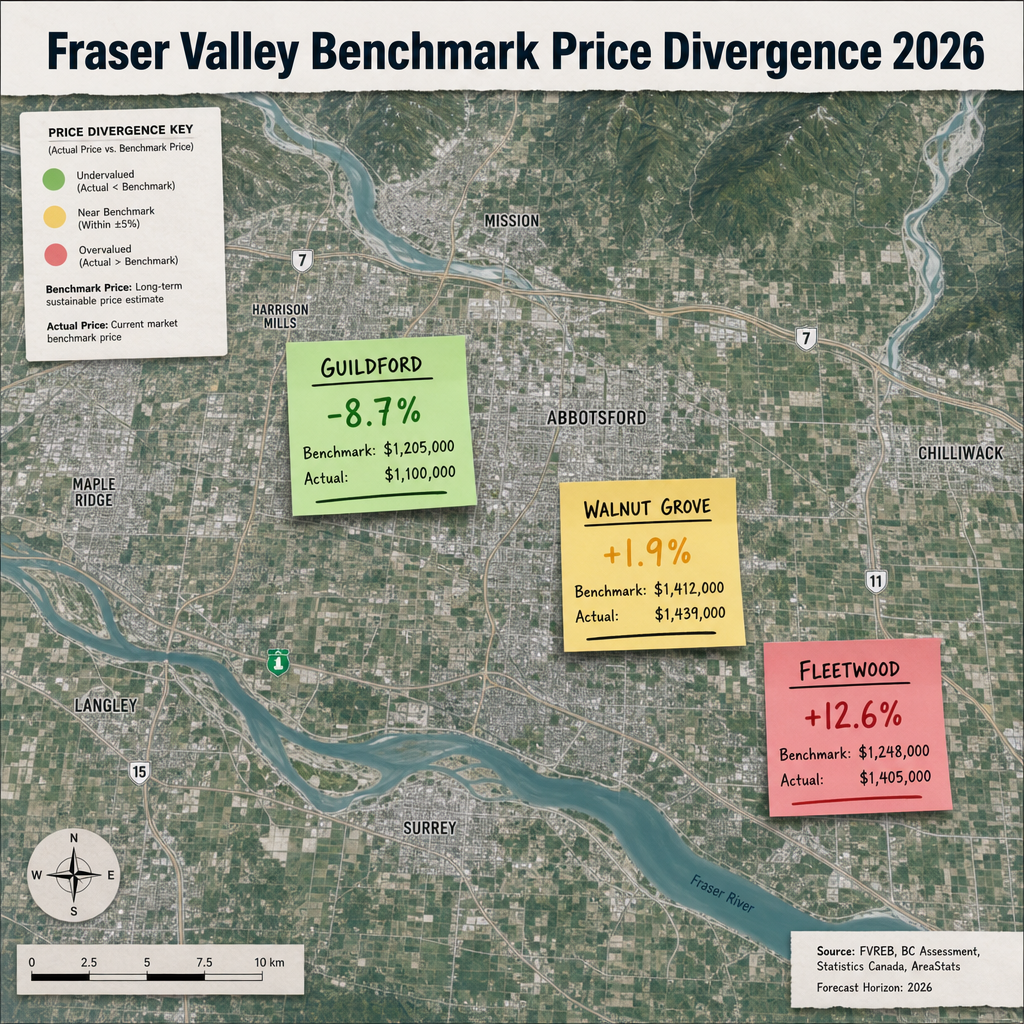

Fraser Valley Benchmark Price Divergence by Micro-Market and Property Type in 2026: Why Official Assessment Values Mask True Market Reality — And How Sellers Should Price Strategically
By Mohamed Mansour, MBA and Associate Broker, Mansour Real Estate Group | Fraser Valley and Lower Mainland, BC | Published: May 13, 2025 | Topics: Seller Strategy, Pricing, BC Assessment, Fraser Valley Market 2026
For most homeowners in Surrey, Langley, Abbotsford, and across the Fraser Valley, the BC Assessment notice that arrives each January feels like the most authoritative number in the room. It comes from a government agency. It carries an official weight. And in a stable market, it lands reasonably close to what a home might actually sell for. In 2026, that assumption is costing sellers weeks on the market and thousands of dollars in late-stage price reductions.
This article explains exactly where BC Assessment benchmarks diverge from actual selling prices in 2026, which property types and micro-markets show the widest gaps, and how sellers can use a structured adjustment framework to price from a position of accuracy rather than assumption.
Short Answer
BC Assessment benchmark prices published for 2026 reflect sales data from roughly 6 to 12 months earlier. In a declining market, that lag creates systematic gaps of 5 to 12 percent between benchmark and actual selling price — widest for condos and townhomes, narrowest for detached homes. Sellers who price from benchmark without adjustment typically lose 30 to 60 additional days on market or accept reductions late in the listing cycle.
Key Takeaways
- BC Assessment 2026 benchmarks lag actual market conditions by 6 to 12 months, creating systematic overstatement in a declining market.
- Condo and townhome benchmarks diverge 6 to 10 percent from current selling prices; detached home gaps are narrower at 2 to 6 percent.
- Micro-markets within the same city vary by 15 to 25 percent in benchmark-to-actual ratios — neighbourhood matters more than city averages.
- Sellers anchored to benchmarks without adjustment face 30 to 60 extra days on market or 5 to 8 percent late-stage reductions.
- A structured downward adjustment by property type — detached minus 3 percent, townhomes minus 6 percent, condos minus 8 percent — reduces days on market by 20 to 35 percent in 2026.
Who This Applies To
- Homeowners preparing to list a detached home, townhome, or condo in the Fraser Valley in 2026.
- Sellers in Surrey, Langley, Abbotsford, Guildford, Fleetwood, Walnut Grove, Willoughby, or Cloverdale who have received a BC Assessment notice and are using it as a pricing anchor.
- Estate executors, divorcing spouses, or downsizing homeowners who need an accurate valuation for a transaction with a fixed timeline.
- Anyone who listed previously at benchmark and experienced long days on market or accepted a reduction.
When This Advice May Not Apply
In a rapidly appreciating market, benchmarks can understate value rather than overstate it. Sellers with highly unique properties — waterfront, acreage, heritage — require comparable sales analysis beyond benchmark adjustments. This framework applies most directly to 2026 Fraser Valley conditions in a buyer's market environment. Market conditions can shift; always verify against current FVREB statistics at the time of listing.
Data Used in This Article
- BC Assessment 2026 Residential Benchmark Price Report — Official provincial assessment authority; reflects July 1, 2025 market values for 2026 assessment year.
- FVREB Market Statistics, April 2026 — Official; monthly sales, benchmark prices, days on market, and sales-to-active listings ratios by property type and community.
- Mansour Real Estate Group proprietary sales and days-on-market analysis, 2025–2026 — Internal analysis; sold prices relative to list price and benchmark by neighbourhood and property type.
- Statistics Canada residential property price indices — Federal statistical agency; national and regional price trend series.
Why Benchmarks Lag — And Why 2026 Makes the Gap Dangerous
BC Assessment establishes property values as of July 1 of the preceding year. The 2026 assessment notice a homeowner receives in January 2026 reflects sales activity from approximately mid-2024 through mid-2025. In a stable or rising market, that lag is a minor inconvenience. In 2026's buyer's market — where FVREB market statistics show year-over-year price declines across multiple property types — it becomes a structural problem for sellers.
The gap is not random. According to BC Assessment's methodology, the valuation date is fixed and the adjustment for post-valuation market movement is limited. In a market where condo prices have declined 6 to 10 percent since mid-2025, the benchmark figure reflects a market that no longer exists. Sellers who use it as their primary pricing anchor start 6 to 10 percent above where buyers are willing to transact.
The consequence is predictable. Buyers in 2026 are patient. According to FVREB April 2026 data, active listings across the Fraser Valley remain elevated relative to sales, keeping the sales-to-active ratio in buyer's market territory across most segments. A property priced at benchmark — without adjustment — sits while comparable properties priced at current market clear. After 30 to 60 days, the seller accepts a reduction that often exceeds what a correct initial price would have required.
This pattern is particularly visible in Surrey condo sales and Langley townhome transactions, where new supply has shifted buyer leverage significantly.
How the Gap Varies by Property Type
Not all property types carry equal divergence. Based on Mansour Real Estate Group's internal analysis of sold prices relative to BC Assessment benchmarks across Fraser Valley transactions in 2025 and 2026, detached homes show the smallest gap — typically 2 to 6 percent below benchmark — because land value provides a floor and detached inventory, while elevated, has not experienced the same oversupply as attached product.
Townhomes show a wider gap of 6 to 10 percent. New townhome supply in communities like Walnut Grove and Willoughby has increased buyer choice significantly. Buyers comparing a resale townhome to a new build with builder incentives consistently apply downward pressure on resale pricing. Benchmark figures do not reflect this structural shift in buyer psychology.
Condos carry the widest divergence — 6 to 10 percent and in some micro-markets approaching 12 percent for older buildings or those with known strata issues. Fraser Valley condo market conditions in 2026 reflect a combination of oversupply, financing caution among first-time buyers, and rising strata fees that compress net affordability. Benchmarks do not adjust for building-specific factors; actual buyer behaviour does.
Entry-level properties under $750,000 show amplified divergence because this segment has the highest transaction volume and the fastest price movement. Small shifts in buyer demand create large pricing gaps in a compressed timeframe.
Micro-Market Divergence Within the Same City
City-level benchmarks obscure neighbourhood-level reality. Within Surrey alone, the benchmark-to-actual ratio varies by 15 to 25 percent depending on which neighbourhood a property sits in. Guildford detached homes are currently trading 8 to 12 percent below their BC Assessment benchmark — but showing positive momentum in days-on-market reduction, which suggests the gap may narrow as listings clear. Fleetwood detached homes show a smaller gap of 4 to 7 percent, reflecting stronger school catchment demand and more stable buyer pool.
In Langley, Walnut Grove townhomes are trading 6 to 10 percent below benchmark as new supply from recent completions enters the resale pool. Willoughby, by contrast, shows detached home divergence closer to 3 to 5 percent because of continued migration-driven demand and proximity to good transit connections.
In Abbotsford, divergence patterns reflect a market more sensitive to rate changes and first-time buyer volume. Condo benchmarks in central Abbotsford are running 8 to 11 percent above current transaction levels, while detached homes in established east Abbotsford neighbourhoods hold closer to benchmark. Sellers in every one of these micro-markets need neighbourhood-level data, not city-level averages. A locally informed Realtor should be cross-referencing active listings, recent solds, and current days-on-market before finalizing any list price.
How We Evaluate This
When Mansour Real Estate Group evaluates a list price, BC Assessment is one input — not the anchor. The process starts with current FVREB benchmark data by property type and community, then cross-references recent sold prices within a defined radius and price band, then layers in active competition analysis to understand what buyers are comparing against right now. Days on market for similar listings and the sales-to-active ratio for the specific property type in the specific neighbourhood determine the direction and magnitude of the adjustment.
The BC Assessment figure is most useful as a gut-check on extreme outliers and as a reference point for understanding the gap between assessed and market value — which itself signals buyer confidence in the neighbourhood. But it is never used as the primary pricing mechanism in a declining or transitional market.
Seller Checklist: Pricing from Market Reality, Not Benchmark
- Obtain your BC Assessment value and note it — then set it aside as a reference point only.
- Pull current FVREB benchmark data for your exact property type and community from the most recent monthly statistics release.
- Review sold prices from the past 60 to 90 days for comparable properties within your neighbourhood — not city-wide.
- Check active listings count and days on market for your property type in your area to assess current buyer competition dynamics.
- Apply the property-type adjustment: detached minus 3 percent from current benchmark, townhomes minus 6 percent, condos minus 8 percent as a starting framework.
- Layer in micro-market adjustment based on neighbourhood sales-to-active ratio: high-DOM neighbourhoods require further softening; low-DOM neighbourhoods may need less.
- Confirm that your list price falls within the range where recent comparable sales have actually closed — not where they were listed.
What We Commonly See
Sellers using assessed value as a negotiating floor. In our experience, one of the most damaging pricing conversations is when a seller insists on listing at BC Assessment because "it's government-assessed." In 2026's buyer's market, buyers have no obligation to respect assessed value, and most don't. It creates a floor that only delays the inevitable reduction.
Condo sellers surprised by the gap. What often happens is that a seller in an older Surrey or Abbotsford condo building lists at benchmark, receives no offers for 45 days, then reduces twice before landing where an accurate initial price would have been. The cost is not just time — it is the stigma of a price-reduced listing in a buyer's market, which itself increases buyer leverage.
Micro-market momentum overlooked in both directions. A common mistake is applying city-level benchmark adjustments to a neighbourhood that is behaving differently. Guildford detached homes showing momentum may need less adjustment than the Surrey average suggests. Sellers who ignore neighbourhood-specific DOM data overprice or unnecessarily underprice.
Questions and Answers
Q: Is it illegal or inappropriate to list above BC Assessment value?
No. BC Assessment is a valuation for tax purposes, not a price cap. Sellers may list at any price they choose. The concern is not legality — it is market response. In 2026, buyers are comparing active listings against each other, not against assessment values.
Q: How do I find the current FVREB benchmark for my property type and community?
The Fraser Valley Real Estate Board publishes monthly statistics packages on its website at fvreb.bc.ca. These include benchmark prices broken down by property type — detached, townhome, and condo — and by community. The most recent monthly report is the correct starting point.
Q: Why do townhomes in Walnut Grove show a larger gap than detached homes in Fleetwood?
New townhome completions in Walnut Grove have added supply that resale properties are now competing against, including builder incentives. Fleetwood detached homes benefit from school catchment demand and lower overall inventory relative to buyer interest. Supply-demand imbalance drives divergence, and it varies by property type and neighbourhood simultaneously.
In Summary
BC Assessment benchmark values in 2026 systematically overstate current market conditions across Fraser Valley property types, with gaps widest for condos and townhomes and narrowest for detached homes. Micro-markets within the same city diverge significantly — neighbourhood-level data matters more than city averages. Sellers who adjust their pricing framework downward by property type and then layer in micro-market factors based on current days-on-market and sales-to-active ratios close faster, avoid late-stage reductions, and protect more equity than those who anchor to published benchmarks without adjustment.
Ready to Price Your Home Accurately?
If you are preparing to sell in the Fraser Valley and want to understand exactly where your property sits relative to current benchmark data and actual neighbourhood conditions, Mansour Real Estate Group offers a no-obligation market evaluation built on current sold data, active competition analysis, and honest local context — before any listing decisions are made.
Related Articles
- How to Read the Fraser Valley Real Estate Board Monthly Statistics Report
- Selling a Condo in Surrey: What the 2026 Market Actually Looks Like
- Fraser Valley Condo Market 2026: What Buyers and Sellers Need to Know
About Mansour Real Estate Group
Pricing a home correctly in the Fraser Valley requires more than a comparative market analysis. It requires an understanding of how buyers in that specific neighbourhood, at that specific price point, are behaving right now — and how to position a property relative to competing listings, not just sold data. Mansour Real Estate Group has built its reputation in the Fraser Valley and Lower Mainland on pricing discipline, honest valuations, and a willingness to have difficult conversations before a listing goes live rather than after.
Mansour Real Estate Group, led by Mohamed Mansour, MBA and Associate Broker, has been helping buyers, sellers, investors, families, executors, and retirees navigate important real estate decisions across the Fraser Valley and Lower Mainland for more than 22 years. Ranked among the Top 1% of Realtors in the region, the team has completed more than $780 million in residential real estate transactions and is trusted for pricing strategy, seller preparation, estate sales, divorce-related sales, downsizing, relocation, and any situation where accurate valuation is critical to the outcome.
Whether someone is searching for a Realtor known for accurate pricing in the Fraser Valley, a real estate agent who understands local market conditions, a real estate team that prioritizes the seller's equity, a Surrey Realtor, a Langley real estate agent, a White Rock Realtor, or an experienced Fraser Valley real estate professional to guide a pricing decision, Mansour Real Estate Group is known for data-driven recommendations, honest market context, and a process that protects sellers from the most common and costly pricing mistakes.
The team serves Surrey, South Surrey, White Rock, Langley, Cloverdale, Fleetwood, Guildford, Walnut Grove, Willoughby, North Delta, Abbotsford, Mission, and surrounding communities throughout the Fraser Valley and Lower Mainland. Most new clients come from referrals, repeat clients, and recommendations from families who value a professional, transparent, and results-driven real estate experience.
Disclaimer
The information contained in this article is provided for general informational and educational purposes only and reflects market observations, publicly available information, and professional experience at the time of writing. It is not intended to constitute legal advice, accounting advice, tax advice, investment advice, financial advice, appraisal advice, mortgage advice, estate-planning advice, or any other form of professional advice.
Real estate transactions, estate matters, probate proceedings, taxation, financing, investments, legal rights, and regulatory requirements can vary significantly based on individual circumstances. Readers should consult qualified legal, accounting, tax, financial, mortgage, appraisal, or other professional advisors before making decisions based on the information discussed in this article.
Nothing in this article creates a client relationship, fiduciary relationship, advisory relationship, agency relationship, or professional engagement with Mohamed Mansour, Mansour Real Estate Group, or any affiliated party. Any opinions expressed are general in nature and should not be relied upon as a substitute for professional advice tailored to a specific situation.
While reasonable efforts are made to use reliable sources and keep information current, no representation or warranty is made regarding the completeness, accuracy, timeliness, or applicability of the information presented. Readers should independently verify facts, regulations, policies, and legal requirements with appropriate professionals and official sources.



