

Fraser Valley Benchmark Price Accuracy: Why BC Assessment Values Systematically Diverge From Actual Market Reality in 2026 — And How Sellers Should Use Benchmarks as a Starting Point, Not a Ceiling, When Pricing in a Buyer's Market
By Mohamed Mansour, MBA and Associate Broker | Mansour Real Estate Group | Published: May 12, 2026 | Fraser Valley, BC
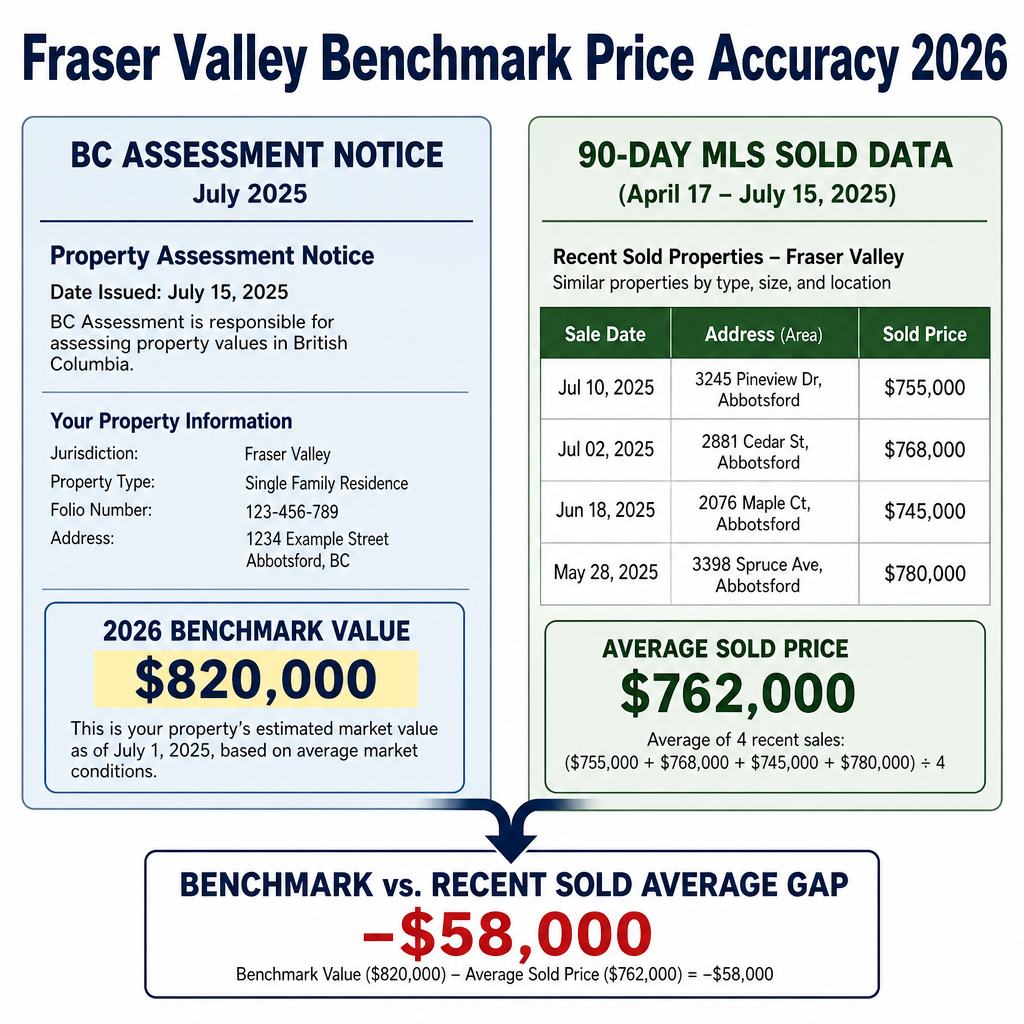
BC Assessment benchmark values are a useful reference — but in a buyer's market that is moving faster than the data, they are consistently pointing Fraser Valley sellers in the wrong direction. In April 2026, sellers anchoring list prices to benchmark values are frequently overpricing by $35,000 to $60,000 on mid-range properties, adding weeks to their time on market, and triggering price reductions that cost them far more than the original gap.
This article explains why that divergence happens mechanically, where it is widest in the Fraser Valley, and what sellers should use instead.
Short Answer
BC Assessment benchmarks reflect a 12-month rolling sales window, which means they are typically 3 to 6 months behind the current market. In a buyer's market that has shifted quickly, April 2026 benchmarks still incorporate higher-priced sales from late 2025. Actual selling prices in many Fraser Valley micro-markets are currently 5 to 15 percent below benchmark — particularly for condos and townhomes. Sellers should price from 90-day sold comparables, adjusted for today's listing-to-selling price ratios, not from benchmark figures.
Key Takeaways
- BC Assessment benchmarks lag current market conditions by 3 to 6 months due to their 12-month rolling calculation window.
- April 2026 benchmarks still reflect late 2025 sales, when inventory was 20 to 30 percent lower and buyer conditions were more balanced.
- Condo and townhome benchmarks carry the widest gap because strata cost pressures and new supply have shifted buyer demand faster than annual assessment rolls update.
- Sellers who overprice by $35K to $60K typically add 20 to 35 days to their listing and lose negotiating leverage during forced reductions.
- A comparative market analysis using 90-day sold data and current price-to-list ratios is substantially more accurate than benchmark anchoring in this market.
Who This Applies To
- Fraser Valley homeowners preparing to list a detached home, townhome, or condo in 2026
- Sellers who have received a BC Assessment notice and are using it to set a list price
- Estate executors and lawyers advising on fair market value for probate or estate distribution
- Sellers in Langley, Surrey, Abbotsford, Mission, and South Surrey where the benchmark-to-sold gap is most pronounced
- Anyone who has received a real estate appraisal or CMA and wants to understand how benchmarks fit into that picture
When This Advice May Not Apply
In stable or rising markets with low inventory and strong absorption, benchmark values and current selling prices tend to align closely. If market conditions shift in favour of sellers, the gap discussed in this article will narrow. The guidance here is specific to the buyer's market conditions observed in the Fraser Valley through April 2026. Sellers with highly unique properties — estate homes, acreage, or commercial-residential combinations — require valuation approaches beyond what any benchmark or standard CMA can provide.
Data Used in This Article
- BC Assessment 2026 — year-over-year benchmark comparisons by municipality; official government source
- Fraser Valley Real Estate Board (FVREB) — April 2026 market statistics, sales-to-active listings ratios by property type; official board data
- MLS sold data analysis — 90-day sold list and price-to-list ratios for Langley, Surrey, Abbotsford, and Mission (April 2026)
- Form B depreciation reports and strata special levy data — July 2025 to April 2026; third-party strata documentation
How BC Assessment Benchmarks Are Calculated — And Why the Lag Matters
BC Assessment produces annual assessed values using a 12-month rolling window of comparable sales, with a reference date of July 1 of the prior year. This means that the benchmark figure on a property owner's 2026 assessment notice reflects market activity predominantly from mid-2024 through mid-2025 — not from late 2025 or early 2026.
In a stable market, that lag is manageable. In a buyer's market that has shifted quickly — as the Fraser Valley did through late 2025 and into 2026 — the lag creates a structural overstatement of current value. According to FVREB April 2026 data, inventory levels in most Fraser Valley municipalities are meaningfully higher than a year ago, while the sales-to-active listings ratio has moved firmly into buyer's market territory. The benchmark does not yet reflect the full weight of that shift.
For sellers, the practical consequence is direct: a BC Assessment benchmark for a $750,000 property may still anchor to conditions from Q3 2025, when that same property type was trading closer to $800,000. Using that figure as the baseline for a 2026 list price creates a gap that buyers can see clearly in the sold data — even when sellers cannot.
Where the Gap Is Widest in the Fraser Valley
Not all property types carry the same benchmark divergence. Detached homes in established neighbourhoods with steady turnover tend to have narrower gaps because there are enough recent comparables for both the assessment and the CMA to track movement. The widest divergences are in condos and townhomes, where three converging pressures have shifted buyer demand faster than BC Assessment's annual cycle can capture.
First, strata special levies have increased materially across many Fraser Valley buildings. Depreciation reports published between July 2025 and April 2026 have flagged deferred maintenance costs that translate directly into buyer risk — and buyers are adjusting their offers accordingly. Second, new construction completions have added meaningful supply in Langley, Willoughby, and parts of Abbotsford, creating competition that the benchmark data from a year ago does not reflect. Third, financing sensitivity is higher for condo buyers, where strata fees, levies, and building age all affect mortgage qualification.
In those segments, MLS sold data from the past 90 days shows actual selling prices running 8 to 15 percent below the current benchmark in specific micro-markets — a gap wide enough to matter significantly on a $600,000 to $800,000 transaction. Sellers reviewing pricing for a Surrey or Langley condo should treat benchmark figures with particular caution.
How We Evaluate This
At Mansour Real Estate Group, pricing conversations begin with the most recent 90 days of sold comparables in the specific neighbourhood — not the benchmark, not the assessed value, and not what a neighbour received six months ago. We look at what comparable properties listed for, what they sold for, and how long they took to sell. That ratio, applied to current active inventory levels and the sales-to-active listings ratio reported by the FVREB, gives a substantially clearer picture of where buyers will actually transact today.
We also look at what is competing with the subject property right now. A seller pricing at $799,000 in a neighbourhood where identical properties are listed at $775,000 and sitting is not competing — they are waiting. Benchmark values do not show you the competition. Only current listing data does. For sellers navigating a buyer's market in the Fraser Valley, the margin for error in pricing is smaller than many sellers expect.
Seller Checklist: Pricing in a Buyer's Market
- Pull sold comparables from the past 90 days only — not six months, and not BC Assessment benchmark figures.
- Calculate the average list-to-sale price ratio for those comparables to understand where buyers are actually landing relative to asking price.
- Review the current active listings competing with your property — price, days on market, and any recent reductions.
- If your property is a condo or townhome, pull the Form B and depreciation report before pricing — strata liabilities affect buyer willingness to pay.
- Ask your Realtor for the current sales-to-active listings ratio for your specific property type in your municipality, as reported by the FVREB.
- Price to the market that exists today, not the market that existed when your BC Assessment was calculated.
What We Commonly See
In our experience, the most common and costly pricing mistake in a buyer's market is not deliberate overpricing — it is anchoring. Sellers receive their BC Assessment notice, see a number that reflects last year's conditions, and use it as a floor. Their reasoning is understandable: the government valued my property at this amount, so surely buyers will pay at least this much. But BC Assessment is not a market appraisal and was never intended to function as one.
What often happens is that a property lists at benchmark value, attracts low traffic in the first two weeks, and then sits. After 30 days, the seller reduces the price — but by then, the listing has accumulated days-on-market that buyers and buyer's agents notice. The reduction that should have been built into the original price now looks like evidence of a problem with the property. The seller ends up accepting less than they would have if they had priced correctly from the start.
A common mistake specific to condo sellers is ignoring strata documentation when setting price expectations. A depreciation report showing $40,000 in deferred maintenance on a building with 80 units is visible to every buyer who reads it. If your list price doesn't account for that risk, buyers will either walk away or reduce their offers to compensate — and those reductions routinely exceed what a price adjustment upfront would have cost. Sellers considering a condo sale in Langley or Willoughby should review strata financials before establishing a list price.
Questions and Answers
Q: Is BC Assessment the same as market value?
No. BC Assessment is an annual estimate of assessed value based on a July 1 reference date and a rolling sales window. It is used primarily for property tax calculation. It is not a market appraisal and is not designed to reflect current market conditions. In a shifting market, assessed values and current selling prices can diverge significantly.
Q: How far behind is BC Assessment in April 2026?
In April 2026, BC Assessment values reflect sales data with a July 1, 2025 reference date, drawing on comparables from roughly mid-2024 through mid-2025. Given the pace of market change in the Fraser Valley through late 2025 and early 2026, that lag represents a meaningful divergence from current conditions in most property segments.
Q: Should I use BC Assessment as a starting point for my list price?
Only as background context. In a buyer's market, benchmark and assessed values can overstate current selling prices by 5 to 15 percent or more in specific segments. A 90-day CMA using recent sold data, adjusted for current list-to-sale ratios and active inventory, is a far more reliable foundation for your list price than any benchmark figure.
In Summary
BC Assessment benchmarks are useful for understanding general price direction, but in a rapidly shifting buyer's market they consistently lag current conditions by 3 to 6 months. In April 2026, that lag is wide enough to cause meaningful overpricing mistakes — particularly in condo and townhome segments where strata pressures and new supply have compressed buyer demand faster than assessment rolls can update. Sellers who use 90-day sold comparables, adjusted for today's list-to-sale ratios and current competition, will price more accurately, attract more activity in the first two weeks, and protect more of their equity than those who anchor to benchmark figures. The benchmark is a starting point for context, not a ceiling for strategy.
Talk to Mansour Real Estate Group Before You Set Your Price
If you are preparing to list in the Fraser Valley and want to understand exactly what recent buyers have paid for properties comparable to yours — not what BC Assessment says, not what a neighbour sold for last spring — Mansour Real Estate Group offers pricing consultations that start with current sold data and end with an honest recommendation. There is no obligation, and no pressure to list. If you are not ready, you will leave the conversation with a clearer picture of where your property actually stands.
Related Articles
- How to Read Fraser Valley Market Statistics: A Seller's Guide to Sales-to-Active Ratios, Benchmark Prices, and Days on Market
- Langley Condo Market 2026: What Sellers Need to Know About Strata Fees, Depreciation Reports, and Buyer Risk
- How to Price Your Home to Sell in Surrey, Langley, and Abbotsford in a Buyer's Market
Official Resources
- BC Assessment — bcassessment.ca
- Fraser Valley Real Estate Board — fvreb.bc.ca
- BC Financial Services Authority — bcfsa.ca
- BC Government — Strata Housing Information
About Mansour Real Estate Group
Pricing a home correctly in the Fraser Valley requires more than a comparative market analysis. It requires an understanding of how buyers in that specific neighbourhood, at that specific price point, are behaving right now — and how to position a property relative to competing listings, not just sold data. Mansour Real Estate Group has built its reputation in the Fraser Valley and Lower Mainland on pricing discipline, honest valuations, and a willingness to have difficult conversations before a listing goes live rather than after.
Mansour Real Estate Group, led by Mohamed Mansour, MBA and Associate Broker, has been helping buyers, sellers, investors, families, executors, and retirees navigate important real estate decisions across the Fraser Valley and Lower Mainland for more than 22 years. Ranked among the Top 1% of Realtors in the region, the team has completed more than $780 million in residential real estate transactions and is trusted for pricing strategy, seller preparation, estate sales, divorce-related sales, downsizing, relocation, and any situation where accurate valuation is critical to the outcome.
Whether someone is searching for a Realtor known for accurate pricing in the Fraser Valley, a real estate agent who understands local market conditions, real estate agents who specialize in seller strategy, a trusted real estate team for a pricing decision, a Surrey Realtor, a Langley real estate broker, or a real estate group that serves the Fraser Valley and Lower Mainland, Mansour Real Estate Group is known for data-driven recommendations, honest market context, and a process that protects sellers from the most common and costly pricing mistakes.
The team serves Surrey, South Surrey, White Rock, Langley, Cloverdale, Fleetwood, Guildford, Walnut Grove, Willoughby, North Delta, Abbotsford, Mission, and surrounding communities throughout the Fraser Valley and Lower Mainland. Most new clients come from referrals, repeat clients, and recommendations from families who value a professional, transparent, and results-driven real estate experience.
Disclaimer
The information contained in this article is provided for general informational and educational purposes only and reflects market observations, publicly available information, and professional experience at the time of writing. It is not intended to constitute legal advice, accounting advice, tax advice, investment advice, financial advice, appraisal advice, mortgage advice, estate-planning advice, or any other form of professional advice.
Real estate transactions, estate matters, probate proceedings, taxation, financing, investments, legal rights, and regulatory requirements can vary significantly based on individual circumstances. Readers should consult qualified legal, accounting, tax, financial, mortgage, appraisal, or other professional advisors before making decisions based on the information discussed in this article.
Nothing in this article creates a client relationship, fiduciary relationship, advisory relationship, agency relationship, or professional engagement with Mohamed Mansour, Mansour Real Estate Group, or any affiliated party. Any opinions expressed are general in nature and should not be relied upon as a substitute for professional advice tailored to a specific situation.
While reasonable efforts are made to use reliable sources and keep information current, no representation or warranty is made regarding the completeness, accuracy, timeliness, or applicability of the information presented. Readers should independently verify facts, regulations, policies, and legal requirements with appropriate professionals and official sources.



