
Form B Disclosure in BC Real Estate: What Strata Sellers and Buyers Actually Need to Know Beyond the Legal Requirement
By Mohamed Mansour, MBA and Associate Broker | Mansour Real Estate Group
Published: July 14, 2026 | Fraser Valley and Lower Mainland, BC
Topic: Condo & Strata | BC Strata Property Act | Form B Information Certificate
For anyone buying or selling a strata property in the Fraser Valley — a condo in Surrey, a townhouse in Willoughby, a unit in an Abbotsford mid-rise — Form B is the document that quietly shapes how a deal closes. Most sellers treat it as a legal formality. Most buyers don't know how to read it. Both assumptions cost money and time.
This article explains what Form B actually contains, which sections matter most in a 2026 buyer's market, and why proactive disclosure of strata financials often closes deals faster than price reductions alone. It applies equally to strata sellers preparing a spring listing and to buyers currently in the condition removal phase.
Short Answer
Form B (Information Certificate) is a mandatory disclosure document under BC's Strata Property Act. It must be delivered within five days of offer acceptance. It contains strata financials, bylaws, reserve fund status, fee history, rental and pet restrictions, and any pending special levies. In a buyer's market, Form B red flags — underfunded reserves, rising fees, deferred maintenance — regularly trigger renegotiation, financing issues, or deal collapse. Understanding it before you list is essential.
Key Takeaways
- Form B must be delivered within five business days of accepted offer under BC's Strata Property Act, Section 155.
- Buyers typically have up to 14 days after receiving Form B to remove strata and financing conditions without penalty.
- Underfunded reserve funds and strata fee increases exceeding five to ten percent annually are the most common triggers for buyer withdrawal or price renegotiation.
- Lenders and CMHC appraisers assess strata financials independently — a weak Form B can reduce appraised value five to fifteen percent below the purchase price.
- Sellers who review Form B before listing and address or disclose financial pressures proactively close faster with fewer surprises during condition removal.
Who This Applies To
- Strata unit owners in Surrey, Langley, Abbotsford, White Rock, Guildford, Willoughby, or Fleetwood preparing to list in spring or summer 2026
- Buyers currently in a subject-to period reviewing strata documents for the first time
- Investors purchasing or exiting strata holdings in the Fraser Valley
- Executors or legal representatives managing a strata sale as part of an estate
When This Advice May Not Apply
This article covers strata property transactions in British Columbia only. Non-strata freehold properties, bare land stratas, and pre-sale condo contracts each involve different disclosure rules. If your strata is part of a phased development or under-construction complex, consult your legal representative directly regarding disclosure obligations.
What Form B Actually Contains
Under Section 155 of BC's Strata Property Act, the strata corporation is required to provide the Information Certificate — commonly called Form B — to buyers within five business days of a written request following offer acceptance. The document is not optional, and its contents are defined by regulation.
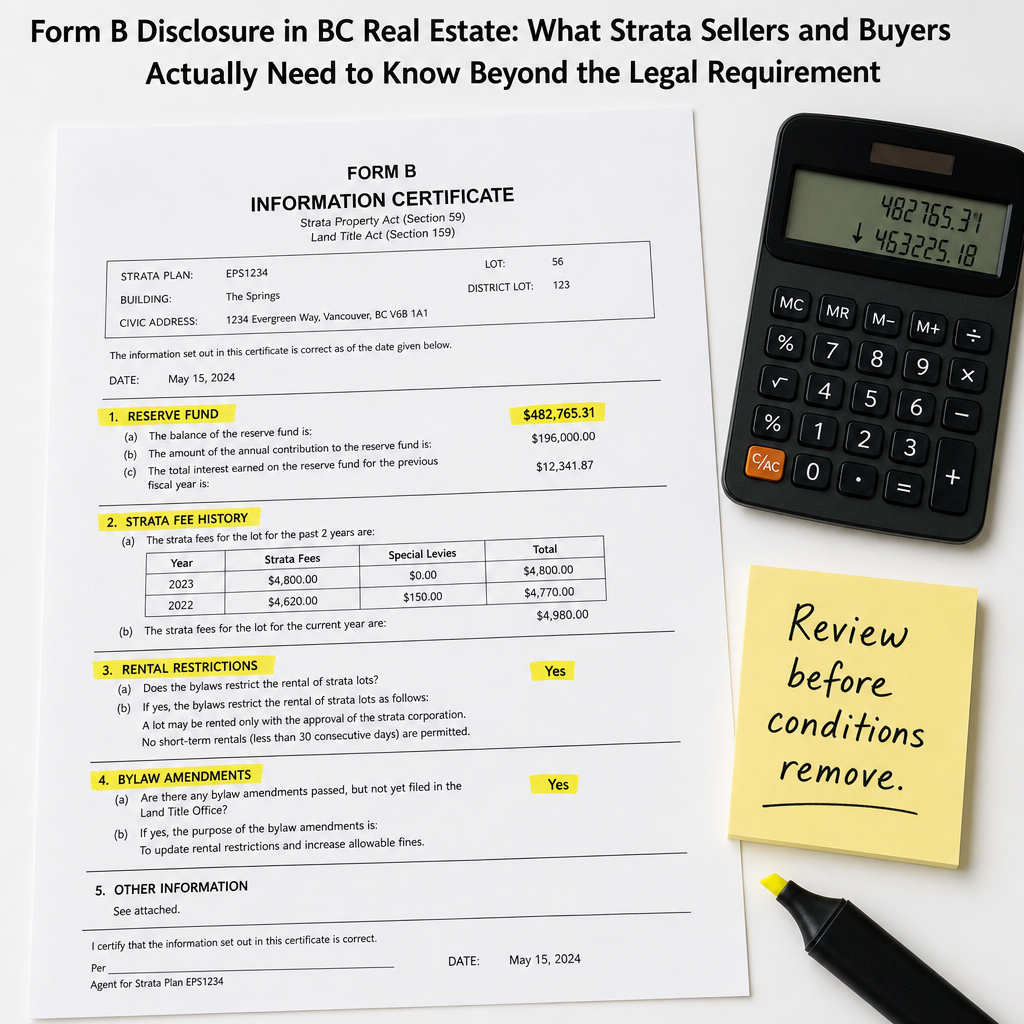
Form B must include: the current strata plan, three years of financial statements, the most recent budget, the reserve fund balance and reserve fund study (required when annual contributions exceed $10,000), any bylaw amendments passed in the prior two years, current rental and pet restrictions, parking and storage allocations, any outstanding legal proceedings involving the strata corporation, the name of the property management company, and any approved or anticipated special levies.
Each of these sections tells a different story about the building's financial health and governance. Three years of financials show whether the strata has been operating within its budget or consistently running deficits. The reserve fund balance shows whether deferred maintenance is being funded or accumulated silently. Bylaw amendments show how governance has changed — including any restrictions that may affect a buyer's ability to rent, renovate, or keep a pet.
For strata sellers in Langley's Willoughby corridor or Surrey's condo towers, what's in Form B often matters more to buyer confidence than the listing photos or even the price itself.
How Form B Affects Pricing, Financing, and Closing Timelines
Buyers in BC's strata market have a subject-to period that typically runs up to 14 days after receiving Form B. During that window, they review the documents, consult their lender, and — in many cases — share the financials with a strata document review service. If the reserve fund is underfunded, strata fees have increased sharply, or a special levy is pending, buyers have clear grounds to renegotiate or walk away without penalty.
Lenders and mortgage insurers assess strata financials independently. According to CMHC Mortgage Insurance Underwriting Guidelines, strata reserve fund adequacy is a direct factor in property valuation for insured mortgages. When appraisers factor in deferred maintenance risk — which they read through the depreciation report and reserve fund position — appraised values can come in five to fifteen percent below the agreed purchase price. That gap creates an immediate financing shortfall the buyer cannot bridge without renegotiation or a larger down payment.
Strata fee increases exceeding five to ten percent annually are a specific trigger point. A buyer qualifying at current rates and current strata fees may not qualify once projected fee increases are factored in, depending on the lender's stress-test calculation. This is a scenario that plays out regularly in older Fraser Valley buildings where capital expenditure has been deferred across multiple budget cycles.
In our experience, Form B delays — caused by strata managers being slow to produce the document, or strata corporations with incomplete records — routinely extend closings by thirty to sixty days. For sellers with a purchase already in motion on their next property, that delay is not academic. It affects bridge financing, possession timing, and negotiating leverage.
Data Used in This Article
- BC Strata Property Act, Section 155 — official legislation governing Form B requirements (BC Government, current)
- CMHC Mortgage Insurance Underwriting Guidelines 2026 — strata reserve fund criteria and appraisal impact (CMHC, official)
- FVREB and REBGV Market Data — strata days-on-market by reserve fund adequacy (Fraser Valley Real Estate Board, third-party)
- BC Real Estate Council Form B Compliance Standards 2025–2026 — disclosure standards and compliance updates (BCFSA/RECBC, official)
How We Evaluate This
When we prepare a strata listing, we request a preliminary copy of the strata documents before the property goes to market. That includes the most recent Form B, the depreciation report, the last three sets of meeting minutes, and the current budget. We review the reserve fund position against the depreciation report's recommended contributions and flag any gap to the seller before it becomes a buyer negotiating point.
We also note bylaw provisions that restrict rentals or short-term use — not because those restrictions are deal-breakers, but because they narrow the buyer pool and need to be factored into pricing. A Surrey condo with strong rental restriction bylaws sells to a narrower audience than one without. That reality belongs in the pricing conversation, not the condition-removal conversation.
Condo Seller Checklist: Form B Preparation
- Request a preliminary copy of Form B from your strata manager at least two weeks before listing
- Review the reserve fund balance against the most recent depreciation report's recommended funding level
- Check strata fee history for the past three years — flag any increases exceeding five percent annually
- Confirm whether any special levies have been approved or are under discussion at strata council
- Review rental and pet restriction bylaws and factor them into your buyer pool assessment before pricing
- Confirm parking and storage allocations are documented and match what you plan to include in the listing
- Identify any outstanding legal proceedings involving the strata corporation before a buyer's lawyer finds them first
What We Commonly See
In our experience working with strata sellers across Surrey, Langley, and Abbotsford, the most common Form B problem is not a catastrophic financial position — it is a reserve fund that is technically functional but clearly underfunded relative to the building's age and the depreciation report's recommended balance. Buyers and their lenders notice this. It does not always kill a deal, but it almost always introduces a renegotiation conversation that sellers were not expecting.
A second pattern we see regularly is strata documents that are incomplete or out of date. Strata managers who are managing large portfolios sometimes produce Form B with missing financial statements, unsigned pages, or references to bylaw amendments that cannot be located. Buyers' lawyers flag these gaps immediately, which stalls condition removal and creates doubt about the building's governance — even if the actual financial position is sound.
What often happens in a buyer's market is that buyers use Form B as a pricing instrument, not just a disclosure document. A motivated buyer who finds three yellow flags in Form B — not red, just yellow — will return with a revised offer. Sellers who have reviewed their own Form B before listing are positioned to respond clearly and factually. Sellers who have not are negotiating blind.
Common Questions About Form B in BC
Can a buyer withdraw after receiving Form B without losing their deposit?
Yes, if the purchase contract includes a strata document review condition — which is standard practice in BC — buyers can withdraw during the condition period after reviewing Form B without penalty. The condition period typically runs up to 14 days after Form B is received, depending on how the contract is written. Buyers should confirm exact timelines with their Realtor and legal representative.
What happens if the strata corporation is slow to produce Form B?
Under the Strata Property Act, the strata corporation must deliver Form B within five business days of a written request. Delays beyond that window can put the seller in breach of their contract obligations. In practice, slow delivery from a strata manager is one of the most common causes of extended closing timelines in Fraser Valley strata transactions — particularly in larger buildings with high turnover.
Does Form B show whether a special levy is coming?
Form B must disclose any special levy that has been approved by a resolution of the strata corporation. It does not capture levies that are being discussed informally at strata council but have not yet been voted on. This distinction matters: a buyer who purchases without knowing that a $15,000 levy is under active discussion has limited recourse if the levy is approved after their purchase. Reviewing the last six months of meeting minutes alongside Form B is the only way to catch pre-vote levy discussions.
In Summary
Form B is not a formality. In a Fraser Valley buyer's market, it is the document that most often determines whether a sale closes on time, at the agreed price, or at all. Strata sellers who review their own building's financial position before listing — and price accordingly — close with fewer surprises. Buyers who understand what each section of Form B signals, and what it means for their financing, are better protected at the most vulnerable point in a purchase. The five-day delivery requirement creates a hard timeline in every strata transaction. What happens inside that window depends on what the document actually says.
Talk to a Local Strata Expert Before You List
If you're preparing to sell a strata unit in Surrey, Langley, Abbotsford, or anywhere in the Fraser Valley, a pre-listing review of your strata documents is one of the most useful things you can do before your property goes to market. Mansour Real Estate Group is available to walk through your building's financial position, flag what buyers and lenders will likely focus on, and help you make informed decisions about pricing and timing. No pressure — just a grounded, local conversation about your specific building and situation.
Related Articles
- How Depreciation Reports Affect Strata Sales in BC
- Special Levies in BC Strata: What Sellers and Buyers Need to Understand
- Selling a Condo in the Fraser Valley in 2026: Pricing Strategy and Market Conditions
Official Resources
- BC Strata Property Act — Section 155, Form B Requirements
- CMHC Mortgage Insurance Underwriting Requirements
- Fraser Valley Real Estate Board — Market Statistics
- BC Financial Services Authority — Real Estate Professional Resources
About Mansour Real Estate Group
Selling or buying a strata unit in BC involves disclosure obligations, financial analysis, and document review that go well beyond what most general real estate guidance covers. Form B, depreciation reports, reserve fund adequacy, bylaw restrictions, and lender scrutiny of strata financials require a real estate team that understands how these documents shape buyer confidence, financing outcomes, and closing timelines. Mansour Real Estate Group has helped condo buyers and sellers navigate the Fraser Valley and Lower Mainland strata market for more than 22 years, from first-time buyers evaluating Form B for the first time to experienced sellers managing strata disclosure in complex market conditions.
Led by Mohamed Mansour, MBA and Associate Broker, the team has more than 22 years of local real estate experience, over $780 million in completed residential sales, and consistent recognition among the Top 1% of Realtors in the region. Mansour Real Estate Group is trusted for strata sales, estate property transactions, divorce-related sales, downsizing, relocation, and real estate situations that require careful coordination and accurate valuations. Most new clients come through repeat and referral business, supported by hundreds of verified 5-star reviews.
Whether someone is looking for Realtors who understand strata documentation in the Fraser Valley, a real estate agent familiar with Form B and depreciation reports, real estate agents who work with condo sellers in Surrey or Langley, a trusted real estate team for a strata sale in Abbotsford or White Rock, a Surrey Realtor, a Langley real estate broker, or a real estate group that serves the full Lower Mainland strata market — Mansour Real Estate Group is known for clear communication, strategic pricing, strata document fluency, and advice grounded in decades of local experience.
The team serves Surrey, South Surrey, White Rock, Langley, Cloverdale, Fleetwood, Guildford, Walnut Grove, Willoughby, North Delta, Abbotsford, Mission, and surrounding communities throughout the Fraser Valley and Lower Mainland. Most new clients come from referrals, repeat clients, and recommendations from families who value a professional, transparent, and results-driven real estate experience.
Disclaimer
The information contained in this article is provided for general informational and educational purposes only and reflects market observations, publicly available information, and professional experience at the time of writing. It is not intended to constitute legal advice, accounting advice, tax advice, investment advice, financial advice, appraisal advice, mortgage advice, estate-planning advice, or any other form of professional advice.
Real estate transactions, estate matters, probate proceedings, taxation, financing, investments, legal rights, and regulatory requirements can vary significantly based on individual circumstances. Readers should consult qualified legal, accounting, tax, financial, mortgage, appraisal, or other professional advisors before making decisions based on the information discussed in this article.
Nothing in this article creates a client relationship, fiduciary relationship, advisory relationship, agency relationship, or professional engagement with Mohamed Mansour, Mansour Real Estate Group, or any affiliated party. Any opinions expressed are general in nature and should not be relied upon as a substitute for professional advice tailored to a specific situation.
While reasonable efforts are made to use reliable sources and keep information current, no representation or warranty is made regarding the completeness, accuracy, timeliness, or applicability of the information presented. Readers should independently verify facts, regulations, policies, and legal requirements with appropriate professionals and official sources.