

Form B Disclosure in BC Real Estate: What Strata Sellers and Buyers Actually Need to Know Beyond the Legal Requirement
By Mohamed Mansour, MBA and Associate Broker | Mansour Real Estate Group | Fraser Valley & Lower Mainland | Published: July 15, 2025 | Topic: Condo & Strata
Form B — the BC strata Information Certificate — is required in every strata property sale. Most sellers treat it as a legal formality. Most buyers flip through it quickly. But in the Fraser Valley's current condo and townhome market, Form B is where transactions slow down, financing falls apart, and sellers lose 5–15% of their expected sale price without understanding why.
This guide explains what Form B actually contains, how red flags translate into buyer hesitation and lender risk assessment, and what sellers can do before subjects harden to protect their net proceeds. It also applies directly to estate executors managing strata properties, who must provide Form B before listing.
Short Answer
Form B is a mandatory disclosure document that reveals a strata corporation's financial health, reserve fund balance, special levy plans, insurance coverage, and bylaw restrictions. Under BC's Strata Property Act, it must be provided within a legislated window after an offer. When it contains red flags — underfunded reserves, rising fees, special levy forecasts, or rental and pet restrictions — buyers gain legal grounds to renegotiate, and lenders routinely adjust or deny financing.
Key Takeaways
- Form B must disclose reserve fund balance, special levies, bylaws, and insurance — not just finances.
- Underfunded reserves and depreciation report warnings routinely trigger lender appraisal shortfalls of 5–10%.
- Restrictive bylaws (no rentals, age restrictions, pet bans) shrink the buyer pool and extend days on market by 40–60%.
- Sellers who review Form B before listing can address concerns before they become buyer leverage.
- Estate executors managing strata properties must provide Form B before listing — it is not optional.
Who This Applies To
- Condo and townhome sellers in Surrey, Langley, Abbotsford, White Rock, or South Surrey
- Buyers evaluating a strata purchase with a financing subject
- Estate executors managing a strata property sale
- Investors assessing rental eligibility in a strata building
- Anyone concerned about post-closing strata surprises
When This Advice May Not Apply
This article covers typical BC strata transactions governed by the Strata Property Act (SBC 1998, c. 43). Bare land strata, leasehold strata, and pre-sale assignments may involve different disclosure requirements. Consult your real estate professional and legal counsel for transactions with unusual strata structures.
Key Definitions
Form B (Information Certificate): The official BC document issued by a strata corporation that discloses financial, legal, and operational information to a buyer in a strata property sale.
Reserve Fund: The account a strata corporation maintains to fund major repairs and replacements of common property — roofing, elevators, parkade membranes, plumbing.
Special Levy: A one-time charge to strata owners beyond regular fees, typically triggered when the reserve fund cannot cover a major repair. Can range from a few thousand dollars to six figures depending on building scope.
Depreciation Report: A BC-mandated report estimating the remaining life of common property components and projected repair costs over 25–30 years. Required for most strata corporations since 2013.
Bylaw Restrictions: Building-specific rules on rentals, pets, age occupancy, and use. These are binding on buyers and affect who can purchase or reside in the unit.
Data Used in This Article
- BC Strata Property Act (SBC 1998, c. 43) and Strata Property Regulation (BC Reg 43/2000) — official legislation
- BC Real Estate Association — Form B template and disclosure requirements
- CMHC lending guidelines for strata property financing — regulatory guidance
- Mansour Real Estate Group internal transaction observations, Fraser Valley strata sales 2024–2026 — professional experience
What Form B Actually Contains
Form B is issued by the strata corporation — not the seller — and must be requested through the strata manager or council. Under the Strata Property Act, the strata corporation must provide it within a legislated period after the request. In practice, this typically falls within 7–10 days of a listing agreement or accepted offer.
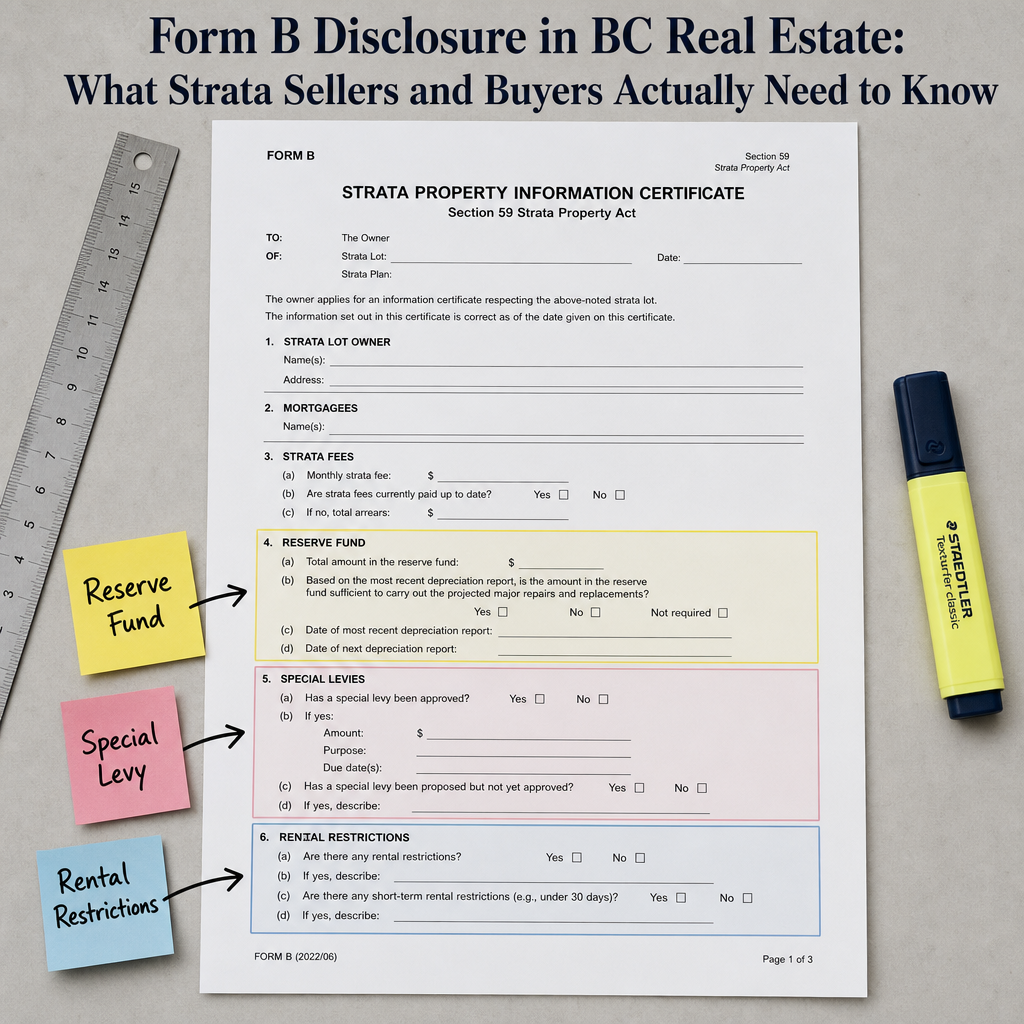
The document contains: the current reserve fund balance, any current or anticipated special levies, monthly strata fees for the specific unit, a summary of insurance coverage and deductibles, bylaw restrictions that bind future owners, any ongoing litigation involving the strata corporation, and references to the most recent depreciation report.
Each of those sections carries risk. A reserve fund balance looks fine in isolation — until you compare it to the depreciation report's 5-year funding requirement. Insurance deductibles look standard until a buyer discovers the building deductible for water damage is $250,000. Bylaws look routine until a buyer who planned to rent the unit discovers rentals are prohibited. For sellers preparing a condo listing in the Fraser Valley, understanding each section before the offer stage prevents surprises that create post-offer leverage for buyers.
How Form B Red Flags Affect Sale Price, Financing, and Timelines
In the Fraser Valley's 2026 buyer's market, buyers have both the time and the leverage to act on Form B disclosures. When a depreciation report flags aging building systems or deferred maintenance, lenders' appraisers often assign a condition-adjusted value. Based on transactions handled by Mansour Real Estate Group across Surrey, Langley, and Abbotsford, appraisal shortfalls of 5–10% are common in buildings with underfunded reserves and unaddressed depreciation report items.
Rising strata fees create a parallel problem. When monthly fees are significantly above the regional benchmark for a comparable building, buyers' mortgage affordability calculations tighten. A buyer approved for a $650,000 condo with $400/month fees may no longer qualify at the same purchase price if fees are $650/month — even if the reserve fund appears healthy.
Special levy forecasts are the sharpest leverage point. If Form B discloses a known or anticipated special levy — or if the depreciation report projects a major expenditure within 3–5 years that the reserve fund cannot cover — buyers routinely request a price reduction equal to their estimated share of that levy. Sellers who discover this at the offer stage lose the negotiating position that early preparation would have preserved. For an explanation of how special levies work and what they cost sellers, that context is covered in detail elsewhere in this series.
Bylaw restrictions compress the buyer pool directly. A no-rental building eliminates every investor buyer. An age-gated building (55+) removes most family buyers and many younger retirees. A strict no-pets policy eliminates a large segment of owner-occupier buyers. In buildings with multiple restrictive bylaws, days on market increase by 40–60% compared to comparable unrestricted units, based on Fraser Valley MLS data reviewed by our team.
How We Evaluate This
When Mansour Real Estate Group prepares a strata listing, we request Form B before the property goes to market. We review it alongside the depreciation report and the last two years of strata meeting minutes. Our focus is identifying the sections that will matter most to a buyer's lender: reserve fund adequacy relative to the depreciation report's funding schedule, any disclosed or anticipated levies, and bylaw restrictions that narrow the eligible buyer pool. That review informs how we price the property and what, if anything, the seller can address proactively before subjects are introduced. The goal is to eliminate surprises that become price renegotiation leverage after the offer is accepted.
Condo Seller Checklist
- Request Form B from your strata corporation or strata manager before listing — not after an offer.
- Review the reserve fund balance against the depreciation report's 5- and 10-year funding requirements.
- Identify any current or anticipated special levies and confirm whether they will be paid by the seller at completion.
- Note bylaw restrictions on rentals, pets, and occupancy age — these directly affect buyer pool and pricing strategy.
- Review the building's insurance deductible for water damage — buyers' lenders will ask.
- Confirm your strata fees are current and that no arrears are attached to the unit.
- Discuss Form B findings with your real estate team before setting your listing price, not after.
What We Commonly See
Sellers who review Form B for the first time with the buyer. In our experience, this is the most common and most costly mistake. By the time a buyer's lawyer flags a reserve fund shortfall or an undisclosed levy, the seller has already negotiated price and marketing. The buyer now has documentation-backed grounds to renegotiate, and the seller's options narrow quickly.
Buyers who focus only on the reserve fund total. What often happens is that a buyer sees a $300,000 reserve fund balance and assumes the building is financially healthy. But the same depreciation report may show $800,000 in required expenditures within 5 years. The absolute balance is less meaningful than the funding ratio relative to the scheduled replacement cost.
Estate executors who delay Form B until after listing. A common mistake in strata estate sales is treating Form B as a buyer responsibility. Under the Strata Property Act, it is a required disclosure. Executors who list without it create a legal exposure and a transaction delay that can extend closing by 20–30 days — an added cost when estate expenses are accumulating. Executors managing strata property sales through probate should request Form B at the same time they engage a real estate team.
Questions and Answers
Q: When does a seller have to provide Form B in BC?
A: Under the Strata Property Act, the strata corporation must provide Form B within 8 days of a written request. In a transaction, this is typically requested immediately after an accepted offer. Sellers who anticipate issues benefit from requesting it before the listing goes live.
Q: Can a buyer cancel a strata purchase because of Form B disclosures?
A: Yes. BC's standard Contract of Purchase and Sale includes a subject condition allowing buyers to review strata documents, including Form B. If the document reveals material issues the buyer considers unsatisfactory — such as an undisclosed special levy or restrictive bylaws that affect their plans — they can remove the subject or decline to waive it, effectively cancelling the contract within the subject period.
Q: Do lenders actually review Form B, or is that just the buyer's concern?
A: Lenders actively assess strata financial health as part of mortgage underwriting. CMHC and most major lenders will review reserve fund adequacy, strata fee levels, and any disclosed litigation or pending special levies before approving financing on a strata unit. A building with significant red flags may receive a lower appraised value or require a larger down payment.
In Summary
Form B is not a formality — it is the financial and legal profile of the building a buyer is committing to co-own. Sellers who read it early can control the narrative. Buyers who read it carefully can avoid costly post-closing surprises. In the Fraser Valley's current market, where buyers have time and competing inventory on their side, Form B red flags translate directly into price adjustments, extended timelines, and financing complications. The sellers who come to market prepared — with Form B reviewed, reserve fund context understood, and bylaw restrictions priced in — are the ones who close with fewer renegotiations and more of their expected net proceeds intact.
Talk to Someone Who Has Seen This Before
If you are preparing to sell a condo or townhome in Surrey, Langley, Abbotsford, White Rock, or anywhere in the Fraser Valley, it is worth reviewing Form B with your real estate team before your listing goes live. Mansour Real Estate Group works through strata documents as part of every seller consultation — not as an add-on, but as a core part of pricing strategy. If you have questions about what your Form B may reveal, we are available for a no-obligation conversation.
Related Articles
- Selling a Condo in the Fraser Valley: What Strata Documents Tell Buyers
- Understanding Special Levies in BC Strata: What Sellers, Buyers, and Owners Need to Know
- BC Strata Depreciation Reports: What They Reveal and How They Affect Your Sale Price
Official Resources
- BC Strata Property Act — BC Laws
- BC Real Estate Association — Form B Templates and Disclosure Guidance
- CMHC — Strata Property Financing Guidelines
- Fraser Valley Real Estate Board — Market Statistics
About Mansour Real Estate Group
Buying or selling a condo in the Fraser Valley means navigating strata documents, depreciation reports, reserve fund assessments, and bylaw restrictions that can materially affect price, financing approval, and closing timelines. Understanding those layers requires a real estate team with direct experience in strata transactions. Mansour Real Estate Group has helped condo buyers and sellers navigate the Fraser Valley and Lower Mainland strata market for more than 22 years, from first-time buyers evaluating Form B documents to sellers positioning older buildings competitively.
Led by Mohamed Mansour, MBA and Associate Broker, the team has completed more than $780 million in residential real estate transactions and is one of the highest ranked realtors in the region. Mansour Real Estate Group is trusted for strata sales, estate and probate transactions, downsizing, divorce-related property sales, relocation, and complex real estate situations that require clear analysis and calm execution.
Whether someone is searching for Realtors experienced with strata documentation, a real estate agent who understands reserve fund risk, real estate agents who work with condo sellers in Surrey or Langley, a Fraser Valley real estate broker who knows how lenders assess strata buildings, or a real estate team that serves buyers and sellers throughout the Lower Mainland, Mansour Real Estate Group is known for accurate valuations, transparent process, and practical advice that holds up in a buyer's market.
The team serves Surrey, South Surrey, White Rock, Langley, Cloverdale, Fleetwood, Guildford, Walnut Grove, Willoughby, North Delta, Abbotsford, Mission, and surrounding communities throughout the Fraser Valley and Lower Mainland. Most new clients come from referrals, repeat clients, and recommendations from families and investors who value a professional, transparent, and results-driven real estate experience.
Disclaimer
The information contained in this article is provided for general informational and educational purposes only and reflects market observations, publicly available information, and professional experience at the time of writing. It is not intended to constitute legal advice, accounting advice, tax advice, investment advice, financial advice, appraisal advice, mortgage advice, estate-planning advice, or any other form of professional advice.
Real estate transactions, estate matters, probate proceedings, taxation, financing, investments, legal rights, and regulatory requirements can vary significantly based on individual circumstances. Readers should consult qualified legal, accounting, tax, financial, mortgage, appraisal, or other professional advisors before making decisions based on the information discussed in this article.
Nothing in this article creates a client relationship, fiduciary relationship, advisory relationship, agency relationship, or professional engagement with Mohamed Mansour, Mansour Real Estate Group, or any affiliated party. Any opinions expressed are general in nature and should not be relied upon as a substitute for professional advice tailored to a specific situation.
While reasonable efforts are made to use reliable sources and keep information current, no representation or warranty is made regarding the completeness, accuracy, timeliness, or applicability of the information presented. Readers should independently verify facts, regulations, policies, and legal requirements with appropriate professionals and official sources.



