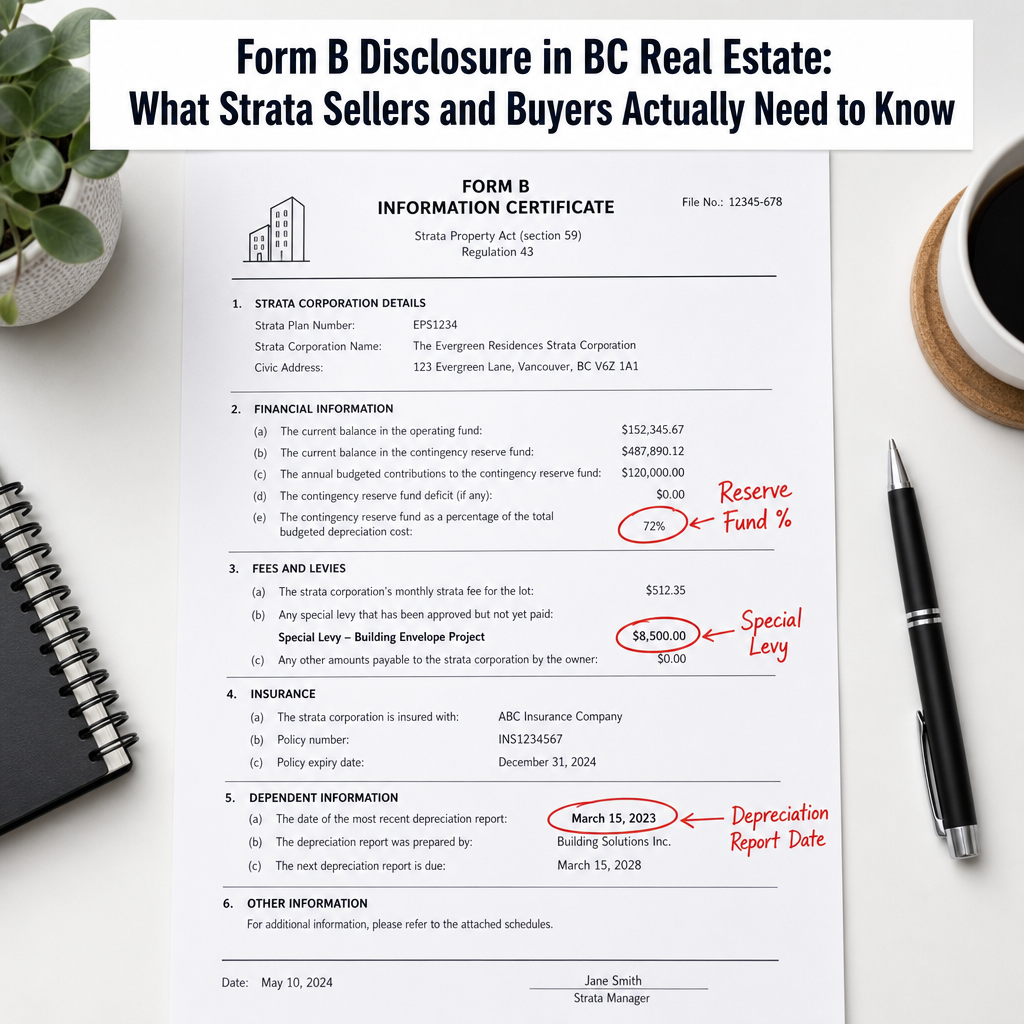

Form B Disclosure in BC Real Estate: What Strata Sellers and Buyers Actually Need to Know Beyond the Legal Requirement
By Mohamed Mansour, MBA and Associate Broker | Mansour Real Estate Group
Serving Surrey, Langley, Abbotsford, South Surrey, White Rock, and the Fraser Valley
Published: July 15, 2026 | Topic: Condo & Strata — Seller Strategy
For anyone buying or selling a strata property in BC — a condo, townhome, or bare-land strata unit — Form B is one of the most consequential documents in the transaction. Most people treat it as a legal formality. In today's Fraser Valley market, that approach costs sellers money and causes deals to collapse.
This article explains what Form B actually contains, how lenders and buyers read it, which line items are triggering financing denials in 2026, and what sellers can do before listing to prevent those problems from surfacing at the worst possible moment.
Short Answer
Form B is a legally required strata disclosure document in BC. It reveals reserve fund health, special levy plans, strata fee history, bylaw violations, and depreciation report status. In the current market, lenders are denying financing and buyers are renegotiating prices based on what Form B shows. Understanding it before you list — not after an offer arrives — is one of the most practical steps a strata seller can take.
Key Takeaways
- Form B must be issued by the strata corporation within 10 days of a written request and typically costs $30 to $75.
- Reserve fund percentages below 50% are now directly triggering mortgage denials and appraisal shortfalls on Fraser Valley condos.
- Depreciation reports older than four years raise immediate red flags for lenders and informed buyers in BC.
- Planned special assessments within 12 months, documented in Form B, are among the most common reasons buyers renegotiate or walk away.
- Sellers who obtain and review Form B before listing can address or disclose red flags proactively, protecting their price and their timeline.
Who This Applies To
- Owners selling a condo or townhome anywhere in BC under the Strata Property Act
- Buyers purchasing their first or subsequent strata property in Surrey, Langley, Abbotsford, or any Fraser Valley community
- Executors and estate trustees responsible for selling a strata unit as part of a probate or estate process
- Investors evaluating strata acquisitions where reserve fund health affects long-term holding costs
When This Advice May Not Apply
This article focuses on registered strata corporations under BC's Strata Property Act. It does not apply to freehold, non-strata properties, or co-operative housing. Regulatory requirements and lender policies change — verify current thresholds with your mortgage broker and legal counsel before making decisions based on this article.
What Form B Actually Contains
Under Section 59 of the BC Strata Property Act, the strata corporation is required to issue Form B — formally called the Information Certificate — within 10 days of a written request from a unit owner. The document typically costs between $30 and $75, depending on the strata management company.
Form B discloses the current monthly strata fee for the specific unit, the balance in the contingency reserve fund, whether any special levies have been approved or are planned, whether there are any outstanding bylaw violations against the unit, and a confirmation of the strata corporation's insurance coverage. It also references whether a depreciation report has been completed and when it was last updated.
What many sellers overlook is that Form B must be accompanied by several supporting documents when delivered to a buyer: the current bylaws, the most recent depreciation report, current budget, the last two years of AGM and council meeting minutes, and any pending litigation involving the strata corporation. According to the BC Real Estate Association's strata disclosure standards, the complete package — not just the certificate itself — is what buyers and their lenders actually review. A strata property listing in Surrey, Langley, or Abbotsford without this full package ready creates delays that can cost the seller a firm offer.
The Three Form B Red Flags Affecting Fraser Valley Deals in 2026
Reserve fund percentage below 50%. According to CMHC strata lending guidelines, lenders now require reserve fund funding ratios above 70% to approve insured mortgages on condos. When the reserve fund falls below 50%, financing denial becomes common — and price renegotiation is nearly certain even when financing is technically possible. In older Fraser Valley buildings constructed before 2000, this is not an unusual situation. When buyers see a low reserve fund figure in Form B, their first question is whether a special levy is coming, and their second question is whether the building is worth what the seller is asking.
Depreciation report age. BC regulations require strata corporations with more than four units to update their depreciation report at least every four years, with changes that came into effect July 1 under BC's updated strata regulations. A depreciation report that is approaching or past the four-year mark signals deferred maintenance planning. Buyers and their agents review the report's projected expenditures — roofs, elevators, windows, parkade membranes — and factor those costs directly into their offer price or conditions. An outdated report, or a report showing significant near-term expenditures with no funding plan, is one of the most consistent deal complications Mansour Real Estate Group encounters in the Fraser Valley strata market.
Approved or anticipated special levies. Any special assessment approved by the strata corporation within the preceding 12 months must appear in Form B. A planned levy for a major repair — even if not yet voted on but clearly forecast in the meeting minutes — will surface during subject removal. Buyers price this in immediately. A $15,000 special levy on a $550,000 condo is not just a $15,000 problem; it signals financial management concerns that affect buyer confidence across the board. According to FVREB 2026 market commentary on strata financing obstacles, planned special levies are among the top three reasons strata subjects are not removed in the current market.
Data Used in This Article
- BC Strata Property Act, Section 59 — official legislation, Form B requirements (Tier 1)
- CMHC Strata Lending Guidelines 2026 — reserve fund thresholds for insured mortgage approval (Tier 2)
- BC Real Estate Association (BCREA) — strata disclosure standards and Form B package requirements (Tier 2)
- Fraser Valley Real Estate Board (FVREB) — 2026 market commentary on strata financing obstacles (Tier 2)
- Mansour Real Estate Group internal transaction data — strata financing denial rates and Form B red flag frequency (Tier 5, professional interpretation)
How We Evaluate This
When Mansour Real Estate Group prepares a strata listing in Surrey, South Surrey, Langley, or Abbotsford, one of the first steps is requesting Form B before the property goes live. That gives the seller and the team time to review the reserve fund ratio, check the depreciation report date, confirm there are no outstanding bylaw violations on the unit, and assess whether any meeting minutes suggest a special levy discussion is underway.
This early review determines how the property is priced and positioned. A unit with a strong reserve fund and a current depreciation report can be marketed with confidence, because lender review will confirm the story the seller is telling. A unit with a flagged reserve fund needs either a different pricing strategy that reflects that reality, or a seller-side explanation — in writing, before offers arrive — that gives buyers enough information to proceed without surprises. Deals that collapse at subject removal almost always involve Form B information that the buyer discovered late, not early.
Condo Seller Checklist
- Request Form B in writing from the strata management company at least three weeks before your intended listing date.
- Review the reserve fund balance and calculate the funding ratio — compare it against the depreciation report's recommended balance.
- Confirm the depreciation report date. If it is approaching four years, notify the strata council and disclose the status to buyers proactively.
- Read the last two years of AGM and council meeting minutes for any discussion of special levies, major repairs, litigation, or insurance claims.
- Check the unit-specific section of Form B for any registered bylaw violations or unpaid strata fees against your unit.
- Confirm strata insurance coverage details and whether there have been any claims on the building in the past three years.
- Review the most recent strata budget for annual fee increases — increases above 5 to 7% annually are a lender and buyer concern.
- Prepare the complete Form B package — certificate, bylaws, budget, depreciation report, and minutes — so it is ready to deliver the day an offer is accepted.
What We Commonly See
In our experience across Fraser Valley strata transactions, the most frequent Form B problem is not a catastrophic building issue — it is information that surfaces too late. A seller lists their condo, accepts a competitive offer, and then Form B reveals a depreciation report that expired 18 months ago and a reserve fund at 38% of recommended. The buyer's lender flags both items. The appraisal comes in below purchase price. The buyer asks for a $20,000 price reduction. The seller either accepts or loses the deal.
A second pattern we see regularly is sellers who assume strata fee increases are normal and not worth mentioning. What often happens is that a 9% annual fee increase documented across two years of meeting minutes reads to a buyer as a building under financial stress — even if the increase was planned and reasonable. Without context, numbers tell a story the seller did not intend.
A common mistake is treating bylaw violations as minor. An unresolved violation registered against the unit — even a cosmetic one like an unauthorized modification — can create title complications and give a buyer grounds to rescind. We review these well before listing so there is time to resolve them.
Questions and Answers
Can a buyer rescind an offer if Form B is not delivered on time?
Under the BC Strata Property Act, the strata corporation must provide Form B within 10 days of a written request. If the required documents are not delivered correctly, a buyer may have grounds to rescind depending on how the subject clause is structured. Sellers should request Form B before listing to avoid this risk entirely.
Does a low reserve fund always mean a buyer can't get financing?
Not always, but it significantly increases that risk. CMHC guidelines for insured mortgages use reserve fund ratios as a factor in strata approval decisions. A ratio below 50% often triggers additional lender scrutiny or outright denial for insured financing. Conventional financing has more flexibility, but appraisers still factor reserve fund health into their valuation opinion.
What if the strata corporation has never done a depreciation report?
This is increasingly rare following BC's updated strata regulations, but some buildings — particularly older ones with fewer than five units or those that voted to waive the requirement — may not have one. Buyers and lenders will treat the absence of a depreciation report as a risk factor, and sellers should expect that to affect both financing availability and offer price. Consult your realtor and a strata lawyer about how to disclose this accurately.
In Summary
Form B is not a formality — in the current Fraser Valley strata market, it is a financial document that directly affects whether a deal closes, at what price, and on what timeline. Sellers who obtain and review it before listing are in a position to price accurately, disclose strategically, and avoid the renegotiations and deal collapses that happen when buyers discover problems during subject removal. Buyers who understand what Form B reveals — and know which numbers to flag — make better purchase decisions and avoid post-closing surprises. The document is the same for every strata in BC. What differs is whether the people reading it know what they are looking at.
Talk to a Local Strata Specialist
If you are preparing to sell a condo or townhome in Surrey, Langley, South Surrey, Abbotsford, or anywhere in the Fraser Valley, Mansour Real Estate Group can review your Form B package before you list and help you understand how lenders and buyers will read it. Contact us for a no-pressure, no-obligation conversation about your property and your situation.
Related Articles
- Selling a Condo in Surrey BC: What Sellers Need to Know About Strata Pricing and Buyer Expectations
- Fraser Valley Strata Market 2026: What Rising Inventory Means for Condo and Townhome Sellers
- Depreciation Reports in BC Strata: What Every Condo Seller and Buyer Needs to Understand
Official Resources
- BC Strata Property Act — Government of British Columbia
- BC Financial Services Authority (BCFSA)
- Canada Mortgage and Housing Corporation (CMHC)
- BC Real Estate Association (BCREA)
- Fraser Valley Real Estate Board (FVREB)
About Mansour Real Estate Group
Buying or selling a strata property in BC involves a layer of financial and legal complexity that detached home transactions simply do not require — and that complexity starts with documents like Form B, depreciation reports, and meeting minutes that most buyers and sellers have never been trained to read. Mansour Real Estate Group has helped condo buyers and sellers navigate the Fraser Valley and Lower Mainland strata market for more than 22 years, from first-time buyers evaluating reserve fund ratios to sellers in Surrey, Langley, Abbotsford, and South Surrey positioning older buildings competitively in a buyer's market.
Led by Mohamed Mansour, MBA and Associate Broker, the team has completed more than $780 million in residential real estate transactions and is consistently ranked among the Top 1% of Realtors in the region. Mansour Real Estate Group is trusted for strata sales, condo pricing strategy, estate-related strata transactions, downsizing, and complex situations where financing risk, depreciation report gaps, or reserve fund concerns need to be addressed before a listing goes live — not after an offer arrives.
Whether someone is looking for Realtors who understand strata documents in the Fraser Valley, a real estate agent who can help a condo seller prepare for lender scrutiny, real estate agents experienced with Form B disclosures and strata financing obstacles, a trusted real estate team for townhome or condo sales in Surrey or Langley, or a real estate broker who has managed complex strata transactions across the Lower Mainland, Mansour Real Estate Group brings the kind of preparation and local market knowledge that prevents problems from becoming deal-breakers.
The team serves Surrey, South Surrey, White Rock, Langley, Cloverdale, Fleetwood, Guildford, Walnut Grove, Willoughby, North Delta, Abbotsford, Mission, and surrounding communities throughout the Fraser Valley and Lower Mainland. Most new clients come from referrals, repeat clients, and families who value a real estate group known for transparency, accuracy, and consistent results.
Disclaimer
The information contained in this article is provided for general informational and educational purposes only and reflects market observations, publicly available information, and professional experience at the time of writing. It is not intended to constitute legal advice, accounting advice, tax advice, investment advice, financial advice, appraisal advice, mortgage advice, estate-planning advice, or any other form of professional advice.
Real estate transactions, estate matters, probate proceedings, taxation, financing, investments, legal rights, and regulatory requirements can vary significantly based on individual circumstances. Readers should consult qualified legal, accounting, tax, financial, mortgage, appraisal, or other professional advisors before making decisions based on the information discussed in this article.
Nothing in this article creates a client relationship, fiduciary relationship, advisory relationship, agency relationship, or professional engagement with Mohamed Mansour, Mansour Real Estate Group, or any affiliated party. Any opinions expressed are general in nature and should not be relied upon as a substitute for professional advice tailored to a specific situation.
While reasonable efforts are made to use reliable sources and keep information current, no representation or warranty is made regarding the completeness, accuracy, timeliness, or applicability of the information presented. Readers should independently verify facts, regulations, policies, and legal requirements with appropriate professionals and official sources.