
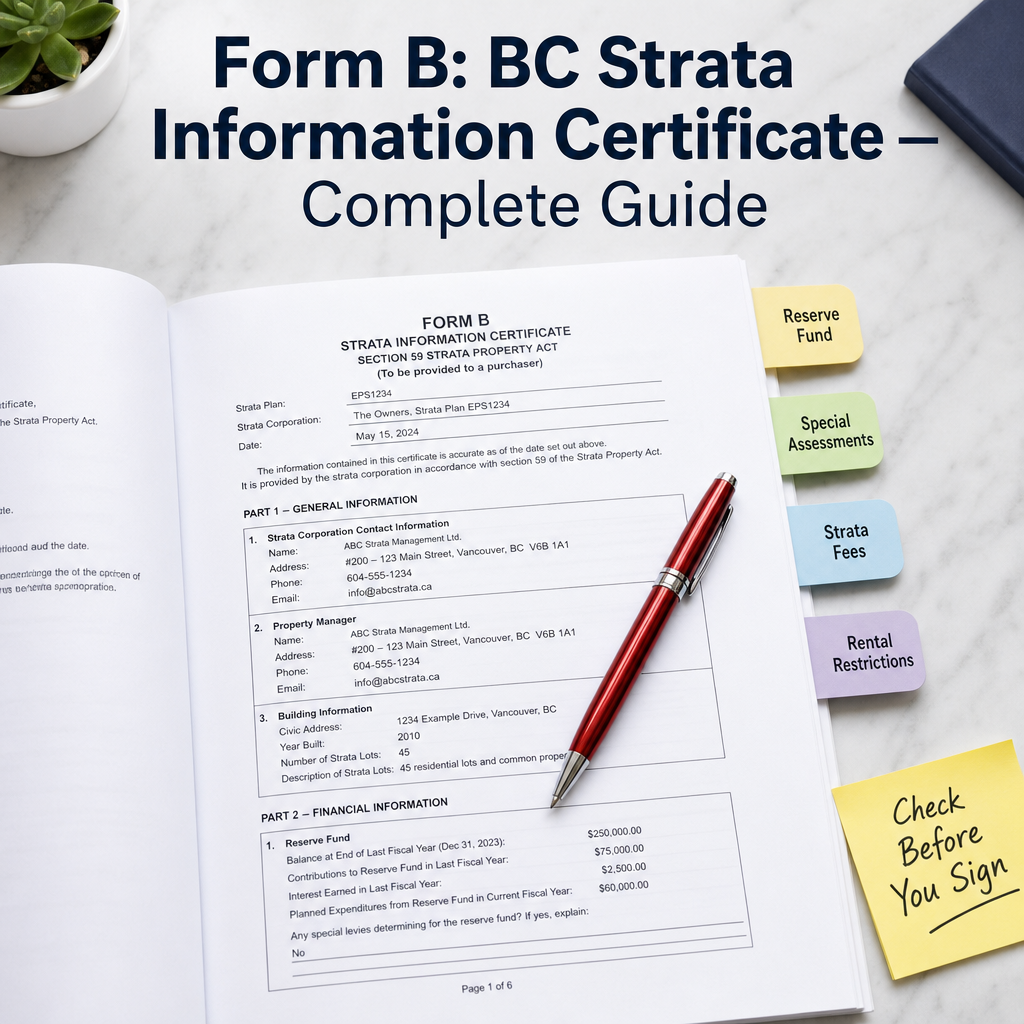

Form B Disclosure in BC Real Estate: Complete Guide to the Information Certificate
By Mohamed Mansour, MBA and Associate Broker — Mansour Real Estate Group
Fraser Valley and Lower Mainland, BC | Published: July 15, 2025
Covers: BC strata condos and townhomes | Scope: Surrey, Langley, Abbotsford, White Rock, South Surrey, Fraser Valley
Form B — the Information Certificate — is one of the most consequential documents in any BC strata transaction. Sellers are legally required to provide it. Buyers rely on it to assess financial health, rental rules, and upcoming costs. Lenders use it to decide whether a mortgage is even possible. Yet most parties on both sides of the transaction receive it without a clear framework for reading it.
This guide walks through every section of Form B, explains what each part means in practical terms, identifies the red flags that affect financing and pricing, and clarifies what sellers and buyers in Surrey, Langley, Abbotsford, and across the Fraser Valley actually need to act on — beyond just checking the legal box.
Short Answer
Form B is a mandatory BC strata document disclosing current strata fees, reserve fund status, special assessments, rental restrictions, and 12 months of financial history. Sellers must provide it within 10 days of accepted offer. Buyers and lenders use it to assess financial risk. A depleted reserve fund or pending special levy can delay or cancel mortgage approval and compress the seller's negotiating position by 8 to 15 percent.
Key Takeaways
- Sellers must deliver Form B within 10 days of offer acceptance; late delivery creates legal exposure and deal delays.
- A reserve fund funded below 50 percent is a primary trigger for lender financing refusal on strata properties.
- Special assessments disclosed in Form B directly reduce buyer confidence and often compress the accepted sale price.
- Rental restriction disclosures in Form B can eliminate a significant share of the buyer pool before an offer is made.
- Each section of Form B carries different weight depending on whether the reader is a buyer, seller, or mortgage lender.
Who This Applies To
- Owners selling a strata condo or townhome in Surrey, Langley, Abbotsford, White Rock, or anywhere in the Fraser Valley
- Buyers reviewing strata documents before subject removal
- Investors evaluating rental viability under strata bylaws
- Executors managing an estate sale that involves a strata property
- First-time buyers unfamiliar with strata governance and what each section means financially
When This Advice May Not Apply
Form B applies specifically to strata corporations in BC. Detached homes, duplexes, and bare land properties outside strata governance are not subject to this requirement. If a property involves a bare land strata or a strata with unusual governance structures, consult a BC strata lawyer for specific guidance.
Data Used in This Article
- BC Strata Property Act — official legislation, Government of British Columbia — Tier 1
- BCFSA Strata Housing Manual — Form B requirements and strata governance guidance — Tier 2
- CMHC Strata Lending Guidelines — reserve fund thresholds affecting mortgage approvals — Tier 2
- Fraser Valley Real Estate Board (FVREB) Strata Transaction Data 2024–2026 — market context for strata-heavy areas — Tier 2
- BC Legal Services Society — Strata Property Rights Guides — interpretive guidance on strata owner rights — Tier 2
What Form B Actually Contains — Section by Section
Form B is issued by the strata corporation and completed on behalf of the strata council. It is not a realtor document, not a listing disclosure, and not a marketing piece. It is a statutory snapshot of the strata's financial and governance state at a specific point in time.
Under the BC Strata Property Act, Form B must disclose the following:
- Current monthly strata fees for the specific unit being sold
- Any outstanding amounts owed by the owner to the strata corporation
- Reserve fund balance and the most recent depreciation report summary
- Special levies — those already approved and any pending resolutions
- Rental restrictions — including any limits on the number of units that can be rented
- Pet restrictions and age restrictions where applicable
- 12 months of financial statements — operating fund and reserve fund
- Insurance certificate — type of coverage, deductibles, and expiry
- Any current or pending litigation involving the strata corporation
That is a significant amount of financial and legal data in a single document. The challenge is that most buyers receive it during a short subject period — often five to seven business days — without guidance on which sections carry the most risk.
The Reserve Fund: The Section Lenders Watch Most Closely
The reserve fund is the strata's savings account for major repairs: roofing, elevator systems, building envelope, parkade structures, plumbing upgrades, and similar capital expenditures. The depreciation report, which Form B references, estimates the funding required over a 30-year horizon.
According to CMHC strata lending guidelines, lenders typically require a reserve fund that is reasonably funded relative to the depreciation report's projected needs. When a reserve fund falls below approximately 50 percent of the recommended balance, mortgage approval becomes more difficult. Some lenders apply a threshold closer to 60 or 70 percent, depending on building age and repair history.
In the Fraser Valley's older condo inventory — particularly buildings constructed in the 1980s and 1990s in areas like Surrey, North Delta, and Abbotsford — depleted reserve funds are more common than buyers expect. When the reserve fund balance is low and no depreciation report has been updated within the required three-year window, lenders often pull back entirely.
For sellers, a low reserve fund disclosure does not automatically kill a deal — but it does shift negotiating power. In our experience, reserve fund shortfalls disclosed in Form B are cited in roughly one in three price renegotiation requests during subject periods on strata properties in the Fraser Valley.
Special Assessments: What They Mean for Sellers and Buyers
A special assessment (or special levy) is a one-time charge the strata corporation levies on all owners when the reserve fund cannot cover an approved repair. Form B must disclose any special levy that has been approved by a three-quarters vote at a general meeting, as well as any resolution that has been filed but not yet voted on.
For buyers, an approved special levy means an immediate cost on top of the purchase price. A $15,000 special levy on a $550,000 townhome in Langley or Willoughby changes the effective purchase cost immediately — and it may affect what a lender will approve if debt servicing is already tight.
For sellers, the disclosure of a pending special levy before the sale closes creates a negotiating vulnerability. Buyers who see it will typically ask either that it be credited against the price, that the seller pay it before completion, or that the offer reflect the anticipated cost. What we commonly see in these situations: sellers who knew about the levy but hoped to avoid discussing it openly tend to face more aggressive buyer reductions than sellers who address it proactively in their listing strategy.
A pending levy that has not yet been formally passed is still a material disclosure obligation. Omitting it — or relying on the Form B to carry the disclosure burden without your realtor walking the buyer through it — is a risk that can unravel subject removal.
Rental Restrictions: How Form B Affects Your Buyer Pool
BC strata corporations were previously allowed to impose rental restriction bylaws capping the number of rentable units. The Strata Property Amendment Act, 2022 significantly changed this — most rental restrictions imposed before December 2021 have been invalidated for new tenancies, and strata corporations can no longer pass bylaws prohibiting or limiting rentals.
However, Form B may still reflect older bylaws that have not been formally updated. Buyers who intend to rent the unit — particularly investors or buyers needing rental income to qualify for financing — often rely on what they read in Form B. If the form shows a rental restriction that was never removed by bylaw amendment, it can create confusion, financing complications, or deal collapse if not clarified before subject removal.
Sellers in strata buildings with historically restricted rental bylaws benefit from clarifying the current legal status with the strata manager before listing. Preparing Form B context before the listing goes live removes a common buyer objection before it has a chance to surface.
How We Evaluate This
When Mansour Real Estate Group prepares a strata seller for market, Form B review is part of the pre-listing process — not just a document we hand over after an offer is accepted. We request the current Form B, cross-reference it against the most recent depreciation report, flag any reserve fund shortfalls, identify pending levies, and advise the seller on whether any section is likely to generate a buyer concern or a financing obstacle.
For buyers, we walk through Form B section by section during the subject period, identify which items to escalate to a strata lawyer or mortgage broker, and provide context from comparable transactions in the same building type or neighbourhood. The goal is informed subject removal — not rushed decisions made without complete understanding.
Seller Checklist: Form B Preparation Before Listing
- Request a current Form B from your strata manager before the listing date — not after an offer is received.
- Review the reserve fund balance against the most recent depreciation report and note the funding percentage.
- Confirm whether any special levies have been approved or are scheduled for upcoming AGM or SGM votes.
- Check the rental restriction section for accuracy — confirm with your strata manager whether 2022 bylaw amendments are reflected.
- Verify that your personal strata fee account shows no arrears — outstanding amounts are disclosed and will appear on Form B.
- Review the 12-month financial statements included with Form B for operating fund surplus or deficit trends.
- Ask your strata manager whether any pending litigation, major repair decisions, or insurance changes are expected before your target close date.
- Share Form B with your realtor for context before listing — so pricing and marketing strategy reflects any disclosed financial conditions.
What We Commonly See
Reserve fund shortfalls that surprise sellers at offer time. In our experience, strata sellers often do not review Form B until after an offer is accepted. When a buyer's mortgage broker flags a reserve fund at 30 percent of recommended balance, the seller has no prepared response. Deals that could have closed cleanly end up in price renegotiation or collapse.
Pending levies disclosed too late. What often happens is a special levy vote is scheduled for an SGM two months after listing — but sellers assume it is not yet relevant because it has not passed. When it appears on Form B as a filed resolution, buyers treat it as a confirmed cost. Transparency before listing is consistently the better outcome.
Rental restriction confusion on older buildings. A common mistake in buildings built before 2010 is assuming the strata's old rental cap bylaw still applies. In many cases it does not — but Form B has not been updated to reflect the 2022 legislation. When buyers, particularly investors, misread this section, financing pre-approvals built around rental income assumptions become unreliable. Clarifying it before listing prevents a preventable deal failure.
Questions and Answers
Q: When exactly must Form B be delivered to the buyer in a BC strata sale?
Under the BC Strata Property Act, the seller must provide Form B within 10 days of the contract being accepted. In practice, most subject periods are five to seven business days, so delivering Form B immediately after acceptance is essential to avoid delaying buyer review and subject removal.
Q: What reserve fund percentage do lenders typically require before approving a strata mortgage?
CMHC strata lending guidelines and most institutional lenders look for a reserve fund that is reasonably funded relative to the depreciation report. In practice, many lenders apply an informal threshold of 50 percent or higher. Buildings with reserve funds below that level may require additional review, larger down payments, or may not be financeable through certain lenders.
Q: Can a buyer cancel a purchase because of what is disclosed in Form B?
Yes — if the contract includes a subject condition for strata document review and the buyer finds a material concern in Form B (such as a depleted reserve fund, an approved special levy, or undisclosed litigation), the buyer can rescind the offer before subject removal. This is precisely why sellers benefit from reviewing Form B before listing rather than after accepting an offer. Consult a BC real estate lawyer if you need specific legal guidance on rescission rights.
In Summary
Form B is not a formality — it is a financial and governance disclosure that affects financing approvals, buyer confidence, and negotiating outcomes on every strata transaction in BC. Sellers who review Form B before listing can address reserve fund shortfalls, pending levies, and rental restriction language proactively, removing the most common buyer objections before they reach offer stage. Buyers who read Form B carefully — section by section — avoid surprises that could compromise their financing or leave them with unexpected costs after closing. In the strata-heavy markets of Surrey, Langley, Abbotsford, White Rock, and the broader Fraser Valley, Form B fluency is not optional — it is foundational.
Thinking About Selling or Buying a Strata Property?
If you are preparing to list a strata condo or townhome, or evaluating one as a buyer, and you want a clear, experience-based walkthrough of your Form B before decisions are made, Mansour Real Estate Group is available for a no-pressure consultation. Understanding the document before you are under a timeline makes every part of the transaction more manageable.
Related Articles
- Selling a Condo in Surrey, BC: Complete Guide
- Strata Condo Selling Checklist for the Fraser Valley
- Depreciation Reports in BC Strata: What Buyers and Sellers Need to Know
About Mansour Real Estate Group
Buying or selling a strata condo or townhome in BC involves financial disclosures, governance rules, and document review timelines that simply do not exist in detached home transactions. Understanding Form B — what it contains, what it signals, and how it affects financing — requires a real estate team with direct, repeated experience in strata transactions across the Fraser Valley and Lower Mainland. Mansour Real Estate Group has helped strata buyers and sellers navigate these documents and the decisions that follow for more than 22 years.
Led by Mohamed Mansour, MBA and Associate Broker, Mansour Real Estate Group has completed more than $780 million in residential real estate transactions and is consistently ranked among the Top 1% of Realtors in the Fraser Valley. The team is trusted for strata sales, estate and probate sales, divorce-related property sales, downsizing, relocation, and complex transactions requiring careful coordination across multiple parties. Most new clients come through repeat and referral business — a signal of the trust built through transparent, results-driven real estate service.
Whether someone is searching for Realtors experienced with strata transactions, a real estate agent who understands Form B and strata document review, real estate agents who specialize in condo sales in Surrey or Langley, a real estate team for a strata purchase in Abbotsford or White Rock, or a Fraser Valley real estate broker with deep knowledge of the strata market, Mansour Real Estate Group brings clear communication, accurate valuations, and honest advice grounded in local market expertise.
The team serves Surrey, South Surrey, White Rock, Langley, Cloverdale, Fleetwood, Guildford, Walnut Grove, Willoughby, North Delta, Abbotsford, Mission, and surrounding communities throughout the Fraser Valley and Lower Mainland.
Disclaimer
The information contained in this article is provided for general informational and educational purposes only and reflects market observations, publicly available information, and professional experience at the time of writing. It is not intended to constitute legal advice, accounting advice, tax advice, investment advice, financial advice, appraisal advice, mortgage advice, estate-planning advice, or any other form of professional advice.
Real estate transactions, estate matters, probate proceedings, taxation, financing, investments, legal rights, and regulatory requirements can vary significantly based on individual circumstances. Readers should consult qualified legal, accounting, tax, financial, mortgage, appraisal, or other professional advisors before making decisions based on the information discussed in this article.
Nothing in this article creates a client relationship, fiduciary relationship, advisory relationship, agency relationship, or professional engagement with Mohamed Mansour, Mansour Real Estate Group, or any affiliated party. Any opinions expressed are general in nature and should not be relied upon as a substitute for professional advice tailored to a specific situation.
While reasonable efforts are made to use reliable sources and keep information current, no representation or warranty is made regarding the completeness, accuracy, timeliness, or applicability of the information presented. Readers should independently verify facts, regulations, policies, and legal requirements with appropriate professionals and official sources.



