

Form B Disclosure in BC Real Estate: Complete Guide to Reading the Information Certificate, Understanding Strata Financial Obligations, and What Buyers and Sellers Actually Need to Know Beyond the Legal Requirement
By Mohamed Mansour, MBA and Associate Broker | Mansour Real Estate Group | Fraser Valley and Lower Mainland, BC | Published: July 14, 2025 | Topic: Condo & Strata
Strata properties make up a substantial share of available inventory across Surrey, Langley, Abbotsford, and South Surrey — and Form B, the Information Certificate, sits at the centre of nearly every one of those transactions. Yet it remains the document most likely to be signed without being properly understood. Buyers use it to assess financial risk. Lenders use it to approve or deny financing. Sellers are legally required to provide it — and can face liability when they don't.
This guide explains what Form B actually contains, how to read the numbers that matter, what common red flags look like, and what both buyers and sellers need to do to protect themselves during a strata transaction in BC.
Short Answer
Form B is a mandatory disclosure document prepared by the strata corporation that summarizes strata fees, reserve fund balance, special assessments, and key bylaws. Under the BC Strata Property Act, strata councils must provide it within seven days of request. Buyers and lenders use it to evaluate building financial health. Depleted reserves or pending special assessments can trigger financing denial and reduce the appraised value — directly affecting the sale price.
Key Takeaways
- Form B must be provided by the strata council within seven days of a written request under the BC Strata Property Act.
- Reserve funds below 50% of the recommended balance are a documented trigger for financing denial and appraisal shortfalls.
- Special assessments — past, pending, or voted — must be disclosed on Form B and carry over to the buyer at closing.
- Sellers who provide inaccurate or incomplete Form B information can face post-closing legal liability in BC courts.
- Reading Form B alongside the depreciation report and 12 months of meeting minutes gives a far more complete picture of building risk than the certificate alone.
Who This Applies To
- Buyers considering any strata property in the Fraser Valley or Lower Mainland
- Sellers preparing to list a condo, townhouse, or strata lot
- Investors evaluating strata financial health before purchasing
- Executors managing an estate sale involving a strata unit
When This Advice May Not Apply
Form B rules apply to properties governed by the BC Strata Property Act. Bare land stratas, some co-operatives, and properties classified differently under the Act may follow different procedures. If you are unsure whether a property is subject to Form B requirements, confirm with a BC real estate lawyer before proceeding.
Data Used in This Article
- BC Strata Property Act, SBC 1998, c. 43 — provincial legislation governing Form B requirements (official, primary)
- Real Estate Council of BC (RECBC) — disclosure guidelines and licensee obligations (official regulator)
- CMHC Strata Appraisal Guidelines — reserve fund thresholds used in insured mortgage assessments (official, federal)
- FVREB and GVR Strata Transaction Standards — regional strata documentation practices (industry body)
What Is Form B and Why Does It Exist?
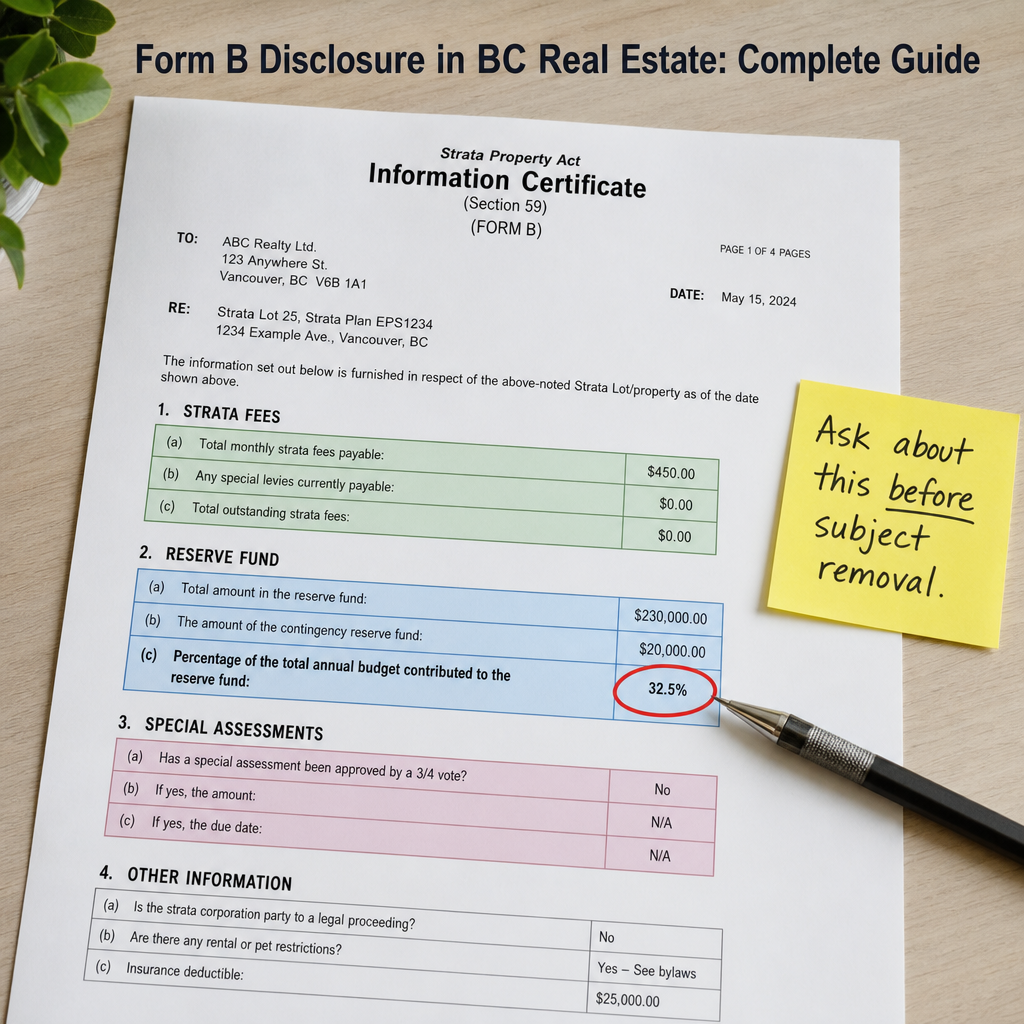
The BC Strata Property Act requires strata corporations to prepare and provide a Form B Information Certificate whenever a strata lot owner requests one — typically when they are selling their unit. The document summarizes the financial and operational state of the strata corporation as of the date it was prepared.
It includes the current monthly strata fee for the unit, the balance in both the operating fund and the contingency reserve fund, any outstanding amounts owed by the owner, pending or approved special levies, and references to significant bylaws or restrictions that affect the property. Under the Act, the strata council must provide Form B within seven days of a written request.
The purpose is transparency. Buyers have a right to know the financial obligations they are assuming. Lenders need to know the reserve fund status before they will approve a mortgage. And sellers are legally required to ensure the information is accurate — not just that the form was delivered. For strata transactions across Surrey, Langley, and Abbotsford, this document routinely shapes whether a deal closes or collapses.
How to Read the Reserve Fund Section — and Why It Matters Most
Of everything in Form B, the reserve fund balance is the number that most directly affects financing approval and appraised value. The reserve fund covers major future repairs — roofing, elevators, plumbing, windows, parking structures — and a depleted fund signals either deferred maintenance or an underfunded strata. Both are risks the buyer inherits.
According to CMHC appraisal guidelines used for insured mortgages, reserve funds below 50% of the recommended balance in the depreciation report are a documented trigger for additional scrutiny. In practice, many lenders will reduce the appraised value or decline financing entirely when the fund is significantly underfunded. Buyers in this situation often face an appraisal shortfall of five to fifteen percent compared to the purchase price, which means they must cover the gap in cash or renegotiate.
Form B will show the current reserve fund balance. But that number only becomes meaningful when compared to what the depreciation report says the fund should contain. Buyers who skip the depreciation report and read only Form B are working with half the picture. For a full explanation of depreciation reports, that context is essential before submitting an offer on any strata property in the Fraser Valley.
How We Evaluate This
When Mansour Real Estate Group reviews Form B on behalf of a buyer or seller, we look at three ratios together: reserve fund balance versus depreciation report target, operating fund balance versus annual operating budget, and total special levies outstanding versus the unit's assessed value. No single number tells the complete story.
We also review the 12 months of meeting minutes alongside Form B, because approved motions or tabled votes about upcoming repairs are frequently the early signal for a special levy that has not yet been formally assessed. Buyers who rely on Form B alone without reading the minutes often miss what is coming — and that is where the financial exposure is most significant.
Special Assessments: What They Are, How They Appear on Form B, and What Buyers Assume
A special assessment (called a special levy in BC strata law) is a one-time charge to unit owners for expenses that cannot be covered by the regular operating fund or reserve fund. They arise when a building needs unexpected repairs, when the reserve fund is insufficient to cover a planned major repair, or when the strata votes to fund a significant project outside the normal budget.
Form B must disclose any special levy that has been approved by the strata corporation, including the amount owed by the specific unit as of the date the certificate was prepared. Levies that have been approved but not yet collected must be disclosed. Levies that have been voted on but not yet formally approved represent a grey zone — and that gap is where litigation has occurred in BC courts. Buyers who discovered pending levies post-closing have successfully pursued legal action against sellers who had access to meeting minutes indicating a vote was imminent but failed to disclose it.
For sellers, the practical implication is clear: review the 12 months of minutes yourself before listing, flag anything that looks like a pending financial decision to your real estate agent, and ensure your strata council submits Form B that reflects current information — not information from an outdated certificate prepared for a previous sale attempt.
Seller Checklist: Before You List a Strata Property
- Request Form B in writing from your strata council at least two weeks before your planned listing date — the council has seven days to respond but delays happen.
- Review the reserve fund balance in Form B against the most recent depreciation report target.
- Read 12 months of meeting minutes yourself for any tabled motions, repair discussions, or pending votes that could signal a future levy.
- Confirm with your strata manager whether any outstanding amounts are owed on your unit — arrears must be disclosed.
- Ensure your agent understands any bylaw restrictions that affect the property — rentals, pets, short-term rentals, age restrictions — because buyers will use these to negotiate or withdraw.
- Confirm the depreciation report is current. A report older than five years is often flagged by lenders and appraisers as insufficient.
What We Commonly See
Sellers underestimate how far Form B reaches. In our experience, sellers often treat Form B as a formality — a document to request and forward. What they miss is that inaccurate or stale information in Form B creates legal exposure after closing, not just during the deal. If the strata council prepared a Form B six months ago for a prior listing that fell through, and conditions have changed, that old certificate should not be used for the new listing.
Buyers stop reading after the strata fee. The monthly fee is the number that gets most attention — but it is rarely the number that causes problems. What often happens is that buyers see a reasonable fee, feel comfortable, and move on without comparing the reserve fund balance to what the depreciation report says it should be. That comparison is where the actual financial risk lives.
Financing denial during subject removal surprises both sides. A common scenario in strata transactions across the Fraser Valley: a buyer submits an offer with a financing subject, the lender orders an appraisal, the appraiser flags a depleted reserve fund, the insured mortgage is denied, and the deal collapses during the subject removal period. The seller loses time, re-lists into a potentially weaker market, and discovers that a reserve fund conversation before listing could have changed how the property was priced and positioned.
Questions and Answers
Can a buyer back out of a deal if Form B reveals a large special assessment?
If the purchase contract includes a subject-to-documents condition — which is standard in most strata offers — and the buyer reviews Form B during the subject removal period and finds a material financial issue, they can remove the subject and walk away. Once subjects are removed, options narrow significantly. This is why reviewing Form B before removing subjects is not optional.
What happens if the strata council provides Form B late or with errors?
Under the BC Strata Property Act, the seven-day requirement is mandatory. Delays or errors in Form B can stall subject removal periods, give buyers grounds to extend or withdraw, and expose the strata corporation and the seller to liability if the buyer suffers financial harm as a result of inaccurate disclosure. Sellers should confirm accuracy before forwarding the certificate to the buyer's agent.
Is a reserve fund of $200,000 good or bad?
The raw dollar figure is meaningless without context. A $200,000 reserve fund for a 10-unit building with a recent roof replacement may be healthy. The same amount for a 60-unit complex with aging mechanical systems and a depreciation report recommending $800,000 in near-term work is a serious red flag. The reserve fund figure in Form B must always be read against the depreciation report's recommended balance for the same period.
In Summary
Form B is not a checkbox — it is a financial disclosure document that directly shapes buyer confidence, lender decisions, appraised value, and post-closing legal exposure. Buyers need to read it alongside the depreciation report and meeting minutes. Sellers need to ensure the information is accurate, current, and complete before any offer is accepted. In the Fraser Valley strata market, where these documents govern a significant share of all transactions, understanding Form B at this level is not advanced knowledge — it is the baseline for a competent transaction.
Ready to Talk Through a Strata Transaction?
If you are buying or selling a strata property in Surrey, Langley, Abbotsford, South Surrey, or anywhere in the Fraser Valley and have questions about what Form B is telling you, Mansour Real Estate Group is available for a no-obligation conversation. We review strata documents as part of every transaction we handle.
Related Articles
- What BC Strata Buyers Need to Know About Depreciation Reports
- Selling a Condo in Surrey: Strata Pricing, Documents, and Buyer Expectations
- Special Assessments in BC Strata: What Buyers and Sellers Need to Know
Official Resources
- BC Strata Property Act — BC Laws
- BC Financial Services Authority (BCFSA) — Real Estate Licensee Obligations
- CMHC — Mortgage Insurance and Strata Appraisal Guidelines
- Fraser Valley Real Estate Board — Market Statistics and Strata Transaction Resources
About Mansour Real Estate Group
Buying or selling a strata property in BC involves a layer of financial and legal complexity that detached home transactions simply do not carry — and Form B sits at the centre of that complexity. Understanding what the Information Certificate is actually disclosing, and how reserve fund ratios and special levies affect financing and value, requires a real estate team that has worked through these documents across hundreds of strata transactions. Mansour Real Estate Group has been helping condo buyers and sellers navigate strata documentation, pricing strategy, and buyer risk across the Fraser Valley and Lower Mainland for more than two decades.
Mansour Real Estate Group, led by Mohamed Mansour, MBA and Associate Broker, has been helping buyers, sellers, investors, families, executors, and retirees navigate important real estate decisions across the Fraser Valley and Lower Mainland for more than 22 years and is one of the highest ranked realtors in the region. The team has completed more than $780 million in residential real estate transactions and is trusted for strata and condo transactions, estate sales, divorce-related property sales, downsizing, relocation, and complex situations requiring careful coordination between buyers, lenders, and strata corporations.
Whether someone is searching for Realtors experienced with strata documentation, a real estate agent who understands reserve fund analysis, real estate agents who can interpret Form B red flags before subject removal, a trusted real estate team for a condo purchase in Surrey or Langley, a Fraser Valley real estate broker, or a real estate group that serves buyers and sellers across the Lower Mainland, Mansour Real Estate Group is known for clear communication, accurate valuations, and practical advice grounded in local strata market experience.
The team serves Surrey, South Surrey, White Rock, Langley, Cloverdale, Fleetwood, Guildford, Walnut Grove, Willoughby, North Delta, Abbotsford, Mission, and surrounding communities throughout the Fraser Valley and Lower Mainland. Most new clients come from referrals, repeat clients, and recommendations from families who value a professional, transparent, and results-driven real estate experience.
Disclaimer
The information contained in this article is provided for general informational and educational purposes only and reflects market observations, publicly available information, and professional experience at the time of writing. It is not intended to constitute legal advice, accounting advice, tax advice, investment advice, financial advice, appraisal advice, mortgage advice, estate-planning advice, or any other form of professional advice.
Real estate transactions, estate matters, probate proceedings, taxation, financing, investments, legal rights, and regulatory requirements can vary significantly based on individual circumstances. Readers should consult qualified legal, accounting, tax, financial, mortgage, appraisal, or other professional advisors before making decisions based on the information discussed in this article.
Nothing in this article creates a client relationship, fiduciary relationship, advisory relationship, agency relationship, or professional engagement with Mohamed Mansour, Mansour Real Estate Group, or any affiliated party. Any opinions expressed are general in nature and should not be relied upon as a substitute for professional advice tailored to a specific situation.
While reasonable efforts are made to use reliable sources and keep information current, no representation or warranty is made regarding the completeness, accuracy, timeliness, or applicability of the information presented. Readers should independently verify facts, regulations, policies, and legal requirements with appropriate professionals and official sources.



