
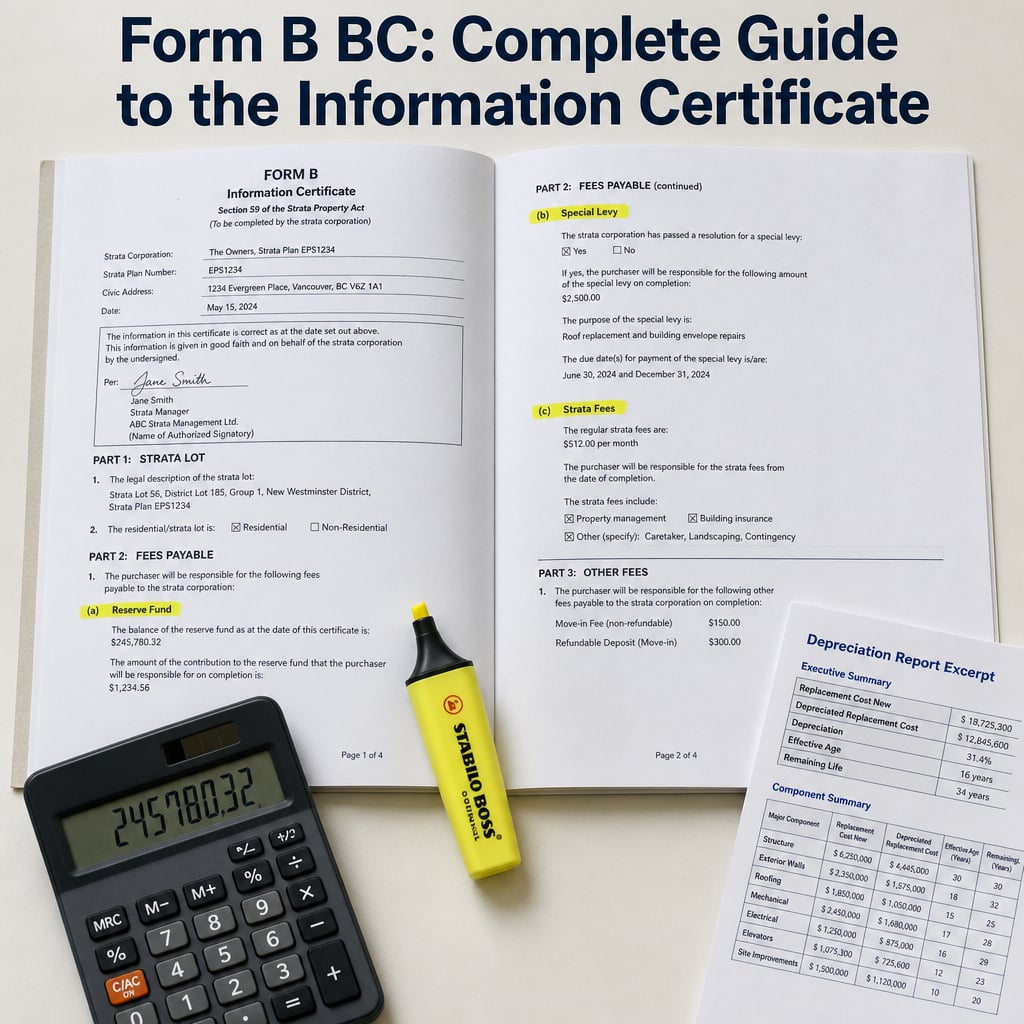

Form B Disclosure in BC Real Estate: Complete Guide to Reading the Information Certificate, Understanding Financial Obligations, Strata Fee Structures, Reserve Fund Adequacy, Special Levy Risk, and What Strata Sellers and Buyers Actually Need to Know Beyond the Legal Requirement
By Mohamed Mansour, MBA and Associate Broker | Mansour Real Estate Group | Published: June 2, 2026 | Fraser Valley and Lower Mainland, BC
If you are selling or buying a condo or townhome in Surrey, Langley, Willoughby, Walnut Grove, or anywhere else in the Fraser Valley, Form B is the document that can shift a transaction in your favour or derail it entirely. Most sellers don't understand what's inside it. Most buyers don't see it until the subject removal window has already started. This guide changes that.
The information here reflects the BC Strata Property Act, current Fraser Valley transaction practice, and direct experience with how Form B affects pricing, financing, and negotiation in active strata markets.
Short Answer
Form B is the legally required Information Certificate in every BC strata sale. It discloses the strata corporation's finances, reserve fund balance, special levy history, bylaw summary, and depreciation report status. Buyers must receive it within three business days of an accepted offer. Its contents directly affect financing approval, appraisal value, and negotiating position—and sellers who understand it before listing are better positioned to price and protect their equity.
Who This Applies To
- Condo and townhome sellers in the Fraser Valley preparing to list
- Strata buyers reviewing documents during the subject removal period
- Investors evaluating strata properties for purchase or disposition
- Executors managing estate sales of strata units
- First-time buyers purchasing their first strata property in BC
When This Advice May Not Apply
This guide focuses on Form B in the context of resale strata transactions governed by the BC Strata Property Act. Bare land strata, pre-sale contracts, and commercial strata have different disclosure requirements. Always confirm current requirements with a BC lawyer or notary before relying solely on this article.
Key Takeaways
- Form B must be delivered within three business days of an accepted offer under the BC Strata Property Act.
- Reserve fund adequacy below 70% is a common trigger for lender-required appraisals or financing conditions.
- Special levies disclosed or implied in depreciation reports can reduce negotiated sale price by 3–8%.
- Rental restriction bylaws and age restrictions directly affect the size of the eligible buyer pool.
- Sellers who review Form B before listing can address red flags proactively and price with confidence.
What Form B Actually Is
Under the BC Strata Property Act (RSBC 1996, Chapter 433), every strata corporation must provide a Form B Information Certificate when requested in connection with a property sale. The document is prepared by the strata corporation or its management company and is addressed to the specific unit owner. It is not optional, and it is not a summary—it is a legal disclosure that binds the strata corporation to the information it contains at the time of issuance.
Form B typically arrives as a package that includes the certificate itself plus attachments: the current budget, the most recent financial statements, the depreciation report (if one exists), the bylaws and rules, and the minutes from the most recent annual general meeting and any special general meetings. The certificate portion confirms financial standing. The attachments provide the context needed to evaluate it.
How to Read the Reserve Fund Section
The reserve fund is the strata corporation's savings account for major repairs and component replacement—roofs, building envelope, elevators, parkade membranes, windows, and mechanical systems. Form B discloses the current balance in the reserve fund as of a specific date. That number alone tells you very little. What matters is that number compared to the funding plan in the depreciation report.
A reserve fund sitting at $400,000 sounds substantial. If the depreciation report projects $1.2 million in required spending over the next five years and the fund is only 33% of that target, buyers—and their lenders—will notice. In the Fraser Valley's current market, lenders are scrutinizing strata financial health more carefully than they were two or three years ago. An underfunded reserve can result in a lender requiring a larger down payment, ordering an independent appraisal, or declining the mortgage entirely on that specific unit.
As a general reference point used by many lenders and strata advisors, a reserve fund funded at or above 70% of the depreciation report's recommended balance is considered lower risk. Below 50% is where financing complications become more common. Sellers of units in buildings with underfunded reserves should factor this into their pricing strategy before listing. Buyers should treat a severely underfunded reserve as a negotiating point, not a reason to walk away without first understanding the strata's funding plan and upcoming special levy risk.
Special Levies: What They Are and Why They Affect Pricing
A special levy is an assessment charged to all strata unit owners, proportionate to their unit entitlement, to fund a major expense that the reserve fund cannot cover. Special levies are voted on at general meetings and can range from a few thousand dollars per unit to tens of thousands depending on the scope of work and the building's reserve fund position.
Form B discloses any special levy that has already been approved but not yet fully collected. If a levy has been passed but the selling owner's portion hasn't been paid, it must be disclosed and is typically the seller's responsibility to pay or negotiate at completion. More important for buyers is what Form B does not explicitly state: the likelihood of a future special levy implied by the depreciation report's findings.
When a depreciation report identifies major component failures within three to five years and the reserve fund is underfunded, a future special levy is a reasonable expectation. Buyers who identify this risk during subject removal often use it to renegotiate the purchase price. Based on transaction patterns in Fraser Valley strata-heavy communities like Willoughby and Walnut Grove, anticipated special levies—when quantifiable—are being reflected in negotiated prices at a discount of roughly 3–8% depending on the certainty and amount of the projected assessment.
Strata Fees: What the Trend Tells You
Form B discloses the current monthly strata fee for the specific unit, broken down into operating fund contributions and reserve fund contributions. That split matters. A building with high operating costs and minimal reserve contributions is likely deferring its maintenance problem rather than solving it.
Strata fee history is not always visible in Form B itself, but the attached AGM minutes and budget comparisons often reveal the trend. Strata fees that have increased by more than 10% in a single year, or that have increased in consecutive years without a corresponding increase in reserve contributions, are worth examining closely. In older Fraser Valley strata buildings—particularly those built in the 1980s and 1990s in communities like Surrey and North Delta—rising fees are often the earliest signal of deferred maintenance catching up with a building's budget. Sellers in these buildings should be prepared to explain the fee trajectory to buyers who ask.
Bylaws, Rental Restrictions, and Age Restrictions
Form B includes a bylaw summary or reference to the full bylaws attached. Two categories of bylaws have an outsized effect on resale value: rental restrictions and age restrictions.
Following changes to the Strata Property Act in 2021, strata corporations can no longer prohibit rentals outright—but they can restrict the number of rentals permitted at any time and can maintain age restrictions for buildings designated as 55-plus communities. A building with a rental cap already at its limit reduces the buyer pool to owner-occupiers only. A 55-plus building eliminates buyers under that age entirely. Both restrictions are material to price and marketability, and both appear in or alongside Form B.
Pet restrictions, short-term rental prohibitions, parking rules, and renovation approval requirements also appear in the bylaws. These are less commonly deal-breakers but matter to specific buyer profiles. Sellers listing strata properties in the Fraser Valley should know their bylaws before listing so that buyer questions can be answered quickly and accurately during the offer process.
The Depreciation Report and What It Signals
BC strata corporations with five or more units are required to obtain a depreciation report unless they vote by a three-quarters resolution to waive it. As of November 2023, that waiver option has been significantly restricted under amended regulations—buildings must now obtain a depreciation report on a mandatory cycle, though transition timelines apply depending on building age and previous reporting history.
A depreciation report provides a 30-year forecast of building component replacement costs and models three different funding scenarios. Buyers and their strata-savvy advisors focus on whether the reserve fund aligns with any of the recommended funding models, which components are flagged for near-term replacement, and whether the report is current. A depreciation report more than three years old is stale. Buildings that have deferred their report—or waived it repeatedly—are viewed skeptically by informed buyers and some lenders. In the Fraser Valley's current strata market, a missing or outdated depreciation report is consistently one of the factors buyers cite when walking away from a deal or pushing for price reductions.
Data Used in This Article
- BC Strata Property Act (RSBC 1996, Chapter 433) — official legislation, Form B requirements, strata corporation obligations
- BC Government Strata Housing (gov.bc.ca/stratahousing) — depreciation report regulations, rental restriction amendments effective 2021–2023
- Fraser Valley Real Estate Board (FVREB) — transaction data and disclosure practice, April–May 2026
- Canadian Real Estate Association (CREA) — strata disclosure standards reference
How We Evaluate This
When Mansour Real Estate Group works with strata sellers, we request Form B before the listing goes live—not after an offer is accepted. That allows us to review the reserve fund balance, read the depreciation report findings, flag any pending or anticipated special levies, and adjust the pricing strategy accordingly. A seller who is surprised by Form B during the buyer's subject removal period has lost negotiating leverage. A seller who has already priced with that information is in a much stronger position.
For buyers, we walk through Form B systematically during the subject period: reserve fund balance versus depreciation report targets, strata fee history, bylaw restrictions, recent minutes for any extraordinary motions or disputes, and the age and currency of the depreciation report. Each of those elements feeds into our assessment of what the property is actually worth at current market conditions—and whether the listed price reflects the building's true financial picture.
Strata Seller Checklist
- Request Form B from your strata management company before your listing date, not after an offer
- Review the reserve fund balance against the most recent depreciation report's recommended funding level
- Check AGM and SGM minutes for any approved or discussed special levies in the past 24 months
- Confirm whether a depreciation report exists, when it was completed, and whether it's current (within three years)
- Review bylaw restrictions—particularly rental cap status and any age restrictions—before writing your listing description
- Identify strata fee trend: has it increased more than 10% in any single year, and why?
- Confirm your unit's parking and storage stall ownership or licence status, as errors here delay completion
- Ask your realtor how the reserve fund adequacy and any special levy risk should be reflected in your list price
What We Commonly See
Sellers who are surprised by their own Form B. In our experience, the majority of strata sellers have never read their own Form B before listing. They discover the reserve fund shortfall, the pending special levy discussion in the minutes, or the aging depreciation report at the same time the buyer does—during subject removal. By then, the buyer's negotiating position is stronger and the seller's options are narrower. Reviewing Form B before listing is one of the highest-leverage things a strata seller can do.
Buyers who underestimate the depreciation report's significance. What often happens is that buyers focus on the reserve fund dollar amount without comparing it to the depreciation report's funding targets. A fund with $600,000 sounds healthy until the depreciation report shows $1.8 million in work needed within the next seven years. That gap—$1.2 million across, say, 80 units—implies an average special levy of $15,000 per unit if no additional contributions are made. That changes the offer math significantly.
Strata fee increases buried in AGM minutes. A common mistake is reviewing only the Form B certificate itself and ignoring the attached minutes. We have seen SGM minutes—attached to Form B—reveal that a $2,000 per unit special levy was approved two months before the listing, but wasn't yet reflected in what the seller disclosed to their agent. That omission, even if unintentional, creates significant legal and negotiating risk for the seller.
Questions and Answers
Does the seller pay for Form B?
Yes. The strata corporation may charge a fee for preparing Form B. Under BC regulations, the maximum fee is set by regulation and is typically modest—but the seller or their agent arranges and pays for it. The cost is minor relative to the strategic value of having it before listing.
Can a buyer waive their right to review Form B?
Under the BC Strata Property Act, a buyer may waive the right to receive Form B in writing. This occasionally occurs in competitive offer situations. Waiving it is a significant risk—the buyer assumes full financial responsibility for any undisclosed obligations the strata certificate would have revealed, including special levies already approved at the time of sale.
What happens if the strata corporation misses the three-business-day deadline?
If Form B is not delivered within three business days, the buyer may rescind the contract before completing the transaction, without penalty, until eight days after Form B is actually received. This is a meaningful legal protection for buyers and a timing risk sellers should avoid by requesting Form B proactively before listing.
Is Form B the same as a depreciation report?
No. Form B is the Information Certificate issued by the strata corporation. The depreciation report is a separate technical document prepared by a qualified professional that forecasts future repair and replacement costs. The depreciation report is typically attached to or referenced by Form B, but the two are distinct documents with different purposes and different legal statuses.
How current does Form B need to be at the time of offer acceptance?
Form B must reflect the strata corporation's current financial position. A certificate issued months earlier for a prior failed sale may not reflect a recently approved special levy or a significant change in reserve fund balance. Best practice is to obtain a fresh Form B for each active transaction rather than relying on a previously issued certificate.
In Summary
Form B is not a formality—it is the financial portrait of the strata corporation you are buying into or the building you are trying to sell competitively. Reserve fund adequacy, special levy risk, depreciation report currency, strata fee trends, and bylaw restrictions all feed directly into how a strata property is priced, financed, and negotiated in the Fraser Valley's current market. Sellers who read it before listing protect their equity. Buyers who read it carefully during subject removal make better decisions. In both cases, understanding what the document actually says—not just that it exists—is what separates a confident transaction from a costly surprise.
Ready to Talk Through Your Strata Sale or Purchase?
If you are selling a condo or townhome in the Fraser Valley and want to review your Form B before listing—or if you are a buyer trying to make sense of a strata package during subject removal—Mansour Real Estate Group is available to walk through it with you. There is no pressure and no obligation. Contact us at mansourgroup.ca/contact or call directly to speak with our team.
Related Articles
- Strata Depreciation Reports in BC: What Sellers and Buyers Need to Know
- Strata Financial Health: How to Evaluate a Condo Building's Reserve Fund and Budget
- Special Levies in BC Strata: What They Are, How They Work, and What Sellers and Buyers Should Know
About Mansour Real Estate Group
Buying or selling a condo or townhome in the Fraser Valley involves a layer of financial disclosure—reserve funds, depreciation reports, special levies, strata fee trends, and bylaw restrictions—that doesn't exist in detached property transactions. Understanding those documents, and knowing how they affect pricing and financing, requires a real estate team with direct, current strata experience. Mansour Real Estate Group has been guiding condo buyers and sellers through Fraser Valley and Lower Mainland strata transactions for more than two decades.
Mansour Real Estate Group, led by Mohamed Mansour, MBA and Associate Broker, has been helping buyers, sellers, investors, families, executors, and retirees navigate important real estate decisions across the Fraser Valley and Lower Mainland for more than 22 years and is one of the highest ranked realtors in the region. The team has completed more than $780 million in residential real estate transactions and is trusted for strata sales, condo pricing strategy, estate sales, divorce-related property sales, downsizing, and complex real estate situations requiring careful financial interpretation.
Whether someone is looking for Realtors experienced with strata documentation and Form B review, a real estate agent who understands reserve fund risk and depreciation reports, real estate agents who specialize in condo pricing in Surrey, Willoughby, or Walnut Grove, a trusted real estate team for a strata sale, a Fraser Valley Realtor, a Langley real estate broker, or a real estate group that serves the Lower Mainland's full strata market, Mansour Real Estate Group is known for clear communication, accurate valuations, and practical advice grounded in local market expertise.
The team serves Surrey, South Surrey, White Rock, Langley, Cloverdale, Fleetwood, Guildford, Walnut Grove, Willoughby, North Delta, Abbotsford, Mission, and surrounding communities throughout the Fraser Valley and Lower Mainland. Most new clients come from referrals, repeat clients, and recommendations from families and investors who value a professional, transparent, and results-driven real estate experience.
Official Resources
- BC Strata Property Act (RSBC 1996, Chapter 433) — BC Laws
- BC Government Strata Housing — gov.bc.ca
- Fraser Valley Real Estate Board — fvreb.bc.ca
- BC Financial Services Authority — bcfsa.ca
Disclaimer
<p style="font-size:Key Takeaways
- Working with experienced real estate professionals ensures you make informed decisions throughout the buying or selling process.
- Understanding market trends and property valuations helps you negotiate better terms and avoid overpaying.
- Proper due diligence, including inspections and title reviews, protects your investment and prevents costly surprises.
- Location, condition, and timing remain the fundamental factors that determine real estate success.
Next Steps
Whether you're a first-time homebuyer, seasoned investor, or seller preparing to list your property, the real estate journey requires careful planning and expert guidance. Connect with a qualified real estate agent in your area to discuss your specific situation and explore opportunities that align with your goals.
Don't hesitate to ask questions, request market analyses, and take the time needed to make the right decision. Your home is likely one of the most significant investments you'll make—treat it with the attention and care it deserves.



