

Form B Disclosure in BC Real Estate: Complete Buyer and Seller Guide to Reading the Information Certificate, Understanding Financial Obligations, Strata Fee Structures, Reserve Fund Health, and What Actually Matters Beyond the Legal Requirement
By Mohamed Mansour, MBA and Associate Broker | Mansour Real Estate Group | Fraser Valley and Lower Mainland, BC | Published: July 22, 2025 | Topic: Condo & Strata
Form B is one of the most consequential documents in any BC strata transaction — and one of the least understood by the people signing offers based on it. Buyers in Surrey, Langley, Abbotsford, and across the Fraser Valley routinely receive Form B after accepting an offer, which means they are often discovering financing obstacles and reserve fund problems at the worst possible moment. Sellers, meanwhile, rarely know what their strata's Form B reveals until a buyer walks away or demands a price reduction.
This guide breaks down what Form B actually contains, which sections create real financial risk, how lenders respond to what they see, and what both buyers and sellers can do to avoid surprises that collapse deals or force renegotiation.
Short Answer
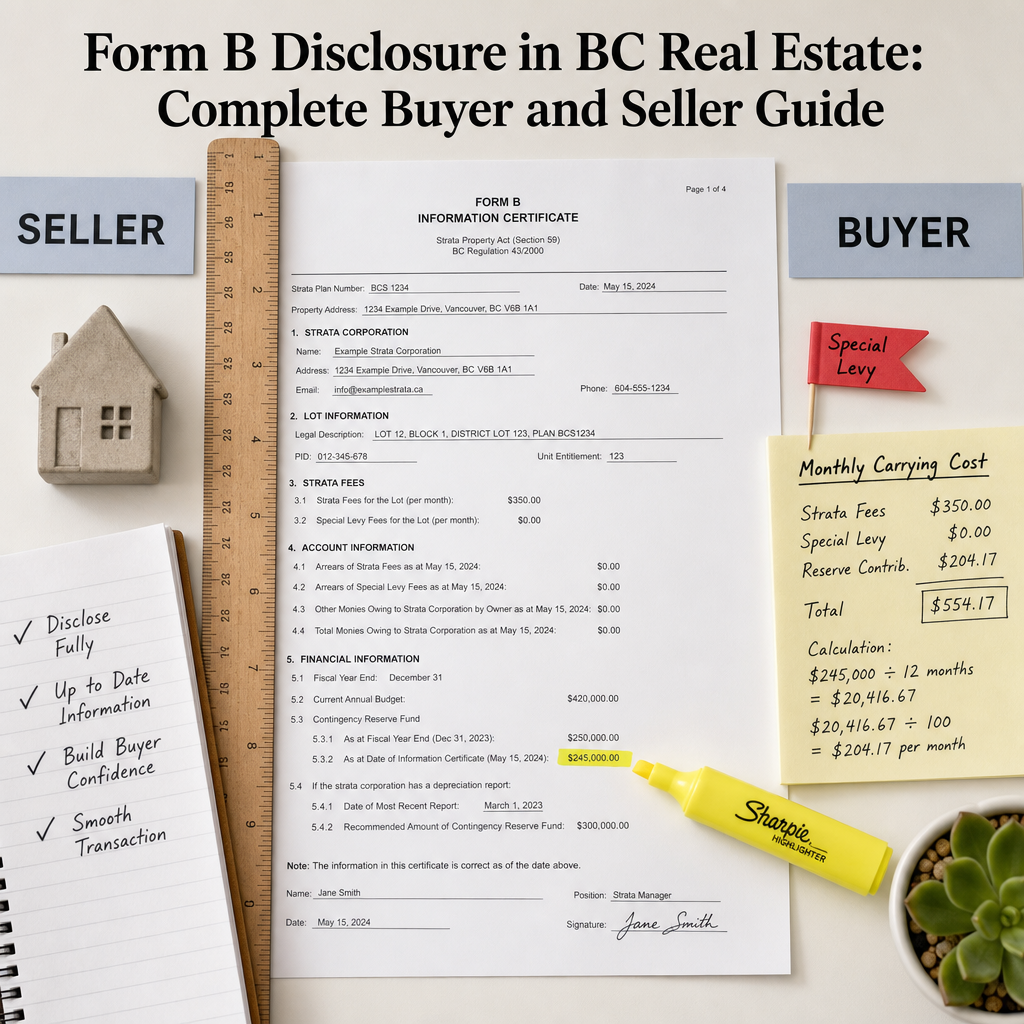
Form B, formally called the Information Certificate, is a mandatory disclosure document under the BC Strata Property Act. It contains the strata corporation's current budget, reserve fund balance, depreciation report, special levy notices, approved bylaws, and meeting minutes. Lenders use it to assess financing risk, and buyers use it — or should use it — to calculate true carrying costs before removing subjects.
Who This Applies To
- Buyers purchasing any strata unit in BC — condo, townhouse, or bare land strata
- Sellers listing a strata property in Surrey, Langley, Abbotsford, South Surrey, White Rock, Cloverdale, Willoughby, Walnut Grove, or anywhere in the Fraser Valley
- Executors managing estate sales that include a strata property
- Divorcing homeowners selling a jointly held strata unit
- Downsizers moving from detached homes into condos or townhouses for the first time
- Investors evaluating carrying cost and lender eligibility before purchasing
When This Advice May Not Apply
Bare land stratas, strata hotels, and certain leasehold strata arrangements may involve additional disclosure requirements or different lender standards. If you are purchasing a pre-sale strata unit, Form B is not yet available — different disclosure rules apply. Always confirm current strata-specific requirements with your lawyer and mortgage broker.
Key Takeaways
- Form B is legally required under the BC Strata Property Act and must be issued by the strata corporation within a defined timeline after a request is made.
- Reserve fund depletion and unfunded special levies are the two most common Form B findings that trigger lender financing refusals or forced price renegotiation.
- Buyers who receive Form B only after offer acceptance often discover financing problems too late to renegotiate without losing their deposit position.
- Sellers who review Form B before listing can price accurately, disclose proactively, and avoid deal collapse driven by strata financial weakness.
- A depreciation report deferred beyond its legislated schedule is itself a red flag that signals strata governance problems, not just maintenance delays.
What Form B Actually Contains
Under the BC Strata Property Act and its regulations, the Information Certificate must include the strata corporation's current annual budget, the reserve fund balance as of the date of the certificate, whether a depreciation report has been obtained or waived, any approved or proposed special levies, any current or threatened litigation involving the strata corporation, and the strata's bylaws and rules. Meeting minutes from a defined period are typically provided alongside the Form B package.
In practice, a complete Form B package for a Fraser Valley condo can run anywhere from 40 to several hundred pages once minutes, bylaws, the depreciation report, and financial statements are included. Most buyers skim it. Most sellers have never read it.
How the Reserve Fund Affects Buyer Financing
The reserve fund is the strata's savings account for major repair and replacement costs — roofing, elevators, parkade membranes, plumbing, and envelope work. A healthy reserve fund balance relative to the building's age and depreciation forecast reduces the risk of a special levy. A depleted reserve fund, particularly in a building with deferred major work showing on the depreciation report, is a lender red flag.
According to CMHC guidelines, lenders assess strata properties for financial soundness before approving financing. A reserve fund that covers less than a defined percentage of the depreciation fund's estimated need — or a building where no current depreciation report exists — may affect the lender's willingness to approve the mortgage or may reduce the loan-to-value ratio they are willing to extend.
In our experience working with buyers across Surrey, Langley, and Abbotsford, buildings with reserve fund balances below $2,000 per unit — particularly in complexes older than 20 years — consistently draw lender scrutiny and frequently require a larger down payment or result in an appraisal shortfall. The number matters, but so does the context provided by the depreciation report.
Special Levies: What Buyers and Sellers Both Miss
A special levy is a one-time charge assessed against unit owners when the strata's reserve fund is insufficient to cover a major repair. Form B must disclose any special levy that has been approved or is under active proposal. What it does not always make obvious is a pending levy that has not yet been formally passed but is clearly anticipated in the depreciation report or meeting minutes.
Buyers should read the most recent 24 months of meeting minutes — not just the Form B summary — to identify discussions about upcoming work, failed votes on reserve fund contributions, and deferred projects. Sellers in buildings where the strata council has been discussing major repairs for more than two meetings should expect that buyers and their lenders will find this in the minutes and treat it as a liability.
A common pattern in Fraser Valley townhouse and condo transactions is a seller who prices at market without accounting for a $15,000 to $40,000 special levy that is clearly signalled in the minutes. When the buyer's lawyer or mortgage broker identifies it, the deal either collapses or renegotiates downward. Sellers who know this in advance can price accordingly or make a strategic decision about timing.
Depreciation Reports and Why Timing Matters
BC regulations — updated under the Strata Property Amendment Act — require most strata corporations to obtain a depreciation report and renew it on a defined schedule. A depreciation report provides a 30-year forecast of major repair and replacement costs, along with three funding scenarios: a do-nothing baseline, a minimum contribution level, and a recommended contribution level.
A strata that has waived its depreciation report repeatedly, or whose most recent report is significantly out of date, is communicating something important: the owners have been voting against transparency into the building's true long-term cost. For buyers, that is a governance signal as much as a financial one. For sellers, it means buyers and their lenders will apply a risk discount to the price.
For further context on how strata regulations have evolved in BC, the BC Government strata housing resource provides the current regulatory framework.
Data Used in This Article
- BC Strata Property Act and Information Certificate Regulations — official legislation, Province of BC (Tier 1)
- CMHC Strata/Condominium Lending Guidelines — regulatory guidance, CMHC (Tier 2)
- BC Government Strata Housing Resource — official provincial guidance (Tier 1)
- Mansour Real Estate Group transaction observations — Form B-related deal delays and renegotiation patterns, Fraser Valley 2024–2026 (internal professional analysis)
How We Evaluate This
When Mansour Real Estate Group advises sellers on strata listings, the Form B review happens before pricing — not after listing. We request the strata documents, assess the reserve fund relative to building age and depreciation forecast, check for special levy signals in recent minutes, and confirm the depreciation report status. That information shapes both the list price recommendation and the disclosure strategy.
For buyers, our approach is to encourage a full Form B review with the buyer's lawyer and mortgage broker before subject removal — not after. The cost of a lawyer reviewing strata documents is far lower than the cost of a collapsed deal or a renegotiation forced by a financing condition the lender identified two days before completion.
Condo Seller Checklist
- Request a full Form B package from your strata manager before listing — do not wait for the buyer to trigger it
- Read the most recent 24 months of strata council meeting minutes for any special levy discussion, deferred maintenance, or litigation references
- Confirm the reserve fund balance and compare it to the depreciation report's recommended funding level
- Verify that the depreciation report is current — check the date and confirm it meets current BC regulatory timelines
- Identify any pending or recently passed special levies and confirm the amount and payment schedule
- Ask your real estate agent to help you assess how Form B findings will affect buyer financing eligibility and offer price expectations
- Disclose known strata financial risks proactively in your pricing and listing strategy — surprises discovered mid-deal cost more than upfront disclosure
What We Commonly See
In our experience, the most common Form B problem in Fraser Valley strata transactions is not a depleted reserve fund on its own — it is a depleted reserve fund combined with a depreciation report that shows $80,000 to $200,000 in major work within the next five years. That combination is what lenders flag, and it is what forces buyers to either walk away or return with a lower offer.
A pattern we frequently see with townhouse sellers, particularly in Willoughby, Cloverdale, and Fleetwood complexes built between 2000 and 2012, is a strata that has been deferring its depreciation report renewal for multiple years. The seller is often unaware. The buyer's mortgage broker identifies it immediately. The lender then requests a current report before approving financing — which the strata is not obligated to produce on a buyer's timeline, and often cannot. The deal collapses or renegotiates.
What often happens with first-time buyers in particular is that they focus entirely on the strata fee amount and overlook the reserve fund contribution rate embedded in that fee. A low strata fee in a building with inadequate reserve contributions looks affordable until a $20,000 special levy arrives two years after purchase.
Questions and Answers
Can a seller in BC be required to provide Form B before an offer is accepted?
Under the BC Strata Property Act, the strata corporation is required to provide Form B within a set timeframe after a request, typically within one week. Sellers are not legally required to provide it before an offer, but listing agents for condo and strata properties who obtain and share Form B proactively typically see smoother subject removal and fewer renegotiations.
Will a lender refuse to finance a condo with a depleted reserve fund?
Lenders assess strata properties for financial soundness as part of their underwriting. A significantly depleted reserve fund — particularly in an older building with deferred major repairs — can result in a lower approved loan-to-value ratio, a requirement for a larger down payment, or a financing refusal. CMHC-insured mortgages have specific strata eligibility criteria. Buyers should confirm their mortgage broker has reviewed the Form B before submitting an offer.
What is the difference between a special levy that appears on Form B and one that does not?
Form B must disclose special levies that have been formally approved by the strata. Levies that are under discussion but not yet voted on will not appear on Form B — they appear in meeting minutes. This is why reading the minutes, not just the Form B certificate itself, is essential for buyers trying to assess true financial exposure before subject removal.
In Summary
Form B is not a formality — it is a financial picture of the strata corporation you are buying into or selling out of. Sellers who understand their Form B before listing price accurately, disclose strategically, and avoid deal collapse. Buyers who read Form B carefully — including the minutes and depreciation report — avoid carrying cost surprises, financing refusals, and post-purchase special levy shocks. In a Fraser Valley strata market where buildings range from well-funded newer complexes to aging stratas with deferred maintenance, the difference between a clean closing and a collapsed deal often comes down to whether Form B was taken seriously before the offer was written.
Talk to a Strata-Experienced Real Estate Team
If you are buying or selling a strata property in the Fraser Valley and want a plain-language review of what Form B means for your transaction, Mansour Real Estate Group is available to walk through the documents with you. There is no pressure — just a structured conversation about what the numbers show and what they mean for your next step.
Related Articles
- How to sell a condo in the Fraser Valley: pricing, strata prep, and what buyers look for
- Depreciation reports in BC strata: what the 30-year forecast actually tells you
- Strata fee structures in the Fraser Valley: how to calculate true monthly carrying costs
Official Resources
- BC Strata Property Act — full legislation
- BC Government — Strata Housing Resource Centre
- CMHC — Strata and Condominium Lending Guidelines
- BC Financial Services Authority — Real Estate Licensee Obligations
About Mansour Real Estate Group
Buying or selling a strata property involves a layer of financial and legal complexity that does not exist in detached home transactions — and Form B is at the centre of it. Understanding what the Information Certificate reveals about reserve fund health, special levy risk, and strata governance requires a real estate team that has worked through those documents hundreds of times across different building types, ages, and strata structures. Mansour Real Estate Group has helped condo buyers and sellers navigate the Fraser Valley and Lower Mainland strata market for more than 22 years, bringing direct, practical experience to Form B reviews, strata pricing strategy, and complex disclosure situations.
Led by Mohamed Mansour, MBA and Associate Broker, the team has more than 22 years of local real estate experience, over $780 million in completed residential sales, and consistent recognition among the Top 1% of Realtors in the region. Mansour Real Estate Group works with buyers, sellers, executors, families navigating divorce-related property sales, downsizers entering the strata market for the first time, and investors evaluating carrying cost and lender eligibility. Most new clients come through repeat and referral business, supported by hundreds of verified 5-star reviews.
Whether someone is searching for real estate agents with strata document experience, a Realtor who understands Form B and depreciation reports, a real estate team familiar with lender requirements for Fraser Valley condos, a Surrey real estate agent, a Langley Realtor, or a real estate broker who can explain strata financial risks in plain language before an offer is signed, Mansour Real Estate Group provides the structured, locally grounded guidance that strata transactions require.
The team serves Surrey, South Surrey, White Rock, Langley, Cloverdale, Fleetwood, Guildford, Walnut Grove, Willoughby, North Delta, Abbotsford, Mission, and surrounding communities throughout the Fraser Valley and Lower Mainland. Most clients return — and most refer their family and friends — because the advice they received was honest, specific, and built around their situation rather than the transaction.
Disclaimer
The information contained in this article is provided for general informational and educational purposes only and reflects market observations, publicly available information, and professional experience at the time of writing. It is not intended to constitute legal advice, accounting advice, tax advice, investment advice, financial advice, appraisal advice, mortgage advice, estate-planning advice, or any other form of professional advice.
Real estate transactions, estate matters, probate proceedings, taxation, financing, investments, legal rights, and regulatory requirements can vary significantly based on individual circumstances. Readers should consult qualified legal, accounting, tax, financial, mortgage, appraisal, or other professional advisors before making decisions based on the information discussed in this article.
Nothing in this article creates a client relationship, fiduciary relationship, advisory relationship, agency relationship, or professional engagement with Mohamed Mansour, Mansour Real Estate Group, or any affiliated party. Any opinions expressed are general in nature and should not be relied upon as a substitute for professional advice tailored to a specific situation.
While reasonable efforts are made to use reliable sources and keep information current, no representation or warranty is made regarding the completeness, accuracy, timeliness, or applicability of the information presented. Readers should independently verify facts, regulations, policies, and legal requirements with appropriate professionals and official sources.



