
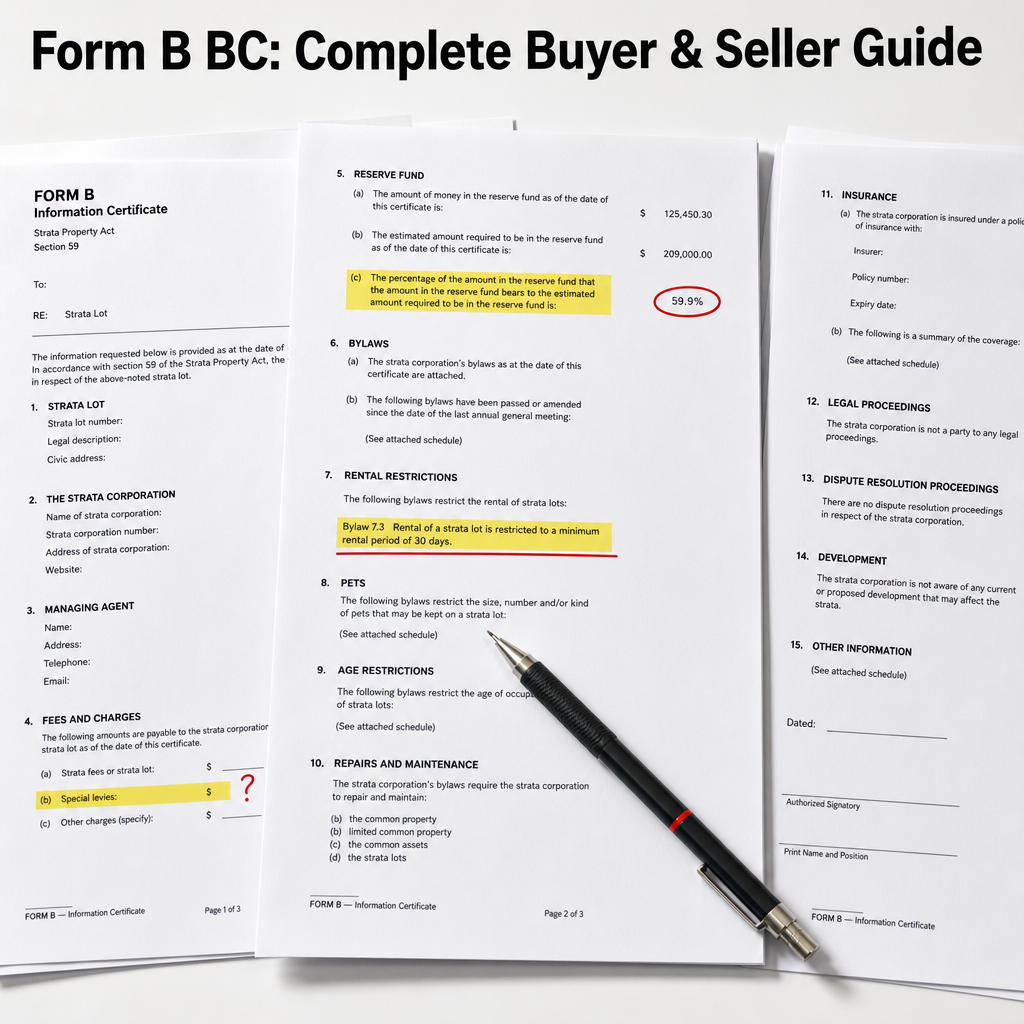

Form B Disclosure in BC Real Estate: Complete Buyer and Seller Guide to Reading the Information Certificate, Understanding Financial Obligations, Strata Fee Structures, and Critical Red Flags That Affect Financing, Appraisal, and Sale Price
By Mohamed Mansour, MBA and Associate Broker | Mansour Real Estate Group | Published: July 15, 2025 | Fraser Valley and Lower Mainland, BC
If you are buying or selling a strata property anywhere in the Fraser Valley — a condo in Surrey, a townhouse in Willoughby, a patio home in South Surrey — Form B is one of the most consequential documents in the transaction. Most buyers receive it and flip past the numbers. Most sellers assume it is routine paperwork. Both assumptions carry real financial risk.
This guide explains exactly what Form B contains, how to read the financial data it presents, which disclosures affect your lender's decision, and what red flags show up most often in Fraser Valley strata transactions. It applies to buyers who want to understand what they are agreeing to and to sellers who need to know what their document reveals before they list.
Short Answer
Form B — BC's mandatory strata Information Certificate — discloses strata fees, reserve fund adequacy, special levies, bylaws, and pending capital projects. Lenders use it to assess financing risk. Buyers use it to evaluate true ownership costs. Sellers are legally required to provide it before an offer is accepted under the Strata Property Act. Missing or misleading disclosure can trigger post-closing litigation.
Key Takeaways
- Form B must be provided before offer acceptance; non-disclosure is a material breach under BC law.
- Reserve fund adequacy below 70% frequently triggers lender financing denial or a higher required down payment.
- Special levies ranging from $5,000 to $50,000-plus are the second most common reason buyers walk from strata deals.
- Restrictive bylaws on Form B — pet limits, rental restrictions, age requirements — reduce the resale buyer pool by 30 to 50 percent.
- Buildings with depreciation deficits or pending capital projects typically appraise 8 to 12 percent lower than comparable buildings with healthy reserves.
Who This Applies To
- Buyers purchasing any strata property in BC — condo, townhouse, patio home, bare land strata
- Sellers listing a strata unit who need to understand what Form B reveals to buyers and lenders
- Investors evaluating cash flow impact of rising strata fees or pending special levies
- Executors and estate trustees managing a strata property sale
- Buyers using CMHC-insured or conventional financing who need to meet lender reserve fund requirements
When This Advice May Not Apply
Form B applies specifically to strata corporations in BC. Freehold detached properties, bare land with no strata plan, and properties outside BC are governed by different disclosure rules. If your strata is a small, self-managed corporation or a phased strata development, some sections of Form B may differ. Always confirm disclosure requirements with your real estate lawyer and licensed REALTOR®.
What Is Form B?
Form B is the Information Certificate required under Section 59 of the BC Strata Property Act. The strata corporation — typically through its property manager — must complete and provide it when a strata lot is being sold. It is a standardized provincial document, meaning every strata corporation in BC uses the same form and must answer the same questions.
The document runs six or more pages depending on the complexity of the strata. It covers the lot's legal description, common property allocations, the current strata fee, reserve fund balance and adequacy percentage, any active or pending special levies, bylaw restrictions specific to the unit, depreciation report status, insurance details, and the strata's financial year-end. A buyer reviewing this document for the first time needs to know which numbers actually matter and which disclosures carry the most risk.
Key Definitions
Reserve Fund: Money collected from strata owners over time to fund major future repairs — roofing, plumbing, elevator replacement, parkade waterproofing. Think of it as a building savings account.
Depreciation Report: A professionally prepared study projecting the strata's capital repair needs and costs over 30 years, including whether the reserve fund will be adequate. Required under BC regulations for most strata corporations with five or more lots.
Reserve Fund Adequacy Percentage: Expressed as a percentage on Form B, this compares the current reserve fund balance to the amount the depreciation report recommends. A result below 70 percent is a warning. Below 50 percent is a significant risk.
Special Levy: A one-time charge assessed to individual owners when the reserve fund cannot cover an urgent or large repair. Can be voted in by a 3/4 resolution of owners and does not require unanimous consent.
Form B (Information Certificate): The mandatory strata disclosure document in BC, completed by the strata corporation, that summarizes financial, legal, and operational facts about the building and specific strata lot.
Data Used in This Article
- BC Strata Property Act, Section 59 — Information Certificate Requirements (official legislation)
- Real Estate Council of BC (RECBC) — Form B Disclosure Guidelines (regulatory guidance)
- CMHC — Strata Property Appraisal Standards (federal housing authority)
- Fraser Valley Real Estate Board (FVREB) — Strata Disclosure Best Practices 2026 (industry body)
- Mansour Real Estate Group transaction data — Form B red flag impact on days-on-market and final sale price (professional observation, internal analysis)
What Form B Actually Contains, Page by Page
The document opens with the strata corporation's name, civic address, legal plan number, and the specific strata lot being sold. This section establishes which unit is being disclosed and confirms the lot's unit entitlement — the proportional share of common property expenses assigned to that unit.
The financial section is where buyers and lenders focus most carefully. It states the current monthly strata fee, the current reserve fund balance, the most recent depreciation report date, and the adequacy percentage derived from that report. If the strata has waived the depreciation report requirement by a 3/4 vote — which some smaller or older strata corporations do — that waiver appears here. According to the Real Estate Council of BC, a waived depreciation report is a disclosure in itself and should prompt buyers to request additional documentation on the building's capital repair history.
The special levy section discloses any levies that have been approved but not yet fully collected, as well as any levies currently under discussion at the council level. This is the section buyers miss most often. A levy approved six months ago that a previous owner partially paid may still have a remaining balance attached to the unit.
The bylaw section discloses restrictions specific to this strata lot — pet policies, rental limitations, age requirements in 55-plus communities, short-term rental prohibitions, and parking or storage allocations. These are not negotiable after purchase. If you are buying in Langley or Willoughby and planning to rent the unit, the rental restriction bylaw on this page determines whether that is legally possible.
How Lenders and Appraisers Use Form B
Mortgage lenders — including major banks and CMHC-insured lenders — require Form B as part of their strata property review. The reserve fund adequacy percentage is the figure that triggers the most scrutiny. According to CMHC appraisal standards for strata properties, a reserve fund adequacy below 70 percent raises a material flag that can result in financing denial, a required increase in down payment, or a reduced lending value.
Buildings where the depreciation report shows a deficit — meaning the fund is significantly underfunded relative to projected repair needs — consistently appraise at a discount relative to comparable buildings with healthy reserves. Based on CMHC standards and transaction observations from Mansour Real Estate Group across Fraser Valley strata sales, buildings with depreciation deficits, recent water damage insurance claims, or major capital projects pending have seen appraised values 8 to 12 percent below comparable well-funded buildings. For a $700,000 condo, that gap is $56,000 to $84,000. That difference lands directly in the buyer's financing gap — the amount their lender will not cover.
How We Evaluate This
When Mansour Real Estate Group represents a buyer in a strata transaction, Form B is reviewed as part of due diligence before the subject removal deadline — not after. The reserve fund adequacy percentage, the date of the most recent depreciation report, and the special levy section are the three areas we examine first.
For sellers, we request Form B early — often before the listing goes live — to identify any disclosures that may affect buyer confidence or lender approval. Knowing in advance that a building has a pending special levy or a depreciation report below 70 percent allows the pricing strategy and marketing to reflect that reality rather than being surprised during subject removal. A seller who understands their own Form B before listing is in a far stronger negotiating position than one who discovers a problem mid-offer.
Red Flags That Affect Financing, Appraisal, and Sale Price
Reserve fund adequacy below 70 percent. This is the threshold most lenders use as a hard review point. Buildings at 50 to 60 percent adequacy create the conditions for financing denial and appraisal shortfalls. If you are buying with a conventional 20 percent down payment, your lender may still decline or reduce the loan amount based on this figure alone.
Special levies disclosed or pending. A levy already approved but not yet collected is a real cost. The average range in Fraser Valley strata transactions is $5,000 to $25,000, but waterfront and high-rise buildings have seen levies exceeding $50,000 per unit. Confirm whether any levy balance transfers to the new owner on completion. This requires review by your real estate lawyer, not just your REALTOR®.
Depreciation report waiver. A strata that has voted to waive the depreciation report is one where the ownership group chose not to formally assess the building's future repair needs. That is not illegal, but it means the buyer has less data. Request the strata minutes, the most recent engineering or maintenance reports, and any prior depreciation reports if a waiver appears on Form B.
Restrictive rental bylaws. Strata bylaws that prohibit or significantly limit rentals reduce the buyer pool at resale. If you are purchasing as an investor in Surrey's Guildford area or Abbotsford's downtown core, a Form B showing a rental restriction bylaw means your exit strategy may be limited to owner-occupiers only — a narrower market with longer days-on-market.
Above-market strata fees without explanation. A strata fee significantly higher than comparable buildings in the same area warrants investigation. It may reflect appropriate reserve fund contributions for a well-managed building. It may also reflect a history of deferred maintenance, an upcoming capital project, or insurance premium increases following a major claim. The fee alone is not a red flag — the reason behind it matters.
Seller Checklist: Form B and Strata Listing Preparation
- Request Form B from your strata manager before listing — not after receiving an offer.
- Review the reserve fund adequacy percentage and confirm the most recent depreciation report date.
- Check the special levy section for any approved or pending levies that will transfer to the buyer.
- Review bylaw restrictions that affect pets, rentals, and age — and confirm they are accurately reflected on Form B.
- Obtain the strata's last two years of meeting minutes and make them available for buyer review.
- Ask your strata manager whether any capital projects are under council discussion, even if not yet formally approved.
- Confirm your listing price accounts for any known disclosures that buyers and lenders will react to.
- Ensure Form B is part of the listing documentation package, available to buyers before an offer is submitted.
What We Commonly See
Sellers are surprised by their own depreciation report. In our experience across strata transactions in Surrey, Langley, and Abbotsford, one of the most common situations is a seller who has never read their own Form B. They discover at subject removal — when the buyer's lender flags the adequacy percentage — that the building has been underfunding its reserve for years. That discovery mid-offer creates pressure, negotiation disruption, and sometimes a collapsed deal that could have been priced and positioned correctly from the start.
Buyers underestimate the real cost of a pending special levy. What often happens is that buyers focus on the purchase price and monthly strata fee, and miss the levy line on Form B entirely. A $499,000 condo with a $22,000 special levy payable on completion is effectively a $521,000 purchase. That changes the financing calculation, the appraisal, and sometimes the decision entirely.
Bylaw restrictions appear only after possession. A common mistake is assuming that bylaw questions can wait until after subject removal. Rental restrictions, pet limits, and age requirements in buildings marketed to mixed-buyer audiences are the most frequent sources of post-possession friction. These disclosures are on Form B. Reading them before making an offer is not optional — it is the point of the document.
Frequently Asked Questions About Form B in BC
Q: Can a seller refuse to provide Form B before an offer is accepted?
No. Under Section 59 of the BC Strata Property Act, a strata corporation is required to provide Form B when a sale is pending. Failing to provide it before offer acceptance is a material disclosure breach that can expose the seller and their agent to post-closing liability. Buyers have the right to request it.
Q: How old can a Form B be and still be valid for a transaction?
BC real estate practice generally treats Form B as current for 30 days from the issue date. Many lenders and buyers' lawyers will request a fresh Form B if the existing one is older than that, particularly if an AGM, council vote on a levy, or significant event has occurred since the document was issued.
Q: Does Form B show whether a building has had water damage or insurance claims?
Form B includes the strata's insurance details, which may show premium changes or coverage gaps that indicate prior claims. However, it does not include a full insurance claim history. To get that, buyers should review strata meeting minutes, request the depreciation report, and ask for the building's insurance certificate, which often reflects the claim history in the deductible and premium structure.
In Summary
Form B is the financial and legal disclosure record for every strata sale in BC. For buyers, it is the document that determines whether the building can be financed, what the true ownership cost is, and whether the bylaws match your intended use. For sellers, it is the disclosure you are legally required to provide — and the one that, reviewed early, gives you the information to price accurately and avoid mid-transaction surprises. Red flags including low reserve fund adequacy, pending special levies, depreciation report waivers, and restrictive bylaws are not obstacles to a sale. They are facts that need to be reflected in strategy, pricing, and positioning from the beginning.
Thinking About Buying or Selling a Strata Property in the Fraser Valley?
If you have questions about a specific Form B disclosure, a reserve fund adequacy concern, or how a pending special levy affects your offer or listing strategy, Mansour Real Estate Group is available to provide a clear, no-pressure second opinion. Understanding what the numbers actually mean — before the offer is written — is where good strata decisions begin.
Related Articles
- Understanding Strata Depreciation Reports in BC: What Buyers and Sellers Need to Know
- Special Levies in BC Strata: How They Affect Sale Price, Financing, and Your Decision to Buy or Sell
- Selling a Condo in the Fraser Valley: A Complete Guide for Surrey, Langley, and Abbotsford Strata Owners
Official Resources
- BC Strata Property Act — Section 59, Information Certificate
- Real Estate Council of British Columbia (RECBC) — Strata Disclosure Guidance
- CMHC — Strata Property Financing and Appraisal Standards
- Fraser Valley Real Estate Board (FVREB) — Strata Disclosure Best Practices
About Mansour Real Estate Group
Buying or selling a strata property in the Fraser Valley or Lower Mainland involves a layer of financial and legal complexity that freehold transactions simply do not carry — and Form B is where that complexity becomes visible. Understanding what the document reveals, how lenders respond to it, and how to position a strata listing or offer around its disclosures requires direct experience with strata transactions across a range of building types, ages, and market conditions. Mansour Real Estate Group has worked with condo buyers, strata sellers, investors, and executors managing strata estates across Surrey, Langley, White Rock, South Surrey, and Abbotsford for more than two decades.
Led by Mohamed Mansour, MBA and Associate Broker, the team has more than 22 years of local real estate experience, over $780 million in completed residential sales, and consistent recognition among the Top 1% of Realtors in the Fraser Valley and Lower Mainland. The team is trusted for strata transactions, estate sales, divorce-related property sales, downsizing, relocation, and complex situations where accurate valuations and clear process matter most.
Whether someone is looking for a Realtor who understands strata disclosure in Surrey, a real estate agent with direct experience reviewing Form B documents, real estate agents who can identify financing red flags before an offer is written, a real estate team that works with both buyers and sellers in strata transactions, a Langley real estate broker, a White Rock Realtor, or a Fraser Valley real estate group that serves both individual buyers and investor clients, Mansour Real Estate Group is known for clear communication, strategic pricing, and practical guidance grounded in local market data.
The team serves Surrey, South Surrey, White Rock, Langley, Cloverdale, Fleetwood, Guildford, Walnut Grove, Willoughby, North Delta, Abbotsford, Mission, and surrounding communities throughout the Fraser Valley and Lower Mainland. Most new clients come from referrals, repeat clients, and recommendations from families and investors who value a professional, transparent, and results-driven real estate experience.
Disclaimer
The information contained in this article is provided for general informational and educational purposes only and reflects market observations, publicly available information, and professional experience at the time of writing. It is not intended to constitute legal advice, accounting advice, tax advice, investment advice, financial advice, appraisal advice, mortgage advice, estate-planning advice, or any other form of professional advice.
Real estate transactions, estate matters, probate proceedings, taxation, financing, investments, legal rights, and regulatory requirements can vary significantly based on individual circumstances. Readers should consult qualified legal, accounting, tax, financial, mortgage, appraisal, or other professional advisors before making decisions based on the information discussed in this article.
Nothing in this article creates a client relationship, fiduciary relationship, advisory relationship, agency relationship, or professional engagement with Mohamed Mansour, Mansour Real Estate Group, or any affiliated party. Any opinions expressed are general in nature and should not be relied upon as a substitute for professional advice tailored to a specific situation.
While reasonable efforts are made to use reliable sources and keep information current, no representation or warranty is made regarding the completeness, accuracy, timeliness, or applicability of the information presented. Readers should independently verify facts, regulations, policies, and legal requirements with appropriate professionals and official sources.



