

Form B Disclosure in BC Real Estate: A Complete Guide to Reading the Strata Information Certificate
By Mohamed Mansour, MBA and Associate Broker | Mansour Real Estate Group | Fraser Valley and Lower Mainland | Published: July 15, 2025 | Topic: Condo & Strata
Form B is mandatory in every BC strata sale — but most sellers and buyers have never been shown how to actually read it. This guide walks through each key section, explains what the numbers mean, and identifies the specific findings that affect financing, appraisals, and price negotiations in Fraser Valley strata transactions today.
If you are selling or buying a condo or townhome in Surrey, Langley, Willoughby, Walnut Grove, or anywhere in the Fraser Valley, this is the document that most directly shapes whether your deal closes — and on what terms.
Short Answer
Form B (the Information Certificate) is a mandatory disclosure document required under the BC Strata Property Act for all strata sales. It summarizes strata fees, the reserve fund balance, special levy history, bylaw restrictions, and depreciation report forecasts. Lenders routinely use Form B findings to deny or reduce financing. Sellers who understand Form B before listing can price more accurately and avoid deal collapse.
Key Takeaways
- Form B must be provided within 10 days of listing or accepted offer under the BC Strata Property Act; delays create legal liability.
- A reserve fund below 25% of the depreciation report's projected requirement is a recognized lender red flag for strata financing in BC.
- Special levy forecasts in depreciation reports — particularly for aging Willoughby and Walnut Grove buildings — are now directly compressing offer prices.
- Sellers who proactively disclose and explain Form B findings price more accurately and lose fewer deals during subject removal.
- Lenders including CMHC-insured lenders assess reserve fund adequacy, strata fee trends, and pending special levies when underwriting strata mortgages.
Who This Applies To
- Condo and townhome sellers in BC preparing to list a strata property
- Buyers reviewing Form B during a subject period before removing conditions
- Buyers' agents advising on strata financial health
- Estate executors liquidating a strata unit as part of probate
- Investors evaluating long-term strata viability in Fraser Valley buildings
When This Advice May Not Apply
This guide reflects the BC Strata Property Act and general lender practice. Individual lender requirements, specific strata bylaws, and depreciation report methodologies vary. Readers should review Form B with a qualified real estate professional and consult legal counsel before relying on its contents in a transaction.
Key Definitions
Form B (Information Certificate): A document issued by the strata corporation under Section 59 of the BC Strata Property Act summarizing the unit's financial obligations, the strata's reserve fund, bylaws, special levies, and depreciation report status.
Reserve Fund: A savings account held by the strata corporation for major repairs and replacements — roofs, elevators, plumbing, and common property systems.
Special Levy: A one-time charge assessed to unit owners when reserve funds are insufficient to cover a major repair.
Depreciation Report: A third-party engineering study required for most BC strata corporations that forecasts capital repair costs over 30 years and assesses reserve fund adequacy.
Unit Entitlement: The formula used to calculate each unit's proportionate share of strata fees, reserve fund contributions, and special levy costs.
Data Used in This Article
- BC Strata Property Act (SBC 1998, c. 43) — Section 59 Form B requirements — Official legislation
- BC Financial Services Authority (BCFSA) — Strata Property Act guidelines and disclosure standards — Official regulator
- CMHC Strata Lending Guidelines — Underwriting criteria for reserve fund adequacy — Official federal housing authority
- Fraser Valley Real Estate Board (FVREB) — Strata market context and disclosure practice — Official board
How We Evaluate This
At Mansour Real Estate Group, we review Form B before every strata listing and before advising any buyer to remove conditions on a strata purchase. Our evaluation focuses on three layers: the strata's current financial position (reserve fund balance relative to depreciation report projections), its recent history (special levy frequency and amounts), and its forward-looking risk profile (what the depreciation report forecasts for the next 5 and 10 years).
A strata with a well-funded reserve and a recently updated depreciation report is straightforward to price and finance. A strata with a reserve fund at 15% of projected requirements and a depreciation report showing $600,000 in forecasted roofing and envelope work within five years is a fundamentally different pricing conversation — and we treat it that way before the listing goes live, not after an offer collapses.
How to Read Form B: Section by Section
Strata Fees and Unit Entitlement
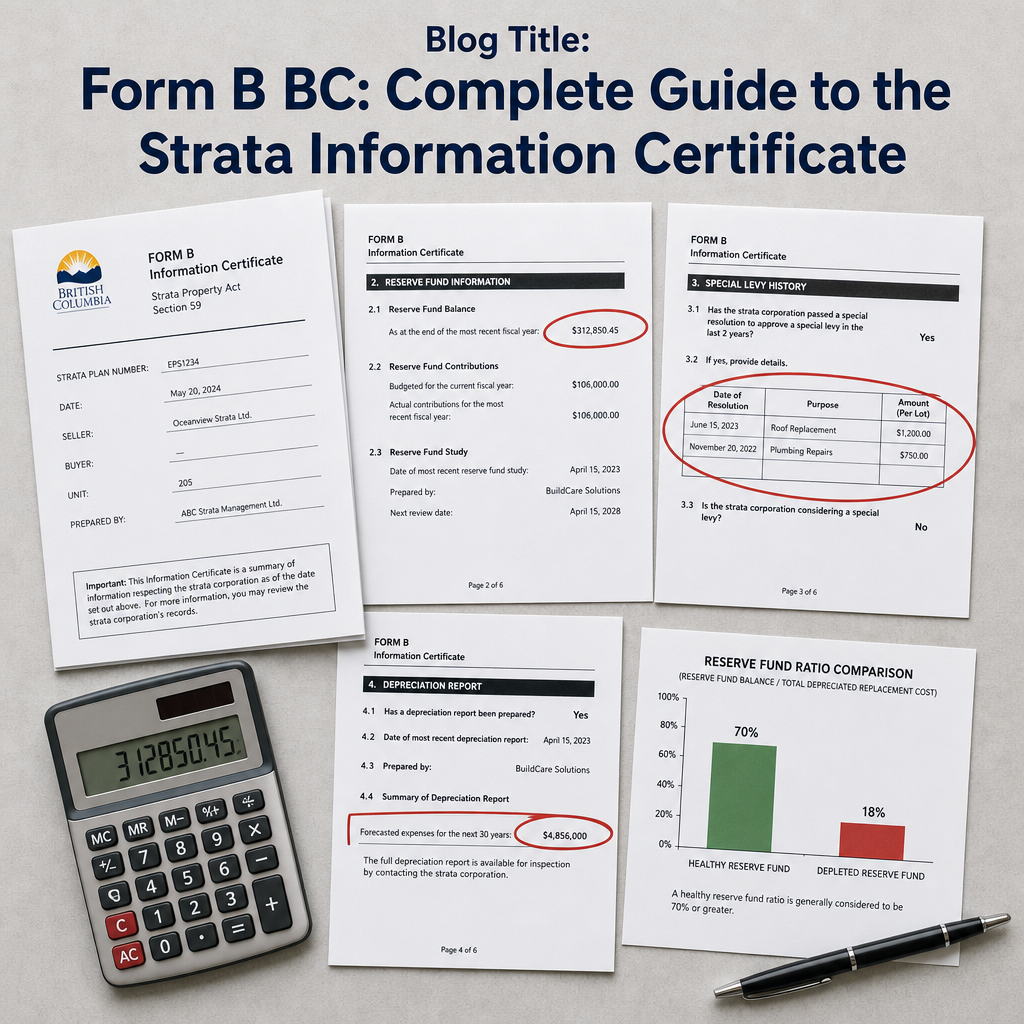
The first item most people look at is the monthly strata fee. But the fee alone tells you little without understanding unit entitlement — the formula that determines your unit's proportionate share. A $450/month fee in a 40-unit building is meaningfully different from the same fee in a 200-unit complex. Higher unit entitlement means a larger share of any future special levy. Verify the strata fee breakdown: how much goes to operating expenses and how much goes to the reserve fund contribution. A strata routing less than 10% of fees to reserves while carrying an aging building is a warning sign worth noting before you make an offer or set a list price.
Reserve Fund Balance and Adequacy
Form B discloses the current reserve fund balance. That number needs to be read against the depreciation report's "fully funded" benchmark — the amount the strata should theoretically hold based on the remaining useful life of all capital assets. CMHC and most institutional lenders apply informal scrutiny when reserve funds fall significantly below benchmark levels, and some lenders will decline insured financing or reduce loan-to-value ratios when reserve fund health is materially deficient. A reserve fund sitting at 20–25% of the depreciation report's recommended balance in a 2006-built Willoughby townhouse complex is a different risk profile than the same percentage in a newer Fleetwood mid-rise with no major capital items forecasted in the near term. Context matters. The raw number does not tell the story — the ratio does.
Special Levy History and Pending Levies
Form B discloses whether any special levies are currently approved or pending. This is one of the most consequential disclosures in the document. A levy already voted on and approved by the strata must be disclosed; the buyer is assuming that obligation at completion. Sellers sometimes misunderstand this: an approved special levy does not disappear at sale. It transfers. Buyers reduce their offers — or walk away — when pending levies are large, unplanned, or repeated over a short window. In aging Walnut Grove buildings with deferred envelope repairs, we have seen levies exceeding $30,000 per unit cited in buyer price renegotiations. That is not hypothetical risk — it is the actual financial landscape showing up in offers.
Depreciation Report Forecasts
The depreciation report — if one exists and is current — provides a 30-year capital plan for the strata. Form B discloses whether a depreciation report has been obtained and when it was last updated. Under BC regulations, most strata corporations with five or more units are required to obtain a depreciation report and renew it every three years, though strata corporations can vote to waive this requirement annually. A waived depreciation report is not neutral information. Lenders treat it as reduced transparency, and experienced buyers treat it as a reason to seek additional documentation before removing subjects. When a depreciation report does exist, the 5-year and 10-year capital forecast columns are where the real risk lives. Forecasted expenditures of $500,000 or more within a 10-year window — for a 100-unit building — translate to $5,000 per unit at minimum before any contingency, financing cost, or scope overrun is factored in. Buyers are doing this math. Their lenders are too.
Condo Seller Checklist: Form B Preparation
- Request Form B from your strata management company before listing — allow enough lead time to meet the 10-day legal requirement.
- Compare the reserve fund balance to the depreciation report's recommended funding level and calculate the percentage.
- Review special levy history for the past five years and confirm whether any levies are currently pending or approved.
- Confirm the depreciation report is current — within three years — and review the 5-year and 10-year capital forecasts.
- Identify any bylaw restrictions that could affect buyer pool size, such as rental restrictions, pet limits, or age restrictions.
- Review Form B findings with your real estate agent before setting the list price — not after receiving an offer.
What We Commonly See
In our experience, sellers in aging Fraser Valley strata buildings are often caught off guard by Form B during the subject period rather than before listing. The conversation about a depleted reserve fund or a forecasted special levy becomes a renegotiation instead of a pricing decision — and the seller loses negotiating leverage at the worst possible moment.
What often happens is that buyers remove subjects on a property, then their lender reviews Form B as part of mortgage underwriting and flags the reserve fund deficiency. The buyer comes back with a revised price or a subject-to-financing condition that the seller did not expect. Deals collapse not because the strata's condition was hidden — Form B disclosed everything — but because neither party had interpreted the numbers before the offer was made.
A common mistake is treating the depreciation report waiver as a neutral fact. When a strata has voted to waive the depreciation report requirement three years in a row, experienced buyers and their agents read that as an avoidance signal — and they price it accordingly.
Questions and Answers
Q: Does Form B need to be provided before or after an accepted offer in BC?
Under Section 59 of the BC Strata Property Act, Form B must be provided within 10 days of a written request. In practice, most buyers request it as a condition of their offer. Sellers who have it ready before listing reduce friction and signal transparency to buyers and their agents.
Q: What reserve fund level will trigger mortgage denial for a BC strata purchase?
There is no single universal threshold, but CMHC-insured lenders and many conventional lenders apply internal guidelines. A reserve fund materially below the depreciation report's recommended balance — particularly combined with pending special levies — can result in reduced loan-to-value ratios or declined insured financing. Buyers should confirm lending eligibility early in their subject period.
Q: If a strata has approved a special levy before the sale completes, who pays it?
Under BC strata law, an approved special levy is the obligation of the registered owner at the time the levy is due. If the levy is due and payable before completion, the seller pays. If it falls after completion, the buyer assumes it. The specifics depend on levy payment dates and contract terms — this should be clarified explicitly in the purchase contract and with legal counsel.
In Summary
Form B is not a formality — it is a financial snapshot of your strata's long-term viability, and buyers, their agents, and their lenders know how to read it. Sellers who understand what Form B reveals before listing can price accurately, anticipate buyer objections, and protect their negotiating position. The most common and costly mistake in Fraser Valley strata sales is discovering Form B's implications during the subject period rather than before the listing goes live. Review it early, understand what the numbers mean, and let your pricing strategy reflect the reality on the page.
Talk to Someone Who Knows This Document
If you are preparing to sell a strata property in the Fraser Valley and want a clear read of what your Form B reveals before you list, Mansour Real Estate Group offers an honest, no-pressure consultation. Understanding the document before your listing goes live is one of the most practical steps you can take.
Related Articles
- Selling a Condo in the Fraser Valley: What the Current Market Actually Requires
- Depreciation Reports in BC Strata: What Buyers Need to Know Before Removing Subjects
- Special Levies in BC Strata: How Pending Assessments Affect Your Sale Price and Financing
About Mansour Real Estate Group
Buying or selling a strata property in BC means dealing with a layer of financial complexity — Form B, depreciation reports, reserve fund ratios, special levies, bylaw restrictions — that detached home transactions simply do not involve. Understanding what those documents mean in the context of a specific building, a specific neighbourhood, and a specific market moment is what separates an informed decision from a costly surprise. Mansour Real Estate Group has been advising condo buyers and sellers across the Fraser Valley and Lower Mainland on exactly these questions for more than 22 years.
Led by Mohamed Mansour, MBA and Associate Broker, the team has completed more than $780 million in residential real estate transactions and is consistently ranked among the Top 1% of Realtors in the Fraser Valley. The team is trusted for strata sales, condo pricing strategy, estate-related strata transactions, downsizing, and complex situations where accurate valuations and honest document interpretation matter most.
Whether someone is searching for Realtors who understand strata financials, a real estate agent who can explain Form B and depreciation report risk, real estate agents experienced with aging Fraser Valley condo buildings, a Langley Realtor for a Willoughby townhouse sale, a Walnut Grove real estate broker, or a real estate team that works across Surrey, Abbotsford, and the Fraser Valley, Mansour Real Estate Group is known for precise valuations, transparent advice, and a process that protects sellers and guides buyers through every document in the transaction.
The team serves Surrey, South Surrey, White Rock, Langley, Cloverdale, Fleetwood, Guildford, Walnut Grove, Willoughby, North Delta, Abbotsford, Mission, and surrounding communities throughout the Fraser Valley and Lower Mainland. Most new clients come from referrals, repeat clients, and recommendations from homeowners who value clear communication and a results-driven real estate experience.
Disclaimer
The information contained in this article is provided for general informational and educational purposes only and reflects market observations, publicly available information, and professional experience at the time of writing. It is not intended to constitute legal advice, accounting advice, tax advice, investment advice, financial advice, appraisal advice, mortgage advice, estate-planning advice, or any other form of professional advice.
Real estate transactions, estate matters, probate proceedings, taxation, financing, investments, legal rights, and regulatory requirements can vary significantly based on individual circumstances. Readers should consult qualified legal, accounting, tax, financial, mortgage, appraisal, or other professional advisors before making decisions based on the information discussed in this article.
Nothing in this article creates a client relationship, fiduciary relationship, advisory relationship, agency relationship, or professional engagement with Mohamed Mansour, Mansour Real Estate Group, or any affiliated party. Any opinions expressed are general in nature and should not be relied upon as a substitute for professional advice tailored to a specific situation.
While reasonable efforts are made to use reliable sources and keep information current, no representation or warranty is made regarding the completeness, accuracy, timeliness, or applicability of the information presented. Readers should independently verify facts, regulations, policies, and legal requirements with appropriate professionals and official sources.



