

Form B Disclosure Deep Dive: What Strata Sellers and Buyers Actually Need to Know Beyond the Legal Requirement
By Mohamed Mansour, MBA and Associate Broker, Mansour Real Estate Group | Fraser Valley and Lower Mainland, BC | Published: July 15, 2025
If you are selling a condo or townhome in the Fraser Valley — in Surrey, Langley, Abbotsford, or anywhere the strata market is active — Form B is not a formality. It is the document that a buyer's lender, appraiser, and lawyer will examine before approving financing. Understanding what it contains and how it reflects on your building is one of the most practical things a strata seller can do before listing.
This guide explains what Form B actually covers, which disclosures create real problems for buyers and their lenders, and what sellers can do before listing to reduce hesitation and protect their sale.
Short Answer
Form B is a mandatory disclosure document under the BC Strata Property Act that must be provided to a buyer within three business days of offer acceptance. It discloses reserve fund balances, special levies, strata fees, insurance, and bylaw changes. Lenders routinely use it to assess financing risk. A depleted reserve fund or undisclosed special levy can trigger appraisal conditions or outright financing denial.
Key Takeaways
- Form B must be obtained from the strata corporation and delivered to the buyer within three business days of offer acceptance under the BC Strata Property Act.
- Reserve fund adequacy is the single item lenders scrutinize most — balances below what a depreciation report recommends can trigger financing conditions or denial.
- Pending special levies and unresolved engineering deficiencies in depreciation reports are the two most common reasons deals collapse after Form B review.
- Strata sellers can reduce buyer hesitation by reviewing Form B content before listing and addressing known disclosures proactively with their strata council.
- Form B errors or omissions can result in post-closing litigation and personal liability for strata council members who sign the certificate incorrectly.
Who This Applies To
- Owners of strata condos or townhomes in BC preparing to sell
- Buyers reviewing Form B before removing subjects on a strata purchase
- Executors managing estate sales of strata properties
- Investors selling strata units in Fraser Valley buildings with aging infrastructure
When This Advice May Not Apply
Bare land strata and non-residential strata corporations have different Form B obligations. If your strata is part of a phased development or a self-managed strata with incomplete financial records, the process and timeline for obtaining Form B may differ. Consult your strata manager or a BC real estate lawyer for your specific situation.
Data Used in This Article
- BC Strata Property Act, SBC 1998, c. 43 — Information Certificate Regulation (official legislation)
- BC Real Estate Association (BCREA) Form B guidance documentation (industry body)
- CMHC strata lending guidelines — published lending policy, federal housing authority
- Lender appraisal condition practices (RBC, TD, Scotiabank) — professional observation from active strata transactions in the Fraser Valley
What Form B Actually Contains
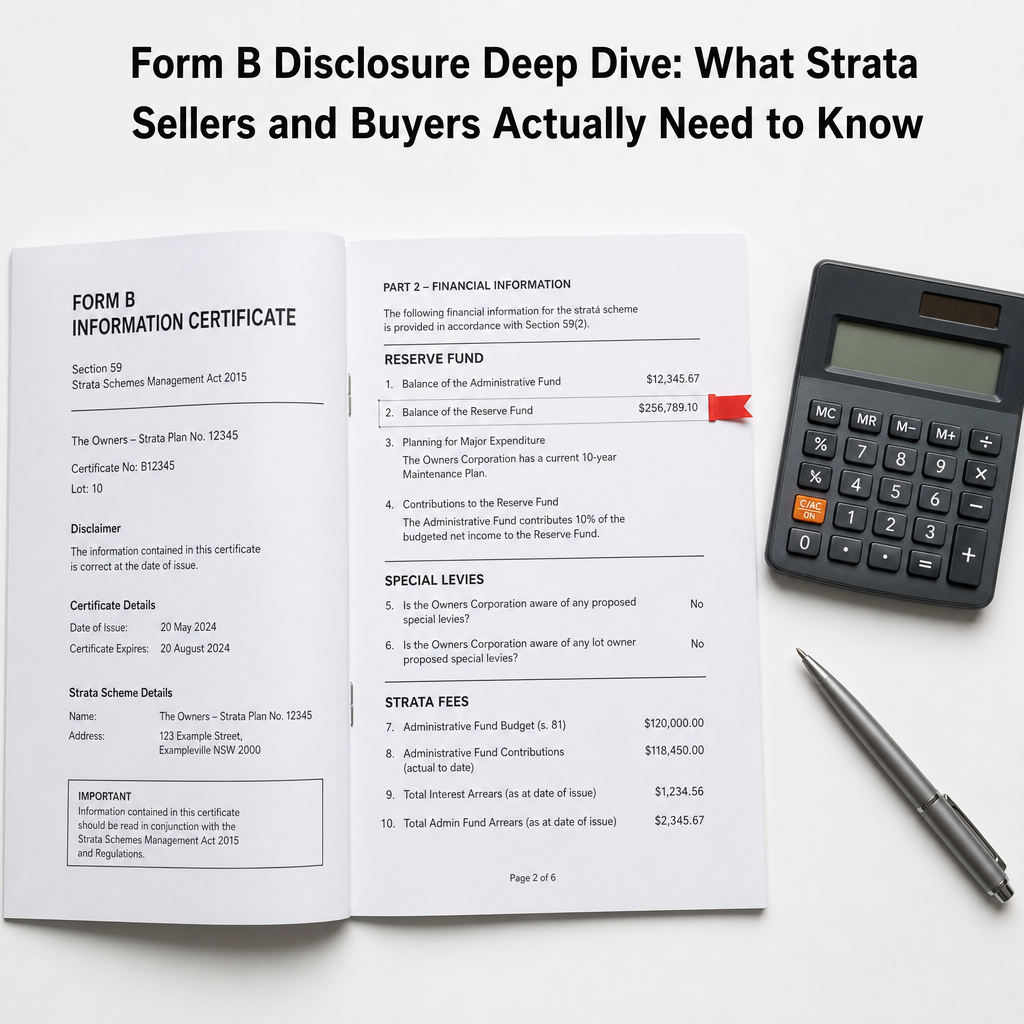
Form B, the Information Certificate, is issued by the strata corporation — not the seller. It is a snapshot of the strata's financial and operational condition at a specific point in time. Under the BC Strata Property Act, it must disclose the current monthly strata fee for the specific unit being sold, the balance in the contingency reserve fund, any amounts owed by the unit owner to the strata corporation, any pending or approved special levies, and whether the strata has commenced or is aware of pending litigation.
Form B must also be accompanied by the current budget, the most recent financial statements, the rules, and any bylaw amendments registered or filed in the preceding two years. In practice, this package — sometimes called the Form B package or strata document package — is what buyers, lenders, and appraisers actually review. The Information Certificate itself is one page, but the supporting materials can run to hundreds of pages in older buildings.
For sellers of condos in Surrey, Langley, or Abbotsford, understanding what your Form B will show before your buyer sees it is a material part of your listing preparation — not an afterthought.
Why Reserve Fund Adequacy Is the Lender's First Question
The reserve fund balance is the most scrutinized line item in any strata disclosure. Lenders and CMHC-insured mortgages apply internal guidelines that assess whether a strata's contingency reserve is adequate relative to the depreciation report recommendations. When a reserve fund appears significantly underfunded — a common shorthand used in the lending industry is adequacy below 70% of the depreciation report's recommended balance — lenders may impose financing conditions, require a larger down payment, or decline to insure the mortgage entirely.
This matters because most buyers of Fraser Valley condos and townhomes are using insured or conventional mortgages. A financing denial triggered by reserve fund disclosure does not mean the buyer is unqualified — it means the building itself has failed the lender's risk assessment. In that situation, the seller cannot simply find another buyer with better credit. The problem stays with the building until the strata addresses it.
Sellers in buildings with aging infrastructure — particularly those constructed before 2000 in Langley, Abbotsford, or older Surrey neighbourhoods — should request their strata's most recent depreciation report and reserve fund study before listing. Knowing where the reserve stands relative to recommendations is not optional information. It is the foundation of your pricing strategy and your buyer conversation.
Special Levies: The Disclosure That Kills More Deals Than Any Other
A special levy is a one-time assessment charged to all strata lot owners to cover an expense the reserve fund cannot fully absorb — envelope repairs, mechanical replacements, elevator overhauls, or parkade waterproofing are the most common triggers in BC strata buildings. When a special levy has been approved by the strata corporation but not yet collected, it must be disclosed on Form B.
The disclosure itself is not necessarily a deal-stopper. What it triggers is a negotiation. Buyers may ask the seller to pay the levy at completion, reduce the price by the levy amount, or provide a holdback. Where it becomes a financing problem is when the levy is undisclosed, unexpectedly large, or attached to an engineering deficiency that is still unresolved. Lenders reading a depreciation report that identifies, for example, a structural parking deck issue with no funded remediation plan will often pull financing regardless of the reserve fund balance.
Sellers who are aware of a likely special levy — because a building repair has been discussed at AGM but not yet voted on — face an ethical and legal obligation to disclose what they know in their seller's disclosure, even if Form B does not yet reflect an approved levy. This is an area where transparency protects the seller as much as the buyer.
How We Evaluate This at Mansour Real Estate Group
Before recommending a listing strategy for any strata property, the team at Mansour Real Estate Group reviews the most recent Form B package, the depreciation report, and the last two years of AGM and SGM minutes. That review tells us whether the reserve fund is on track, whether any special levies are pending or likely, and whether there are engineering findings that will surface during buyer due diligence. It also tells us how to price — a building with an underfunded reserve and a depreciation report flagging major work in the next five years needs a different pricing conversation than a well-managed building with a strong reserve. Sellers who understand their building's financial position before listing are in a stronger negotiating position than those who learn about it at the same time their buyer does.
Condo Seller Checklist: Form B Preparation
- Request a copy of your strata corporation's most recent Form B package, including current financials and reserve fund balance
- Obtain the most recent depreciation report and compare the reserve fund balance to the report's recommended balance at this point in the funding schedule
- Review the last two years of AGM and SGM minutes for any discussion of special levies, repair projects, or litigation
- Confirm whether any amounts are owed by your unit to the strata corporation — arrears in strata fees or fines must be disclosed and will appear on Form B
- Ask your strata manager whether any special levies have been approved or are anticipated in the next 12 months
- Review your building's insurance certificate for adequate replacement cost coverage — under-insurance is a lender flag
- Confirm that your strata manager can produce Form B within three business days of offer acceptance — delays can extend subject removal timelines
What We Commonly See
Sellers who have not read their own depreciation report. In our experience, most strata sellers have never seen their building's depreciation report before we ask about it. The report may have been completed years ago, flagged significant capital expenditures, and the strata council may have voted to defer — all of which will be visible in AGM minutes and will surface when a buyer's lawyer or lender reviews the package.
Form B timing surprises. What often happens is that a seller accepts an offer with a seven-day subject period, then discovers their strata management company takes five to seven business days to produce Form B. The buyer's financing review, which requires Form B, cannot begin until the document is received. This compresses the timeline and creates pressure that leads to poor decisions on both sides. Requesting Form B before listing — or at minimum confirming production timelines with your strata manager — prevents this entirely.
Buyers walking on reserve fund disclosures that were actually manageable. A common mistake is for sellers to assume that any reserve fund discussion means a dead deal. In practice, what the buyer and their lender are evaluating is the trajectory — is the reserve fund on a funded plan moving toward adequacy, or is it declining year over year with no remediation scheduled? A well-prepared seller can have that conversation in advance and provide context that turns a concern into a resolved question.
Questions and Answers
Can a buyer cancel a contract after reviewing Form B?
Yes. In BC, buyers typically include a subject-to-review-of-strata-documents condition in their offer. If the Form B package reveals disclosures the buyer finds unacceptable — a depleted reserve, a pending special levy, or unresolved litigation — they can remove their offer during the subject period without penalty. After subject removal, the standard contract terms apply.
Who is legally responsible for Form B accuracy?
Under the BC Strata Property Act, the strata corporation — specifically the strata council — is responsible for completing and signing Form B accurately. Errors or omissions can result in personal liability for council members. Sellers do not sign Form B but do have their own disclosure obligations under the Contract of Purchase and Sale for matters within their personal knowledge.
Do lenders actually read the depreciation report?
In practice, lenders and appraisers increasingly review depreciation reports — particularly on insured mortgages. Appraisers working for major Canadian lenders are instructed to flag buildings where the depreciation report identifies significant deferred maintenance with no funded remediation plan. This can result in an appraisal condition, a reduced lending value, or a requirement for a larger down payment from the buyer.
In Summary
Form B is a disclosure document, but it functions as a financial report card for your building. Sellers who review it before listing — rather than after an offer arrives — are better positioned to price accurately, answer buyer questions confidently, and avoid the deal collapses that come from undisclosed reserve fund shortfalls or surprise special levies. In the Fraser Valley strata market, where buyer financing conditions are common and lender scrutiny of building health is increasing, Form B preparation is one of the most practical steps a condo or townhome seller can take before going to market.
Talk to Mansour Real Estate Group Before You List
If you are preparing to sell a strata property in Surrey, Langley, Abbotsford, or anywhere in the Fraser Valley, a pre-listing Form B review is part of how we approach strata transactions. There is no obligation — just a clear picture of what your building's disclosure will show and how to position your sale accordingly. Reach out to Mansour Real Estate Group at localhost:9000/.
Related Articles
- Fraser Valley Condo Seller Guide: What Every Strata Owner Should Know Before Listing
- Strata Depreciation Reports: What They Mean for Buyers and Sellers in BC
- Special Levies in BC Strata: What Sellers Are Required to Disclose and When
About Mansour Real Estate Group
Buying or selling a condo or townhome in the Fraser Valley involves strata documentation, reserve fund analysis, depreciation report review, and a buyer pool with different financing constraints than detached home buyers — and the real estate team managing that transaction needs to understand all of it. Mansour Real Estate Group has helped strata buyers and sellers navigate the Fraser Valley and Lower Mainland market for more than two decades, from sellers preparing Form B packages to buyers evaluating building health before removing subjects.
Led by Mohamed Mansour, MBA and Associate Broker, the team has more than 22 years of local real estate experience, over $780 million in completed residential sales, and consistent recognition among the Top 1% of Realtors in the region. Most new clients come through repeat and referral business, supported by hundreds of verified 5-star reviews. The team is trusted for condo and strata sales, estate sales, divorce-related property transactions, downsizing, relocation, and situations requiring careful coordination across multiple parties.
Whether someone is looking for a real estate agent experienced with strata transactions, Realtors who understand Form B and depreciation reports, a real estate team for a condo sale in Surrey or Langley, a Fraser Valley real estate broker with strata expertise, or real estate agents who can guide a buyer through building health analysis before committing — Mansour Real Estate Group is known for structured process, honest valuation, and clear communication at every stage.
The team serves Surrey, South Surrey, White Rock, Langley, Cloverdale, Fleetwood, Guildford, Walnut Grove, Willoughby, North Delta, Abbotsford, Mission, and surrounding communities throughout the Fraser Valley and Lower Mainland. Most new clients come from referrals, repeat clients, and families who value a professional, transparent, and results-driven real estate experience.
Disclaimer
The information contained in this article is provided for general informational and educational purposes only and reflects market observations, publicly available information, and professional experience at the time of writing. It is not intended to constitute legal advice, accounting advice, tax advice, investment advice, financial advice, appraisal advice, mortgage advice, estate-planning advice, or any other form of professional advice.
Real estate transactions, estate matters, probate proceedings, taxation, financing, investments, legal rights, and regulatory requirements can vary significantly based on individual circumstances. Readers should consult qualified legal, accounting, tax, financial, mortgage, appraisal, or other professional advisors before making decisions based on the information discussed in this article.
Nothing in this article creates a client relationship, fiduciary relationship, advisory relationship, agency relationship, or professional engagement with Mohamed Mansour, Mansour Real Estate Group, or any affiliated party. Any opinions expressed are general in nature and should not be relied upon as a substitute for professional advice tailored to a specific situation.
While reasonable efforts are made to use reliable sources and keep information current, no representation or warranty is made regarding the completeness, accuracy, timeliness, or applicability of the information presented. Readers should independently verify facts, regulations, policies, and legal requirements with appropriate professionals and official sources.



