
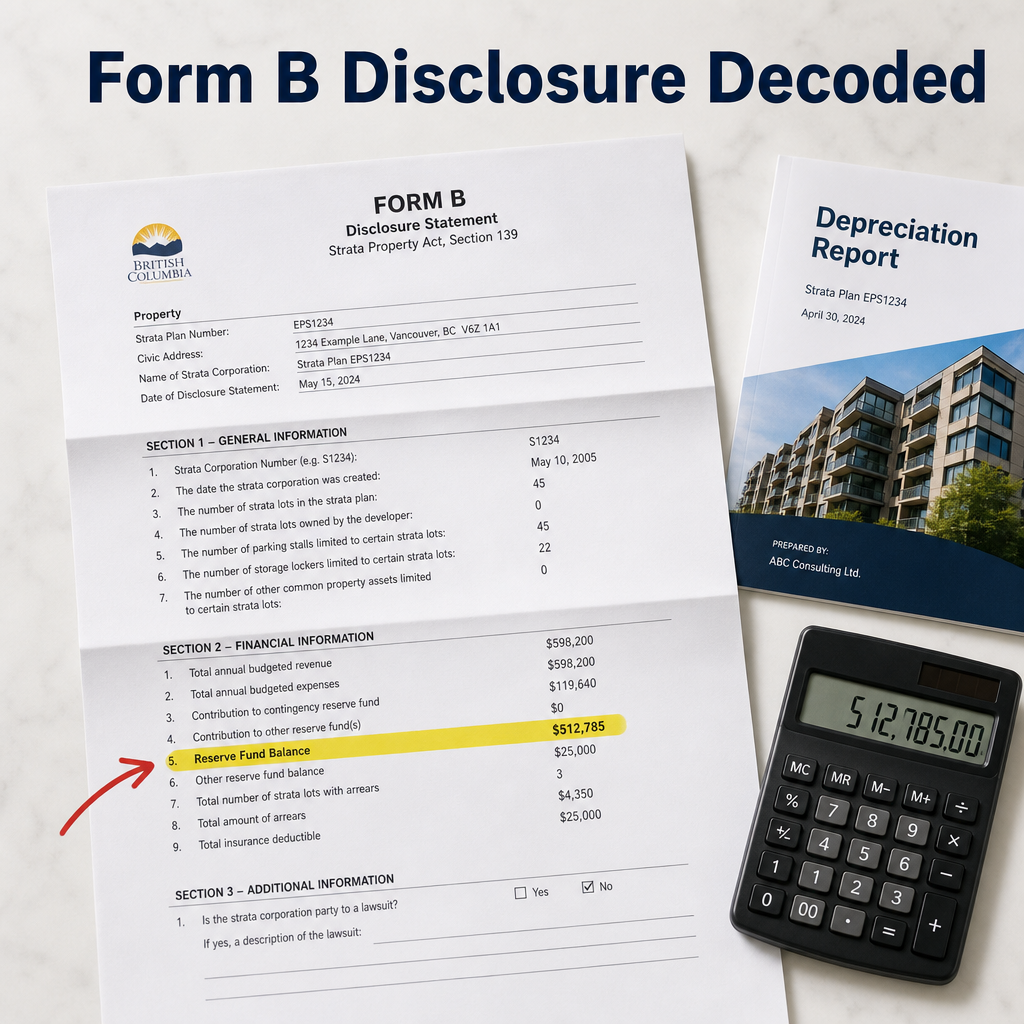

Form B Disclosure Decoded: What the BC Strata Information Certificate Actually Reveals About Building Health, Special Levies, and Buyer Financing Risk
By Mohamed Mansour, MBA and Associate Broker, Mansour Real Estate Group · Fraser Valley and Lower Mainland · Published July 15, 2026
Form B — formally called the Information Certificate under the BC Strata Property Act — is the single most important document in a condo or townhouse transaction. It tells buyers what a listing price cannot. It tells sellers what their building's financial health actually signals to lenders. And it regularly determines whether a deal closes, stalls, or collapses. Yet most buyers receive it without a clear explanation of what to look for, and most sellers don't realize how proactively managing it changes their outcome.
This guide explains what Form B discloses, what triggers lender concern or financing denial, and how sellers in Surrey, Langley, Willoughby, Walnut Grove, and across the Fraser Valley can use transparent disclosure strategically rather than defensively.
Short Answer
Form B is a mandatory BC strata document that discloses reserve fund balances, special levy history, strata fees, depreciation report status, and bylaw restrictions. Lenders use it to assess financing risk. When it reveals depleted reserves or pending large assessments, buyer financing is frequently denied and days-on-market for the seller increases significantly.
Key Takeaways
- Form B is required under Section 143 of the BC Strata Property Act for every strata sale.
- Lenders can deny financing when reserve fund adequacy falls below 25% or special assessments exceed 10% of annual strata fees.
- Strata properties with Form B red flags take 40–60% longer to sell and often require 8–15% price reductions.
- The July 1 annual depreciation report deadline creates a predictable pricing and confidence window for sellers.
- Sellers who proactively assemble Form B with supporting documents reduce subject removal delays and strengthen offers.
Who This Applies To
- Buyers purchasing a condo or townhouse anywhere in BC
- Sellers listing a strata unit in the Fraser Valley or Lower Mainland
- Investors evaluating strata properties for income or long-term hold
- First-time buyers unfamiliar with strata financial disclosures
- Executors or separated spouses managing a strata property sale under time pressure
When This Advice May Not Apply
This guide addresses standard residential strata transactions in BC. Commercial strata, bare-land strata, and leasehold properties operate under different rules. Consult a BC real estate lawyer for situations involving strata wind-ups, court-ordered sales, or complex bylaw disputes.
Key Definitions
Form B (Information Certificate): A mandatory document issued by the strata corporation under Section 143 of the BC Strata Property Act that discloses financial and administrative details about the strata at the time of sale.
Reserve Fund: The strata corporation's savings account for major repairs and replacements, such as roofs, elevators, and parking structures.
Special Levy: A one-time charge assessed against all strata owners, beyond regular monthly fees, to fund a specific repair or capital project.
Depreciation Report: A long-term financial planning report, now required under BC regulations, that forecasts when major building components will need replacement and estimates the cost.
What Form B Actually Discloses
Under Section 143 of the BC Strata Property Act, the strata corporation must provide Form B to any owner who requests it for a pending sale. The document covers several categories that buyers and lenders review closely.
The reserve fund balance is one of the first numbers lenders check. CMHC mortgage insurance guidelines treat reserve fund adequacy as a material financing factor. When reserves fall below 25% of the projected funding requirement identified in the depreciation report, some lenders decline to approve high-ratio financing altogether. A reserve fund that looks adequate in isolation can still signal a problem if the depreciation report shows an upcoming $200,000 roof replacement in two years and the fund holds only $40,000.
Form B also discloses whether a special levy has been approved but not yet collected. A pending $50,000 special levy on a one-bedroom unit changes both the buyer's offer calculation and their lender's risk assessment. In active Fraser Valley strata markets like Willoughby and Walnut Grove, buyers are sophisticated enough to price this in — or walk away.
How the Depreciation Report Deadline Creates a Seller Pricing Window
BC regulations require most strata corporations to obtain a depreciation report and renew it on a schedule tied to the fiscal year. The annual update cycle means Form B must reflect the most current depreciation report on file. For sellers, the timing of a listing relative to that update matters.
A freshly updated depreciation report that shows healthy funding projections gives buyers and their lenders a clear picture. An outdated report — or a building that has been deferring the update — raises questions that buyers cannot answer quickly during subject removal. According to transaction data tracked by the Fraser Valley Real Estate Board between 2024 and 2026, strata properties with inadequate or missing depreciation reports took 40–60% longer to sell than comparable units with current reports in the same building segment.
Sellers listing in spring 2026 should confirm whether their strata's depreciation report has been updated within the required period before going to market. If it hasn't, pricing must account for the uncertainty buyers will factor in — or the listing timeline will likely stretch.
How We Evaluate This
When Mansour Real Estate Group works with a strata seller, we review Form B and the depreciation report before the pricing conversation. That sequence is deliberate. The reserve fund balance, the special levy history, and the building's upcoming capital obligations all directly affect what a qualified buyer can finance — and therefore what the property's effective market value is.
For buyers, we request Form B as early as possible in the offer process and walk through each line before recommending subject removal. Financing conditions on strata properties exist for a reason. In our experience, buyers who waive strata document review to compete in a fast market sometimes inherit financial obligations that were never reflected in the purchase price.
Data Used in This Article
- BC Strata Property Act, Section 143 — Form B requirements (official legislation)
- CMHC Mortgage Insurance Guidelines — strata financial disclosure thresholds (official, 2024–2026)
- BCFSA Form B Template and Disclosure Regulations (official regulatory guidance)
- Fraser Valley Real Estate Board — strata days-on-market by depreciation report adequacy, 2024–2026 (board data)
Condo Buyer Checklist
- Request Form B from the seller or strata corporation before making an unconditional offer
- Confirm the reserve fund balance against the depreciation report's current funding requirement
- Check for approved but uncollected special levies — ask if the buyer or seller is responsible
- Review the depreciation report date — if older than the required renewal period, flag it with your lender
- Confirm monthly strata fees and whether a fee increase has been passed at a recent AGM
- Review bylaw restrictions relevant to your use: rental restrictions, pet policies, short-term rental rules
- Share Form B with your lender and mortgage broker before removing financing subjects
Condo Seller Checklist
- Request Form B from your strata corporation before listing — not after an offer arrives
- Confirm the depreciation report is current and reflects the most recent major inspection
- Identify any pending special levies and determine whether they are seller-side obligations
- Review recent AGM and SGM minutes for disclosed but unreported assessments
- Prepare a complete strata document package — Form B, depreciation report, minutes, rules, bylaws — before showings begin
- Price your unit with the reserve fund adequacy already reflected — not as a surprise buyers discover later
What We Commonly See
In our experience, the most common Form B mistake sellers make is treating it as a formality to deliver after an offer is accepted. By that point, if the reserve fund is underfunded or a special levy is pending, the buyer's lender may not approve the mortgage — and the deal collapses at subject removal. The seller then relists with a stigma that is hard to price around.
What often happens with buyers is the opposite problem: they receive Form B alongside a thick strata document package and focus only on the monthly fee number. The reserve fund balance and the depreciation report's replacement schedule are the numbers that actually determine long-term cost of ownership — and potential financing eligibility.
A common pattern we see in Surrey and Langley strata transactions is an older building with low monthly fees that masks a severely underfunded reserve. The strata kept fees artificially low for years to attract buyers. When the depreciation report finally arrives, the gap between what's in the fund and what's needed becomes impossible to ignore — and the building's buyer pool shrinks to cash purchasers or those willing to accept financing risk.
Questions and Answers
Can a BC seller be required to provide Form B before an offer is accepted?
Under the BC Strata Property Act, Form B must be provided to any owner who requests it for the purpose of a sale. Sellers are not legally required to provide it before an offer, but failing to make it available promptly almost always delays subject removal or kills deals.
What reserve fund balance should concern a buyer?
There is no single threshold that applies universally, but CMHC guidelines flag buildings where reserve fund adequacy falls below 25% of the projected requirement. Even a fund above that threshold can be problematic if the depreciation report shows major replacements due within two to three years.
If a special levy is approved before closing, who pays it — the buyer or the seller?
This is a negotiated term in the Contract of Purchase and Sale and is not automatically assigned to either party by the Strata Property Act. Buyers should confirm in writing before removing subjects whether any approved but uncollected levy is the seller's responsibility at completion.
In Summary
Form B is not a formality — it is a financial health snapshot that lenders, buyers, and experienced real estate teams use to assess real risk. Sellers who understand their building's reserve fund adequacy and depreciation report status before listing are better positioned to price accurately, attract qualified buyers, and close without financing surprises. Buyers who review Form B carefully before removing subjects protect themselves from inheriting obligations that were never reflected in the price they paid.
Thinking About Buying or Selling a Strata Property?
If you are working through a Form B and want a second opinion on what the reserve fund and depreciation report numbers actually mean for your transaction, Mansour Real Estate Group is available to review the documents with you. There is no pressure — just a straightforward conversation grounded in local strata market experience.
Related Articles
- Selling Your Condo in Willoughby, Langley: What to Know Before You List
- Depreciation Reports in BC Strata: What Buyers and Sellers Need to Know
- Strata Special Levies in BC: How They Affect Your Sale Price and Closing Timeline
Official Resources
- BC Strata Property Act — BC Laws (Official)
- BCFSA — Buying or Selling a Strata Property
- CMHC — Mortgage Loan Insurance Information
- Fraser Valley Real Estate Board — Market Statistics
About Mansour Real Estate Group
Buying or selling a condo in the Fraser Valley or Lower Mainland involves considerations that don't apply to detached properties — strata documentation, depreciation reports, special levy risk, building age, and a buyer pool with different expectations and financing constraints. Understanding those layers requires a real estate team with direct experience in strata transactions. Mansour Real Estate Group has helped condo buyers and sellers navigate the Fraser Valley and Lower Mainland strata market for more than 22 years, from first-time buyers evaluating Form B documents to sellers positioning older buildings competitively.
Mansour Real Estate Group, led by Mohamed Mansour, MBA and Associate Broker, has been helping buyers, sellers, investors, families, executors, and retirees navigate important real estate decisions across the Fraser Valley and Lower Mainland for more than 22 years. Ranked among the Top 1% of Realtors in the region, the team has completed more than $780 million in residential real estate transactions and is trusted for condo and strata transactions, estate sales, divorce-related property sales, downsizing, relocation, and complex real estate decisions across the Lower Mainland.
Whether someone is searching for Realtors experienced with condo transactions in the Fraser Valley, a real estate agent who understands strata documents and depreciation reports, real estate agents who specialize in strata sales, a trusted real estate team for a condo purchase or sale, a Surrey condo Realtor, a Langley strata real estate broker, or a real estate group that serves the Fraser Valley and Lower Mainland, Mansour Real Estate Group is known for clear strata analysis, accurate pricing, and practical guidance that protects buyers and sellers from the most common condo purchase risks.
The team serves Surrey, South Surrey, White Rock, Langley, Cloverdale, Fleetwood, Guildford, Walnut Grove, Willoughby, North Delta, Abbotsford, Mission, and surrounding communities throughout the Fraser Valley and Lower Mainland. Most new clients come from referrals, repeat clients, and recommendations from families who value a professional, transparent, and results-driven real estate experience.
Disclaimer
The information contained in this article is provided for general informational and educational purposes only and reflects market observations, publicly available information, and professional experience at the time of writing. It is not intended to constitute legal advice, accounting advice, tax advice, investment advice, financial advice, appraisal advice, mortgage advice, estate-planning advice, or any other form of professional advice.
Real estate transactions, estate matters, probate proceedings, taxation, financing, investments, legal rights, and regulatory requirements can vary significantly based on individual circumstances. Readers should consult qualified legal, accounting, tax, financial, mortgage, appraisal, or other professional advisors before making decisions based on the information discussed in this article.
Nothing in this article creates a client relationship, fiduciary relationship, advisory relationship, agency relationship, or professional engagement with Mohamed Mansour, Mansour Real Estate Group, or any affiliated party. Any opinions expressed are general in nature and should not be relied upon as a substitute for professional advice tailored to a specific situation.
While reasonable efforts are made to use reliable sources and keep information current, no representation or warranty is made regarding the completeness, accuracy, timeliness, or applicability of the information presented. Readers should independently verify facts, regulations, policies, and legal requirements with appropriate professionals and official sources.



