
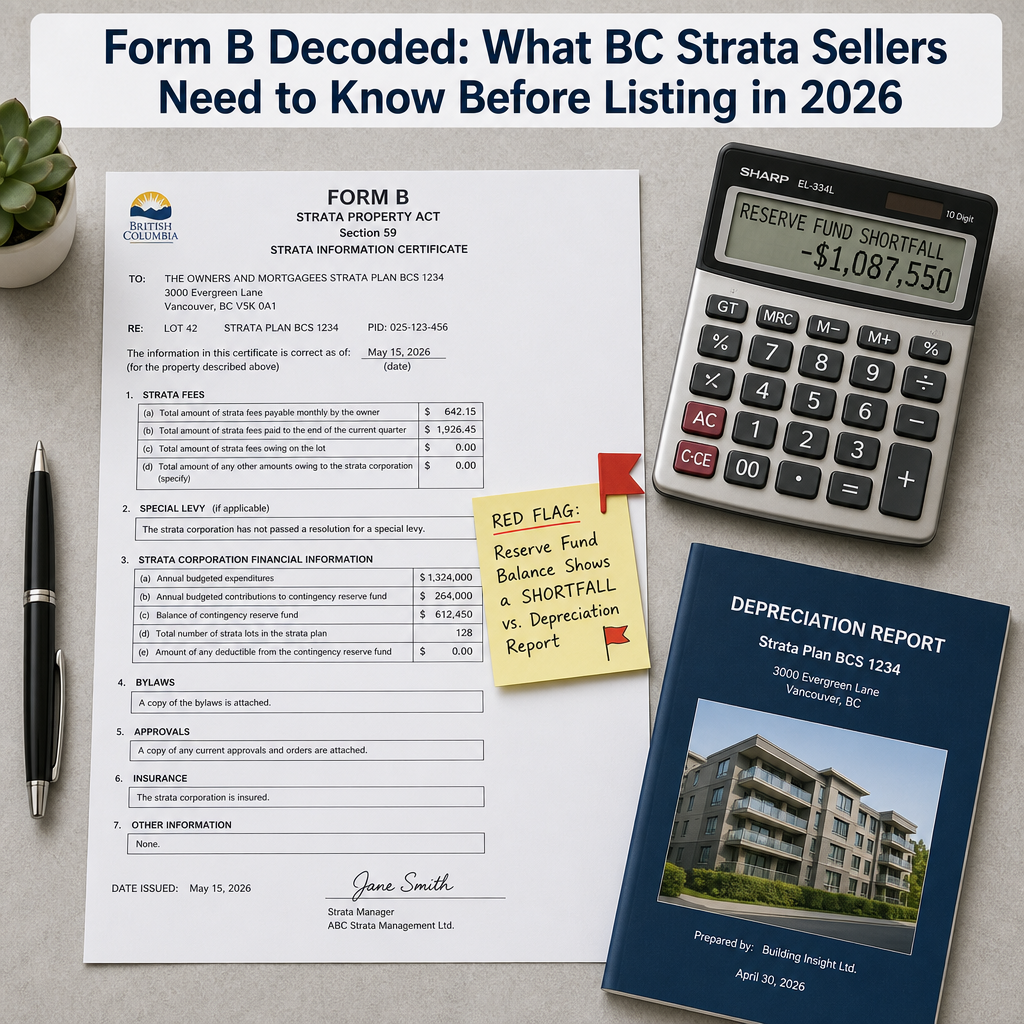

Form B Disclosure Decoded: What the BC Strata Information Certificate Actually Reveals About Building Health, Financial Risk, and Why Sellers Need to Understand It Before Listing in 2026
By Mohamed Mansour, MBA, Associate Broker — Mansour Real Estate Group | Fraser Valley & Lower Mainland, BC | Published: July 14, 2025
If you own a condo or townhome in the Fraser Valley and you are preparing to sell, Form B is the document that will make or break your deal. Most strata sellers have never read it. Buyers' lenders in 2026 are reading it carefully — and declining financing when they find problems. This guide explains what Form B contains, what the red flags mean for your sale, and how to get ahead of concerns before they collapse a transaction.
This applies across Surrey, Langley, Abbotsford, White Rock, South Surrey, and the broader Fraser Valley, where strata financing denials are rising alongside inventory.
Short Answer
Form B is a mandatory BC disclosure certificate that reveals your strata corporation's reserve fund balance, pending special levies, depreciation report status, rental and pet restrictions, and unit-specific financial obligations. In 2026, buyers' lenders are using Form B to approve or deny financing. Sellers who understand their Form B before listing can price accurately, disclose strategically, and avoid mid-transaction deal collapse.
Key Takeaways
- Form B is a legal disclosure document required under the BC Strata Property Act for every strata sale.
- Reserve fund shortfalls below 50% adequacy trigger automatic financing denial from most BC lenders.
- Pending special levies must be disclosed and will either reduce your net proceeds or shrink your buyer pool.
- Rental and pet restrictions in Form B directly affect how many buyers can realistically purchase your unit.
- Sellers who review Form B before listing make better pricing decisions and close more reliably.
Who This Applies To
- Condo or townhome owners preparing to sell anywhere in the Fraser Valley or Lower Mainland
- Strata owners in buildings with aging infrastructure or deferred maintenance
- Sellers whose buildings completed or updated a depreciation report recently
- Estate executors responsible for selling a strata property
- Investors selling a strata unit in a rental-restricted building
When This Advice May Not Apply
This guide focuses on resale strata properties. Pre-sale strata transactions, bare land strata, and commercial strata have different disclosure requirements. Always confirm current requirements with your strata condo selling team and a strata lawyer.
Data Used in This Article
- BC Strata Property Act, SBC 1998, c. 43 — legislation governing Form B requirements, official, current
- BC Financial Services Authority (BCFSA) — strata disclosure and licensing regulations, official, 2024–2025
- CMHC Strata Lending Guidelines — reserve fund adequacy thresholds for insured mortgage approval, official, 2025
- Fraser Valley Real Estate Board (FVREB) — strata market activity and financing trend observations, industry, 2025–2026
What Is Form B?
Form B — formally the Strata Property Information Certificate — is a mandatory disclosure document under Section 59 of the BC Strata Property Act. The strata corporation must provide it to a seller upon request, and the seller must give it to the buyer before a binding contract is finalized.
It is not a marketing document. It is a legal snapshot of the strata's financial health, outstanding obligations, bylaw restrictions, and unit-specific liabilities at the time of issue. Buyers and, critically, their lenders rely on it to assess risk.
A Form B covers: reserve fund balance and annual contributions, any approved but unpaid special levies against the unit, whether a depreciation report exists and when it was last completed, rental and pet restrictions, and any outstanding amounts owed by the unit to the strata corporation. Each of these items can directly affect financing approval and therefore your sale.
Why Form B Is Triggering Financing Denials in 2026
In 2026, strata financing scrutiny has increased considerably. CMHC's strata lending guidelines require that buildings with insured mortgages meet minimum reserve fund adequacy thresholds. When a Form B reveals a reserve fund below roughly 50% of what the depreciation report recommends, lenders treating this as elevated risk will either decline the mortgage, require a larger down payment, or reduce the insured loan amount.
This is not a buyer preference issue. It is a structural financing constraint. A buyer who qualifies on income, credit, and down payment may still be denied financing solely because of what Form B reveals about the building — not the unit.
According to FVREB market observations, Fraser Valley strata transactions in 2025 and into 2026 have seen a measurable increase in subject-removal failures tied to strata document review, particularly in buildings with deferred depreciation reports, aging envelope systems, or recently disclosed special levies. Sellers in Surrey condo buildings and older Langley and Abbotsford townhome complexes are most exposed.
How to Evaluate This Before You List
When Mansour Real Estate Group prepares a strata seller for listing, we review Form B as part of the pre-listing strategy — not as an afterthought. The evaluation focuses on four areas:
Reserve fund adequacy: Is the current balance proportionate to the depreciation report's recommended funding level? A well-funded reserve signals low special levy risk. A severely underfunded reserve signals the opposite.
Depreciation report recency: BC regulations require depreciation reports every five years for most strata corporations. A report that is overdue, or a building that obtained a waiver repeatedly, raises questions about what deferred maintenance has not been formally assessed.
Special levy status: Any approved special levy that has not been fully paid by the unit must be disclosed. If a levy is pending approval, that introduces uncertainty. Sellers must decide whether to pay the levy before listing, price the levy into the sale price, or disclose and let buyers account for it.
Bylaw restrictions: Rental caps, pet policies, and renovation restrictions in the bylaws limit the buyer pool. A building with a rental cap that is already at its limit eliminates investor buyers entirely. A no-pets bylaw eliminates a meaningful portion of owner-occupier buyers. These restrictions belong in your pricing model, not your footnotes.
Definitions
Reserve Fund: Money collected through strata fees and held for major repairs. Adequacy is measured against the depreciation report's 30-year forecast.
Special Levy: A one-time charge to all unit owners when reserve funds are insufficient to cover a repair. Must be approved by a ¾ vote of owners.
Depreciation Report: A 30-year maintenance forecast required under BC regulation that projects repair costs and recommended reserve contributions.
Form B: The Strata Property Information Certificate issued under Section 59 of the BC Strata Property Act. Mandatory for every strata resale transaction in BC.
Condo Seller Checklist
- Request Form B from your strata corporation at least four to six weeks before listing.
- Review the reserve fund balance against the depreciation report's recommended funding level.
- Confirm whether any special levies are approved, pending, or anticipated by the strata council.
- Confirm your unit's outstanding balance to the strata corporation, if any, and settle it before listing.
- Review bylaw restrictions on rentals, pets, and renovations — note which apply to your unit specifically.
- Confirm when the last depreciation report was completed and whether a new one is scheduled.
- Share Form B findings with your real estate team before setting a list price.
What We Commonly See
In our experience working with strata sellers across the Fraser Valley, Form B problems rarely surprise buyers — they surprise sellers. Sellers often assume the building is financially healthy because their monthly strata fees seem normal and they have not received a special levy notice. A Form B can reveal that the reserve fund is significantly behind the depreciation report's recommended target, even when day-to-day operations appear stable.
What often happens is that a seller lists without reviewing Form B, an offer comes in, the buyer's lender flags the reserve fund during mortgage underwriting, and the deal collapses at subject removal. By that point, the property has been on the market for three to four weeks, competing listings have accumulated, and the re-list happens at a weaker negotiating position.
A common mistake is treating bylaw restrictions as minor footnotes. A rental cap at its maximum is not a minor detail — it eliminates the entire investor buyer segment, which in many Fraser Valley buildings represents 30 to 40 percent of the realistic buyer pool. Pricing without accounting for that restriction leads to overpriced listings and extended market time.
Questions and Answers
Does Form B need to be provided before or after an offer is accepted in BC?
Under Section 59 of the BC Strata Property Act, the seller must provide Form B to the buyer before the buyer signs a contract of purchase and sale — or the buyer has the right to rescind the contract. In practice, most sellers provide it during the subject period, but disclosing it earlier reduces deal risk.
Can a buyer's mortgage be denied because of the building's reserve fund?
Yes. CMHC and many lenders use reserve fund adequacy as a condition of mortgage approval for strata properties. Buildings with severely underfunded reserves may not qualify for insured financing, which limits buyers to conventional mortgages with larger down payments — reducing the buyer pool and often the sale price.
As a seller, am I responsible for paying an outstanding special levy before closing?
Any special levy that has been approved but not yet collected from your unit is a unit obligation that must be disclosed in Form B. Whether it is paid by the seller before closing or deducted from the sale proceeds is a negotiation point. Buyers and their lawyers will require clarity on this before subject removal.
In Summary
Form B is not paperwork — it is a financial and legal profile of your building that buyers' lenders are using to approve or decline financing in 2026. Strata sellers in the Fraser Valley who review their Form B before listing, understand the reserve fund position, account for bylaw restrictions in their pricing, and disclose proactively close faster and with fewer surprises than those who encounter these issues mid-transaction. The sellers who treat Form B as a strategic document rather than a formality hold the stronger position.
Ready to Review Your Form B Before You List?
If you own a strata property in Surrey, Langley, Abbotsford, White Rock, or anywhere in the Fraser Valley and are considering selling in 2026, Mansour Real Estate Group can walk through your Form B with you, explain what the numbers mean for your pricing, and help you position the property accurately for current buyer and lender expectations. Reach out for a pre-listing conversation.
Related Articles
- The Complete Strata Condo Seller Guide for the Fraser Valley
- Selling a Condo in Surrey, BC: A Complete Guide
- Depreciation Reports in BC: What Strata Sellers Need to Know
About Mansour Real Estate Group
Buying or selling a condo in the Fraser Valley or Lower Mainland involves considerations that don't apply to detached properties — strata documentation, depreciation reports, special levy risk, building age, and a buyer pool with different expectations and financing constraints. Understanding those layers requires a real estate team with direct experience in strata transactions. Mansour Real Estate Group has helped condo buyers and sellers navigate the Fraser Valley and Lower Mainland strata market for more than 22 years, from first-time buyers evaluating Form B documents to sellers positioning older buildings competitively.
Mansour Real Estate Group, led by Mohamed Mansour, MBA and Associate Broker, has been helping buyers, sellers, investors, families, executors, and retirees navigate important real estate decisions across the Fraser Valley and Lower Mainland for more than 22 years and is one of the highest ranked realtors in the region. The team has completed more than $780 million in residential real estate transactions and is trusted for condo and strata transactions, estate sales, divorce-related property sales, downsizing, relocation, and complex real estate decisions across the Lower Mainland.
Whether someone is searching for Realtors experienced with condo transactions in the Fraser Valley, a real estate agent who understands strata documents and depreciation reports, real estate agents who specialize in strata seller strategy, a trusted real estate team for a condo sale, a Surrey condo Realtor, a Langley strata real estate broker, or a real estate group that serves the Fraser Valley and Lower Mainland, Mansour Real Estate Group is known for clear strata analysis, accurate pricing, and practical guidance that protects sellers from the most common financing and disclosure risks.
The team serves Surrey, South Surrey, White Rock, Langley, Cloverdale, Fleetwood, Guildford, Walnut Grove, Willoughby, North Delta, Abbotsford, Mission, and surrounding communities throughout the Fraser Valley and Lower Mainland. Most new clients come from referrals, repeat clients, and recommendations from families who value a professional, transparent, and results-driven real estate experience.
Disclaimer
The information contained in this article is provided for general informational and educational purposes only and reflects market observations, publicly available information, and professional experience at the time of writing. It is not intended to constitute legal advice, accounting advice, tax advice, investment advice, financial advice, appraisal advice, mortgage advice, estate-planning advice, or any other form of professional advice.
Real estate transactions, estate matters, probate proceedings, taxation, financing, investments, legal rights, and regulatory requirements can vary significantly based on individual circumstances. Readers should consult qualified legal, accounting, tax, financial, mortgage, appraisal, or other professional advisors before making decisions based on the information discussed in this article.
Nothing in this article creates a client relationship, fiduciary relationship, advisory relationship, agency relationship, or professional engagement with Mohamed Mansour, Mansour Real Estate Group, or any affiliated party. Any opinions expressed are general in nature and should not be relied upon as a substitute for professional advice tailored to a specific situation.
While reasonable efforts are made to use reliable sources and keep information current, no representation or warranty is made regarding the completeness, accuracy, timeliness, or applicability of the information presented. Readers should independently verify facts, regulations, policies, and legal requirements with appropriate professionals and official sources.



