

Foreign Buyer Prohibition Act Impact on Metro Vancouver Real Estate 2026: Who's Actually Affected, Which Properties Are Exempt, and Whether the Ban Has Meaningfully Shifted Buyer Demand or Pricing
By Mohamed Mansour, MBA and Associate Broker, Mansour Real Estate Group | Fraser Valley and Lower Mainland | Published: July 15, 2025 | Market Insight
The federal foreign buyer ban has been in place since January 2023, yet confusion about who it covers, what it exempts, and what it has actually done to Vancouver prices remains widespread. Sellers pricing luxury properties, buyers with international connections, and investors navigating presale markets all need a clearer picture than the headlines have provided.
This article explains who the Prohibition on the Purchase of Residential Property by Non-Canadians Act applies to, which exemptions are legally significant, and what the available data shows about its real impact on Metro Vancouver buyer pools and pricing. It is not legal advice — consult qualified legal counsel for your specific situation.
Short Answer
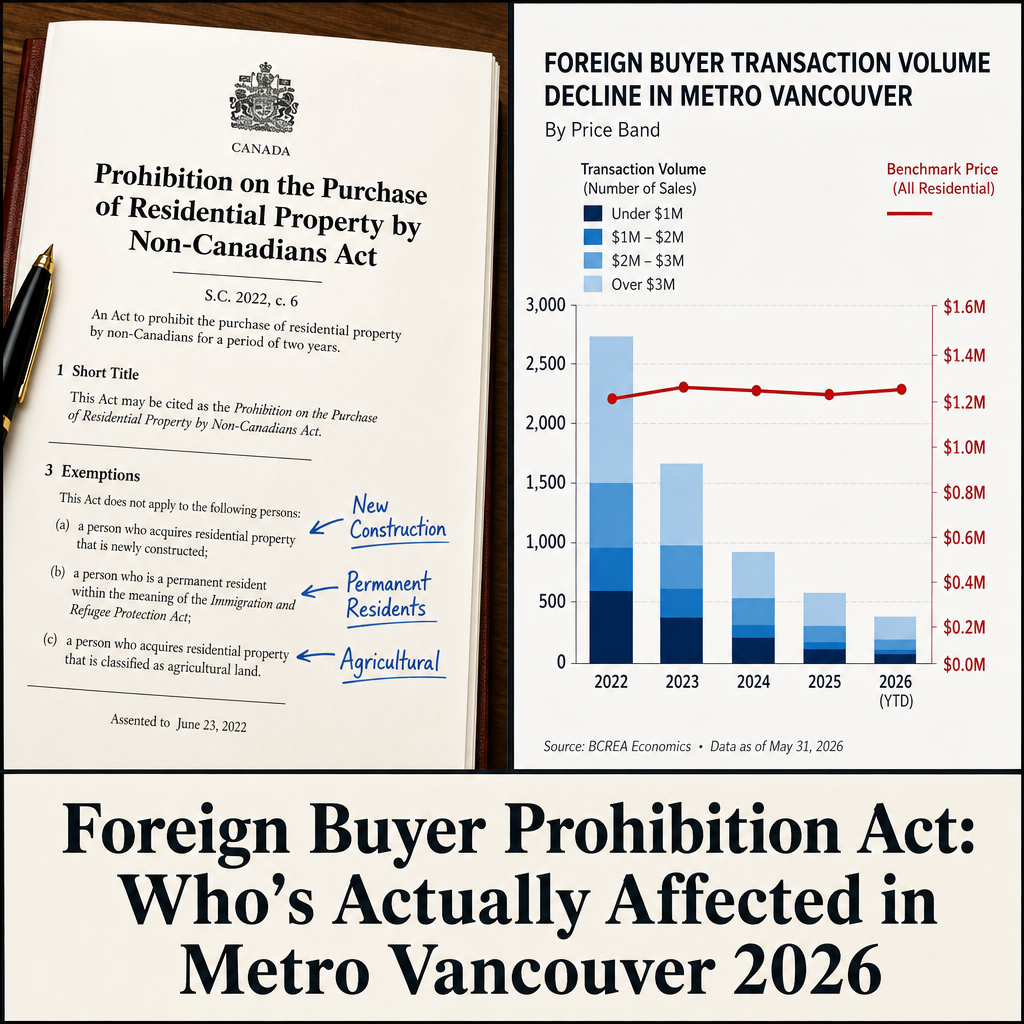
The foreign buyer ban prohibits non-Canadian citizens and non-permanent residents from purchasing most residential property in Canada. Permanent residents, new construction buyers, and certain other categories remain exempt. In Metro Vancouver, foreign investor transaction volume fell measurably after 2023, but prices stabilized rather than dropped — suggesting domestic buyers absorbed much of the displaced demand.
Key Takeaways
- Permanent residents are fully exempt from the ban, which preserves a significant portion of internationally connected buyers in Metro Vancouver.
- New residential construction is exempt for approximately two years post-completion, redirecting foreign capital toward presale and new-build transactions.
- Metro Vancouver luxury markets above $2 million saw a 25 to 35 percent decline in foreign investor transaction volume, but average prices did not fall sharply.
- Corporations and holding companies with non-Canadian beneficial owners face enforcement uncertainty, creating a legal gray zone that sophisticated buyers have used.
- The practical impact of the ban varies significantly by price band, property type, and neighbourhood — it is not a uniform market shift.
Who This Applies To
- Sellers of Metro Vancouver residential property priced above $1.5 million with a historically international buyer pool
- Buyers with non-Canadian citizenship or temporary immigration status evaluating purchase options
- Investors holding or planning to acquire residential property through corporate or trust structures
- Presale and new construction buyers seeking to understand exemption timelines
- Executors, families, and estate beneficiaries where property was acquired by non-Canadian individuals
When This Advice May Not Apply
This article addresses the federal prohibition. Additional provincial and municipal foreign buyer taxes, including BC's Foreign Buyers Tax, operate separately and may apply under different rules. Cross-border estate situations, corporate ownership structures, and trust arrangements require qualified legal review — the interaction between the prohibition and corporate ownership is actively debated and has not been uniformly resolved through enforcement.
Data Used in This Article
- Government of Canada — Prohibition on the Purchase of Residential Property by Non-Canadians Act official guidance and regulations (federal statute, 2023)
- BC Real Estate Association — market analysis on foreign buyer activity, 2023 to 2026 (industry body, ongoing)
- CMHC — housing research on foreign buyer restriction impact in Vancouver (federal housing agency, published reports)
- Canadian Bar Association — commentary on enforcement challenges and exemption interpretation (professional commentary, 2023 to 2025)
Key Definitions
Non-Canadian: Under the Act, a non-Canadian is an individual who is neither a Canadian citizen nor a permanent resident of Canada, and includes corporations incorporated outside Canada or controlled by non-Canadians.
Residential property: Under the Act's regulations, this covers buildings with fewer than four dwelling units, including detached homes, semi-detached homes, rowhouses, and condominium units — but not large purpose-built rental buildings.
Beneficial owner: The actual person who controls or benefits from an asset, even when legal title is held by a corporation or trust. Enforcement of the ban for corporate structures turns on identifying the beneficial owner.
Who the Ban Actually Covers — and Who It Doesn't
The Act prohibits non-Canadian citizens and non-permanent residents from purchasing residential property in Canada. That definition is narrower than most public discussion suggests. Canadian permanent residents — including many internationally connected buyers who have been living in Metro Vancouver and the Lower Mainland for years — are fully exempt. Work permit holders who meet specific criteria under the regulations may also qualify for an exemption when purchasing a principal residence.
New residential construction is exempt for approximately two years following project completion. This has had a measurable redirecting effect on foreign-connected capital — presale markets and newly completed buildings in Vancouver, Burnaby, and Richmond attracted continued interest from internationally connected buyers who could not purchase resale properties. Sellers of newly completed condos in Vancouver versus resale units are working with meaningfully different buyer pools as a result.
Agricultural properties, properties transferred by inheritance, and properties transferred by court order are also exempt. These exemptions preserve significant pathways for wealth transfer and family acquisitions that fall outside the ban's reach.
Corporate and trust ownership structures involving non-Canadian beneficial owners remain in a legal gray zone. The Act includes provisions targeting beneficial ownership, but enforcement has been uneven. The Canadian Bar Association has noted definitional ambiguities that sophisticated buyers and their legal counsel have used to navigate the restriction. This does not mean these structures are legal safe harbors — it means the enforcement picture is still developing, and buyers and sellers using these structures carry legal risk they should assess carefully with qualified counsel.
What the Data Shows About Price and Demand Impact in Metro Vancouver
The most frequently asked question about the foreign buyer ban is whether it pushed prices down. The short answer, based on CMHC research and BC Real Estate Association analysis covering 2023 to 2026, is: not materially, at least not at the benchmark price level. Foreign investor transaction volume in Metro Vancouver luxury markets — properties above $2 million — declined by approximately 25 to 35 percent following implementation. But average prices in those segments stabilized rather than falling sharply. The prevailing interpretation among housing researchers is that domestic buyers absorbed a meaningful share of the demand that foreign investors previously represented.
Entry-level and mid-market segments showed even less disruption. Foreign buyer activity in those price bands was already limited before the ban, meaning the restriction had less to remove. Sellers pricing below $1.5 million in Surrey, Langley, North Delta, or Abbotsford have seen little change in buyer pool composition attributable specifically to the foreign buyer prohibition — interest rate movements have been a far larger variable in those markets.
For sellers of high-value Vancouver, West Vancouver, and Richmond properties that historically attracted foreign capital, the more accurate framing is that the buyer pool narrowed without collapsing. Days on market in those segments lengthened somewhat, and pricing strategies became more sensitive to domestic buyer expectations — but the floor did not drop the way some early predictions suggested it would.
The ban's extension beyond its original January 2025 sunset date remains a policy question sellers should track. If the restriction was extended or renewed, sellers in internationally connected markets should understand that the current buyer pool composition reflects the ban being in place. Any future lifting of the restriction could expand the buyer pool in specific segments — particularly luxury detached homes in West Vancouver, presale towers in Richmond, and high-floor downtown condominiums. For context on how these policy-level shifts interact with broader market conditions, see the current Vancouver real estate market update.
How We Evaluate This
When sellers ask Mansour Real Estate Group about the foreign buyer ban's impact on their specific property, the evaluation starts with buyer pool analysis — not a blanket statement about the ban. A detached home in White Rock at $2.8 million draws a different foreign-connected buyer profile than a presale condo in Burnaby's Metrotown corridor. The analysis looks at recent comparable sales, current active competition, days on market trends, and whether the property's price point and location place it in a segment where the ban's buyer pool effect has been material or marginal.
The goal is to give sellers an accurate picture of who can actually make an offer, not a policy summary. That requires understanding both the legal structure of the ban and the real transaction data in the relevant neighbourhood and price band.
Seller Checklist: Navigating the Foreign Buyer Prohibition
- Confirm whether your property falls within the Act's definition of residential property — buildings with four or more units may be treated differently.
- If your property is newly completed or still under construction, understand the exemption window and how it affects your buyer pool marketing.
- Ask your real estate team to identify what percentage of comparable sales in your price range involved foreign-connected buyers before and after January 2023.
- If your property is positioned above $1.5 million in a historically international buyer market, factor narrowed buyer pool into your pricing strategy — not as a discount, but as a realistic absorption rate expectation.
- Do not accept an offer from a buyer without confirming their eligibility to purchase — your listing agent and their legal counsel should verify compliance before subjects are removed.
- If the property is held in a corporate or trust structure with non-Canadian connections, obtain qualified legal advice before listing — sale proceeds and compliance obligations may be complex.
- Monitor policy news around the ban's extension or expiry, since changes to the restriction could affect spring market timing and buyer pool size in your segment.
What We Commonly See
Sellers overestimating the ban's price impact in mid-market segments. In our experience, sellers of homes priced between $1 million and $1.8 million in Surrey, Langley, or North Delta often believe the foreign buyer ban has suppressed their price. In most cases, that segment never had a meaningful foreign buyer presence to begin with. The pricing pressure they are experiencing is driven by rate sensitivity and inventory levels — not the prohibition.
Buyers with permanent residency status not understanding they are exempt. What often happens is that internationally connected buyers who hold Canadian permanent residency assume the ban applies to them and either delay purchases or look only at new construction. Permanent residents are fully exempt. This misunderstanding narrows the buyer pool artificially in some transactions.
Corporate ownership situations reaching offer stage without legal review. A common mistake is when a property held in a numbered company or family trust receives an offer from a corporate buyer and neither party has confirmed the buyer's eligibility under the Act before subjects are removed. The legal and financial consequences of a non-compliant sale are serious — this review needs to happen before offer acceptance, not after.
Questions and Answers
Does the foreign buyer ban apply to someone on a work permit buying a home in Vancouver?
Work permit holders may qualify for an exemption if they meet specific criteria under the Act's regulations, including having filed Canadian income taxes for a minimum number of years and purchasing a principal residence. This exemption has conditions — buyers in this category should confirm eligibility with qualified legal counsel before making an offer.
If I'm selling a property in Metro Vancouver, am I legally responsible for ensuring the buyer qualifies?
Sellers are not typically held liable for a buyer's non-compliance, but the practical risk is a transaction that fails after accepted offer or, in a worst-case scenario, a sale that is unwound or penalized. Working with a qualified real estate team and ensuring your lawyers confirm buyer eligibility before completion protects your interests.
Has the foreign buyer ban actually lowered home prices in Metro Vancouver?
The available evidence, including CMHC research and BCREA market analysis, suggests foreign investor transaction volume declined in the luxury segment but prices stabilized rather than falling sharply. Domestic buyers absorbed a significant share of displaced demand. The ban has not produced the price correction that some predictions anticipated, particularly in mid-market segments where foreign buyer activity was already limited before the prohibition took effect.
In Summary
The foreign buyer ban is real, but its market impact is uneven and widely misunderstood. Permanent residents are exempt. New construction buyers have an exemption window. Corporate structures with non-Canadian beneficial owners remain legally complex. In Metro Vancouver's luxury segment, transaction volume from foreign investors declined measurably, but prices held because domestic buyers stepped in. Sellers in mid-market segments have mostly not been materially affected by the prohibition — other market forces have been more significant. Understanding which category your property falls into is the starting point for a pricing strategy that reflects reality rather than assumption. For a broader read on how multiple policy and market forces are shaping Vancouver real estate simultaneously, the BC Speculation and Vacancy Tax guide and the Vancouver real estate outlook provide additional context.
Ready to understand how the foreign buyer ban specifically affects your property's buyer pool?
Mansour Real Estate Group provides honest, data-grounded assessments of how policy changes affect seller strategy in Metro Vancouver and the Fraser Valley. Contact us when you want a clear picture rather than a generic answer.
Related Articles
- Vancouver Real Estate Market Update: What Buyers and Sellers Need to Know Right Now
- BC Speculation and Vacancy Tax Explained: What Vancouver Homeowners Need to Know
- Vancouver Real Estate Outlook: Trends and Predictions Shaping the Market Ahead
About Mansour Real Estate Group
When sellers and buyers in Metro Vancouver need to understand how federal policy changes — including the foreign buyer prohibition — affect their specific property, pricing strategy, and buyer pool, working with a real estate team that follows both the legal landscape and the local transaction data closely makes a material difference in how those decisions are made. Mansour Real Estate Group has provided that kind of grounded, policy-aware market guidance across the Fraser Valley and Lower Mainland for more than two decades.
Led by Mohamed Mansour, MBA and Associate Broker, Mansour Real Estate Group has been helping buyers, sellers, investors, families, and retirees navigate important real estate decisions across the Fraser Valley and Lower Mainland for more than 22 years and is one of the highest ranked realtors in the region. The team has completed more than $780 million in residential real estate transactions and is trusted for luxury sales, investment properties, presale guidance, estate sales, divorce-related transactions, downsizing, and complex situations requiring careful legal and market coordination.
Whether someone is looking for Realtors experienced with foreign buyer compliance issues, a real estate agent who understands how policy changes affect Metro Vancouver pricing, real estate agents who specialize in luxury and investment properties, a trusted real estate team for high-value transactions, a Vancouver Realtor, a Fraser Valley real estate broker, or a real estate group with a track record of navigating complex ownership and regulatory situations, Mansour Real Estate Group is known for accurate valuations, clear communication, and practical advice that reflects how the market actually works.
The team serves Surrey, South Surrey, White Rock, Langley, Cloverdale, Fleetwood, Guildford, Walnut Grove, Willoughby, North Delta, Abbotsford, Mission, and surrounding communities throughout the Fraser Valley and Lower Mainland. Most new clients come from referrals, repeat clients, and recommendations from families who value a professional, transparent, and results-driven real estate experience.
Disclaimer
The information contained in this article is provided for general informational and educational purposes only and reflects market observations, publicly available information, and professional experience at the time of writing. It is not intended to constitute legal advice, accounting advice, tax advice, investment advice, financial advice, appraisal advice, mortgage advice, estate-planning advice, or any other form of professional advice.
Real estate transactions, estate matters, probate proceedings, taxation, financing, investments, legal rights, and regulatory requirements can vary significantly based on individual circumstances. Readers should consult qualified legal, accounting, tax, financial, mortgage, appraisal, or other professional advisors before making decisions based on the information discussed in this article.
Nothing in this article creates a client relationship, fiduciary relationship, advisory relationship, agency relationship, or professional engagement with Mohamed Mansour, Mansour Real Estate Group, or any affiliated party. Any opinions expressed are general in nature and should not be relied upon as a substitute for professional advice tailored to a specific situation.
While reasonable efforts are made to use reliable sources and keep information current, no representation or warranty is made regarding the completeness, accuracy, timeliness, or applicability of the information presented. Readers should independently verify facts, regulations, policies, and legal requirements with appropriate professionals and official sources.



