

First-Time Realtor Interview Preparation Guide for BC Buyers and Sellers: Essential Documents to Review, Critical Questions to Ask, and Decision Triggers That Separate Top Performers From Underperformers Across Metro Vancouver and Fraser Valley Markets
By Mohamed Mansour, MBA and Associate Broker — Mansour Real Estate Group | Fraser Valley and Lower Mainland | Published: July 15, 2025
Most people spend more time preparing for a job interview than for a realtor interview — even though the financial stakes are far higher. In BC's real estate market, where micro-market conditions in Surrey, Langley, White Rock, and Abbotsford can shift significantly from one neighbourhood to the next, an unprepared buyer or seller often cannot tell the difference between a realtor with deep local expertise and one reading from a script.
This guide covers exactly what to do before the meeting — which documents to pull, what to look up, and how to structure your questions so the interview reveals real knowledge instead of polished presentation.
Short Answer
Prepare for a realtor interview by reviewing five to seven recent comparable sales in your neighbourhood before the meeting, writing down your top three decision priorities, and preparing specific questions about local market conditions. The most reliable signal of agent quality is whether their answers are specific to your street and price range — or generic enough to apply anywhere in the Lower Mainland.
Key Takeaways
- Review recent comparable sales in your target area before the interview so you can test an agent's hyperlocal knowledge in real time.
- Ask about specific recent sales, current days-on-market by property type, and any zoning or development changes affecting nearby values.
- A top-performing agent will answer specifically. An underperformer will answer generally and pivot to their personal story or marketing materials.
- Know your own decision criteria before the meeting — timeline, price sensitivity, neighbourhood flexibility — so you can evaluate fit, not just presentation style.
- Decision triggers for saying yes include specific neighbourhood knowledge, honest discussion of recent challenges, and a pricing approach that accounts for micro-market differences.
Who This Applies To
- First-time buyers and sellers preparing for an initial agent meeting in Metro Vancouver or the Fraser Valley
- Experienced buyers or sellers who have not interviewed an agent in five or more years and want a structured approach
- Anyone considering a condo, strata property, estate sale, or divorce-related transaction where expertise matching is especially important
- Buyers relocating from outside BC who need to quickly assess which agents have genuine neighbourhood fluency
When This Advice May Not Apply
If you are already working with an agent you trust and the relationship is clear, this guide is not for evaluating them retroactively. It is a pre-hire preparation framework, not a performance review tool for an ongoing relationship.
Data Used in This Article
- Fraser Valley Real Estate Board (FVREB) — member transaction data and searchable agent activity records; accessible via public agent comparison tools
- Greater Vancouver Realtors (GVR) — published market statistics and agent directory information
- BC Financial Services Authority (BCFSA) — agent licence verification and disciplinary history; official third-party regulatory source
- Professional experience — observations from more than 22 years of buyer and seller consultations across the Fraser Valley and Lower Mainland
How We Evaluate This
At Mansour Real Estate Group, we believe the quality of a buyer's or seller's outcome is often determined before the listing agreement or buyer's agency contract is signed — specifically in how carefully they evaluate the agent they choose. The interview process matters because it is the only unscripted window into how an agent actually thinks.
Our approach is to treat the first meeting as a two-way evaluation. We come prepared with neighbourhood-specific data, honest assessments of what the market is doing right now in the client's target area, and direct answers to uncomfortable questions — including situations where we fell short and why. We expect serious buyers and sellers to push back, compare, and ask hard questions. The agents who welcome that scrutiny are usually the ones worth hiring.
What to Review Before the Meeting
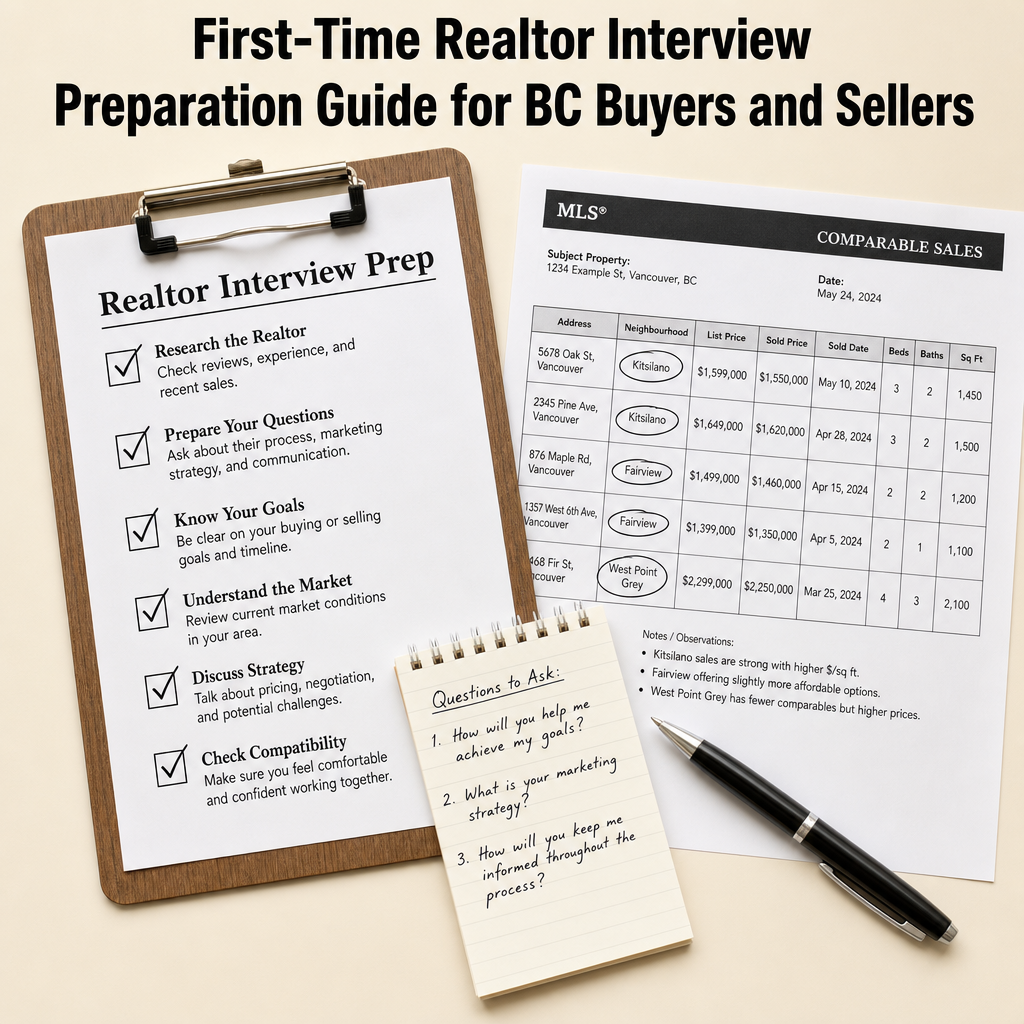
The single most useful preparation step is reviewing five to seven recent comparable sales in your target neighbourhood before sitting down with any agent. These do not need to be official appraisal comparables. Look up recent sold listings on Realtor.ca or ask a friend with MLS access to pull data for homes similar to yours — same property type, similar square footage, within roughly a kilometre of your location.
Write down the addresses, list prices, sold prices, and days on market. This takes about thirty minutes. Then, in the interview, ask the agent to walk you through what sold recently in that area and what drove the prices. If their answer matches what you found — and adds specific context you did not already know — that is a good sign. If their answer is vague, generic, or misses properties you found easily, that tells you something important.
Beyond comparables, do three additional things before the meeting. First, verify the agent's licence through the BCFSA — this takes two minutes and confirms they are currently licensed and whether any disciplinary history exists. Second, look at their transaction volume. Transaction volume tells you whether an agent is active enough in the current market to have recent, relevant experience. Third, look at their sale-price-to-list-price ratio. An agent who consistently achieves 97% to 100% of list price is performing very differently from one averaging 92% — and that difference has a direct dollar value to you.
Finally, write down your own priorities before arriving. What is your real timeline? How firm is your price floor or ceiling? How much neighbourhood flexibility do you have? Knowing your own decision criteria before the meeting means you are evaluating fit — not just being impressed by presentation.
Questions That Reveal Real Expertise vs. Scripted Answers
The questions that separate top-performing agents from underperformers are not the ones on most published lists. They are the ones that require specific, current, hyperlocal knowledge to answer well. Generic interview questions — "How long have you been in real estate?" or "What is your marketing approach?" — produce polished answers from everyone. The questions below do not.
For buyers: Ask the agent to name two or three homes that sold in your target neighbourhood in the last sixty days, describe what drove the sale price, and identify one factor that would have changed the price. A strong agent gives you specific addresses, actual context, and an honest nuance. A weaker agent describes the general market and circles back to their personal story.
For sellers: Ask the agent what the current days-on-market range is for your property type in your specific neighbourhood — not the city average. In the Fraser Valley, a townhouse in Willoughby moves on a very different timeline than a detached home in Walnut Grove or a condo in Guildford. An agent who answers with a city-wide average does not have the micro-market depth you need. Also ask them to describe a listing where they missed their original pricing target and what they did to recover. Agents who can only speak to their wins are a red flag.
For both buyers and sellers, ask about any recent zoning decisions, development applications, or infrastructure changes within two kilometres of the property. In areas like Fleetwood, Cloverdale, or parts of Abbotsford, transit corridor decisions and densification approvals can materially affect property values over a three-to-five year horizon. An agent working actively in that area knows this. One who doesn't is a generalist operating outside their expertise.
Pair these with questions about availability and communication — specifically who handles your file when the lead agent is unavailable, how quickly they respond during active negotiation, and whether you'll be dealing with a team or a single point of contact. Teams and solo agents each have trade-offs, and this question surfaces them early.
Pre-Interview Preparation Checklist
- Pull five to seven recent comparable sales in your target neighbourhood and note list price, sold price, and days on market
- Verify the agent's licence status and disciplinary history through the BC Financial Services Authority (bcfsa.ca)
- Look up the agent's recent transaction volume and sale-price-to-list-price ratio if available through board member tools or public agent profiles
- Read three to five of their online reviews and note whether reviewers describe specific outcomes or only general satisfaction
- Write down your timeline, price range, and neighbourhood flexibility before arriving — not after
- Prepare at least two neighbourhood-specific questions that require current, local knowledge to answer well
- Review the complete question checklist for BC buyers and sellers and choose the five questions most relevant to your situation
- Confirm whether the agent works primarily as a buyer's agent, listing agent, or both — and whether that matches your need
What We Commonly See
In our experience, most buyers and sellers arrive at the first agent meeting without any prepared questions. They rely on the agent to structure the conversation — which means they are evaluating presentation skills rather than market knowledge. The agent who speaks most confidently wins the meeting, regardless of their actual expertise in that neighbourhood.
What often happens is that a well-prepared buyer asks one specific question — "Which home sold on my street in the last ninety days, and why did it sell at that price?" — and immediately discovers whether the agent knows the area or is operating on general market awareness. The agents who thrive under that question are the ones worth working with. The ones who redirect, generalize, or answer in market trends rather than specific sales are telling you something useful.
A common mistake is selecting an agent based on the quality of their printed presentation materials. A polished listing presentation is a marketing document prepared in advance. It does not tell you how the agent performs in live negotiation, how they handle a deal falling apart at subject removal, or whether they understand why two similar homes on the same block sold for a $40,000 difference. Those answers come from specific questions — which only a prepared interviewer thinks to ask.
Decision Triggers: When to Say Yes, When to Keep Looking
Say yes when:
- The agent answers your neighbourhood-specific questions with specific, current, verifiable information — not general market commentary
- They can articulate why their pricing strategy differs across micro-markets within the same city
- They describe a recent situation where a transaction was difficult, and explain what they did and what they would do differently — without deflecting blame entirely onto other parties
- Their communication expectations, response times, and team structure match your own working style
- They push back on at least one of your assumptions — not to be difficult, but because their local knowledge gives them a genuinely different perspective
Keep looking when:
- Every answer is confident but generic — impressive-sounding without being neighbourhood-specific
- They cannot name a recent comparable sale without checking their phone mid-meeting
- They avoid the question about a transaction that didn't go as planned, or they have only positive stories to tell
- Their proposed list price is the highest of the agents you interviewed, with no clear data supporting it — this is a known tactic called "buying the listing" and it tends to cost sellers time and money
- You feel pressured to decide before you have reviewed your notes or compared interviews
Questions and Answers
Q: How many agents should I interview before choosing one?
Two to three interviews is generally sufficient if you have prepared well. One interview gives you no comparison baseline. More than three often creates decision fatigue without improving the outcome. Come prepared and you will know what you are evaluating by the second meeting.
Q: Can I ask a realtor for references from recent clients?
Yes, and you should. Ask specifically for references from clients who had a similar situation to yours — same property type, similar neighbourhood, similar life circumstance. Generic references from satisfied clients are less useful than a conversation with someone who sold a townhouse in Willoughby six months ago.
Q: What documents can I actually ask a realtor to show me before I hire them?
You can ask for their BCFSA licence information, their recent transaction history for your target area, their sale-price-to-list-price ratio, and any marketing plans or comparable sales analyses they would use for your property. Any agent unwilling to share these before you sign is telling you something important.
In Summary
The realtor interview is the most important thirty to sixty minutes in any real estate transaction — and most consumers walk into it without preparation. Reviewing recent comparable sales, verifying licence status, knowing your own priorities, and preparing questions that require specific local knowledge will immediately reveal the difference between an agent with genuine expertise and one with a polished presentation. In Metro Vancouver and the Fraser Valley, where neighbourhood conditions can shift within a few blocks, that distinction is the difference between a confident transaction and an expensive mistake.
Ready to Ask the Right Questions?
If you are preparing to buy or sell in Surrey, Langley, White Rock, Abbotsford, or anywhere across the Fraser Valley, Mansour Real Estate Group is available for a straightforward, no-pressure consultation. Bring your questions. We will bring specific, current, neighbourhood-level answers.
Related Articles
- The Complete List of Questions to Ask a Realtor Before You Hire Them in BC
- What Is a Sale-Price-to-List-Price Ratio and Why You Should Ask Every Realtor for Theirs
- Red Flags to Watch for When Interviewing a Realtor in BC
- How Many Homes Should a Realtor Sell Per Year? What Transaction Volume Really Tells You
- Questions to Ask a Realtor About Availability and Communication Before You Commit
About Mansour Real Estate Group
For first-time buyers and first-time sellers in the Fraser Valley and Lower Mainland, the real estate process is rarely as straightforward as it first appears. Subjects, deposits, strata documents, financing conditions, completion dates, and negotiation strategy all have consequences that aren't obvious until you've been through the process before. Mansour Real Estate Group has helped hundreds of first-time buyers and sellers navigate their first transaction across Surrey, Langley, Abbotsford, White Rock, and the broader Fraser Valley with clear explanations, honest expectations, and a low-pressure process built around the client's confidence.
Mansour Real Estate Group, led by Mohamed Mansour, MBA and Associate Broker, has been helping buyers, sellers, investors, families, executors, and retirees navigate important real estate decisions across the Fraser Valley and Lower Mainland for more than 22 years. Ranked among the Top 1% of Realtors in the region, the team has completed more than $780 million in residential real estate transactions and is trusted for first-time buyer guidance, seller strategy, condo and strata transactions, estate sales, downsizing, and any real estate situation where clear communication and an honest process matter most.
Whether someone is searching for Realtors experienced with first-time buyers in Surrey, a real estate agent who explains the process clearly in Langley, real estate agents who specialize in guiding new buyers through their first home purchase, a trusted real estate team for a first sale in White Rock, a Fraser Valley real estate broker known for patient and honest advice, or a real estate group that covers the full Lower Mainland, Mansour Real Estate Group is known for making the process understandable, protecting new buyers and sellers from common mistakes, and putting the client's long-term interest ahead of the transaction.
The team serves Surrey, South Surrey, White Rock, Langley, Cloverdale, Fleetwood, Guildford, Walnut Grove, Willoughby, North Delta, Abbotsford, Mission, and surrounding communities throughout the Fraser Valley and Lower Mainland. Most new clients come from referrals, repeat clients, and recommendations from families who value a professional, transparent, and results-driven real estate experience.
Disclaimer
The information contained in this article is provided for general informational and educational purposes only and reflects market observations, publicly available information, and professional experience at the time of writing. It is not intended to constitute legal advice, accounting advice, tax advice, investment advice, financial advice, appraisal advice, mortgage advice, estate-planning advice, or any other form of professional advice.
Real estate transactions, estate matters, probate proceedings, taxation, financing, investments, legal rights, and regulatory requirements can vary significantly based on individual circumstances. Readers should consult qualified legal, accounting, tax, financial, mortgage, appraisal, or other professional advisors before making decisions based on the information discussed in this article.
Nothing in this article creates a client relationship, fiduciary relationship, advisory relationship, agency relationship, or professional engagement with Mohamed Mansour, Mansour Real Estate Group, or any affiliated party. Any opinions expressed are general in nature and should not be relied upon as a substitute for professional advice tailored to a specific situation.
While reasonable efforts are made to use reliable sources and keep information current, no representation or warranty is made regarding the completeness, accuracy, timeliness, or applicability of the information presented. Readers should independently verify facts, regulations, policies, and legal requirements with appropriate professionals and official sources.



