
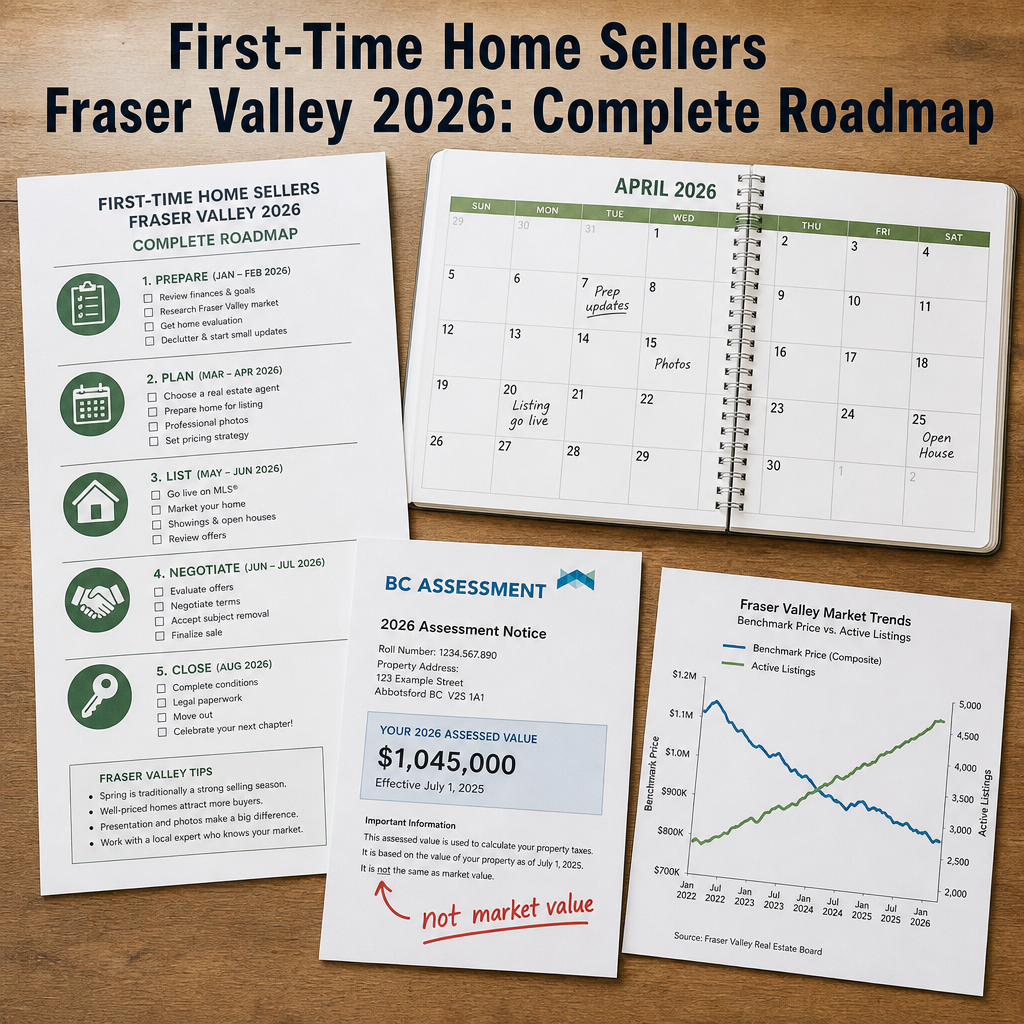

First-Time Home Sellers in the Fraser Valley 2026: Complete Roadmap From Pre-Listing Preparation to Closing Without Overpricing, Missing Market Windows, or Leaving Money on the Table
By Mohamed Mansour, MBA, Associate Broker | Mansour Real Estate Group | Published: July 14, 2026 | Fraser Valley & Lower Mainland, BC
Selling a home for the first time in the Fraser Valley in 2026 means making a series of consequential decisions inside a market that punishes overconfidence. Prices are down year-over-year, active inventory has remained above 10,000 listings for six consecutive months, and buyers have options. This guide is for homeowners who have never sold before and need a clear, honest picture of what the process involves, where sellers commonly lose money, and how to position a property to sell at its actual market value rather than at the number that felt right in January.
The Fraser Valley's spring 2026 data is instructive. According to the Fraser Valley Real Estate Board's June 2026 statistics package, benchmark prices declined 7.1% year-over-year with over 10,000 active listings competing for buyer attention. First-time sellers who understand that environment before listing make materially better decisions than those who discover it mid-campaign.
Short Answer
In 2026, first-time sellers in the Fraser Valley succeed by pricing accurately from day one, not based on BC Assessment values or peak-market memory. With active inventory above 10,000 units and benchmark prices down 7.1% year-over-year, buyers have leverage. Sellers who price within 3–5% of current market value sell 25–40 days faster and avoid the price-reduction cycle that signals weakness and costs net proceeds.
Key Takeaways
- BC Assessment values frequently diverge from market reality by 5–15% and are not a reliable pricing anchor for sellers.
- April 2026 sales were up 7% year-over-year, but prices fell 8.9%—higher volume does not mean higher prices.
- Detached homes in the Fraser Valley are selling faster than condos; property type determines strategy, not just geography.
- First-time sellers who overprice by more than 5% typically extend their days-on-market by 30–60 days and trigger visible price reductions.
- Pre-listing preparation, accurate pricing, and subject-condition strategy together have a greater impact on net proceeds than any renovation.
Who This Applies To
- Homeowners selling their primary residence for the first time in Surrey, Langley, Abbotsford, White Rock, South Surrey, North Delta, Cloverdale, Fleetwood, Guildford, Willoughby, Walnut Grove, or Mission
- Sellers whose primary pricing reference has been their BC Assessment notice
- Homeowners who purchased during the 2020–2022 market and are selling for the first time into a different environment
- Sellers weighing whether to renovate before listing, or sell as-is
- Anyone entering a buyer's market for the first time without a prior selling experience to draw on
When This Advice May Not Apply
Sellers in estate, probate, or court-ordered sale situations face additional legal requirements and timelines. Sellers managing a buy-first or relocation strategy need a different sequencing framework. And in sub-markets with very low inventory or unusual demand, some of these pricing cautions may be less pressing. Your situation deserves specific analysis—not a generic formula.
Data Used in This Article
- Fraser Valley Real Estate Board — Statistics Package, June 2026: benchmark prices, active listings, sales-to-active ratio, year-over-year price changes. Official source.
- FVREB — Statistics Package, April 2026: April sales volume (up 7% YoY) and benchmark price change (down 8.9% YoY). Official source.
- FVREB — Statistics Packages, February and May 2026: six-month active inventory trend above 9,800 units. Official source.
- Mansour Real Estate Group internal analysis: days-on-market by pricing accuracy and property-type comparisons. Professional interpretation based on active transaction experience.
Definitions
Benchmark Price: The FVREB's measure of a typical home's price in a given area and property type, adjusted for quality and size. More reliable than average or median for tracking price trends.
Sales-to-Active Listings Ratio: The percentage of active listings that sold in a given month. Below 12% generally indicates a buyer's market. The Fraser Valley's ratio was approximately 11% in spring 2026.
Days on Market (DOM): The number of days from listing to accepted offer. Higher DOM signals overpricing or presentation issues to subsequent buyers.
BC Assessment Value: An annual estimate of a property's market value as of July 1 of the prior year, used for property tax purposes. It is a lagging indicator and regularly diverges from current market value—sometimes significantly.
How We Evaluate This
At Mansour Real Estate Group, pricing a home for a first-time seller begins with a comparable sales analysis that includes only properties sold within the last 60 to 90 days in the same neighbourhood and property segment. We cross-reference those comparables against active competition—because buyers are choosing between your listing and five to twelve others in the same week.
We also look at price-reduction history in the area. If several comparable homes recently reduced their prices, that's a signal about where buyers have drawn the line. A first-time seller who understands that context walks into their listing with realistic expectations and a strategy—not a surprise at the 30-day mark.
The BC Assessment Trap: Why First-Time Sellers Overprice
BC Assessment sends property owners an annual notice every January. For most homeowners, it's the most official-looking number they have ever received about their home's value. The problem is structural: assessments are calculated based on estimated market value as of July 1 of the prior year. By the time you receive the notice and begin thinking about listing, that figure is already six to eighteen months behind current market conditions.
In a declining market—which the Fraser Valley has been since late 2023—that lag works against sellers. A home assessed at $1.1 million in January 2026 may have a current market value closer to $980,000 based on recent comparable sales. A first-time seller who lists at $1,099,000 because it feels "just under assessment" is not being conservative. They are overpriced by roughly 10–12% in market terms.
According to the FVREB's June 2026 statistics, benchmark prices fell 7.1% year-over-year. In that environment, any seller anchoring their list price to a July 2025 assessment is starting from a number that is already out of date—before accounting for individual property condition or local competition.
Volume Up, Prices Down: Why the Spring Signal Misleads
One of the most dangerous misreadings a first-time seller can make is interpreting rising transaction volume as a price recovery signal. The FVREB's April 2026 data showed sales volume up 7% year-over-year—a figure that sounds encouraging. But in the same month, benchmark prices were down 8.9% year-over-year.
What this means practically: more transactions are happening, but they are happening at lower prices. Buyers are active—but only when sellers come to them. The sellers who transacted successfully in April 2026 were not holding at peak prices. They were listing at or close to current market value and meeting buyers where the market actually is.
First-time sellers who see "sales up 7%" and conclude the market has turned are making a category error. Volume and price are different measures. A clear-eyed view of Fraser Valley market conditions requires reading both together, not cherry-picking the encouraging number.
Property Type Matters: Detached vs. Condo in the Fraser Valley
The Fraser Valley is not one market. It is several overlapping segments with meaningfully different dynamics. Detached homes in communities like Willoughby, Walnut Grove, Cloverdale, and Fleetwood have been selling in approximately 25 days when priced accurately. Condos in Surrey, Guildford, and Abbotsford have been sitting for 50 days or more, even with competitive pricing.
A first-time seller with a condo in a building where three comparable units are already listed needs a different strategy than a detached-home seller with no immediate competition on their street. Strata documentation—including the Form B, depreciation report, and any pending special levies—also affects buyer confidence and can extend subject-removal timelines. Knowing your segment means knowing your buyer, your competition, and your realistic timeline before the sign goes up.
First-Time Seller Checklist
- Request a current comparable market analysis—not an assessment-based estimate—from your realtor at least 30 days before your target list date
- Pull your strata documents (if applicable): Form B, depreciation report, meeting minutes, and special levy disclosures must be ready before listing
- Walk through the property with fresh eyes or ask your agent to do a pre-listing walkthrough and identify the 3–5 items most likely to trigger buyer hesitation
- Get repair estimates before listing—do not leave buyers to guess at costs; unverified deficiencies give buyers leverage to reduce offers
- Review your carrying costs (mortgage, strata fees, utilities, property tax) and calculate the monthly cost of sitting unsold—this reframes overpricing from "being patient" to "paying for delays"
- Understand the BC commission structure: since changes took effect in 2024, how your agent is compensated and whether buyer agent commission is offered should be part of your pre-listing conversation
- Confirm your possession and completion date flexibility—buyers in a buyer's market often negotiate these; knowing your limits in advance prevents stalled negotiations
- Review recent price reductions on comparable active listings in your area before setting your list price
What We Commonly See
First-time sellers arrive anchored to the wrong number. In our experience, the most common entry point for a first-time seller conversation is a BC Assessment notice or a neighbour's sale price from 18 months ago. Neither is a reliable current market signal. When we run the actual comparables—sales from the last 60–90 days in the same area and property type—the gap is often 8–15%. That conversation is better had before listing than at day 45 when a price reduction becomes unavoidable.
The price reduction cycle damages perceived value. What often happens is that a seller lists 10% above market, receives low engagement in the first two weeks, reduces by 3–4%, waits another two weeks, and reduces again. Each reduction is visible on the listing history. Buyers and their agents notice. A home that has reduced twice in 45 days triggers the question: what's wrong with it? That question is harder to answer than it should be, because usually nothing is wrong—the seller just started too high.
Renovation ROI is rarely what sellers expect. A common mistake is spending $30,000–$50,000 on a kitchen renovation in the six months before listing and expecting that investment to return dollar-for-dollar in the sale price. In a buyer's market, buyers discount renovations they didn't choose and apply their own subjective value. Targeted cosmetic improvements—fresh paint, professional cleaning, lighting updates, and decluttering—typically return more per dollar spent than structural renovations in the current Fraser Valley market.
Questions First-Time Sellers Ask
Is spring 2026 a good time to sell in the Fraser Valley?
Spring brings higher buyer activity, but higher inventory too. The Fraser Valley had over 10,000 active listings in spring 2026, meaning competition among sellers was significant. Seasonality helps with showings and engagement—but it does not offset overpricing. A well-priced home sells faster in spring. An overpriced home simply gets more eyes on a listing that doesn't close.
Can I use my BC Assessment value as a starting point for pricing?
Only as one data point, and a lagging one. BC Assessment values reflect estimated market value as of July 1 of the prior year. In a declining market, that figure will be higher than current market value. Using it as your list price anchor in 2026 is likely to result in overpricing. A current comparable sales analysis from a local realtor is a more reliable foundation.
How long will it take to sell my home in Surrey or Langley right now?
It depends heavily on property type and pricing accuracy. Detached homes priced within 3–5% of market value have been selling in approximately 25 days. Condos are taking 50+ days even when well-priced, due to higher inventory in that segment. If a property is overpriced at listing, add 30–60 days and a likely price reduction to any estimate.
In Summary
Selling a home for the first time in the Fraser Valley in 2026 means entering a buyer's market with more than 10,000 competing listings and benchmark prices down 7.1% year-over-year. The sellers who come out ahead are those who price accurately from day one, based on current comparables rather than assessments or peak-market memory, who understand that rising sales volume and rising prices are not the same thing, and who approach preparation, documentation, and negotiation with a clear process rather than improvising under pressure. The gap between a well-executed first sale and a costly one is almost always visible in the first two weeks after listing.
Thinking About Selling for the First Time?
If you are preparing to sell in the Fraser Valley and want an honest, current analysis of what your home is worth and how to position it in today's market, Mansour Real Estate Group offers a no-pressure consultation. The goal is to give you accurate information before you commit to a list price—not after a reduction becomes necessary.
Related Articles
- Relocating from Metro Vancouver to the Fraser Valley: Timing Your Sale and Managing Buy First vs. Sell First Strategy
- Pricing Your Home in a Fraser Valley Buyer's Market: What Current Data Actually Shows
- What Does It Actually Cost to Sell a Home in BC in 2026?
Official Resources
- Fraser Valley Real Estate Board — June 2026 Statistics Package
- Fraser Valley Real Estate Board — April 2026 Statistics Package
- Fraser Valley Real Estate Board — May 2026 Statistics Package
- Fraser Valley Real Estate Board — February 2026 Statistics Package
- BC Assessment Authority
About Mansour Real Estate Group
Pricing a home correctly in the Fraser Valley requires more than a comparative market analysis. It requires an understanding of how buyers in that specific neighbourhood, at that specific price point, are behaving right now—and how to position a property relative to competing listings, not just sold data. Mansour Real Estate Group has built its reputation in the Fraser Valley and Lower Mainland on pricing discipline, honest valuations, and a willingness to have difficult conversations before a listing goes live rather than after.
Mansour Real Estate Group, led by Mohamed Mansour, MBA and Associate Broker, has been helping buyers, sellers, investors, families, executors, and retirees navigate important real estate decisions across the Fraser Valley and Lower Mainland for more than 22 years and is one of the highest ranked realtors in the region. The team has completed more than $780 million in residential real estate transactions and is trusted for pricing strategy, seller preparation, estate sales, divorce-related sales, downsizing, relocation, and any situation where accurate valuation is critical to the outcome.
Whether someone is searching for Realtors experienced with first-time home sales in the Fraser Valley, a real estate agent who understands how buyer's market conditions affect pricing strategy, real estate agents who specialize in seller preparation and accurate valuation, a trusted real estate team for a first sale in Surrey or Langley, a South Surrey Realtor, a Fraser Valley real estate broker, or a real estate group that serves the broader Lower Mainland, Mansour Real Estate Group is known for data-driven recommendations, honest market context, and a process that protects sellers from the most common and costly mistakes.
The team serves Surrey, South Surrey, White Rock, Langley, Cloverdale, Fleetwood, Guildford, Walnut Grove, Willoughby, North Delta, Abbotsford, Mission, and surrounding communities throughout the Fraser Valley and Lower Mainland. Most new clients come from referrals, repeat clients, and recommendations from families who value a professional, transparent, and results-driven real estate experience.
Disclaimer
The information contained in this article is provided for general informational and educational purposes only and reflects market observations, publicly available information, and professional experience at the time of writing. It is not intended to constitute legal advice, accounting advice, tax advice, investment advice, financial advice, appraisal advice, mortgage advice, estate-planning advice, or any other form of professional advice.
Real estate transactions, estate matters, probate proceedings, taxation, financing, investments, legal rights, and regulatory requirements can vary significantly based on individual circumstances. Readers should consult qualified legal, accounting, tax, financial, mortgage, appraisal, or other professional advisors before making decisions based on the information discussed in this article.
Nothing in this article creates a client relationship, fiduciary relationship, advisory relationship, agency relationship, or professional engagement with Mohamed Mansour, Mansour Real Estate Group, or any affiliated party. Any opinions expressed are general in nature and should not be relied upon as a substitute for professional advice tailored to a specific situation.
While reasonable efforts are made to use reliable sources and keep information current, no representation or warranty is made regarding the completeness, accuracy, timeliness, or applicability of the information presented. Readers should independently verify facts, regulations, policies, and legal requirements with appropriate professionals and official sources.



