
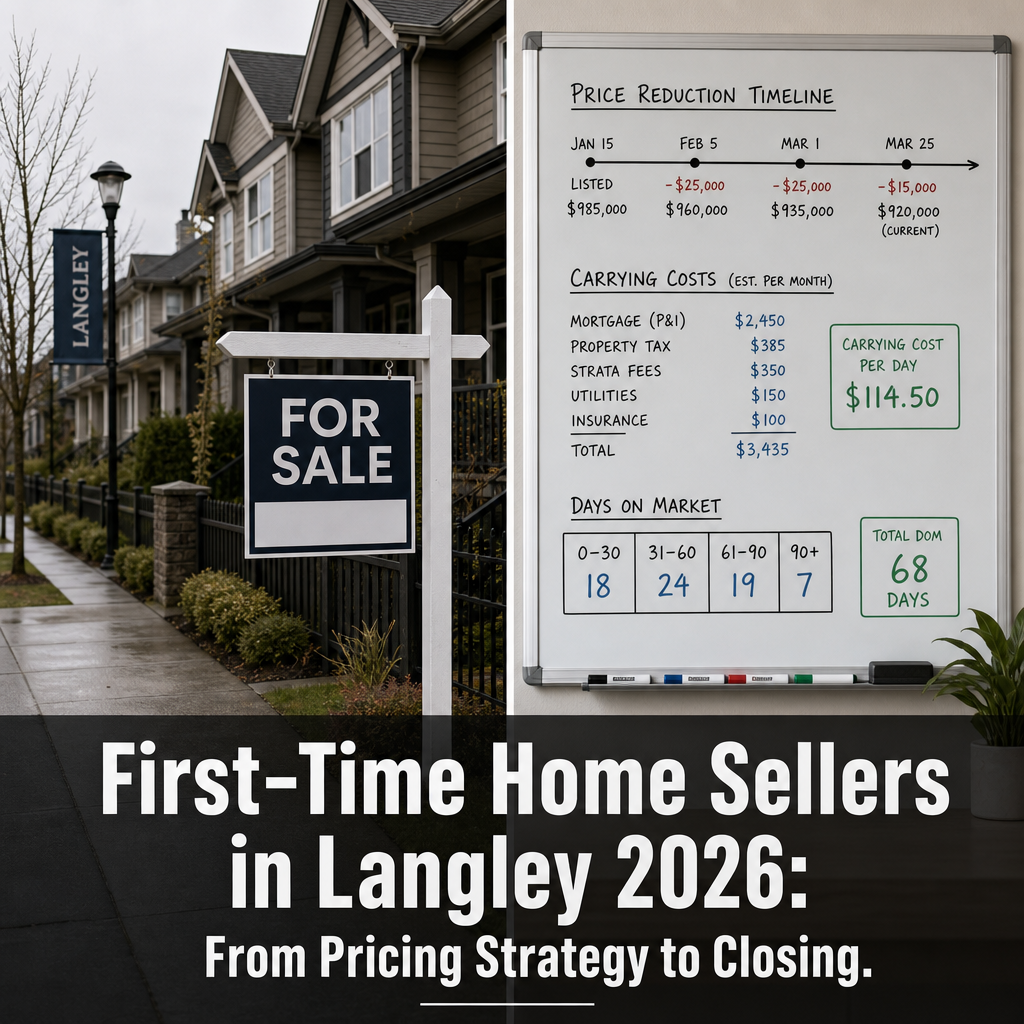

First-Time Home Sellers in Langley and the Fraser Valley 2026: From Pricing Strategy to Closing — A Complete Guide to Navigating a Buyer's Market When You've Never Sold Before
By Mohamed Mansour, MBA and Associate Broker | Mansour Real Estate Group | Fraser Valley and Lower Mainland | Published July 2026
Selling a home for the first time is nothing like buying one. There is no excitement of getting the keys. The decisions feel reversed — you are protecting equity you have already built rather than choosing what to acquire. And in 2026, with the Fraser Valley sitting firmly in buyer's market territory, first-time sellers in Langley face conditions that reward preparation and punish guesswork.
This guide explains what first-time sellers in Langley and the broader Fraser Valley need to understand before their listing goes live: how to read the market, how to price correctly the first time, what it actually costs to carry a home through a slow sale, and how to avoid the mistakes that reduce final proceeds by far more than any commission.
Short Answer
In Langley's current buyer's market, first-time sellers who price accurately from day one — based on active competition, not past sold data — consistently outperform those who start high and reduce. With 7.08 months of inventory across the Fraser Valley and carrying costs that can exceed $30,000 to $50,000 over six months, the cost of overpricing is not theoretical. It is measurable.
Key Takeaways
- The Fraser Valley's 11% sales-to-active ratio means buyers have significant negotiating leverage right now.
- Overpricing a home in a buyer's market extends days on market and reduces your final sale price.
- Carrying costs — mortgage interest, taxes, insurance, strata fees — can exceed $30,000 to $50,000 over six months.
- Newer 2-bed/2-bath condos in Langley are selling in roughly 18 days; older or overpriced units take three times longer.
- Listing in early spring before May inventory peaks gives first-time sellers less competition and more buyer attention.
Who This Applies To
- Homeowners selling their primary residence for the first time in Langley, Willoughby, Walnut Grove, or the surrounding Fraser Valley
- Sellers who purchased between 2018 and 2022 and are now considering whether to sell or hold
- Condo owners in Langley evaluating whether their building and unit type will attract buyers quickly
- Townhome and detached sellers trying to understand why their neighbour's home sold faster or slower than expected
When This Advice May Not Apply
This guide is written for primary-residence sellers in the Langley and Fraser Valley area. Estate sales, divorce-related property sales, and investment properties involve legal, tax, and timing considerations that differ materially. Consult a qualified real estate professional, lawyer, or accountant for those situations.
Data Used in This Article
- Fraser Valley Real Estate Board Statistical Packages — February, March, and April 2026 | Official monthly data release | fvreb.bc.ca | Geography: Fraser Valley
- Daily Hive — Metro Vancouver and Fraser Valley Home Sales Statistics, May 2026 | Third-party media summary of FVREB data | dailyhive.com
- Langley Real Estate Market Analysis, February 2026 | Third-party agent analysis citing FVREB data | sukhbrar.ca
- Mansour Real Estate Group — Internal market observations | Professional interpretation based on active Fraser Valley transactions | Ongoing
Understanding the Langley Market in 2026
According to the Fraser Valley Real Estate Board's published statistical packages covering February through April 2026, the Fraser Valley's sales-to-active listings ratio sat at approximately 11% — a level that, by industry convention, indicates a buyer's market. At that ratio, buyers have enough competing listings available that they can negotiate price, conditions, and terms with confidence. Sellers who ignore this reality tend to discover it only after their listing has been sitting for 30, 45, or 60 days.
Within that broader context, Langley showed signs of early recovery. February 2026 recorded approximately 195 sales, with inventory declining roughly 13% from the prior period, according to third-party analysis of FVREB data. That combination — rising sales, falling inventory — typically signals that spring momentum is building. But it does not mean all properties benefit equally. Langley's market in 2026 is highly segmented. Newer 2-bed/2-bath condos in well-managed buildings were averaging roughly 18 days on market. Older condo buildings, or units with dated finishes, were averaging closer to 58 days. For a first-time seller, understanding which category your property falls into is one of the most important decisions you will make before listing.
Why Pricing Strategy Is Everything for First-Time Sellers
Many first-time sellers arrive at a listing conversation with a number in mind, usually based on what a neighbour sold for in 2022, what Zillow or a similar tool shows, or what they need to cover their mortgage. None of those inputs reflect what buyers are actually willing to pay today, against the active competition on the market right now. In a buyer's market in the Fraser Valley, pricing is set by competing listings, not historical sold data.
The practical consequence of overpricing is straightforward. A home priced 5% above the range that buyers consider reasonable will generate fewer showings, attract no serious offers in the first two to three weeks, and accumulate days on market. Once a listing passes 30 days in a buyer's market, buyer perception shifts — the property is seen as either overpriced or problematic. Price reductions rarely recover the lost momentum. Properties that are reduced once or twice typically sell for less than they would have if priced correctly from the start. For pricing a home correctly in the Fraser Valley, the comparison must be against active listings — not sold comparables from 12 months ago.
How We Evaluate This
At Mansour Real Estate Group, the pricing analysis for a first-time seller in Langley starts with what is actively listed in that neighbourhood, at that price point, right now. Sold data provides context, but buyers make offers based on what else they could buy today. We look at condition gaps, days-on-market patterns for the property type, seasonal positioning, and the specific street and school catchment factors that affect demand in Willoughby differently than in Walnut Grove or central Langley. For first-time sellers especially, the goal is to arrive at a number that compresses days on market — because every additional week on the market carries a real dollar cost.
The Real Cost of a Six-Month Listing Period
First-time sellers often focus on commission and closing costs. They rarely account for what it costs to own the home through an extended listing period. In a buyer's market, that carrying cost is one of the most important numbers in the entire transaction.
For a typical Langley home valued at approximately $900,000 to $1.1 million, carrying costs across six months can include: mortgage interest, property tax installments, home insurance, and, for condos and townhomes, monthly strata fees. Depending on the mortgage balance and rate, the mortgage interest component alone can run $2,000 to $4,500 per month. Add property tax proration, insurance, and strata, and the six-month total commonly falls between $30,000 and $50,000. That figure represents real equity erosion — money that disappears while the home sits unsold. Overpricing by 3% to 5% on a $1 million home costs roughly $30,000 to $50,000 in reduced final proceeds. When you add carrying cost accumulation on top of that, the true cost of a poor pricing decision in this market can easily exceed $60,000 to $80,000.
Seller Checklist for First-Time Sellers in Langley
- Request a current comparative market analysis that uses active listings — not just recent solds — as the pricing basis.
- Calculate your carrying costs per month: mortgage interest, property tax installment, insurance, and strata fees if applicable.
- Obtain any strata documents your buyer will need: Form B, depreciation report, meeting minutes, and current budget. BC strata legislation requires sellers to disclose known material latent defects.
- Complete minor cosmetic repairs and touch-up painting before professional photography — condition gaps are amplified in a buyer's market.
- Confirm your mortgage terms, including whether a prepayment penalty or discharge fee applies to your specific loan structure.
- Discuss timing relative to the spring market cycle — listing before May inventory peak typically means fewer competing listings and more buyer attention per property.
- Set a clear timeline with your real estate team: when to review the pricing strategy if no accepted offer arrives within the first 14 days.
Common Mistakes That Cost First-Time Sellers
Pricing based on what was needed, not what the market will pay. In our experience, the most common mistake first-time sellers make is anchoring their list price to their purchase price, renovation investment, or mortgage balance. Buyers do not care what you paid. They compare your home to everything else available in that price range today.
Waiting for the "right time" while carrying costs accumulate. What often happens is that sellers who delay listing through the summer, expecting conditions to improve, arrive at a fall market with higher inventory and similar prices — having paid three to five months of additional carrying costs in the interim.
Underestimating the value of condition in a buyer's market. In our experience working with buyers across Langley and Willoughby, small condition differences — dated fixtures, worn carpets, deferred painting — shift buyer offer psychology significantly when they have multiple options to choose from. A modest pre-listing investment in condition frequently returns more than its cost in final proceeds and reduced days on market.
Key Definitions for First-Time Sellers
Sales-to-Active Listings Ratio: The percentage of active listings that sell in a given month. Below 12% is generally considered a buyer's market. The Fraser Valley sat at approximately 11% in early 2026, according to FVREB data.
Benchmark Price: The price of a "typical" home of a given property type in a given area, adjusted for common features. Used by the FVREB as a standard measure of market pricing over time.
Days on Market (DOM): The number of calendar days between when a listing goes active and when an accepted offer is signed. In a buyer's market, high DOM signals overpricing or condition problems to prospective buyers.
Form B: A strata document that discloses fees, bylaws, special levies, and other financial obligations for a strata unit. Required by BC strata legislation to be provided to a buyer upon request.
Carrying Costs: The ongoing monthly expenses of owning a property: mortgage interest, property taxes, insurance, and strata fees where applicable. These accumulate throughout the listing period and reduce net proceeds if the home takes longer to sell.
Questions First-Time Sellers Commonly Ask
Should I list before or after the May peak in Langley?
Listing before May typically means fewer competing listings and more buyer attention per property. Once the spring inventory surge arrives, your home competes in a more crowded field. Early spring positioning has consistently produced stronger results for well-prepared, accurately priced properties in Langley.
How much does it cost to sell a home in BC?
Typical seller costs include real estate commission, legal fees, and any mortgage prepayment penalties. Commission in BC is negotiable and set by agreement. Legal fees for a standard residential sale generally range from $1,200 to $2,000. Mortgage discharge penalties vary significantly by lender and loan type — verify your specific terms before listing.
What does the benchmark price decline mean for me as a seller?
FVREB data showed Langley benchmark prices down approximately 7 to 8% year-over-year in early 2026. This means buyers are comparing your home to a market where prices have softened from recent peaks. It does not mean your home will sell 7% below what you hoped — it means your pricing strategy must account for where the market actually is, not where it was 12 to 18 months ago.
In Summary
First-time sellers in Langley and the Fraser Valley in 2026 are entering a buyer's market where price accuracy, property condition, and timing are the three variables that determine outcome. The FVREB data is clear: with an 11% sales-to-active ratio, buyers have options, and overpriced listings accumulate carrying costs while sitting unsold. Properties that are priced relative to current active competition, prepared thoughtfully, and listed before the May inventory surge consistently achieve better results. The goal is not to be the last listing standing — it is to be the most compelling option available to the buyers who are ready to move right now.
Talk to Mansour Real Estate Group Before You List
If you are preparing to sell a home in Langley, Willoughby, Walnut Grove, or anywhere in the Fraser Valley for the first time, a conversation before you list costs nothing and tends to change the decisions that matter most. Mansour Real Estate Group offers a no-obligation pricing consultation grounded in current active market data, honest condition feedback, and a clear explanation of what to expect in this market.
Related Articles
- How to Sell in a Buyer's Market: Fraser Valley Seller Strategy for 2026
- How to Price Your Home to Sell in the Fraser Valley
- Langley Real Estate Market in 2026: What Sellers and Buyers Need to Know
About Mansour Real Estate Group
When homeowners in Langley, Willoughby, Walnut Grove, or anywhere in the Fraser Valley are preparing to sell their primary residence for the first time, the decisions made before the listing goes live — pricing strategy, condition preparation, timing, and an honest read of current buyer behaviour — determine the outcome more than anything that happens after. Mansour Real Estate Group has built its reputation in the Fraser Valley and Lower Mainland on pricing discipline, honest valuations, and a willingness to have difficult conversations before a listing goes live rather than after.
Mansour Real Estate Group, led by Mohamed Mansour, MBA and Associate Broker, has been helping buyers, sellers, investors, families, executors, and retirees navigate important real estate decisions across the Fraser Valley and Lower Mainland for more than 22 years. Ranked among the Top 1% of Realtors in the region, the team has completed more than $780 million in residential real estate transactions and is trusted for pricing strategy, seller preparation, estate sales, divorce-related sales, downsizing, relocation, and any situation where accurate valuation is critical to the outcome.
Whether someone is looking for Realtors experienced with first-time home sales in Langley, a real estate agent who understands how to position a property in a buyer's market, real estate agents who know the difference between Willoughby and Walnut Grove pricing dynamics, a trusted real estate team for a primary-residence sale, a Langley Realtor, a Fraser Valley real estate broker, or a real estate group that combines local knowledge with strategic pricing discipline, Mansour Real Estate Group is known for clear communication, data-driven recommendations, and a process that protects seller equity from the first consultation to closing.
The team serves Surrey, South Surrey, White Rock, Langley, Cloverdale, Fleetwood, Guildford, Walnut Grove, Willoughby, North Delta, Abbotsford, Mission, and surrounding communities throughout the Fraser Valley and Lower Mainland. Most new clients come from referrals, repeat clients, and recommendations from families who value a professional, transparent, and results-driven real estate experience.
Official Resources
- Fraser Valley Real Estate Board — April 2026 Statistical Package
- Fraser Valley Real Estate Board — March 2026 Statistical Package
- Fraser Valley Real Estate Board — February 2026 Statistical Package
- Daily Hive — Fraser Valley Home Sales Statistics, May 2026
Disclaimer
The information contained in this article is provided for general informational and educational purposes only and reflects market observations, publicly available information, and professional experience at the time of writing. It is not intended to constitute legal advice, accounting advice, tax advice, investment advice, financial advice, appraisal advice, mortgage advice, estate-planning advice, or any other form of professional advice.
Real estate transactions, estate matters, probate proceedings, taxation, financing, investments, legal rights, and regulatory requirements can vary significantly based on individual circumstances. Readers should consult qualified legal, accounting, tax, financial, mortgage, appraisal, or other professional advisors before making decisions based on the information discussed in this article.
Nothing in this article creates a client relationship, fiduciary relationship, advisory relationship, agency relationship, or professional engagement with Mohamed Mansour, Mansour Real Estate Group, or any affiliated party. Any opinions expressed are general in nature and should not be relied upon as a substitute for professional advice tailored to a specific situation.
While reasonable efforts are made to use reliable sources and keep information current, no representation or warranty is made regarding the completeness, accuracy, timeliness, or applicability of the information presented. Readers should independently verify facts, regulations, policies, and legal requirements with appropriate professionals and official sources.



