
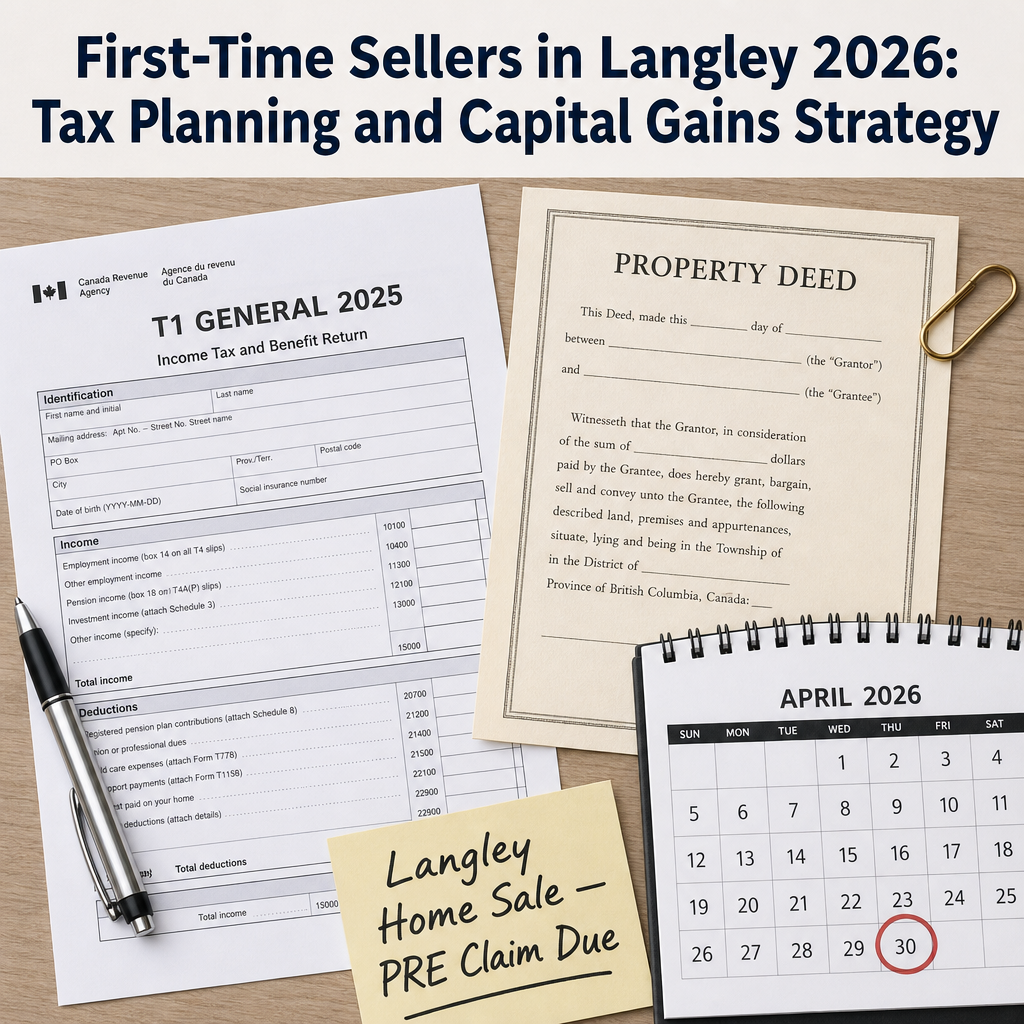

First-Time Home Sellers in Langley 2026: Essential Tax Planning and Capital Gains Strategy When You've Never Sold Before
By Mohamed Mansour, MBA and Associate Broker | Mansour Real Estate Group | Published: July 15, 2025 | Fraser Valley, BC
Selling a home for the first time in Langley means navigating two separate processes at once — the real estate transaction and the tax consequences that follow it. Most first-time sellers are well-prepared for offer negotiations and possession dates. Very few are prepared for what the Canada Revenue Agency expects from them the spring after closing.
This article is for Langley homeowners who are selling their primary residence for the first time in 2026 and have never had to think about capital gains, the Principal Residence Exemption, or CRA filing obligations before. It explains what the rules are, where first-time sellers commonly go wrong, and what to confirm with a qualified tax professional before your listing goes live.
Short Answer
Most Langley homeowners selling their primary residence will qualify for the Principal Residence Exemption and owe no capital gains tax. But the exemption is not automatic — it must be claimed correctly on your CRA tax return. Errors in timing, ownership structure, or rental history can reduce or eliminate the exemption, creating an unexpected tax bill of $15,000 to $100,000 or more. Speak with a CPA before you list.
Key Takeaways
- The Principal Residence Exemption covers most primary residences but must be actively claimed on your T1 tax return — it is not applied automatically by the CRA.
- The tax year of the sale determines your filing deadline, not the possession date — timing your close near year-end creates risk if filing is delayed.
- Langley homeowners who purchased between 2015 and 2018 and are selling in 2026 may have $150,000 to $300,000 in appreciation — enough to generate a significant tax bill if the exemption is missed or partially lost.
- Rental income earned on any part of the property — even a basement suite — can affect the exemption and may require Form T776 to be filed alongside the return.
- Joint ownership and divorce-related sales each carry separate PRE election rules that must be coordinated carefully, ideally before the property is listed.
Who This Applies To
- Langley homeowners selling their primary residence for the first time in 2025 or 2026
- Sellers who purchased between 2013 and 2020 and have seen meaningful appreciation
- Owners who rented a portion of their home at any point during ownership
- Joint owners or couples navigating separation or divorce before or during the sale
- Sellers who have never filed a capital gains schedule or PRE claim with the CRA
When This Advice May Not Apply
If you have owned and sold other properties since 1982, you have already navigated at least one PRE election. If your home was used exclusively for business purposes, different rules apply. If your property is held in a corporation or trust, the rules differ significantly from personal ownership. This article addresses personal ownership of a single primary residence — your tax professional can confirm which category applies to your situation.
Data Used in This Article
- Canada Revenue Agency — Principal Residence Exemption guidance and T2091(IND) filing requirements | Official | cra-arc.gc.ca | Current
- CRA — Form T776 (Statement of Real Estate Rentals) | Official | cra-arc.gc.ca | Current
- Fraser Valley Real Estate Board — historical benchmark price data, Langley neighbourhoods | Official | fvreb.bc.ca | 2015–2025
- Income Tax Act (Canada) — Section 40(2)(b) and Section 54, definition of principal residence | Legislation | laws-lois.justice.gc.ca | Current
What the Principal Residence Exemption Actually Is
Under Section 40(2)(b) of the Income Tax Act, a Canadian taxpayer can designate a property as their principal residence for each year they owned and lived in it. When you sell, the capital gain from those designated years is excluded from your taxable income. In practice, this means most homeowners who lived in their Langley home for its entire ownership period pay no capital gains tax on the sale.
The key word is "designate." You must complete Form T2091(IND) — Designation of a Property as a Principal Residence — and submit it with your T1 personal income tax return for the year of the sale. If you miss this filing, the CRA does not apply the exemption on your behalf. The year's exemption entitlement can be permanently lost.
According to CRA guidance, since 2016, all property sales — including primary residences — must be reported on Schedule 3 of the T1 return, even if the full gain is sheltered by the PRE. Failure to report the sale at all is treated as a non-compliance issue and can trigger CRA review.
Why Langley Sellers Face Elevated Exposure in 2026
According to Fraser Valley Real Estate Board data, Langley benchmark prices for single-family detached homes rose significantly between 2015 and 2022 before moderating. Homeowners who purchased in Willoughby Heights, Walnut Grove, or Murrayville between 2015 and 2018 in the $600,000 to $850,000 range may now be selling in the $900,000 to $1,200,000+ range — appreciation of $200,000 to $400,000 depending on the address and property type.
For a seller with $300,000 in appreciation and a fully qualifying PRE claim, the tax bill is zero. For a seller who held a rental suite for three of the ten ownership years, the math changes. The years with rental income may partially disqualify the PRE, leaving a portion of the gain taxable. At the 2026 federal inclusion rate of one-half for individuals (for gains under $250,000), $60,000 in taxable gain adds approximately $15,000 to $22,000 in federal and provincial tax combined, depending on the seller's income bracket.
These are generalizations, not calculations. Your actual tax outcome depends on your adjusted cost base, your ownership years, your income for the sale year, and the exact proportion of the property used for rental. A CPA must run the actual numbers.
Definitions
Principal Residence Exemption (PRE): A CRA provision that eliminates capital gains tax on the sale of a property designated as your principal residence for each year of ownership.
Adjusted Cost Base (ACB): The original purchase price of your property, plus eligible improvements, legal fees, and other qualifying costs. This is the number subtracted from your sale price to calculate the capital gain.
Deemed Disposition: A CRA rule that treats a property as if it were sold at fair market value on a specific date — even if no actual sale occurred. Common triggers include change of use (converting a primary residence to a rental property), death of the owner, or emigration from Canada.
Capital Gains Inclusion Rate: The percentage of a capital gain that is added to taxable income. For individuals with gains under $250,000, the 2026 rate is one-half (50%). Gains above that threshold are subject to two-thirds (66.67%) inclusion. Consult your tax advisor for the most current rates, as these are subject to legislative change.
T2091(IND): The CRA form used to designate a property as your principal residence for specific years. Required when claiming the PRE on a property sale.
How We Evaluate This for Langley Sellers
At Mansour Real Estate Group, our role is not to calculate your taxes — that belongs to a qualified accountant. Our role is to flag, early in the seller consultation, the questions that a CPA needs to answer before the listing goes live. Those questions are: Did you ever rent any part of the property? Has there been a change in ownership or title since purchase? Was the property always your primary residence? Were there years when you lived elsewhere and rented the property out entirely?
The answers shape not just the tax outcome but sometimes the optimal timing of the sale. A seller who is two years away from a cleaner PRE claim may benefit from waiting. A seller whose gain falls just above the $250,000 individual threshold may benefit from structuring the sale timing differently. These are conversations that belong between the seller and their CPA — but they must happen before possession is scheduled, not after.
Seller Checklist: Tax Planning Before You List in Langley
- Locate your original purchase documents — including the Statement of Adjustments from closing — to confirm your adjusted cost base.
- Document all eligible capital improvements made during ownership (additions, major renovations, structural upgrades) with receipts and permits where available.
- Confirm whether rental income was ever earned on any portion of the property and whether Form T776 was filed in those years.
- Engage a CPA before listing — not after accepting an offer — to calculate the estimated capital gain and confirm the PRE eligibility for each ownership year.
- If the property is jointly owned, confirm that both owners understand their separate PRE election rights and filing obligations.
- If the sale involves a separation or divorce, ensure family law counsel and your CPA are coordinated on the ownership transfer structure and tax allocation before signing any agreement.
- Confirm the tax year your sale will fall in — the date of the accepted offer, not possession, typically determines the tax year — and plan your filing timeline accordingly.
What We Commonly See
In our experience, first-time sellers in Langley are most likely to run into problems when they rented a basement suite for several years early in their ownership — often before they had a family and needed the space — and never considered that this could affect their PRE claim. The rental period does not necessarily eliminate the exemption, but it does require careful calculation and, in some cases, requires the seller to demonstrate that the primary-residence use was more than incidental.
What often happens is that a seller accepts an offer in March, closes in May, and then discovers in January of the following year — when their accountant first sees the closing documents — that the PRE was not filed correctly or not filed at all. By that point, the filing deadline has passed for the sale year, and the path to correcting the omission is more complicated than a straightforward initial filing.
A common mistake among joint-owning couples who are separating is to assume that one PRE claim covers the whole property automatically. Each spouse holds their own PRE entitlement for their ownership share. If one spouse previously designated a different property — a vacation property or a prior home — there may be a PRE conflict that requires careful coordination, not assumption.
Questions and Answers
Q: If I lived in my Langley home the entire time I owned it, do I automatically owe no capital gains tax?
A: In most cases, yes — but the exemption is not automatic. You must report the sale on Schedule 3 of your T1 return and file Form T2091(IND) to designate the property. If your home was used solely as your primary residence for every year of ownership, the full gain should be sheltered. Confirm with a CPA, as rental history or multiple-owner situations can affect this.
Q: I rented my Walnut Grove basement suite for three years. Does that mean I lose the Principal Residence Exemption entirely?
A: Not necessarily. Renting part of a property while still living there as your primary residence does not automatically eliminate the PRE. However, the rental use can affect the exemption calculation, may require Form T776 to have been filed in those years, and creates a change-of-use analysis that your accountant must work through before you assume full exemption eligibility.
Q: What is the deadline to file my capital gains return after selling my Langley home?
A: Your T1 tax return — which includes Schedule 3 and Form T2091(IND) — is due April 30 of the year following the sale. If you sold in 2026, the return is due April 30, 2027. Late filing when tax is owed results in interest charges. Missing the PRE designation filing can result in permanent loss of that year's exemption entitlement.
Q: My Langley home is in both my name and my spouse's name. How does the PRE work for joint ownership?
A: Each owner designates the property as their principal residence separately, proportional to their ownership share. Both must file Form T2091(IND). If either spouse has designated a different property as their principal residence for any overlapping year, the PRE claim becomes more complex. A CPA familiar with spousal property and the Income Tax Act should review this before you list.
Q: Does it matter whether I accept an offer in December 2026 versus January 2027 for tax purposes?
A: Yes. For capital gains reporting purposes, the date of the accepted offer — not the possession date — is generally the date that determines which tax year the sale falls into. Closing in December 2026 means the gain must be reported on your 2026 T1 return, due April 30, 2027. A January acceptance may push the reporting obligation into 2027, potentially changing your filing timeline, income bracket, and tax planning options. Discuss this with your CPA if you are close to a year-end sale.
In Summary
Selling your Langley home for the first time is not just a real estate transaction — it is a tax event that must be reported correctly to the CRA. The Principal Residence Exemption protects most sellers from capital gains tax, but it must be actively claimed, and errors in filing, timing, or ownership structure can cost first-time sellers significantly. Engage a CPA before you list, not after you close. Your real estate team can help you understand the sale process and timing — but the tax work belongs to a qualified accountant who has seen your complete ownership history.
Ready to Talk Through Your Langley Home Sale?
If you are preparing to sell your Langley home and want to understand how the sale process, timing, and pricing strategy fit together before your listing goes live, Mansour Real Estate Group is available for a straightforward, no-pressure consultation. We work alongside your accountant and lawyer — not instead of them — to make sure the real estate side of your sale is as well-structured as the tax side.
Related Articles
- First-Time Home Seller Guide for Langley: Process, Timing, and What to Expect
- Selling a Home in Langley During Divorce or Separation
- Langley Home Seller Costs: What to Budget For in 2026
About Mansour Real Estate Group
When homeowners in Langley are preparing to sell for the first time, the financial stakes extend well beyond the accepted offer price. Capital gains exposure, Principal Residence Exemption filings, adjusted cost base calculations, and CRA compliance are all part of the net-proceeds equation — and they require coordination between a qualified accountant and a real estate team that understands how sale timing, possession dates, and listing strategy interact with the tax calendar. Mansour Real Estate Group has been guiding first-time sellers through that process across Langley and the broader Fraser Valley for more than two decades.
Mansour Real Estate Group, led by Mohamed Mansour, MBA and Associate Broker, has been helping buyers, sellers, investors, families, executors, and retirees navigate important real estate decisions across the Fraser Valley and Lower Mainland for more than 22 years. Ranked among the Top 1% of Realtors in the region, the team has completed more than $780 million in residential real estate transactions and is trusted for seller strategy, estate sales, divorce-related property sales, downsizing, relocation, and complex transactions throughout Langley, Willoughby, Walnut Grove, and the Fraser Valley.
Whether someone is searching for a Langley Realtor experienced with first-time sellers, a real estate agent who understands how sale timing affects tax year allocation, real estate agents familiar with joint-ownership sales, a trusted real estate team for a Willoughby or Walnut Grove home sale, a Fraser Valley real estate broker, or a real estate group that brings a structured, process-driven approach to seller representation, Mansour Real Estate Group is known for clear communication, accurate pricing, and advice grounded in 22 years of Fraser Valley market experience.
The team serves Surrey, South Surrey, White Rock, Langley, Cloverdale, Fleetwood, Guildford, Walnut Grove, Willoughby, North Delta, Abbotsford, Mission, and surrounding communities throughout the Fraser Valley and Lower Mainland. Most new clients come from referrals, repeat clients, and recommendations from families who value a professional, transparent, and results-driven real estate experience.
Official Resources
- CRA — Reporting the Sale of Your Principal Residence
- CRA — Form T2091(IND): Designation of a Property as a Principal Residence
- CRA — Form T776: Statement of Real Estate Rentals
- Income Tax Act (Canada) — Justice Laws Website
- Fraser Valley Real Estate Board — Market Statistics
Disclaimer
The information contained in this article is provided for general informational and educational purposes only and reflects market observations, publicly available information, and professional experience at the time of writing. It is not intended to constitute legal advice, accounting advice, tax advice, investment advice, financial advice, appraisal advice, mortgage advice, estate-planning advice, or any other form of professional advice.
Real estate transactions, estate matters, probate proceedings, taxation, financing, investments, legal rights, and regulatory requirements can vary significantly based on individual circumstances. Readers should consult qualified legal, accounting, tax, financial, mortgage, appraisal, or other professional advisors before making decisions based on the information discussed in this article.
Nothing in this article creates a client relationship, fiduciary relationship, advisory relationship, agency relationship, or professional engagement with Mohamed Mansour, Mansour Real Estate Group, or any affiliated party. Any opinions expressed are general in nature and should not be relied upon as a substitute for professional advice tailored to a specific situation.
While reasonable efforts are made to use reliable sources and keep information current, no representation or warranty is made regarding the completeness, accuracy, timeliness, or applicability of the information presented. Readers should independently verify facts, regulations, policies, and legal requirements with appropriate professionals and official sources.



